What is the Integrated Workplace Management System Market Size and Growth Rate?
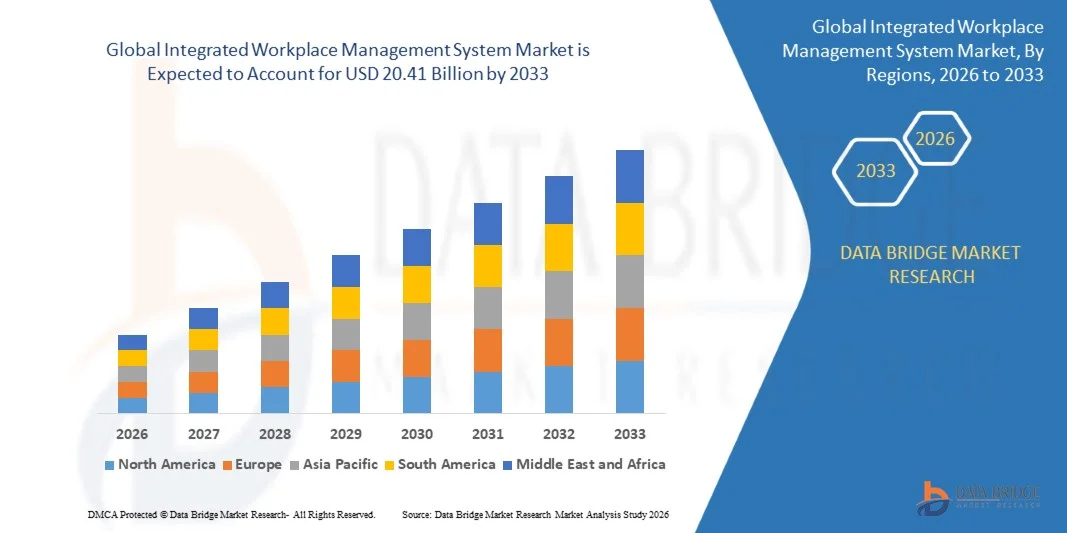
- As per Data Bridge Market Research analysis, the integrated workplace management system market was valued at USD 6.79 billion in 2025 and is projected to reach USD 20.41 billion by 2033, growing at a CAGR of 14.75% from 2026 to 2033.
- The market is experiencing consistent growth driven by rising demand for centralized workplace management solutions, increasing adoption of cloud-based technologies, and growing emphasis on optimizing real estate, facilities, assets, and workplace operations across organizations.
- The increasing complexity of corporate real estate portfolios, combined with the need for efficient space utilization, predictive maintenance, sustainability management, and data-driven workplace decisions, is compelling enterprises to adopt integrated workplace management systems. Cloud-based and AI-enabled IWMS platforms are increasingly replacing fragmented workplace management tools by providing centralized, scalable, and real-time environments for managing facilities, assets, leases, projects, and employee workplace experiences.
Market Size & Forecast
- Global Market Value (2025): USD 6.79 Billion
- Expected Market Value (2033): USD 20.41 Billion
- Forecast CAGR (2026–2033): 14.75%
- Leading Region in 2025: North America
- Fastest Growing Region: Asia Pacific
What are the Major Takeaways of the Integrated Workplace Management System Market?
- North America dominated the integrated workplace management system market with the largest revenue share of 38.6% in 2025, supported by advanced commercial real estate infrastructure, high enterprise technology adoption, and strong demand for workplace optimization solutions.
- Asia-Pacific is expected to be the fastest-growing region at a CAGR of 16.2% from 2026 to 2033, fueled by rapid urbanization, expanding corporate infrastructure, digital transformation initiatives, and increasing adoption of cloud-based workplace management platforms.
- The solution segment led the market with a 60% share in 2025, driven by the growing need for centralized platforms that integrate property, facilities, space, asset, maintenance, and workplace operations.
- Services are the fastest-growing component type, projected to register a CAGR of 14.1%, reflecting the surge in demand for implementation, consulting, integration, customization, training, and managed support
- The large enterprises segment dominated the organisation size category with a 66.8% revenue share in 2025, led by extensive real-estate portfolios, geographically distributed facilities, and complex workplace-management requirements.
- On-Premise accounted for 50.7% of the market share in 2025, preferred by continued demand for direct control over sensitive workplace, property, asset, and facilities data
- The space & move management segment is the fastest-growing application category, with a CAGR of 15.5%, driven by hybrid work models, changing office footprints, and increasing focus on workplace utilization.
Report Scope and Integrated Workplace Management System Market Segmentation
|
Attributes |
Integrated Workplace Management System Key Market Insights |
|
Segments Covered |
|
|
Countries Covered |
North America
Europe
Asia-Pacific
Middle East and Africa
South America
|
|
Key Market Players |
|
|
Market Opportunities |
|
|
Value Added Data Infosets |
In addition to the market insights such as market value, growth rate, market segments, geographical coverage, market players, and market scenario, the market report curated by the Data Bridge Market Research team includes in-depth expert analysis, import/export analysis, pricing analysis, production consumption analysis, and pestle analysis. |
What is the Key Trend in the Integrated Workplace Management System Market?
- AI-powered workplace analytics and intelligent automation are increasingly becoming core IWMS capabilities, enabling organizations to analyze occupancy, facility, asset, and real-estate data while improving operational efficiency and workplace decision-making.
- For instance, in April 2025, Eptura announced AI-powered innovations for its Archibus IWMS, including integrated workplace dashboards, enhanced technician mobility, and tools designed to optimize real estate and create more frictionless in-office experiences
- Hybrid-work adoption is accelerating demand for IWMS platforms capable of integrating occupancy data, workplace scheduling, space utilization, and employee-facing services across flexible office environments.
- For instance, in June 2025, Johnson Controls launched OpenBlue Workplace in the Middle East as an IWMS and facility-maintenance platform incorporating intelligent space utilization, asset management, workplace planning, reporting, analytics, and sensor-driven smart-building insights.
- As organizations increasingly prioritize intelligent automation, hybrid workplace optimization, and data-driven portfolio management, AI-enabled IWMS platforms are expected to become increasingly central to modern workplace operations.
What are the Key Drivers of the Integrated Workplace Management System Market?
- The growing complexity of corporate real-estate portfolios and workplace operations is significantly increasing demand for integrated systems that consolidate space, facilities, assets, maintenance, lease, and workplace data.
- For instance, in April 2025, JLL announced a collaboration with ServiceNow to expand its IWMS capabilities by integrating real-estate, facilities management, workplace services, reservations, space management, move management, maintenance management, and analytics, demonstrating growing demand for integrated workplace operations.
- Organizations are increasingly adopting data-driven workplace management to optimize underutilized spaces, reduce operating costs, improve maintenance efficiency, and support strategic real-estate decisions across distributed facilities.
- For instance, in April 2025, Johnson Controls reported that its OpenBlue platform, including FM:Systems solutions, could deliver up to 10% energy savings, a 67% reduction in chiller maintenance, and a 155% three-year ROI for a representative organization, highlighting the financial and operational benefits driving adoption of integrated workplace technologies.
- With enterprises increasingly integrating workplace data, automation, and analytics to improve operational efficiency and space utilization, IWMS platforms will remain essential for digitally transforming complex workplace and real-estate management processes.
What Factors are Challenging the Growth of the Integrated Workplace Management System Market?
- Integrated workplace management systems can require significant implementation investment because organizations must integrate multiple legacy applications, standardize fragmented data, customize workflows, and train employees across different operational functions.
- For instance, in October 2024, JLL highlighted that IWMS ownership costs extend beyond software licensing to include upgrades, support and maintenance, user training, infrastructure, data-lake integration, and information-security audits, demonstrating the substantial total cost of ownership associated with IWMS implementation.
- These implementation requirements can particularly challenge smaller organizations with limited technology budgets, fragmented facility data, and insufficient internal expertise for managing complex enterprise-wide IWMS deployments.
- For instance, in March 2024, EY reported that organizations implementing intelligent facilities management face hurdles including poor data quality, inadequate integration among systems, and limited understanding of AI benefits, highlighting the technical and organizational complexity that can slow adoption of integrated workplace technologies.
- The complexity of integrating legacy systems, improving data quality, and controlling implementation costs continues to restrict IWMS adoption, particularly among smaller organizations, slowing deployment despite increasing demand for connected workplace management solutions.
How is the Integrated Workplace Management System Market Segmented?
The integrated workplace management system market is segmented on the basis of component, organization size, deployment, application, and industry vertical.
- By Component
On the basis of component, the integrated workplace management system market is segmented into solution and services. The solution segment dominated the market with 60% share in 2025, owing to the growing need for centralized platforms that integrate property, facilities, space, asset, maintenance, and workplace operations. Organizations increasingly prefer unified software platforms over multiple disconnected workplace-management applications. IWMS solutions provide centralized visibility into workplace resources while supporting analytics, workflow automation, and operational planning. Integration with IoT, AI, enterprise applications, and workplace analytics is further increasing the functionality of these solutions. The growing digital transformation of corporate real-estate and facilities operations continues to strengthen demand for integrated software platforms.
The services segment is projected to register the fastest growth at CAGR of 14.1% during forecast period, driven by rising demand for implementation, consulting, integration, customization, training, and managed support. IWMS deployments frequently require specialist expertise to integrate legacy systems, migrate workplace data, configure workflows, and connect enterprise applications. Professional service providers also assist organizations in change management and platform optimization after implementation. Increasing adoption among organizations with limited internal facilities-technology expertise is creating additional demand for outsourced support. Managed services are also gaining importance as enterprises seek continuous administration and technical assistance without expanding internal teams. The increasing complexity of workplace technology deployments is therefore expected to accelerate demand for IWMS-related services.
- By Organization Size
On the basis of organization size, the integrated workplace management system market is segmented into micro small-to-midsize business (SMB), small-to-midsize business (SMB), mid-market small-to-midsize business (SMB), and large enterprises. The large enterprises segment dominated the market with 66.8% share in 2025, supported by extensive real-estate portfolios, geographically distributed facilities, and complex workplace-management requirements. Large organizations require centralized systems to coordinate property, lease, asset, space, maintenance, and workplace information across multiple locations. They also have greater requirements for enterprise security, compliance, analytics, and integration with finance and human-resource systems. Large enterprises generally possess greater technology budgets and dedicated IT and facilities teams capable of implementing comprehensive IWMS platforms. Their need to optimize workplace costs and utilization further encourages adoption of integrated systems.
The mid-market small-to-midsize business (SMB) segment is projected to register the fastest growth at CAGR of 16.0% during forecast period, driven by the increasing availability of modular and cloud-based IWMS platforms. Mid-market organizations are increasingly seeking affordable technologies that can provide enterprise-level workplace visibility without the complexity of traditional large-scale implementations. Subscription-based models are reducing upfront infrastructure requirements and making advanced workplace analytics more accessible. Growing hybrid-work adoption is also increasing demand for space scheduling, occupancy monitoring, and workplace coordination capabilities. Vendors are increasingly offering scalable platforms that allow organizations to begin with selected modules and expand functionality as requirements evolve. As digital workplace management becomes more accessible to mid-sized businesses, the segment is expected to expand rapidly.
- By Deployment
On the basis of deployment, the integrated workplace management system market is segmented into cloud and on-premises. The on-premises segment dominated the market with 50.7% share in 2025, supported by continued demand for direct control over sensitive workplace, property, asset, and facilities data. Large enterprises and highly regulated organizations often prefer infrastructure that can be managed within their own security environments. On-premises systems can also integrate with established enterprise infrastructure and legacy applications already used by organizations. Data governance, security, and compliance considerations remain important factors supporting adoption of internally hosted IWMS platforms. Organizations with substantial existing infrastructure investments may also prefer extending current systems rather than completely shifting to cloud environments.
The cloud segment is projected to register the fastest growth at a CAGR of 17.11% during forecast period, driven by scalability, flexible subscription models, rapid deployment, and lower infrastructure requirements. Cloud-based IWMS enables organizations to manage workplace information across geographically dispersed facilities through centralized and remotely accessible platforms. Hybrid-work environments are increasing demand for cloud-based occupancy analytics, desk booking, workplace scheduling, and employee-service applications. Cloud architecture also allows vendors to deliver software updates, analytics capabilities, and AI functionality without extensive infrastructure upgrades by customers. Smaller and mid-market organizations are particularly attracted to cloud platforms because they reduce technology maintenance requirements and upfront capital expenditure. The increasing shift toward SaaS-based workplace management is therefore expected to accelerate cloud adoption.
- By Application
On the basis of application, the integrated workplace management system market is segmented into property management, maintenance management, space & move management, and technology management. The property management segment dominated the market with 38% share in 2025, supported by the growing requirement to manage corporate properties, leases, portfolios, occupancy, and related operational information through centralized platforms. Property management capabilities allow organizations to maintain visibility across multiple buildings and geographically distributed real-estate assets. Integration with financial and enterprise systems improves portfolio planning, lease administration, compliance, and cost management. Large enterprises and property-intensive organizations increasingly rely on these capabilities to optimize their real-estate portfolios. The continued digitization of property-management activities is strengthening demand for integrated platforms.
The space & move management segment is projected to register the fastest growth at CAGR of 15.5% during forecast period, driven by hybrid work models, changing office footprints, and increasing focus on workplace utilization. Organizations are increasingly adopting occupancy analytics, desk-booking, room scheduling, and move-management capabilities to understand how workplaces are being used. These applications help identify underutilized areas and support more efficient allocation of offices, meeting rooms, and shared facilities. Integration with sensors, calendars, workplace applications, and real-time occupancy data is further improving space visibility. Growing emphasis on flexible work and employee experience is accelerating the adoption of intelligent space-management technologies. As enterprises continue to redesign workplace environments around hybrid operations, demand for space and move management is expected to increase rapidly.
- By Industry Vertical
On the basis of industry vertical, the integrated workplace management system market is segmented into IT & telecom, manufacturing, real estate, travel & transportation, retail, healthcare, BFSI, and others. The IT & telecom segment dominated the market with 34.1% share in 2025, supported by large distributed workforces, technology-intensive workplaces, and high adoption of digital workplace-management technologies. Companies in this sector require efficient management of offices, assets, infrastructure, facilities, and flexible workplace environments. High technology maturity enables greater integration of IWMS platforms with cloud systems, IoT devices, analytics, and enterprise applications. The expansion of hybrid working is also increasing demand for workplace scheduling and occupancy-management capabilities. Strong investment in automation and digital transformation further supports adoption across the sector.
The healthcare segment is projected to register the fastest growth at a CAGR of 16.18% during forecast period, driven by growing requirements for asset availability, facility safety, maintenance optimization, compliance, and efficient space utilization. Healthcare organizations operate complex facilities containing medical equipment, patient areas, specialized infrastructure, and critical building systems. IWMS platforms enable centralized management of maintenance schedules, assets, space, and facility operations across hospitals and healthcare networks. Increasing healthcare infrastructure development is creating additional demand for digitally connected facility-management solutions. Predictive maintenance and real-time analytics can also improve operational reliability while supporting compliance and patient-safety objectives. The growing emphasis on efficient healthcare-facility management is therefore expected to accelerate IWMS adoption across the healthcare sector.
Which Region Holds the Largest Share of the Integrated Workplace Management System Market?
- North America dominated the integrated workplace management system market with the largest revenue share of 38.6% in 2025, supported by advanced commercial real estate infrastructure, high enterprise technology adoption, and strong demand for workplace optimization solutions.
- The region also benefits from widespread adoption of smart-building technologies, workplace analytics, hybrid-work management, and integrated facilities solutions across the U.S., Canada, and Mexico. Increasing demand for efficient space utilization, predictive maintenance, sustainability management, and centralized real-estate operations continues to strengthen North America's leadership position in the global integrated workplace management system market.
U.S. Integrated Workplace Management System Market Insight
The U.S. integrated workplace management system market is witnessing strong growth due to rising adoption of digital workplace platforms, smart-building technologies, and integrated facilities management solutions. The country’s mature commercial real-estate ecosystem, along with increasing demand for hybrid workplace management and efficient space utilization, is driving adoption across enterprises. In addition, growing emphasis on workplace analytics, predictive maintenance, sustainability, and centralized property management is accelerating demand for IWMS solutions. The presence of leading technology providers and strong investment in enterprise digital transformation is further strengthening the U.S. market.
Asia-Pacific Integrated Workplace Management System Market Insight
The Asia-Pacific integrated workplace management system market is expected to witness rapid growth, driven by increasing urbanization, expanding commercial infrastructure, and rising digital transformation across countries such as China, India, and Japan. Growing demand for efficient workplace planning, facilities management, and real-estate optimization is supporting regional market expansion. In addition, increasing adoption of cloud-based platforms, smart-building technologies, and workplace analytics is encouraging organizations to modernize fragmented management systems. The growing presence of multinational enterprises, expanding corporate offices, and increasing focus on flexible and hybrid work environments are further accelerating IWMS adoption across the region.
Japan Integrated Workplace Management System Market Insight
The Japan integrated workplace management system market is witnessing consistent growth due to rising investments in workplace digitalization, smart-building technologies, and efficient facility management solutions. Enterprises, commercial property operators, and large organizations are increasingly adopting IWMS platforms for space optimization, property management, asset monitoring, and maintenance planning. Moreover, the country’s focus on operational efficiency, sustainability, and technology-driven workplace environments is supporting market development. Increasing integration of cloud computing, IoT, workplace analytics, and automation is further improving the capabilities of IWMS platforms and contributing to the adoption of integrated workplace management solutions across Japan.
China Integrated Workplace Management System Market Insight
The China integrated workplace management system market is growing rapidly, driven by expanding commercial infrastructure, increasing urbanization, and rising investment in digital transformation across enterprises. Growing adoption of cloud-based workplace platforms, smart-building technologies, and automated facilities management solutions is significantly boosting market demand across corporate and commercial environments. In addition, increasing emphasis on energy efficiency, workplace optimization, asset management, and centralized property operations is encouraging organizations to replace fragmented systems with integrated platforms. Rising investments in technology-enabled buildings, expanding enterprise operations, and rapid development of modern commercial facilities are positioning China as an important market for IWMS solutions globally.
U.K. Integrated Workplace Management System Market Insight
The U.K. integrated workplace management system market is experiencing steady growth, supported by rising adoption of digital facilities management, workplace analytics, and integrated property-management solutions. Increasing demand for flexible office environments and efficient space utilization is contributing to market expansion across enterprises and commercial property organizations. Furthermore, growing emphasis on sustainability, energy efficiency, maintenance optimization, and workplace experience is encouraging organizations to implement centralized IWMS platforms. Integration of cloud technologies, IoT-enabled building systems, automation, and real-time analytics is improving workplace management capabilities, positioning the U.K. as a key European market for integrated workplace management solutions.
Germany Integrated Workplace Management System Market Insight
The Germany integrated workplace management system market is expanding steadily due to the country’s strong industrial base, advanced commercial infrastructure, and increasing adoption of digital facilities management technologies. Enterprises, manufacturers, property operators, and corporate organizations are increasingly utilizing IWMS platforms for asset management, maintenance planning, workplace optimization, and property operations. Continuous advancements in cloud computing, smart-building solutions, automation, and data analytics are further enhancing system capabilities. In addition, strong focus on operational efficiency, sustainability, energy management, and digitalization is driving demand for integrated workplace technologies and supporting the continued growth of the IWMS market in Germany.
Which are the Top Companies in Integrated Workplace Management System Market?
The integrated workplace management system industry is primarily led by well-established companies, including:
- Eptura (U.S.)
- ServiceNow, Inc. (U.S.)
- IBM Corporation (U.S.)
- Oracle (U.S.)
- SAP SE (Germany)
- Yardi Systems, LLC (U.S.)
- Tango (U.S.)
- Facilio Inc. (U.S.)
- OfficeSpace Software Inc. (U.S.)
- Envoy (U.S.)
- Skedda (Australia)
- MaintainX Inc. (U.S.)
- UpKeep Technologies, Inc. (U.S.)
- Robin Powered, Inc. (U.S.)
- HqO, Inc. (U.S.)
- VergeSense (U.S.)
- CBRE, Inc. (U.S.)
- Johnson Controls (U.S.)
- Schneider Electric (France)
- Siemens AG (Germany)
What are Latest Developments in Integrated Workplace Management System Market?
- In April 2025, Eptura announced new AI-powered innovations across its worktech portfolio, including a mobile technician application, Technician Copilot, conversational AI for workplace bookings, return-to-office analytics, integrated workplace dashboards, and real-time connections between digital twins and asset systems. The updates are designed to improve workplace operations, optimize space utilization, strengthen visitor management, and provide enterprises with more intelligent, connected tools for managing people, workplaces, and assets.
- In April 2024, Eptura announced a new series of worktech advancements for its integrated platform, introducing enhanced workplace planning and asset-maintenance capabilities. The developments connected employee workspace applications with maintenance workflows, enabled digital mapping of assets, introduced AI-powered workspace recommendations, improved visitor and occupancy insights, and expanded workplace analytics for hybrid-work planning. These developments strengthened the integration of facilities, asset, workplace, and real-estate management within a unified platform.
- In March 2023, Eptura launched its unified worktech platform combining Eptura Workplace and Eptura Asset, creating an integrated solution connecting workplace experience with physical asset management. The platform brought together asset management, facility management, preventive maintenance, space planning, visitor management, and workplace experience capabilities, while also providing shared workplace data and integrations with tools such as Autodesk, Microsoft, Google, Slack, Zoom, sensors, and HR platforms. This launch marked a significant move toward unified management of workplaces and physical assets.
- In June 2022, Planon launched Planon Workplace Edition, a cloud-based solution designed to modernize workplace management and provide organizations with a pathway to the full Planon Integrated Workplace Management System suite. The solution combined workplace insights and workplace engagement with smart IoT technology, using occupancy, utilization, people-flow, and indoor-air-quality data to support workplace decisions. It also introduced space and service management processes, mobile workplace functionality, room-booking panels, and kiosks to improve workplace engagement and operational efficiency.
- In July 2021, ServiceNow announced enhancements to its Workplace Service Delivery solution to support hybrid work and improve workplace management. The update introduced enhanced workspace reservations, expanded space-utilization capabilities, improved workplace mapping, and mobile workplace services, enabling organizations to optimize real-estate use and provide employees with easier access to desks, conference rooms, and workplace services. The development reflected the growing shift toward digitally managed, flexible, and data-driven workplace environments

- Interactive Data Analysis Dashboard
- Company Analysis Dashboard for high growth potential opportunities
- Research Analyst Access for customization & queries
- Competitor Analysis with Interactive dashboard
- Latest News, Updates & Trend analysis
- Harness the Power of Benchmark Analysis for Comprehensive Competitor Tracking
Data collection and base year analysis are done using data collection modules with large sample sizes. The stage includes obtaining market information or related data through various sources and strategies. It includes examining and planning all the data acquired from the past in advance. It likewise envelops the examination of information inconsistencies seen across different information sources. The market data is analysed and estimated using market statistical and coherent models. Also, market share analysis and key trend analysis are the major success factors in the market report. To know more, please request an analyst call or drop down your inquiry.
The key research methodology used by DBMR research team is data triangulation which involves data mining, analysis of the impact of data variables on the market and primary (industry expert) validation. Data models include Vendor Positioning Grid, Market Time Line Analysis, Market Overview and Guide, Company Positioning Grid, Patent Analysis, Pricing Analysis, Company Market Share Analysis, Standards of Measurement, Global versus Regional and Vendor Share Analysis. To know more about the research methodology, drop in an inquiry to speak to our industry experts.
Data Bridge Market Research is a leader in advanced formative research. We take pride in servicing our existing and new customers with data and analysis that match and suits their goal. The report can be customized to include price trend analysis of target brands understanding the market for additional countries (ask for the list of countries), clinical trial results data, literature review, refurbished market and product base analysis. Market analysis of target competitors can be analyzed from technology-based analysis to market portfolio strategies. We can add as many competitors that you require data about in the format and data style you are looking for. Our team of analysts can also provide you data in crude raw excel files pivot tables (Fact book) or can assist you in creating presentations from the data sets available in the report.