


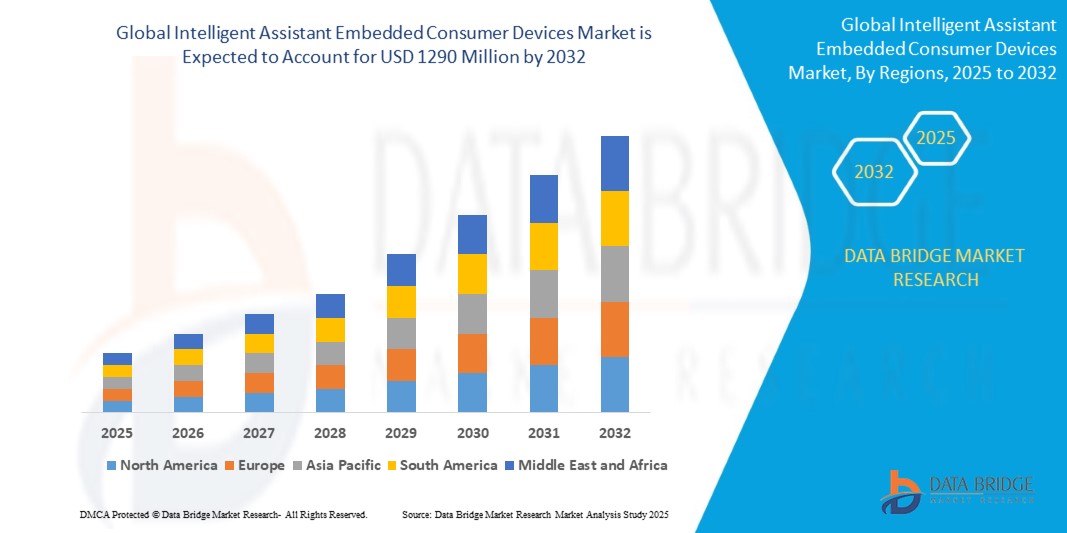
Intelligent Assistant Embedded Consumer Devices Market Size
- The Intelligent Assistant Embedded Consumer Devices Market was valued at USD 942 million in 2025 and is projected to reach USD 1290 million by 2032, growing at a CAGR of 5% during the forecast period.
- Growth is driven by the increasing demand for voice-enabled and AI-integrated consumer devices, rising adoption of smart home ecosystems, and advancements in natural language processing (NLP) and machine learning. The need for hands-free convenience, real-time assistance, and seamless multi-device interaction also fuels market expansion across both residential and commercial segments.
Intelligent Assistant Embedded Consumer Devices Market Analysis
- Intelligent assistant embedded consumer devices enable natural, voice-based, and context-aware interactions across a wide range of smart products, including speakers, TVs, smartphones, appliances, and wearables. These devices integrate AI, natural language processing (NLP), and machine learning to deliver personalized, intuitive, and real-time user experiences.
- Cloud-based virtual assistants are gaining widespread adoption for their scalability, continuous learning capabilities, and seamless cross-device functionality. Integration with IoT platforms and smart home ecosystems allows synchronized control of lighting, entertainment, appliances, and security through a unified voice interface.
- The consumer electronics and smart home segments dominate the application landscape, where automation, convenience, and interoperability are key. Automotive and healthcare sectors are also experiencing strong growth, with AI assistants enabling voice navigation, in-car entertainment, health monitoring, and medication reminders.
- Advanced AI algorithms and edge computing technologies ensure faster response times, improved contextual understanding, and offline capabilities—enhancing privacy and reducing latency for critical applications in residential and in-vehicle environments.
- Modern intelligent assistant platforms are increasingly incorporating built-in privacy settings, local data processing, and secure user authentication to address rising concerns over data protection and surveillance, particularly in regulated and high-sensitivity use cases.
Report Scope and Intelligent Assistant Embedded Consumer Devices Market Segmentation
|
Attributes |
Intelligent Assistant Embedded Consumer Devices Market Insights |
|
Segments Covered |
|
|
Countries Covered |
North America
Europe
Asia-Pacific
Middle East and Africa
South America
|
|
Key Market Players |
|
|
Market Opportunities |
|
|
Value Added Data Infosets |
In addition to the insights on market scenarios such as market value, growth rate, segmentation, geographical coverage, and major players, the market reports curated by the Data Bridge Market Research also include import export analysis, production capacity overview, production consumption analysis, price trend analysis, climate change scenario, supply chain analysis, value chain analysis, raw material/consumables overview, vendor selection criteria, PESTLE Analysis, Porter Analysis, and regulatory framework. |
Intelligent Assistant Embedded Consumer Devices Market Trends
“Voice-First Interfaces, AI Personalization, and Contextual Intelligence Reshaping User Experience”
- A key and rapidly advancing trend in the Intelligent Assistant Embedded Consumer Devices Market is the shift toward voice-first interfaces and cloud-based AI platforms that enable real-time learning, contextual awareness, and seamless control across devices. These solutions improve responsiveness, reduce manual interaction, and offer intuitive user engagement in smart environments.
- Personalization powered by AI and machine learning is becoming central to device functionality. Intelligent assistants can now adapt to individual user preferences, routines, and habits—offering customized content recommendations, proactive suggestions, and behavioral pattern recognition for enhanced usability.
- The integration of assistants across ecosystems—spanning smartphones, smart TVs, speakers, appliances, and vehicles—is reshaping the user experience by offering consistent interaction and continuity across touchpoints. Interoperability is being enhanced through universal protocols and IoT frameworks like Matter.
- Edge AI and hybrid cloud architectures are gaining traction to ensure data privacy and faster offline processing. This reduces reliance on continuous internet connectivity while addressing latency and compliance concerns, especially in healthcare and automotive use cases.
- Voice assistants are evolving with contextual intelligence, enabling more natural, multi-turn conversations and better understanding of tone, sentiment, and situational context. These capabilities are transforming how consumers interact with their environments—making smart devices more human-centric and integrated into daily life.
Intelligent Assistant Embedded Consumer Devices Market Dynamics
Driver
“AI Integration, Smart Home Expansion, and Cross-Device Interoperability Fueling Market Growth”
- The rapid integration of AI-driven virtual assistants into everyday consumer electronics is driving the widespread adoption of intelligent assistant embedded devices. As households and commercial spaces seek more automated, intuitive, and voice-activated experiences, embedded assistants offer hands-free operation, contextual responsiveness, and personalized control.
- For instance, smart home ecosystems across North America, Europe, and Asia-Pacific are increasingly adopting embedded assistants in devices such as thermostats, lighting systems, smart speakers, appliances, and entertainment consoles. These devices respond to voice commands, automate tasks, and learn user preferences over time—enhancing energy efficiency, comfort, and convenience.
- Tech giants and OEMs are integrating assistants with multi-device compatibility and interoperability, allowing users to control an entire ecosystem from a single voice command. Platforms like Amazon Alexa, Google Assistant, and Apple Siri now support third-party integrations and multi-room setups for seamless cross-device communication.
- Additionally, the growing adoption of voice AI in automotive infotainment systems is boosting the market. Consumers increasingly expect their in-vehicle experiences to mirror their smart home environments—with voice-activated navigation, entertainment, and diagnostics improving safety and reducing driver distraction.
- Governments and smart city initiatives are also encouraging the use of intelligent systems for residential automation, energy conservation, and elderly care—creating a regulatory and infrastructural push for connected, AI-embedded consumer products across regions.
Restraint/Challenge
“Limited offline functionality in cloud-reliant systems”
- One of the key challenges hindering widespread adoption of intelligent assistant embedded consumer devices is the limited functionality of cloud-dependent assistants in offline or low-connectivity environments. Many virtual assistants rely heavily on cloud processing to interpret commands, retrieve information, and deliver personalized responses.
- For example, in smart homes or vehicles with unreliable internet connectivity, users may experience delayed responses, failed command execution, or restricted access to essential features. This reliance on cloud infrastructure limits the device's effectiveness in remote or underdeveloped regions where connectivity is inconsistent.
- Additionally, the complexity of on-device AI implementation poses challenges for manufacturers. Enabling advanced features such as natural language understanding, real-time personalization, or contextual learning without cloud support requires significant hardware resources and optimized algorithms—driving up device costs and development time.
- The lack of edge AI capabilities in entry-level or cost-sensitive devices restricts their ability to perform core assistant functions independently. As a result, user experience suffers, and brands risk dissatisfaction and reduced engagement in key segments.
- Furthermore, privacy-conscious users and regulatory frameworks increasingly demand offline options for voice processing and data handling. The absence of secure, offline-compatible AI processing limits market potential in sectors such as healthcare, education, and finance, where local data processing is critical.
Intelligent Assistant Embedded Consumer Devices Market Scope
The market is segmented on the basis of component, deployment type, application, and end user.
|
Segmentation |
Sub-Segmentation |
|
By Device Type |
|
|
By Technology |
|
|
By Application |
|
|
By Distribution Channel |
|
• By Device Type
Device types include Mobile Devices, Personal Computers, Household Devices, and Home Video Entertainment Devices.Mobile Devices account for the largest market share, driven by the widespread adoption of smartphones and tablets integrated with intelligent assistants like Siri, Google Assistant, and Bixby. Personal Computers are increasingly adopting assistant functionalities for enhanced productivity, accessibility, and virtual collaboration. Household Devices such as smart speakers, appliances, and thermostats are gaining traction with rising smart home integration. Home Video Entertainment Devices like smart TVs and streaming boxes are embedding voice assistants to improve content discovery and user control.
• By Technology
Technology types include Voice Recognition, Natural Language Processing (NLP), Machine Learning, and Others.Voice Recognition holds the largest market share, driven by its foundational role in enabling seamless voice-user interfaces across devices. Natural Language Processing (NLP) supports context-aware responses and enhances user experience through intelligent dialogue. Machine Learning enables personalization and real-time learning by analyzing user behavior. Other technologies contribute to auxiliary functions like emotion detection and gesture-based controls.
• By Application
Applications include Commercial and Household.
Household applications dominate the market due to rising adoption of smart home devices equipped with intelligent assistants for automation, control, and entertainment. Commercial applications are expanding across retail, automotive, hospitality, and healthcare sectors where voice-enabled systems improve customer interaction, productivity, and operational efficiency.
• By Distribution Channel
Distribution channels include Online Channels and Offline Channels.Online Channels lead the market due to the growing popularity of e-commerce platforms and direct-to-consumer models, offering a wide variety of intelligent assistant-embedded devices with ease of comparison and purchase. Offline Channels remain relevant, particularly in consumer electronics retail stores, where in-person demonstrations and bundled offers help drive adoption.
Intelligent Assistant Embedded Consumer Devices Market Regional Analysis
- North America dominates the Intelligent Assistant Embedded Consumer Devices Market with the largest revenue share in 2025, driven by high consumer adoption of smart speakers, smartphones, and home automation products. The region benefits from strong technology infrastructure, early adoption of AI-powered virtual assistants, and major market players like Amazon, Apple, and Google headquartered in the U.S.
- In the United States, growing demand for personalized, voice-enabled experiences in both residential and commercial sectors is fueling market growth. Integration of intelligent assistants with IoT, cloud, and connected ecosystems across homes, cars, and retail environments is accelerating adoption and innovation.
United States Intelligent Assistant Embedded Consumer Devices Market Insight
The U.S. Intelligent Assistant Embedded Consumer Devices Market captured the largest revenue share within North America in 2025, owing to widespread adoption of smart speakers, smartphones, and home automation systems integrated with assistants like Alexa and Siri. The country’s strong IT infrastructure, high consumer digital literacy, and presence of major tech giants such as Amazon, Apple, and Google drive innovation and domestic adoption across residential and commercial sectors.
Europe Intelligent Assistant Embedded Consumer Devices Market Insight
The Europe Intelligent Assistant Embedded Consumer Devices Market is projected to grow steadily through the forecast period. Consumer demand for convenience, energy efficiency, and security in smart homes is rising, alongside government initiatives promoting digital transformation. Countries in the region are increasingly integrating voice assistants in personal devices, household electronics, and vehicles—driven by sustainability goals and advancements in AI integration.
Germany Intelligent Assistant Embedded Consumer Devices Market Insight
Germany is one of the key markets in Europe, driven by strong demand in the automotive and consumer electronics sectors. The country's leadership in engineering, manufacturing automation, and smart home innovation supports rapid adoption of embedded AI assistants. Integration with in-car infotainment systems and smart appliances is fueling growth, aligned with Germany’s Industry 4.0 and digital living goals.
France Intelligent Assistant Embedded Consumer Devices Market Insight
France's market is expanding rapidly due to increasing smart home penetration, digital infrastructure development, and consumer interest in AI-enabled devices. Government initiatives encouraging automation and connectivity in households and industries are pushing demand for voice assistants in entertainment, appliance control, and personal productivity applications. The growing e-commerce and electronics retail landscape also supports adoption.
Asia-Pacific Intelligent Assistant Embedded Consumer Devices Market Insight
The Asia-Pacific region is poised to grow at the fastest CAGR through 2032, fueled by large-scale digital adoption, high smartphone penetration, and rapidly expanding smart home ecosystems. Countries like China, Japan, and India are key growth engines, with rising consumer awareness, urbanization, and AI integration into affordable consumer electronics. Local tech players and global brands are expanding aggressively in the region.
Japan Intelligent Assistant Embedded Consumer Devices Market Insight
apan’s market is characterized by high standards of technology integration, quality, and consumer expectations. Intelligent assistants are being embedded into home entertainment systems, healthcare devices, and smart appliances. The country’s leadership in robotics, electronics, and precision technology further supports innovation in voice-driven interfaces and user personalization.
China Intelligent Assistant Embedded Consumer Devices Market Insight
China leads the Asia-Pacific market in revenue share as of 2025, driven by robust domestic manufacturing, aggressive rollout of smart city initiatives, and widespread use of AI across consumer tech. Chinese firms like Baidu, Xiaomi, and Huawei are advancing voice assistant technologies in smartphones, smart home products, and automotive systems. The booming e-commerce ecosystem further accelerates product adoption.
Intelligent Assistant Embedded Consumer Devices Market Share
The Intelligent Assistant Embedded Consumer Devices Market is primarily led by a combination of global technology giants, AI software developers, and smart device manufacturers, including:
- Amazon.com, Inc.
- Microsoft corporation
- ARM Holdings
- Intel Corporation
- Samsung Electronics
- Google LLC
- Apple Inc.
- Lenovo Group Limited
- LG Electronics.
- HP Development Company L.P.
- Dell Technologies
Latest Developments in Intelligent Assistant Embedded Consumer Devices Market
- In February 2025, Amazon introduced a new generation of Echo devices featuring enhanced AI-driven conversational capabilities and local on-device processing, improving response times and data privacy in smart home environments.
- In January 2025, Google rolled out a major update to its Google Assistant platform, enabling multi-language simultaneous interpretation and deeper contextual awareness across smartphones, smart displays, and Android TV devices.
- In November 2024, Apple launched on-device Siri upgrades with its A18 chip, offering offline functionality for common tasks, enhanced personalization, and tighter privacy controls for iPhone and HomePod users.
- In September 2024, Samsung expanded SmartThings integration with its voice assistant Bixby, enabling cross-device control of appliances, TVs, and security systems with enhanced AI routines and voice recognition tailored to individual users.

- Interactive Data Analysis Dashboard
- Company Analysis Dashboard for high growth potential opportunities
- Research Analyst Access for customization & queries
- Competitor Analysis with Interactive dashboard
- Latest News, Updates & Trend analysis
- Harness the Power of Benchmark Analysis for Comprehensive Competitor Tracking
Global Intelligent Assistant Embedded Consumer Devices Market, Supply Chain Analysis and Ecosystem Framework
To support market growth and help clients navigate the impact of geopolitical shifts, DBMR has integrated in-depth supply chain analysis into its Global Intelligent Assistant Embedded Consumer Devices Market research reports. This addition empowers clients to respond effectively to global changes affecting their industries. The supply chain analysis section includes detailed insights such as Global Intelligent Assistant Embedded Consumer Devices Market consumption and production by country, price trend analysis, the impact of tariffs and geopolitical developments, and import and export trends by country and HSN code. It also highlights major suppliers with data on production capacity and company profiles, as well as key importers and exporters. In addition to research, DBMR offers specialized supply chain consulting services backed by over a decade of experience, providing solutions like supplier discovery, supplier risk assessment, price trend analysis, impact evaluation of inflation and trade route changes, and comprehensive market trend analysis.
Data collection and base year analysis are done using data collection modules with large sample sizes. The stage includes obtaining market information or related data through various sources and strategies. It includes examining and planning all the data acquired from the past in advance. It likewise envelops the examination of information inconsistencies seen across different information sources. The market data is analysed and estimated using market statistical and coherent models. Also, market share analysis and key trend analysis are the major success factors in the market report. To know more, please request an analyst call or drop down your inquiry.
The key research methodology used by DBMR research team is data triangulation which involves data mining, analysis of the impact of data variables on the market and primary (industry expert) validation. Data models include Vendor Positioning Grid, Market Time Line Analysis, Market Overview and Guide, Company Positioning Grid, Patent Analysis, Pricing Analysis, Company Market Share Analysis, Standards of Measurement, Global versus Regional and Vendor Share Analysis. To know more about the research methodology, drop in an inquiry to speak to our industry experts.
Data Bridge Market Research is a leader in advanced formative research. We take pride in servicing our existing and new customers with data and analysis that match and suits their goal. The report can be customized to include price trend analysis of target brands understanding the market for additional countries (ask for the list of countries), clinical trial results data, literature review, refurbished market and product base analysis. Market analysis of target competitors can be analyzed from technology-based analysis to market portfolio strategies. We can add as many competitors that you require data about in the format and data style you are looking for. Our team of analysts can also provide you data in crude raw excel files pivot tables (Fact book) or can assist you in creating presentations from the data sets available in the report.













