


Intensity Modulated Radiotherapy Market Size
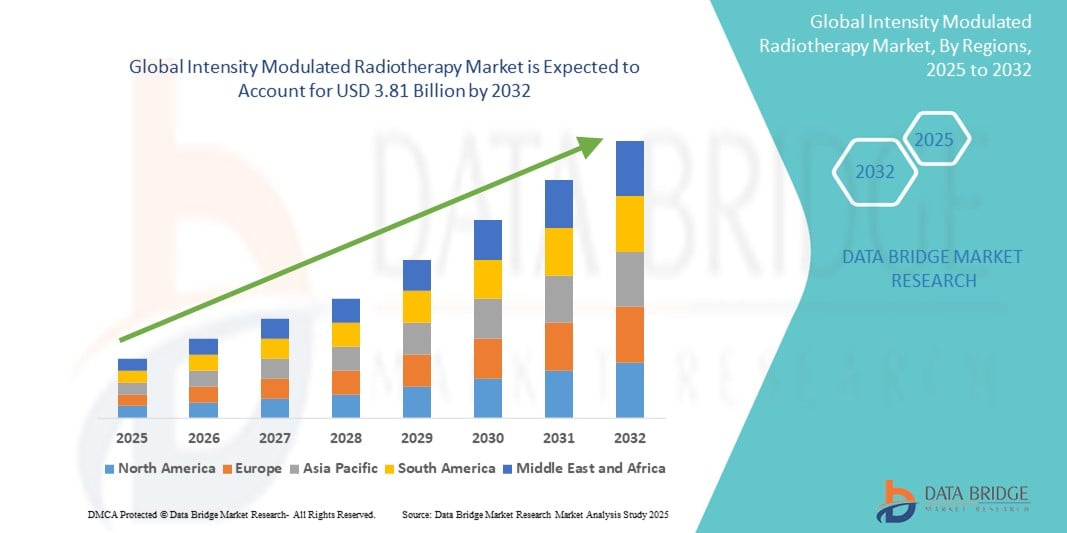
- The global intensity modulated radiotherapy market size was valued at USD 2.50 billion in 2024 and is expected to reach USD 3.81 billion by 2032, at a CAGR of 5.40% during the forecast period
- The market growth is largely fueled by the rising global cancer burden and increasing preference for precision-based treatment modalities that minimize radiation exposure to surrounding healthy tissues
- Furthermore, advancements in treatment planning systems, growing awareness of non-invasive cancer therapies, and widespread adoption of image-guided and adaptive radiotherapy techniques are strengthening IMRT's clinical value. These synergistic trends are driving the demand for IMRT systems, significantly accelerating the market’s expansion trajectory
Intensity Modulated Radiotherapy Market Analysis
- Intensity modulated radiotherapy (IMRT), a form of advanced external beam radiation therapy, is playing an increasingly critical role in modern cancer treatment due to its ability to precisely target tumors while minimizing radiation exposure to surrounding healthy tissues
- The growing demand for IMRT is primarily fueled by the global rise in cancer incidence, increasing adoption of image-guided and adaptive radiotherapy technologies, and a shift toward personalized and minimally invasive treatment approaches
- North America dominated the intensity modulated radiotherapy market with the largest revenue share of 39.8% in 2024, supported by advanced healthcare infrastructure, strong presence of key oncology technology providers, and widespread availability of reimbursement for radiotherapy procedures, with the U.S. leading in both procedure volume and equipment installation
- Asia-Pacific is expected to be the fastest growing region in the intensity modulated radiotherapy market during the forecast period due to rising cancer prevalence, expanding healthcare infrastructure, and increasing public and private investments in advanced radiotherapy technologies
- Photon radiation segment dominated the intensity modulated radiotherapy market by radiation type with a market share of 68.9% in 2024, attributed to its wide clinical usage, technological accessibility, and proven effectiveness across various cancer types
Report Scope and Intensity Modulated Radiotherapy Market Segmentation
|
Attributes |
Intensity Modulated Radiotherapy Key Market Insights |
|
Segments Covered |
|
|
Countries Covered |
North America
Europe
Asia-Pacific
Middle East and Africa
South America
|
|
Key Market Players |
|
|
Market Opportunities |
|
|
Value Added Data Infosets |
In In addition to the insights on market scenarios such as market value, growth rate, segmentation, geographical coverage, and major players, the market reports curated by the Data Bridge Market Research also include in-depth expert analysis, pricing analysis, brand share analysis, consumer survey, demography analysis, supply chain analysis, value chain analysis, raw material/consumables overview, vendor selection criteria, PESTLE Analysis, Porter Analysis, and regulatory framework. |
Intensity Modulated Radiotherapy Market Trends
“Precision Enhancement Through AI and Image-Guided Technologies”
- A significant and accelerating trend in the global IMRT market is the integration of artificial intelligence (AI) and advanced image-guided radiotherapy (IGRT) systems to enhance treatment precision, planning, and delivery. These technologies are revolutionizing how radiation therapy is administered by improving tumor targeting accuracy and reducing damage to healthy tissue
- For instance, companies such as Varian have introduced AI-enabled treatment planning systems that automate contouring and dose calculations, significantly reducing planning time while improving consistency and accuracy. Similarly, Elekta's AI-integrated oncology platforms leverage real-time imaging data to adapt treatment plans dynamically
- AI enhances radiotherapy workflows by enabling predictive analytics for patient-specific responses, adaptive planning based on tumor motion, and intelligent beam modulation. For instance, AI-driven software from RaySearch Laboratories optimizes dose distributions and personalizes radiotherapy plans using large datasets
- Integration with image-guided tools allows real-time tumor visualization during treatment, ensuring radiation is delivered precisely to the target while sparing nearby healthy organs. Technologies such as MRI-guided radiotherapy are increasingly being adopted in advanced cancer centers globally
- This trend toward greater personalization and automation is reshaping oncological care standards and is pushing providers to adopt smarter, data-driven IMRT platforms. As a result, key players are continuously developing next-generation systems with AI, IGRT, and adaptive capabilities to meet the evolving demands of clinicians and patients
- The rising demand for more intelligent, accurate, and patient-centric radiotherapy solutions is driving robust innovation and adoption across hospitals and cancer centers worldwide, particularly in technologically advanced and high-incidence regions
Intensity Modulated Radiotherapy Market Dynamics
Driver
“Growing Cancer Prevalence and Demand for Targeted Therapy”
- The global rise in cancer incidence, along with the increasing focus on improving survival rates and quality of life, is a major driver for the growing adoption of IMRT. With its ability to deliver high radiation doses precisely to tumors while minimizing exposure to surrounding healthy tissues, IMRT is increasingly preferred over conventional radiation techniques
- For instance, in February 2024, Elekta announced the expansion of its AI-powered radiotherapy platform to include more adaptive capabilities, aiming to enhance personalized cancer care. Such innovations are expected to drive IMRT market growth in the coming years
- IMRT is particularly beneficial in treating cancers located near sensitive organs such as prostate, head and neck, and brain cancers where precision is critical. As clinicians seek treatment modalities that minimize side effects and improve patient compliance, the value proposition of IMRT continues to strengthen
- In addition, rising healthcare investments, expanding radiotherapy access in developing regions, and growing training and awareness among oncologists are propelling the market forward. Collaborations between manufacturers and healthcare institutions to expand access to advanced radiotherapy solutions are further enhancing adoption
- The rising demand for personalized cancer therapies, along with the technological evolution of radiotherapy platforms, positions IMRT as a key modality in the global fight against cancer
Restraint/Challenge
“High Cost of Equipment and Technical Complexity”
- The high capital and operational costs associated with IMRT systems remain a significant challenge, particularly in low- and middle-income countries. Acquiring advanced radiotherapy machines, planning systems, and supporting infrastructure requires substantial investment, which can limit accessibility in resource-constrained settings
- For instance, while many developed nations have integrated IMRT into standard cancer care protocols, several emerging markets still rely on older, less precise radiation techniques due to financial and technical limitations
- Moreover, the technical complexity of IMRT requiring highly trained personnel for treatment planning, quality assurance, and machine operation can further hinder adoption. Shortages of skilled radiation oncologists, physicists, and technologists are especially pronounced in underserved regions
- Regulatory challenges related to equipment approval, safety standards, and reimbursement policies also pose hurdles to widespread market penetration. Inconsistent reimbursement for advanced therapies may limit patient access, even in countries with advanced healthcare systems
- Overcoming these barriers through cost-effective technology development, workforce training programs, and policy support will be essential to ensuring broader global access to IMRT and realizing its full potential in cancer treatment
Intensity Modulated Radiotherapy Market Scope
The market is segmented on the basis of radiation type, application, and end user.
- By Radiation Type
On the basis of radiation type, the intensity modulated radiotherapy market is segmented into photon radiation, proton radiation, electron radiation, and carbon-ion radiation. Photon radiation dominated the market with the largest revenue share of 68.9% in 2024, owing to its widespread clinical use, accessibility, and established efficacy in treating a broad range of cancers. Most IMRT systems in hospitals and radiotherapy centers are optimized for photon-based treatments, making them the default choice globally. The affordability and availability of linear accelerators that deliver photon radiation further solidify this segment's dominance in both developed and developing markets.
Proton radiation is anticipated to witness the fastest growth rate from 2025 to 2032, driven by its precision in dose delivery and ability to minimize radiation exposure to healthy tissues, especially in pediatric and brain cancer cases. Growing investment in proton therapy centers and technological advancements improving the cost-efficiency of proton systems are contributing to the segment’s accelerated expansion.
- By Application
On the basis of application, the intensity modulated radiotherapy market is segmented into prostate cancer, lung cancer, breast cancer, brain cancer, gynaecological cancers, gastrointestinal cancers, and other cancers. Prostate cancer accounted for the largest revenue share of 27.8% in 2024, driven by its high global prevalence among aging male populations and IMRT's proven effectiveness in targeting prostate tumors while preserving surrounding organs such as the bladder and rectum. The increasing number of early-stage prostate cancer diagnoses and preference for organ-preserving treatments have further boosted the adoption of IMRT for this indication.
Brain cancer is expected to grow at the fastest pace during the forecast period due to IMRT’s critical advantage in delivering highly conformal doses to tumors located in sensitive areas of the brain. As awareness and early diagnosis of brain tumors increase, coupled with improvements in imaging and adaptive radiotherapy, demand for precise treatment modalities such as IMRT is projected to rise substantially.
- By End User
On the basis of end user, the intensity modulated radiotherapy market is segmented into hospitals, independent radiotherapy centers, and other. Hospitals led the IMRT market with a dominant share of 54.6% in 2024, reflecting their integrated oncology services, broad patient base, and financial capacity to invest in high-end radiotherapy systems. The concentration of multidisciplinary cancer care teams and access to diagnostic and treatment planning tools within hospital settings position them as the primary providers of IMRT services.
Independent radiotherapy centers are anticipated to experience the fastest CAGR from 2025 to 2032, fueled by the growing trend of outpatient cancer care, partnerships with technology vendors, and expansion into underserved regions. These centers often focus exclusively on radiotherapy, enabling more streamlined and patient-centric treatment models, particularly in areas lacking large hospital infrastructure.
Intensity Modulated Radiotherapy Market Regional Analysis
- North America dominated the intensity modulated radiotherapy market with the largest revenue share of 39.8% in 2024, supported by advanced healthcare infrastructure, strong presence of key oncology technology providers, and widespread availability of reimbursement for radiotherapy procedures, with the U.S. leading in both procedure volume and equipment installation
- The U.S. contributes significantly to this dominance due to widespread availability of IMRT technology, favorable reimbursement policies, and a high level of clinical awareness and expertise in precision oncology
- Adoption is further supported by continued investments in cancer research, integration of AI and imaging technologies, and increasing demand for minimally invasive, patient-centric treatment modalities, positioning IMRT as a frontline therapy option across a wide range of cancers in both hospital and specialized cancer center settings
U.S. Intensity Modulated Radiotherapy Market Insight
The U.S. intensity modulated radiotherapy market captured the largest revenue share of 84.2% in 2024 within North America, fueled by high cancer incidence rates, advanced healthcare infrastructure, and strong reimbursement policies. The country leads in the adoption of AI-integrated IMRT systems and image-guided radiotherapy, with widespread availability across hospitals and specialized oncology centers. Growing investments in precision medicine, robust clinical research activity, and access to skilled oncology professionals further drive the rapid adoption of IMRT technologies across multiple cancer types.
Europe Intensity Modulated Radiotherapy (IMRT) Market Insight
The Europe intensity modulated radiotherapy market is projected to expand at a substantial CAGR throughout the forecast period, driven by increasing cancer prevalence, government support for advanced cancer treatment, and rising investments in healthcare infrastructure. Regulatory initiatives promoting the use of high-precision radiotherapy technologies and the growing demand for patient-centric, minimally invasive therapies are supporting market growth. Both public and private healthcare institutions across the region are increasingly adopting IMRT to improve outcomes and reduce long-term treatment costs.
U.K. Intensity Modulated Radiotherapy (IMRT) Market Insight
The U.K. intensity modulated radiotherapy market is anticipated to grow at a noteworthy CAGR during the forecast period, propelled by a rising emphasis on early cancer diagnosis and access to advanced treatment technologies through the National Health Service (NHS). Increased funding for radiotherapy infrastructure, a growing number of radiotherapy centers, and the push for reducing treatment waiting times are contributing to wider IMRT adoption. The country’s robust clinical trial ecosystem also supports innovation and patient access to next-generation IMRT solutions.
Germany Intensity Modulated Radiotherapy (IMRT) Market Insight
The Germany intensity modulated radiotherapy market is expected to expand at a considerable CAGR during the forecast period, driven by high healthcare spending, a focus on technological innovation, and a growing geriatric population vulnerable to cancer. Germany’s strong emphasis on evidence-based treatment, alongside a network of advanced cancer centers and university hospitals, promotes rapid uptake of AI- and image-guided IMRT systems. Increased adoption in both public and private healthcare settings underscores the country’s commitment to high-precision oncology care.
Asia-Pacific Intensity Modulated Radiotherapy (IMRT) Market Insight
The Asia-Pacific intensity modulated radiotherapy market is poised to grow at the fastest CAGR of 24.6% from 2025 to 2032, driven by a rising cancer burden, improving healthcare infrastructure, and government initiatives supporting advanced cancer therapies. Countries such as China, India, and Japan are witnessing rapid expansion in radiotherapy centers, fueled by increasing healthcare investments and a growing demand for localized treatment access. The region’s rising middle class and focus on technology-driven healthcare solutions are accelerating IMRT adoption across both urban and semi-urban populations.
Japan Intensity Modulated Radiotherapy (IMRT) Market Insight
The Japan intensity modulated radiotherapy market is gaining momentum due to its technologically advanced healthcare system, aging population, and emphasis on precision oncology. The country is at the forefront of adopting AI-enabled radiotherapy planning tools and MRI-guided IMRT systems. High awareness of cancer prevention and early intervention, coupled with integration of radiotherapy into national cancer control programs, is supporting strong market growth. Japan’s commitment to minimally invasive and highly targeted treatments is a key factor in the expansion of IMRT.
India Intensity Modulated Radiotherapy (IMRT) Market Insight
The India intensity modulated radiotherapy market accounted for the largest market revenue share in Asia Pacific in 2024, attributed to the country’s rising cancer incidence, growing healthcare expenditure, and expanding network of radiotherapy centers. Government initiatives to improve access to affordable cancer care, along with strong demand for advanced yet cost-effective treatment options, are fueling IMRT adoption. India’s emergence as a hub for medical technology manufacturing and its large pool of oncology professionals further bolster the market’s growth trajectory.
Intensity Modulated Radiotherapy Market Share
The intensity modulated radiotherapy industry is primarily led by well-established companies, including:
- Varian Medical Systems, Inc. (U.S.)
- Elekta AB (Sweden)
- Accuray Incorporated (U.S.)
- ViewRay, Inc. (U.S.)
- Siemens Healthineers AG (Germany)
- Ion Beam Applications SA (Belgium)
- Brainlab AG (Germany)
- RaySearch Laboratories AB (Sweden)
- Hitachi, Ltd. (Japan)
- Mitsubishi Electric Corporation (Japan)
- Shenzhen Mindray Bio-Medical Electronics Co., Ltd. (China)
- Toshiba Corporation (Japan)
- Canon Medical Systems Corporation (Japan)
- GE HealthCare (U.S.)
- Mevion Medical Systems, Inc. (U.S.)
- C-RAD AB (Sweden)
- BD (U.S.)
- Reflexion Medical, Inc. (U.S.)
- Shinva Medical Instrument Co., Ltd. (China)
- ScandiDos AB (Sweden)
What are the Recent Developments in Global Intensity Modulated Radiotherapy Market?
- In May 2024, Elekta AB, a leading innovator in precision radiation medicine, announced the launch of Elekta Harmony Pro, an advanced linear accelerator designed to streamline IMRT treatment workflows. This next-generation platform integrates AI-assisted planning and real-time imaging to deliver faster, more accurate treatments while reducing patient setup time. The launch reflects Elekta’s commitment to improving patient outcomes and operational efficiency in oncology departments worldwide
- In April 2024, Varian, a Siemens Healthineers company, expanded its Adaptive Intelligence technology suite across multiple IMRT platforms. This enhancement enables real-time treatment adaptation based on tumor motion and anatomical changes, improving precision in complex cancer cases. The development underscores Varian’s leadership in AI-driven radiotherapy and its focus on personalized, high-accuracy cancer care
- In March 2024, Accuray Incorporated unveiled the Radixact 2.0 System with Synchrony for adaptive IMRT, offering clinicians continuous target tracking during treatment. The system enables automated dose modulation to account for patient movement, particularly in thoracic and abdominal cancers. This innovation aims to boost clinical confidence and treatment accuracy, especially for tumors located near vital organs
- In February 2024, ViewRay Inc. completed the installation of its MRIdian Linac system in a major cancer center in South Korea, bringing real-time MRI-guided IMRT capabilities to the region. This milestone represents a growing global demand for image-guided and adaptive radiotherapy technologies, especially in Asia-Pacific markets where cancer incidence is rapidly increasing
- In January 2024, RaySearch Laboratories partnered with Brainlab AG to integrate their RayStation® treatment planning system with Brainlab’s ExacTrac Dynamic platform. This collaboration enhances IMRT delivery through high-precision patient positioning and motion monitoring, optimizing treatment accuracy and safety. The partnership reflects an industry-wide shift toward interoperability and end-to-end oncology solutions tailored for complex cancer cases

- Interactive Data Analysis Dashboard
- Company Analysis Dashboard for high growth potential opportunities
- Research Analyst Access for customization & queries
- Competitor Analysis with Interactive dashboard
- Latest News, Updates & Trend analysis
- Harness the Power of Benchmark Analysis for Comprehensive Competitor Tracking
Data collection and base year analysis are done using data collection modules with large sample sizes. The stage includes obtaining market information or related data through various sources and strategies. It includes examining and planning all the data acquired from the past in advance. It likewise envelops the examination of information inconsistencies seen across different information sources. The market data is analysed and estimated using market statistical and coherent models. Also, market share analysis and key trend analysis are the major success factors in the market report. To know more, please request an analyst call or drop down your inquiry.
The key research methodology used by DBMR research team is data triangulation which involves data mining, analysis of the impact of data variables on the market and primary (industry expert) validation. Data models include Vendor Positioning Grid, Market Time Line Analysis, Market Overview and Guide, Company Positioning Grid, Patent Analysis, Pricing Analysis, Company Market Share Analysis, Standards of Measurement, Global versus Regional and Vendor Share Analysis. To know more about the research methodology, drop in an inquiry to speak to our industry experts.
Data Bridge Market Research is a leader in advanced formative research. We take pride in servicing our existing and new customers with data and analysis that match and suits their goal. The report can be customized to include price trend analysis of target brands understanding the market for additional countries (ask for the list of countries), clinical trial results data, literature review, refurbished market and product base analysis. Market analysis of target competitors can be analyzed from technology-based analysis to market portfolio strategies. We can add as many competitors that you require data about in the format and data style you are looking for. Our team of analysts can also provide you data in crude raw excel files pivot tables (Fact book) or can assist you in creating presentations from the data sets available in the report.













