What is the Internet of Things Analytics Market Size and Growth Rate?
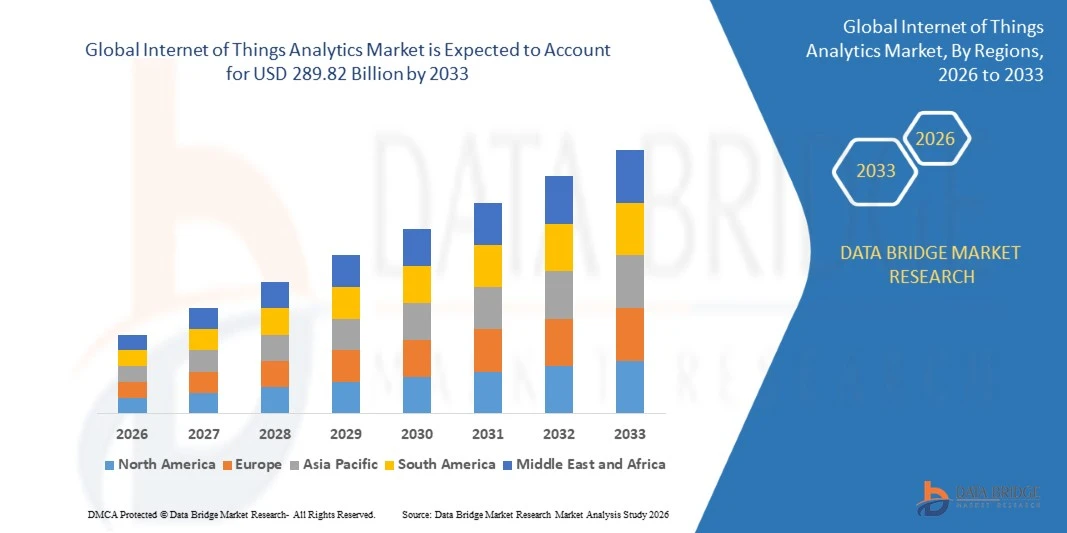
- As per Data Bridge Market Research analysis, the internet of things analytics market was valued at USD 41.50 billion in 2025 and is projected to reach USD 289.82 billion by 2033, growing at a CAGR of 27.50% from 2026 to 2033.
- The market is experiencing strong growth driven by the increasing adoption of connected IoT devices, rapid advancements in artificial intelligence and machine learning, and expanding applications across manufacturing, healthcare, energy and utilities, transportation, and smart infrastructure.
- The growing volume of data generated by connected devices, combined with the need for real-time monitoring and operational efficiency, is compelling enterprises to adopt advanced IoT analytics solutions. Predictive maintenance, cloud-based analytics, and automated data processing are helping organizations reduce equipment downtime, optimize resource utilization, improve decision-making, and strengthen operational performance across industries.
Market Size & Forecast
- Global Market Value (2025): USD 41.50 Billion
- Expected Market Value (2033): USD 289.82 Billion
- Forecast CAGR (2026–2033): 27.50%
- Leading Region in 2025: North America
- Fastest Growing Region: Asia Pacific
What are the Major Takeaways of the Internet of Things Analytics Market?
- North America dominated the internet of things analytics market with a revenue share of 38.52% in 2025, supported by advanced digital infrastructure, strong enterprise investments in cloud computing, and widespread adoption of connected devices across manufacturing, healthcare, and energy.
- Asia-Pacific is expected to be the fastest-growing region at a CAGR of 21.6% from 2026 to 2033, fueled by rapid industrial digitalization, expanding IoT infrastructure, and increasing adoption of data analytics technologies across China, India, Japan, and South Korea
- The software segment led the market with a 67.80% share in 2025, driven by increasing demand for platforms that collect, process, visualize, and analyze data generated by connected devices.
- Services are the fastest-growing component type, projected to register a CAGR of 23.12%, reflecting the surge in demand for implementation, integration, consulting, and managed analytics services.
- The on-premises segment dominated the deployment mode category with a 64.62% revenue share in 2025, led by enterprises requiring greater control over sensitive operational data, security policies, and analytics infrastructure.
- Descriptive analytics accounted for 42.60% of the market share in 2025, preferred by widespread demand for historical data analysis, operational reporting, and performance monitoring
- The asset management segment is the fastest-growing application category, with a CAGR of 22.15%, driven by increasing demand for real-time asset visibility, improved utilization, and lifecycle cost optimization.
Report Scope and Internet of Things Analytics Market Segmentation
|
Attributes |
Internet of Things Analytics Key Market Insights |
|
Segments Covered |
|
|
Countries Covered |
North America
Europe
Asia-Pacific
Middle East and Africa
South America
|
|
Key Market Players |
|
|
Market Opportunities |
|
|
Value Added Data Infosets |
In addition to the market insights such as market value, growth rate, market segments, geographical coverage, market players, and market scenario, the market report curated by the Data Bridge Market Research team includes in-depth expert analysis, import/export analysis, pricing analysis, production consumption analysis, and pestle analysis. |
What is the Key Trend in the Internet of Things Analytics Market?
- Enterprises are increasingly integrating artificial intelligence (AI) and machine learning (ML) with IoT analytics platforms to transform connected-device data into actionable insights, improve operational efficiency, and enable faster, data-driven decision-making across industries.
- For instance, in April 2025, IoT Analytics reported that new IoT products were increasingly incorporating AI integration, security, and connectivity, reflecting the growing use of AI-enabled analytics to derive actionable insights from connected-device data
- The growing adoption of edge analytics and real-time data processing is enabling organizations to analyze information closer to connected devices, reducing latency, minimizing bandwidth requirements, and supporting time-sensitive applications in manufacturing, healthcare, transportation, and energy management.
- Businesses are increasingly combining cloud-based IoT analytics with predictive maintenance and automated monitoring to identify equipment anomalies, improve asset utilization, and reduce unplanned operational disruptions.
- For instance, in October 2025, Omdia reported that 82% of surveyed enterprises were already using or planning to implement real-time analytics for IoT deployments, highlighting the growing importance of immediate data processing and faster operational decision-making.
- As connected-device deployments expand and enterprises seek faster insights from increasingly complex data streams, the integration of AI-driven analytics, edge computing, and cloud platforms is expected to strengthen the role of IoT analytics in industrial digitalization and intelligent operations.
What are the Key Drivers of the Internet of Things Analytics Market?
- The rapid expansion of connected devices and industrial IoT networks is increasing demand for advanced analytics platforms capable of processing large volumes of sensor data, identifying operational patterns, and supporting real-time business decisions.
- For instance, in July 2025, Amazon Web Services (AWS) announced the general availability of multivariate anomaly detection in AWS IoT SiteWise, enabling industrial organizations to identify abnormal equipment behavior and implement predictive maintenance strategies to reduce unplanned downtime and improve operational efficiency.
- The growing adoption of predictive maintenance, smart manufacturing, and automated monitoring is encouraging enterprises to integrate IoT analytics into their operational workflows to improve equipment reliability, reduce downtime, and optimize resource utilization.
- For instance, in November 2023, Apollo Tyres and Deloitte showcased an IoT-enabled manufacturing solution that helped increase primary equipment productivity by 9%, reduce energy consumption by 3%, and cut idle time on curing presses by 50%, highlighting the role of IoT analytics in manufacturing optimization.
- As enterprises increasingly prioritize operational efficiency, data-driven decisions, and connected infrastructure, IoT analytics is expected to remain an important technology for industrial digitalization, predictive operations, and intelligent asset management.
What Factors are Challenging the Growth of the Internet of Things Analytics Market?
- IoT analytics implementation requires substantial investment in connected-device infrastructure, data integration, cloud computing resources, cybersecurity systems, and specialized analytics software, increasing the overall cost of deployment.
- For instance, in October 2024, the U.S. National Institute of Standards and Technology (NIST) highlighted those shortages of skilled professionals, cybersecurity concerns, and privacy risks were significant barriers to wider IoT adoption. These challenges increase implementation complexity and require additional investment in secure data management and analytics infrastructure.
- These financial and technical requirements limit adoption among small and medium-sized enterprises, particularly organizations operating legacy equipment or lacking skilled data engineers, cybersecurity professionals, and IoT integration specialists.
- Integrating data from heterogeneous devices and legacy systems also creates interoperability challenges, while concerns about unauthorized access, data privacy, and regulatory compliance can complicate analytics deployment across interconnected business environments.
- Forr instance, in December 2025, a study published in Digital Business identified high initial investment, interoperability issues, skills shortages, regulatory challenges, and data security and privacy concerns as influential barriers to IoT integration.
- These implementation costs, security concerns, and technical complexities continue to challenge the wider adoption of IoT analytics, particularly among resource-constrained enterprises, despite growing demand for real-time insights and data-driven operational improvements.
How is the Internet of Things Analytics Market Segmented?
The internet of things analytics market is segmented on the basis of component, deployment mode, analytics type, and application.
- By Component
On the basis of component, the internet of things analytics market is segmented into software and services. The software segment dominated the market with 67.80% share in 2025, driven by increasing demand for platforms that collect, process, visualize, and analyze data generated by connected devices. IoT analytics software enables organizations to transform sensor data into actionable insights for operational decision-making. These solutions support real-time monitoring, predictive maintenance, and performance optimization across industrial and commercial environments. Integration with artificial intelligence and machine learning enhances anomaly detection and forecasting capabilities. Growing adoption of connected devices across manufacturing, healthcare, transportation, and energy is further strengthening software demand.
The services segment is projected to register the fastest growth at a CAGR of 23.12% during forecast period, driven by increasing demand for implementation, integration, consulting, and managed analytics services. Organizations require specialized expertise to connect diverse IoT devices with existing enterprise systems and data platforms. Professional services help businesses configure analytics solutions according to their operational requirements. Managed services enable continuous monitoring, maintenance, and optimization without requiring extensive in-house technical teams. Growing cybersecurity and data governance requirements are further increasing demand for specialist support. Small and medium-sized enterprises can also benefit from outsourced expertise and flexible service models.
- By Deployment Mode
On the basis of deployment mode, the internet of things analytics market is segmented into cloud-based, on-premises, and hybrid deployment. The on-premises segment dominated the market with 64.62% share in 2025, supported by enterprises requiring greater control over sensitive operational data, security policies, and analytics infrastructure. On-premises deployments enable organizations to process information within their own IT environments. They are particularly relevant for regulated industries and businesses operating critical infrastructure. These systems can integrate with existing industrial equipment and enterprise applications. Organizations also benefit from greater control over data access and infrastructure configurations.
The cloud-based segment is projected to register the fastest growth at a CAGR of 23.30% during forecast period, driven by scalable computing resources, flexible deployment, and lower upfront infrastructure requirements. Cloud platforms enable organizations to analyze data from connected devices distributed across multiple facilities and locations. They also support integration with artificial intelligence and machine learning applications. Remote accessibility helps operational teams monitor performance without maintaining extensive local infrastructure. Subscription-based services can simplify implementation and infrastructure management.
- By Analytics Type
On the basis of analytics type, the internet of things analytics market is segmented into descriptive analytics, diagnostic analytics, predictive analytics, and prescriptive analytics. The descriptive analytics segment dominated the market with 42.60% share in 2025, supported by widespread demand for historical data analysis, operational reporting, and performance monitoring. Descriptive analytics converts raw IoT data into dashboards, summaries, and key performance indicators. Businesses use these capabilities to monitor equipment utilization, production efficiency, and energy consumption. The technology helps organizations understand existing operating conditions and identify performance patterns.
The prescriptive analytics segment is expected to register the fastest growth, with CAGR of 22% during forecast period, driven by increasing demand for automated recommendations and optimization of operational decisions. Prescriptive analytics combines IoT data with predictive models, optimization techniques, and business constraints to recommend suitable actions. Manufacturing companies can use it to optimize maintenance schedules and production parameters. Energy operators can apply it to improve resource allocation and equipment performance. Integration with AI and machine learning is expanding its ability to support complex decisions. Adoption is also benefiting from the growing use of automated industrial systems.
- By Application
On the basis of application, the internet of things analytics market is segmented into predictive maintenance, energy management, asset management, inventory management, remote monitoring, security and emergency management, building automation, sales and customer management, infrastructure management, and others. The predictive maintenance segment dominated the market with 37.74% share in 2025, driven by increasing demand to reduce equipment failures and unplanned downtime. IoT sensors collect information on vibration, temperature, pressure, and equipment operating conditions. Analytics platforms process this information to identify anomalies and potential equipment failures. Businesses use these insights to schedule maintenance before breakdowns interrupt operations. Predictive maintenance can also improve asset reliability and reduce unnecessary servicing.
The asset management segment is expected to witness the fastest growth at a CAGR of 22.15% during forecast period, driven by increasing demand for real-time asset visibility, improved utilization, and lifecycle cost optimization. IoT analytics enables organizations to monitor asset condition, location, availability, and performance. Businesses can identify underutilized equipment and prioritize maintenance based on actual operating conditions. Integration with enterprise asset management systems improves planning and resource allocation. Connected industrial machinery and smart infrastructure are expanding the volume of data available for asset-related analysis. Organizations are increasingly using these insights to improve reliability and reduce operating costs.
Which Region Holds the Largest Share of the Internet of Things Analytics Market?
- North America dominated the internet of things analytics market with a revenue share of 38.52% in 2025, supported by advanced digital infrastructure, strong enterprise investments in cloud computing, and widespread adoption of connected devices across manufacturing, healthcare, and energy
- The region also benefits from the presence of leading technology providers, growing implementation of predictive analytics solutions, and increasing demand for real-time data processing across manufacturing, healthcare, energy, and transportation. Rising investments in industrial automation, smart infrastructure, and enterprise digital transformation continue to strengthen North America's leadership position in the global market.
U.S. Internet of Things Analytics Market Insight
The U.S. Internet of Things analytics market is witnessing strong growth due to rising investments in industrial automation, cloud computing, and advanced data analytics technologies. The country’s mature technology ecosystem, along with increasing adoption of AI-powered analytics, connected devices, and predictive maintenance solutions, is driving demand across manufacturing, healthcare, energy, and transportation applications. In addition, growing emphasis on operational efficiency, real-time monitoring, and data-driven decision-making is accelerating IoT analytics adoption across enterprises and industrial organizations.
Asia-Pacific Internet of Things Analytics Market Insight
The Asia-Pacific Internet of Things analytics market is expected to witness rapid growth, driven by increasing industrialization, expanding digital infrastructure, and rising investments in smart manufacturing across countries such as China, India, and Japan. Growing adoption of connected devices, cloud-based analytics platforms, and AI-enabled monitoring solutions is supporting regional market expansion. In addition, increasing smart city initiatives, expanding telecommunications infrastructure, and rising demand for predictive maintenance are accelerating IoT analytics adoption across industrial and commercial sectors.
Japan Internet of Things Analytics Market Insight
The Japan Internet of Things analytics market is witnessing consistent growth due to rising investments in industrial automation, smart manufacturing, and advanced digital technologies. Manufacturing companies, technology providers, and infrastructure operators are increasingly adopting IoT analytics for equipment monitoring, predictive maintenance, and production optimization. Moreover, increasing integration of artificial intelligence, robotics, and connected industrial systems, combined with the country’s focus on productivity improvement and operational efficiency, is further contributing to market growth.
China Internet of Things Analytics Market Insight
The China Internet of Things analytics market is growing rapidly, driven by expanding industrial digitalization, increasing deployment of connected devices, and government initiatives supporting smart manufacturing and intelligent infrastructure. Growing adoption of AI-enabled analytics platforms across manufacturing, transportation, energy, and logistics is significantly boosting market demand. In addition, rising investments in industrial automation, smart city development, and cloud computing infrastructure are strengthening China's position as a major growth market for IoT analytics.
U.K. Internet of Things Analytics Market Insight
The U.K. Internet of Things analytics market is experiencing steady growth, supported by rising adoption of connected technologies across manufacturing, healthcare, utilities, and transportation. Increasing investments in cloud-based analytics platforms and demand for real-time operational insights are contributing to market growth. Furthermore, integration of AI, predictive analytics, and automated monitoring technologies is improving asset performance and resource management, positioning the U.K. as an important market for IoT analytics solutions.
Germany Internet of Things Analytics Market Insight
The Germany Internet of Things analytics market is expanding steadily due to the country’s strong industrial manufacturing base, advanced engineering capabilities, and increasing adoption of Industry 4.0 technologies. Manufacturers, logistics operators, and energy companies are increasingly utilizing IoT analytics for predictive maintenance, production monitoring, and supply chain optimization. Continuous advancements in industrial connectivity, cloud computing, and AI-enabled analytics, along with a strong focus on manufacturing efficiency and digital transformation, are further driving market growth in Germany.
Which are the Top Companies in Internet of Things Analytics Market?
The internet of things analytics industry is primarily led by well-established companies, including:
- Amazon Web Services, Inc. (U.S.)
- Microsoft Corporation (U.S.)
- IBM Corporation (U.S.)
- Cisco Systems, Inc. (U.S.)
- Oracle Corporation (U.S.)
- SAP SE (Germany)
- Dell Inc. (U.S.)
- Hewlett Packard Enterprise Company (U.S.)
- Teradata Corporation (U.S.)
- Salesforce, Inc. (U.S.)
- Accenture plc (Ireland)
- PTC Inc. (U.S.)
- Hitachi, Ltd. (Japan)
- Cloudera, Inc. (U.S.)
- Software AG (Germany)
- SAS Institute Inc. (U.S.)
- C3.ai, Inc. (U.S.)
- Siemens AG (Germany)
- Schneider Electric SE (France)
- QlikTech International AB (U.S.)
What are Latest Developments in Internet of Things Analytics Market?
- In August 2025, Amazon Web Services (AWS) added native anomaly detection capabilities to AWS IoT SiteWise, enabling industrial organizations to monitor equipment behavior, identify potential failures, and support predictive maintenance using machine learning. This development strengthens the use of IoT analytics for industrial monitoring and operational optimization.
- In November 2024, Telenor IoT launched its Analytics and Insights service to help businesses analyze IoT connectivity data, monitor device deployments, identify usage patterns, and detect connectivity issues. The service enables enterprises to improve operational efficiency, mitigate risks, and make data-driven decisions across connected-device fleets.
- In July 2024, Amazon Web Services (AWS) published an update outlining how businesses could build scalable IoT analytics solutions using Amazon Kinesis, Amazon S3, and Amazon Athena. The approach supports high-volume data ingestion, cost-efficient storage, and SQL-based analysis for organizations handling growing volumes of IoT-generated data. The article also announced the closure of new customer access to AWS IoT Analytics from July 25, 2024.
- In February 2022, Mavenir announced the commercial availability of its Intelligent IoT Platform, which applies artificial intelligence to IoT sensor data to deliver low-latency insights and actionable intelligence. The platform was designed to support enterprises and communications service providers adopting IoT applications alongside expanding 5G networks.
- In August 2021, Amazon Web Services (AWS) launched AWS IoT Analytics in its Asia Pacific (Mumbai) Region, expanding access to managed IoT data collection, processing, storage, and analysis capabilities for customers in India. The regional expansion enabled users to analyze connected-device data with built-in SQL queries and machine-learning capabilities while supporting local deployment requirements.

- Interactive Data Analysis Dashboard
- Company Analysis Dashboard for high growth potential opportunities
- Research Analyst Access for customization & queries
- Competitor Analysis with Interactive dashboard
- Latest News, Updates & Trend analysis
- Harness the Power of Benchmark Analysis for Comprehensive Competitor Tracking
Data collection and base year analysis are done using data collection modules with large sample sizes. The stage includes obtaining market information or related data through various sources and strategies. It includes examining and planning all the data acquired from the past in advance. It likewise envelops the examination of information inconsistencies seen across different information sources. The market data is analysed and estimated using market statistical and coherent models. Also, market share analysis and key trend analysis are the major success factors in the market report. To know more, please request an analyst call or drop down your inquiry.
The key research methodology used by DBMR research team is data triangulation which involves data mining, analysis of the impact of data variables on the market and primary (industry expert) validation. Data models include Vendor Positioning Grid, Market Time Line Analysis, Market Overview and Guide, Company Positioning Grid, Patent Analysis, Pricing Analysis, Company Market Share Analysis, Standards of Measurement, Global versus Regional and Vendor Share Analysis. To know more about the research methodology, drop in an inquiry to speak to our industry experts.
Data Bridge Market Research is a leader in advanced formative research. We take pride in servicing our existing and new customers with data and analysis that match and suits their goal. The report can be customized to include price trend analysis of target brands understanding the market for additional countries (ask for the list of countries), clinical trial results data, literature review, refurbished market and product base analysis. Market analysis of target competitors can be analyzed from technology-based analysis to market portfolio strategies. We can add as many competitors that you require data about in the format and data style you are looking for. Our team of analysts can also provide you data in crude raw excel files pivot tables (Fact book) or can assist you in creating presentations from the data sets available in the report.