


What is the Intraoperative Fluorescence Imaging Market Size and Growth Rate?
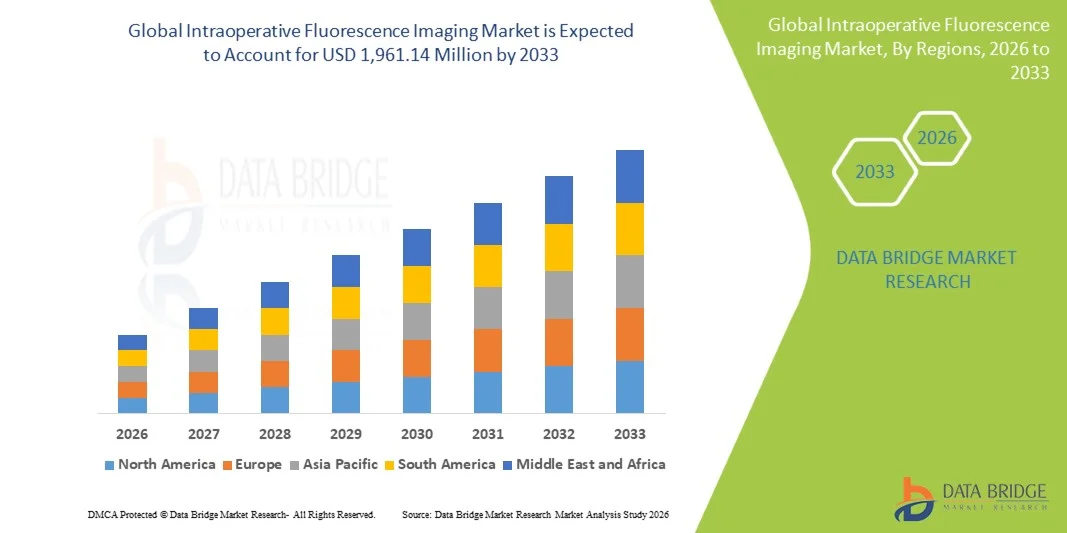
- As per Data Bridge Market Research analysis the intraoperative fluorescence imaging market was valued at USD 775.30 million in 2025 and is projected to reach USD 1,961.14 million by 2033, growing at a CAGR of 12.30% from 2026 to 2033.
- The market is experiencing rapid growth driven by increasing adoption of fluorescence-guided surgery, rising demand for precise visualization of anatomical structures, and technological advancements in near-infrared fluorescence imaging systems across various surgical procedures.
- The increasing focus on minimally invasive and precision-based surgeries, combined with the growing need to improve surgical accuracy and patient outcomes, is encouraging hospitals and surgical centers to adopt advanced intraoperative fluorescence imaging technologies.
Market Size & Forecast
- Market Value (2025): USD 775.30 Million
- Expected Market Value (2033): USD 1,961.14 Million
- Forecast CAGR (2026–2033): 12.30%
- Leading Region in 2025: North America
- Fastest Growing Region: Asia-Pacific
What are the Major Takeaways of the Intraoperative Fluorescence Imaging Market?
- North America dominated the intraoperative fluorescence imaging market with the largest revenue share in 2025, supported by advanced healthcare infrastructure, high adoption of minimally invasive surgeries, and increasing demand for real-time surgical visualization.
- Asia-Pacific intraoperative fluorescence imaging market is expected to witness the fastest growth rate from 2026 to 2033, supported by expanding healthcare infrastructure, increasing surgical volumes, and rising adoption of advanced imaging technologies across China, Japan, and India.
- The devices segment held the largest market revenue share in 2025, driven by widespread adoption of fluorescence imaging platforms, cameras, light sources, and integrated visualization systems across surgical procedures. Fluorescence imaging devices are preferred due to their ability to provide real-time visualization, enhanced tissue contrast, and improved surgical guidance during complex interventions.
- The imaging agents segment is projected to register the fastest growth from 2026 to 2033, driven by increasing use of fluorescent agents such as indocyanine green for tissue perfusion, lymphatic mapping, and anatomical visualization. Rising adoption of fluorescence-guided surgery and expanding clinical applications are accelerating segment expansion.
- The laser diodes segment held the largest market revenue share in 2025, driven by their high optical efficiency, precise wavelength control, and increasing integration into advanced fluorescence imaging systems. Laser diodes are preferred due to their ability to provide consistent illumination and support sensitive fluorescence detection during surgical procedures.
- The light emitting diodes segment is projected to register the fastest growth from 2026 to 2033, driven by increasing demand for energy-efficient and compact illumination technologies. Rising adoption of LED-based fluorescence systems in surgical imaging devices is accelerating segment expansion due to their longer operating life, lower energy consumption, and flexible system integration.
Report Scope and Intraoperative Fluorescence Imaging Market Segmentation
|
Attributes |
Intraoperative Fluorescence Imaging Key Market Insights |
|
Segments Covered |
|
|
Countries Covered |
North America
Europe
Asia-Pacific
Middle East and Africa
South America
|
|
Key Market Players |
|
|
Market Opportunities |
|
|
Value Added Data Infosets |
In addition to the insights on market scenarios such as market value, growth rate, segmentation, geographical coverage, and major players, the market reports curated by the Data Bridge Market Research also include depth expert analysis, patient epidemiology, pipeline analysis, pricing analysis, and regulatory framework. |
What is the Key Trend in the Intraoperative Fluorescence Imaging Market?
- Surgeons are increasingly adopting fluorescence-guided imaging systems to visualize tissue perfusion, lymphatic flow, and anatomical structures in real time, supporting more precise decision-making across minimally invasive, reconstructive, and cancer surgeries.
- For instance, in 2025, the Society of American Gastrointestinal and Endoscopic Surgeons (SAGES) issued guidelines supporting the use of indocyanine green (ICG) fluorescence imaging for applications including gastrointestinal cancer identification, lymph-node mapping, and assessment of colorectal and esophageal anastomoses, strengthening clinical adoption of fluorescence-guided surgery.
- Real-time integration of fluorescence and white-light imaging enables surgeons to assess tissue characteristics, blood flow, and anatomical structures during procedures, providing additional information beyond conventional visualization.
- For instance, Stryker's fluorescence imaging systems use near-infrared fluorescence to visualize blood flow, tissue perfusion, lymphatics, and anatomical structures during surgical procedures, supporting real-time intraoperative assessment.
- As surgical teams increasingly prioritize real-time visualization, improved tissue assessment, and precision-guided procedures, the adoption of intraoperative fluorescence imaging is expected to accelerate across oncology, reconstructive, vascular, and minimally invasive surgeries.
What are the Key Drivers of the Intraoperative Fluorescence Imaging Market?
- The growing adoption of minimally invasive and robotic-assisted surgery is significantly increasing demand for fluorescence imaging technologies that provide enhanced visualization of anatomical structures and tissue perfusion during complex procedures.
- For instance, Medtronic has integrated indocyanine green fluorescence capabilities into its Hugo robotic-assisted surgery platform, enabling surgeons to use fluorescence visualization alongside conventional imaging during supported procedures.
- Hospitals and surgical centers are increasingly integrating fluorescence imaging with robotic platforms, laparoscopic systems, and digital operating-room technologies to improve visualization and support intraoperative decision-making.
- For instance, SAGES' 2025 guidelines recommend ICG fluorescence imaging for intraoperative lymph-node identification in gastrointestinal cancer surgery and for assessing the quality of left-sided colorectal anastomoses, demonstrating growing clinical acceptance of the technology.
- With the increasing use of robotic-assisted and minimally invasive procedures, alongside growing demand for real-time tissue visualization and improved surgical precision, fluorescence imaging is expected to remain an important component of advanced surgical platforms.
Which Factors are Challenging the Growth of the Intraoperative Fluorescence Imaging Market?
- Advanced intraoperative fluorescence imaging systems require substantial investment in specialized imaging platforms, cameras, light sources, compatible surgical equipment, and fluorescent imaging agents, increasing the overall cost of surgical technology adoption.
- These high costs can limit adoption among smaller hospitals, ambulatory surgical centers, and healthcare facilities operating with constrained capital budgets, particularly in emerging markets.
- For instance, advanced fluorescence systems combine near-infrared imaging, digital cameras, specialized illumination, and image-processing technologies to provide real-time visualization, increasing the technological complexity and investment required for implementation.
- In addition, healthcare providers may require specialized training and workflow integration to effectively use fluorescence imaging during different surgical procedures, while clinical evidence and regulatory requirements can vary across applications and countries.
- The high equipment and implementation costs, specialized training requirements, and regulatory considerations continue to restrict widespread adoption, particularly among smaller healthcare organizations and price-sensitive markets, despite growing demand for advanced intraoperative visualization technologies.
How is the Intraoperative Fluorescence Imaging Market Segmented?
The market is segmented on the basis of product type, light source, application, and end user.
- By Product Type
On the basis of product type, the intraoperative fluorescence imaging market is segmented into devices and imaging agents. The devices segment held the largest market revenue share in 2025, driven by widespread adoption of fluorescence imaging platforms, cameras, light sources, and integrated visualization systems across surgical procedures. Fluorescence imaging devices are preferred due to their ability to provide real-time visualization, enhanced tissue contrast, and improved surgical guidance during complex interventions.
The imaging agents segment is projected to register the fastest growth from 2026 to 2033, driven by increasing use of fluorescent agents such as indocyanine green for tissue perfusion, lymphatic mapping, and anatomical visualization. Rising adoption of fluorescence-guided surgery and expanding clinical applications are accelerating segment expansion.
- By Light Source
On the basis of light source, the intraoperative fluorescence imaging market is segmented into laser diodes, light emitting diodes, and filtered lamp source. The laser diodes segment held the largest market revenue share in 2025, driven by their high optical efficiency, precise wavelength control, and increasing integration into advanced fluorescence imaging systems. Laser diodes are preferred due to their ability to provide consistent illumination and support sensitive fluorescence detection during surgical procedures.
The light emitting diodes segment is projected to register the fastest growth from 2026 to 2033, driven by increasing demand for energy-efficient and compact illumination technologies. Rising adoption of LED-based fluorescence systems in surgical imaging devices is accelerating segment expansion due to their longer operating life, lower energy consumption, and flexible system integration.
- By Application
On the basis of application, the intraoperative fluorescence imaging market is segmented into cancer surgery, cardiovascular surgery, reconstructive surgery, thyroid surgery, and others. The cancer surgery segment held the largest market revenue share in 2025, driven by increasing use of fluorescence imaging for tumor visualization, lymphatic mapping, and assessment of tissue perfusion. Growing demand for precision-guided oncology procedures is supporting the adoption of fluorescence imaging technologies in cancer surgery.
The reconstructive surgery segment is projected to register the fastest growth from 2026 to 2033, driven by increasing demand for real-time assessment of tissue perfusion during reconstructive and microsurgical procedures. Rising adoption of fluorescence imaging for flap viability and blood-flow visualization is accelerating segment expansion.
- By End User
On the basis of end user, the intraoperative fluorescence imaging market is segmented into hospitals, clinics, and ambulatory surgical centers. The hospitals segment held the largest market revenue share in 2025, driven by the high volume of complex surgical procedures and increasing investments in advanced surgical visualization technologies. Hospitals are increasingly adopting fluorescence imaging systems to improve intraoperative visualization, surgical precision, and patient outcomes.
The ambulatory surgical centers segment is projected to register the fastest growth from 2026 to 2033, driven by the increasing shift toward minimally invasive outpatient procedures and growing adoption of advanced surgical imaging technologies. Rising investments in compact fluorescence imaging systems and increasing demand for efficient surgical workflows are accelerating segment expansion across ambulatory surgical facilities.
Which Region Holds the Largest Share of the Intraoperative Fluorescence Imaging Market?
- North America dominated the intraoperative fluorescence imaging market with the largest revenue share in 2025, supported by advanced healthcare infrastructure, high adoption of minimally invasive surgeries, and increasing demand for real-time surgical visualization.
- Hospitals and surgical centers across the region are increasingly adopting fluorescence-guided technologies for cancer surgery, cardiovascular procedures, and reconstructive surgeries. Strong healthcare expenditure, technological innovation, and the presence of leading medical device companies are further establishing North America as a major market for intraoperative fluorescence imaging.
U.S. Intraoperative Fluorescence Imaging Market Insight
U.S. intraoperative fluorescence imaging market captured the largest revenue share in 2025 within North America, fueled by the rapid adoption of advanced surgical visualization technologies and growing demand for precision-guided procedures. Surgeons are increasingly using fluorescence imaging for tumor visualization, tissue perfusion assessment, and lymphatic mapping during complex surgeries. Moreover, strong investments in healthcare technology, increasing adoption of robotic-assisted surgery, and the presence of leading manufacturers are significantly contributing to market expansion.
Europe Intraoperative Fluorescence Imaging Market Insight
Europe intraoperative fluorescence imaging market is expected to witness the fastest growth rate from 2026 to 2033, primarily driven by increasing adoption of minimally invasive procedures and growing demand for advanced surgical visualization technologies. The region's well-developed healthcare infrastructure and rising investments in precision medicine are fostering the use of fluorescence-guided surgery. Furthermore, increasing applications in oncology, cardiovascular, reconstructive, and thyroid surgeries are supporting market growth across European countries.
U.K. Intraoperative Fluorescence Imaging Market Insight
U.K. intraoperative fluorescence imaging market is expected to witness the fastest growth rate from 2026 to 2033, driven by increasing adoption of advanced surgical technologies and growing emphasis on precision-based healthcare. Hospitals are increasingly integrating fluorescence imaging into cancer, reconstructive, and minimally invasive procedures to improve intraoperative visualization and surgical decision-making. In addition, investments in modern surgical infrastructure and increasing demand for advanced imaging solutions are expected to continue stimulating market growth.
Germany Intraoperative Fluorescence Imaging Market Insight
Germany intraoperative fluorescence imaging market is expected to witness the fastest growth rate from 2026 to 2033, fueled by the country's advanced healthcare infrastructure, strong medical technology industry, and increasing focus on precision surgery. German hospitals are increasingly adopting fluorescence-guided systems to improve tissue visualization, assess perfusion, and support complex surgical procedures. The country's emphasis on technological innovation, high-quality healthcare delivery, and advanced surgical equipment further promotes the adoption of intraoperative fluorescence imaging.
Asia-Pacific Intraoperative Fluorescence Imaging Market Insight
The Asia-Pacific intraoperative fluorescence imaging market is expected to witness the fastest growth rate from 2026 to 2033, supported by expanding healthcare infrastructure, increasing surgical volumes, and rising adoption of advanced imaging technologies across China, Japan, and India. Growing healthcare expenditure and increasing demand for minimally invasive procedures are encouraging hospitals to invest in fluorescence-guided surgical systems. Furthermore, modernization of operating rooms, increasing access to advanced medical technologies, and growing awareness of precision surgery are expanding adoption across the region.
Japan Intraoperative Fluorescence Imaging Market Insight
Japan intraoperative fluorescence imaging market is expected to witness the fastest growth rate from 2026 to 2033 due to the country's advanced healthcare system, strong technological capabilities, and increasing demand for precision-based surgical procedures. Japanese hospitals are increasingly adopting fluorescence imaging technologies for oncology, cardiovascular, reconstructive, and other complex surgeries. Moreover, the country's aging population and increasing prevalence of chronic diseases requiring surgical intervention are supporting demand for advanced intraoperative visualization solutions.
China Intraoperative Fluorescence Imaging Market Insight
China intraoperative fluorescence imaging market accounted for the largest market revenue share in Asia Pacific in 2025, attributed to expanding healthcare infrastructure, increasing surgical volumes, and growing investments in advanced medical imaging technologies. The country's rapid modernization of hospitals and increasing adoption of minimally invasive surgical procedures are driving demand for fluorescence-guided imaging systems. Furthermore, rising healthcare expenditure, expansion of specialized surgical centers, and growing availability of advanced surgical technologies are key factors propelling the intraoperative fluorescence imaging market in China.
Which are the Top Companies in Intraoperative Fluorescence Imaging Market?
The intraoperative fluorescence imaging industry is primarily led by well-established companies, including:
- Medtronic plc (Ireland)
- Stryker Corporation (U.S.)
- Intuitive Surgical, Inc. (U.S.)
- Olympus Corporation (Japan)
- Carl Zeiss Meditec AG (Germany)
- KARL STORZ SE & Co. KG (Germany)
- Shimadzu Corporation (Japan)
- Hamamatsu Photonics K.K. (Japan)
- Leica Microsystems GmbH (Germany)
- Richard Wolf GmbH (Germany)
- SCHÖLLY FIBEROPTIC GMBH (Germany)
- Guerbet (France)
- Diagnostic Green GmbH (Germany)
- LI-COR, Inc. (U.S.)
- FluoGuide A/S (Denmark)
What are Latest Developments in Intraoperative Fluorescence Imaging Market?
- In May 2023, Hamamatsu Photonics announced plans to construct a new production facility in the Miyakoda industrial area of Hamamatsu City, Japan, to expand its semiconductor laser manufacturing capacity. The investment was intended to address increasing global demand for semiconductor laser technologies and strengthen the company's production capabilities.
- In September 2023, Mayo Clinic and GE HealthCare announced a strategic collaboration to advance research and product development in radiology. The partnership focuses on developing innovative imaging solutions, improving clinical and patient experiences, and supporting more advanced diagnostic and therapeutic approaches.
- In October 2023, IMRIS, in collaboration with Black Forest Medical Group, introduced a cranial stabilization system specifically designed for intraoperative MRI procedures. The solution is intended to enhance patient positioning and surgical workflow, supporting greater precision and efficiency during complex neurosurgical interventions.

- Interactive Data Analysis Dashboard
- Company Analysis Dashboard for high growth potential opportunities
- Research Analyst Access for customization & queries
- Competitor Analysis with Interactive dashboard
- Latest News, Updates & Trend analysis
- Harness the Power of Benchmark Analysis for Comprehensive Competitor Tracking
Data collection and base year analysis are done using data collection modules with large sample sizes. The stage includes obtaining market information or related data through various sources and strategies. It includes examining and planning all the data acquired from the past in advance. It likewise envelops the examination of information inconsistencies seen across different information sources. The market data is analysed and estimated using market statistical and coherent models. Also, market share analysis and key trend analysis are the major success factors in the market report. To know more, please request an analyst call or drop down your inquiry.
The key research methodology used by DBMR research team is data triangulation which involves data mining, analysis of the impact of data variables on the market and primary (industry expert) validation. Data models include Vendor Positioning Grid, Market Time Line Analysis, Market Overview and Guide, Company Positioning Grid, Patent Analysis, Pricing Analysis, Company Market Share Analysis, Standards of Measurement, Global versus Regional and Vendor Share Analysis. To know more about the research methodology, drop in an inquiry to speak to our industry experts.
Data Bridge Market Research is a leader in advanced formative research. We take pride in servicing our existing and new customers with data and analysis that match and suits their goal. The report can be customized to include price trend analysis of target brands understanding the market for additional countries (ask for the list of countries), clinical trial results data, literature review, refurbished market and product base analysis. Market analysis of target competitors can be analyzed from technology-based analysis to market portfolio strategies. We can add as many competitors that you require data about in the format and data style you are looking for. Our team of analysts can also provide you data in crude raw excel files pivot tables (Fact book) or can assist you in creating presentations from the data sets available in the report.













