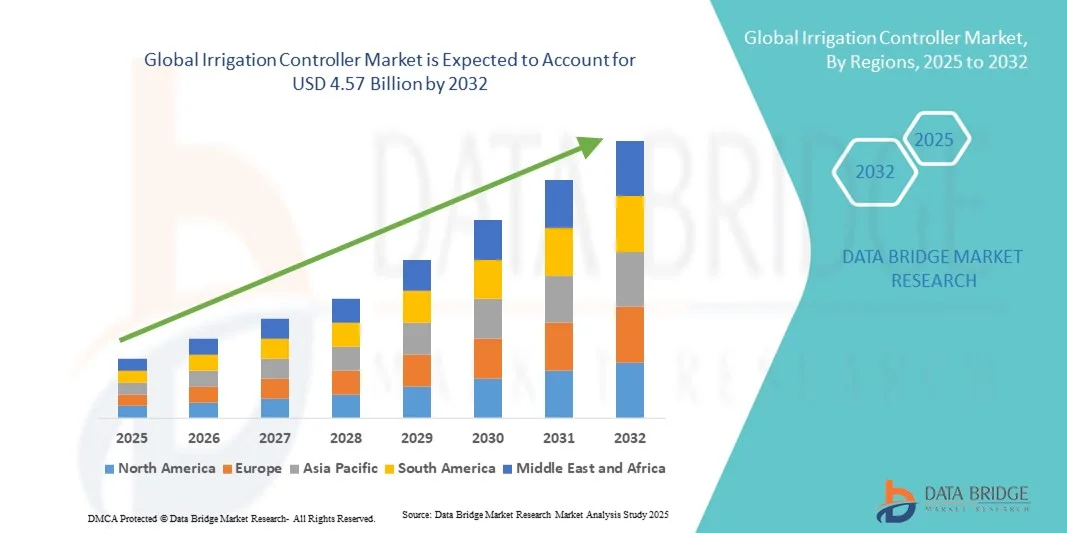
What is the Global Irrigation Controller Market Size and Growth Rate?
- The global irrigation controller market size was valued at USD 1.18 billion in 2024 and is expected to reach USD 4.57 billion by 2032, at a CAGR of 18.40% during the forecast period
- The irrigation controller market is such asly to gain growth, due to the increasing need for water conservation because of the growing population. Also, the rising adoption of climate-smart agriculture solutions by the government to help small-scale farmers to preserve and advance water management is also expected to drive the market for irrigation controller
- Such aswise, the rapid advancement in wireless technologies such as integrating Wi-Fi or cloud-based systems in plant canopy along with soil moisture sensors to receive real-time data on field conditions and utilizing GPS for the movement tracking of central pivot or linear move machines are also acting as the key determinants fueling the growth of the target market
What are the Major Takeaways of Irrigation Controller Market?
- High initial cost of installation and dilapidated farm income will curb the growth of the irrigation controller market in the above-mentioned forecast period, whereas the various design challenges resulting in low demand from developing economies have the potential to challenge the growth of the irrigation controller market
- Furthermore, the growing global demand for lawn and garden equipment and increasing use of modern agriculture practices are also projected to thrust the use of irrigation controller in the forecast period
- North America dominated the irrigation controller market with the largest revenue share of 34.28% in 2024, driven by growing demand for smart home and precision irrigation solutions as well as increasing awareness of water conservation technologies
- The Asia-Pacific irrigation controller market is projected to grow at the fastest CAGR of 9.57% during 2025–2032, driven by urbanization, rising disposable incomes, and increasing technological adoption in countries such as China, Japan, and India
- The Weather-Based Controllers segment dominated the market with the largest revenue share of 61.4% in 2024, driven by the growing use of weather forecasting data to automatically adjust watering schedules based on temperature, humidity, and rainfall
Report Scope and Irrigation Controller Market Segmentation
|
Attributes |
Irrigation Controller Key Market Insights |
|
Segments Covered |
|
|
Countries Covered |
North America
Europe
Asia-Pacific
Middle East and Africa
South America
|
|
Key Market Players |
|
|
Market Opportunities |
|
|
Value Added Data Infosets |
In addition to the insights on market scenarios such as market value, growth rate, segmentation, geographical coverage, and major players, the market reports curated by the Data Bridge Market Research also include in-depth expert analysis, pricing analysis, brand share analysis, consumer survey, demography analysis, supply chain analysis, value chain analysis, raw material/consumables overview, vendor selection criteria, PESTLE Analysis, Porter Analysis, and regulatory framework. |
What is the Key Trend in the Irrigation Controller Market?
Enhanced Convenience Through AI and IoT-Based Smart Integration
- A major emerging trend in the global irrigation controller market is the integration of artificial intelligence (AI) and Internet of Things (IoT) technologies, enhancing automation and remote management of irrigation systems. This integration allows users to optimize water usage, monitor soil conditions, and control irrigation schedules seamlessly through smart devices
- For instance, The Toro Company introduced its Tempus Automation System, which utilizes IoT and cloud-based data to enable real-time irrigation control and monitoring. Similarly, Hunter Industries offers controllers compatible with smart assistants and weather-based automation to ensure precise water management
- AI integration helps analyze soil moisture, weather forecasts, and crop type to determine optimal irrigation cycles, improving water efficiency and crop productivity. Through smart mobile apps and voice assistants, users can automate irrigation based on predictive analytics and environmental data
- The integration of irrigation controllers with smart home and farm automation systems enables centralized management of multiple functions, including lighting and pump operations, offering a unified control ecosystem
- This trend is transforming user expectations by promoting intelligent, efficient, and sustainable irrigation practices, reducing manual labor while maximizing water conservation. Companies such as Rain Bird Corporation and NETAFIM are leading this transition with AI-driven and connected irrigation technologies designed for precision agriculture and smart landscaping applications
- The rising demand for AI- and IoT-enabled irrigation controllers across residential, commercial, and agricultural sectors underscores the growing focus on smart water management and sustainability worldwide
What are the Key Drivers of Irrigation Controller Market?
- The growing need for efficient water management in agriculture and landscaping, combined with increasing global concerns over water scarcity, is a primary driver fueling demand for advanced irrigation controllers
- For instance, in March 2024, Rain Bird Corporation launched its ESP-LXIVM 2-Wire Controller, featuring IoT connectivity and advanced diagnostics for improved irrigation precision. Such technological innovations are driving the adoption of smart controllers across multiple end-use sectors
- With governments promoting water conservation initiatives and subsidies for smart irrigation systems, demand for controllers that automate and optimize irrigation schedules is surging
- The rising adoption of smart agriculture, urban green spaces, and precision farming practices is further supporting the market’s growth, as these technologies offer improved efficiency, crop yield, and reduced resource wastage
- Features such as remote access, weather-based scheduling, and integration with mobile and cloud platforms are increasing the appeal of modern irrigation controllers among farmers, landscapers, and homeowners
- Overall, the shift toward sustainable water use and digitally connected irrigation infrastructure is a key factor propelling global market expansion
Which Factor is Challenging the Growth of the Irrigation Controller Market?
- Concerns over cybersecurity vulnerabilities and data privacy in connected irrigation devices pose a significant challenge to widespread adoption. As irrigation controllers increasingly rely on IoT networks, they become susceptible to hacking or operational disruptions
- For instance, reported vulnerabilities in connected agricultural systems have raised awareness about potential risks to data integrity and system control, leading to cautious adoption among some users
- Manufacturers are addressing these concerns by incorporating secure encryption, multi-level authentication, and regular firmware updates to safeguard user data and ensure reliable performance
- In addition, the high initial investment cost of advanced smart controllers compared to conventional systems remains a barrier, particularly for small and medium-sized farms in developing regions
- While affordable models from brands such as Orbit Irrigation and Weathermatic are becoming available, premium AI-integrated or weather-sensing controllers still carry higher price tags.
- Overcoming these challenges through enhanced security frameworks, cost optimization, and user education on smart irrigation benefits will be essential to ensuring steady market growth in the coming years
How is the Irrigation Controller Market Segmented?
The market is segmented on the basis of type, product, irrigation type, and application.
- By Type
On the basis of type, the irrigation controller market is segmented into Weather-Based Controllers and Sensor-Based Controllers. The Weather-Based Controllers segment dominated the market with the largest revenue share of 61.4% in 2024, driven by the growing use of weather forecasting data to automatically adjust watering schedules based on temperature, humidity, and rainfall. These systems enhance water efficiency and are increasingly adopted in residential and commercial landscaping projects for sustainable irrigation management.
The Sensor-Based Controllers segment is expected to witness the fastest CAGR from 2025 to 2032, owing to their ability to monitor real-time soil moisture and environmental parameters. This ensures precision irrigation and reduces water wastage, making them ideal for modern agricultural applications. The growing integration of IoT and AI-based soil sensors further supports the rapid adoption of sensor-based irrigation solutions across farms and green spaces.
- By Product
On the basis of product, the irrigation controller market is segmented into Smart Controllers, Tap Timers, and Basic Controllers. The Smart Controllers segment held the largest market share of 56.8% in 2024, driven by the increasing adoption of connected devices and cloud-based irrigation systems. These controllers allow users to remotely manage watering schedules via mobile applications, voice assistants, or IoT platforms, enhancing convenience and water efficiency.
The Tap Timers segment is anticipated to record the fastest CAGR during 2025–2032, supported by their affordability, compact design, and suitability for small-scale gardens and residential landscapes. Tap timers are easy to install and require minimal technical knowledge, making them highly preferred among household users. The rising trend of home gardening and small-scale irrigation setups is expected to further fuel their demand in the coming years.
- By Irrigation Type
On the basis of irrigation type, the irrigation controller market is segmented into Drip/Trickle Irrigation and Sprinkler Irrigation. The Sprinkler Irrigation segment dominated the market with a revenue share of 58.2% in 2024, attributed to its wide application in lawns, sports grounds, and commercial landscapes. Its ability to provide uniform water distribution and compatibility with automated controllers has made it the preferred choice in urban and semi-urban setups.
The Drip/Trickle Irrigation segment is projected to grow at the fastest CAGR from 2025 to 2032, driven by its efficiency in conserving water and providing targeted irrigation to plant roots. This method is particularly beneficial for agricultural applications and areas facing water scarcity. Government incentives promoting micro-irrigation practices further support the rapid adoption of drip/trickle systems globally.
- By Application
On the basis of application, the irrigation controller market is segmented into Agriculture and Non-Agriculture. The Non-Agriculture segment accounted for the largest market share of 64.5% in 2024, driven by rising adoption across residential, commercial, and institutional landscapes. Increasing awareness about water conservation, coupled with the integration of smart city projects, is fueling demand for automated irrigation systems in urban infrastructure
The Agriculture segment is expected to register the fastest CAGR during 2025–2032, supported by the growing emphasis on precision farming and the need to optimize water usage in crop cultivation. The use of IoT-enabled irrigation controllers in large farms ensures efficient crop management, reduces operational costs, and boosts productivity. The trend toward sustainable and data-driven farming is expected to accelerate the adoption of smart irrigation controllers in the agricultural sector.
Which Region Holds the Largest Share of the Irrigation Controller Market?
- North America dominated the irrigation controller market with the largest revenue share of 34.28% in 2024, driven by growing demand for smart home and precision irrigation solutions as well as increasing awareness of water conservation technologies
- Consumers in the region highly value the convenience, automation, and seamless integration offered by irrigation controllers with other smart devices such as mobile apps, cloud platforms, and IoT-enabled farm systems
- This widespread adoption is further supported by high disposable incomes, technologically savvy users, and the preference for remote monitoring and centralized control, establishing irrigation controllers as the preferred solution for both residential and commercial properties
U.S. Irrigation Controller Market Insight
The U.S. irrigation controller market captured the largest revenue share of 71% in North America in 2024, fueled by rapid adoption of connected devices and smart home/farm automation systems. Consumers increasingly prioritize efficient water management, automated scheduling, and remote access via mobile and cloud platforms. The rising trend of DIY smart irrigation setups, combined with growing demand for voice-assisted and app-based controllers, is driving market expansion. Moreover, integration with AI, weather sensors, and smart home ecosystems such as Alexa, Google Assistant, and Apple HomeKit significantly contributes to market growth.
Europe Irrigation Controller Market Insight
The Europe irrigation controller market is projected to expand at a substantial CAGR, supported by stringent regulations on water conservation and urban landscaping. Increasing urbanization and the demand for connected devices are encouraging adoption across residential, commercial, and institutional sectors. Consumers are drawn to the convenience, water savings, and automation features offered by these controllers. Growth is also driven by the integration of smart irrigation systems in new construction and renovation projects, providing sustainable and cost-effective water management solutions.
U.K. Irrigation Controller Market Insight
The U.K. irrigation controller market is anticipated to grow at a notable CAGR during the forecast period, supported by the rising adoption of smart home automation and efficient water usage solutions. Growing concerns regarding water scarcity and landscaping maintenance are encouraging homeowners and commercial users to adopt automated irrigation systems. The U.K.’s advanced e-commerce infrastructure and availability of connected devices further stimulate market growth, with both residential gardens and commercial landscapes increasingly embracing precision irrigation technologies.
Germany Irrigation Controller Market Insight
The Germany irrigation controller market is expected to grow at a significant CAGR, fueled by increasing awareness of sustainable water management and smart technologies. Well-developed infrastructure, focus on innovation, and government incentives promoting eco-conscious practices encourage the adoption of advanced irrigation controllers. Integration with IoT platforms, mobile apps, and smart city initiatives is increasingly prevalent, and consumers prefer reliable, energy-efficient, and secure solutions that align with local environmental and privacy standards.
Which Region is the Fastest Growing in the Irrigation Controller Market?
The Asia-Pacific irrigation controller market is projected to grow at the fastest CAGR of 9.57% during 2025–2032, driven by urbanization, rising disposable incomes, and increasing technological adoption in countries such as China, Japan, and India. The region’s growing interest in smart homes and precision farming, supported by government digitalization initiatives, is accelerating the adoption of automated irrigation systems. In addition, as APAC becomes a hub for manufacturing irrigation controller components, affordability and accessibility of smart irrigation solutions are expanding, enabling wider market penetration.
Japan Irrigation Controller Market Insight
The Japan irrigation controller market is gaining momentum due to a high-tech culture, urbanization, and demand for convenient water management. The increasing number of smart homes and connected buildings drives adoption, while integration with IoT devices such as soil sensors and water pumps enhances efficiency. Japan’s aging population also encourages demand for user-friendly and automated irrigation solutions suitable for residential and commercial applications.
China Irrigation Controller Market Insight
The China irrigation controller market held the largest revenue share in Asia-Pacific in 2024, driven by rapid urbanization, technological adoption, and a growing middle class. China is a leading market for smart irrigation and water-efficient devices, with applications in residential, commercial, and agricultural landscapes. Government initiatives for smart city development, domestic manufacturing capabilities, and availability of affordable automated controllers are key factors fueling market growth in the region.
Which are the Top Companies in Irrigation Controller Market?
The irrigation controller industry is primarily led by well-established companies, including:
- Rain Bird Corporation (U.S.)
- HydroPoint Data Systems, Inc. (U.S.)
- Weathermatic (U.S.)
- The Toro Company (U.S.)
- Holman Industries (U.S.)
- Orbit Irrigation Products LLC (U.S.)
- CALSENSE (U.S.)
- Lindsay Corporation (U.S.)
- NELSON IRRIGATION (U.S.)
- FlyBird Farm Innovations Pvt. Ltd (India)
- Galcon (Israel)
- Mottech Water Solutions Ltd. (Israel)
- HUNTER INDUSTRIES (U.S.)
- NETAFIM (Israel)
- Delta Irrigation LLP (India)
- RainMachine – Green Electronics LLC (U.S.)
- Jain Irrigation, Inc. (India)
- The Scotts Company LLC (U.S.)
- Banyan Water, Inc. (U.S.)
- Valmont Industries, Inc. (U.S.)
What are the Recent Developments in Global Irrigation Controller Market?
- In November 2022, Valmont announced the divestiture of its offshore wind business, streamlining its operations to focus on core irrigation and agricultural solutions, marking a strategic shift in the company’s portfolio
- In October 2022, the EPA awarded the WaterSense Excellence Award to The Toro Company, recognizing its commitment to water-efficient irrigation technologies and reinforcing its industry leadership
- In October 2022, Hunter Industries launched a Spanish-language edition of its popular irrigation designer program, expanding accessibility for Spanish-speaking users and supporting global adoption of smart irrigation planning tools
- In May 2022, Toro introduced a new robotic lawnmower, advancing automated lawn care technology and enhancing convenience for both residential and commercial customers
- In March 2022, Lindsay formally announced a strategic alliance with Blyncsy, aimed at leveraging advanced data analytics and IoT solutions for precision irrigation, highlighting its focus on innovation and connected agriculture
- In February 2022, Calsense introduced Irrigation Management as a Service (IMaaS), eliminating the need for customers to make capital investments in controllers, sensors, and software, and promoting wider adoption of smart irrigation technologies

- Interactive Data Analysis Dashboard
- Company Analysis Dashboard for high growth potential opportunities
- Research Analyst Access for customization & queries
- Competitor Analysis with Interactive dashboard
- Latest News, Updates & Trend analysis
- Harness the Power of Benchmark Analysis for Comprehensive Competitor Tracking
Data collection and base year analysis are done using data collection modules with large sample sizes. The stage includes obtaining market information or related data through various sources and strategies. It includes examining and planning all the data acquired from the past in advance. It likewise envelops the examination of information inconsistencies seen across different information sources. The market data is analysed and estimated using market statistical and coherent models. Also, market share analysis and key trend analysis are the major success factors in the market report. To know more, please request an analyst call or drop down your inquiry.
The key research methodology used by DBMR research team is data triangulation which involves data mining, analysis of the impact of data variables on the market and primary (industry expert) validation. Data models include Vendor Positioning Grid, Market Time Line Analysis, Market Overview and Guide, Company Positioning Grid, Patent Analysis, Pricing Analysis, Company Market Share Analysis, Standards of Measurement, Global versus Regional and Vendor Share Analysis. To know more about the research methodology, drop in an inquiry to speak to our industry experts.
Data Bridge Market Research is a leader in advanced formative research. We take pride in servicing our existing and new customers with data and analysis that match and suits their goal. The report can be customized to include price trend analysis of target brands understanding the market for additional countries (ask for the list of countries), clinical trial results data, literature review, refurbished market and product base analysis. Market analysis of target competitors can be analyzed from technology-based analysis to market portfolio strategies. We can add as many competitors that you require data about in the format and data style you are looking for. Our team of analysts can also provide you data in crude raw excel files pivot tables (Fact book) or can assist you in creating presentations from the data sets available in the report.