


Jarcho Levin Syndrome Market Size
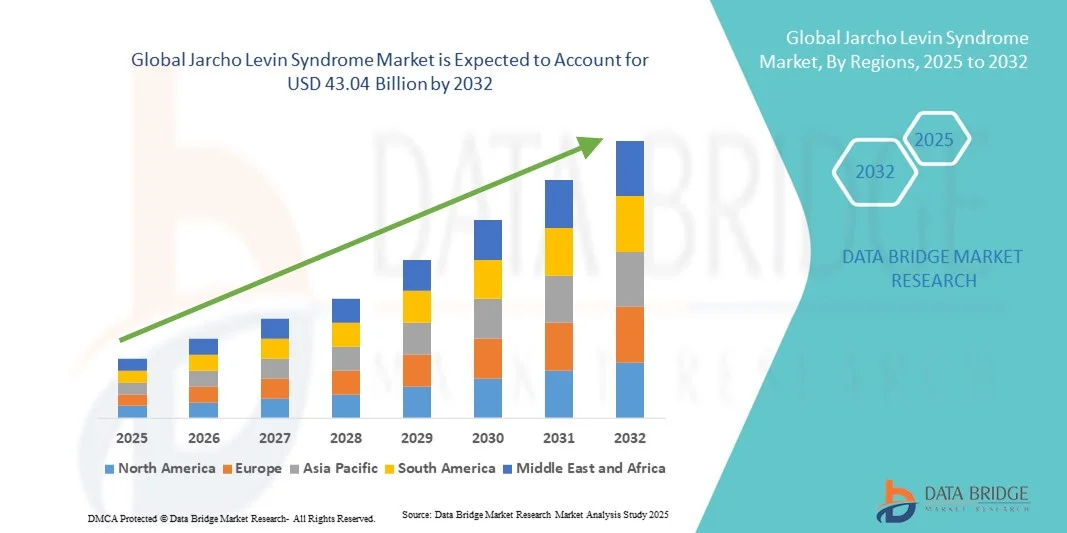
- The global jarcho levin syndrome market size was valued at USD 30.5 billion in 2024 and is expected to reach USD 43.04 billion by 2032, at a CAGR of4.40% during the forecast period
- The market growth is largely fueled by the increasing advancements in genetic research, improved diagnostic technologies, and growing awareness among healthcare professionals about rare congenital skeletal disorders, leading to earlier identification and better management of Jarcho-Levin Syndrome (JLS). In addition, ongoing research into the genetic mutations responsible for the disorder, particularly in the DLL3, MESP2, and LFNG genes, is facilitating more accurate molecular testing and family counseling, thereby strengthening diagnostic precision and treatment outcomes
- Furthermore, the rising demand for specialized care, the development of innovative surgical techniques for spinal deformities, and government initiatives promoting rare disease registries are significantly driving the market forward. These converging factors are accelerating the adoption of Jarcho-Levin Syndrome diagnostic and therapeutic solutions across hospitals, specialty clinics, and genetic research institutions, thereby substantially boosting the overall industry growth
Jarcho Levin Syndrome Market Analysis
- Jarcho-Levin Syndrome (JLS), a rare congenital disorder characterized by abnormal development of the spine and ribs, is increasingly gaining clinical attention due to rising genetic awareness and improved diagnostic capabilities. The market is witnessing significant growth driven by advances in molecular genetics, enhanced availability of multigene testing, and better prenatal screening programs that enable early detection and management. Growing collaborations between genetic research institutes and hospitals are also supporting the expansion of diagnostic and therapeutic solutions for this rare condition
- The increasing demand for effective treatment interventions such as spinal correction surgeries, genetic counseling, and supportive care therapies is further fueling the market’s growth. In addition, the establishment of rare disease networks, improved healthcare infrastructure, and government funding for rare genetic disorder research are accelerating innovation in both diagnosis and treatment
- North America dominated the jarcho-levin syndrome market with the largest revenue share of 41.6% in 2024, driven by strong clinical research initiatives, early adoption of advanced diagnostic technologies, and a robust presence of genetic testing companies in the U.S. and Canada. The region’s growth is also supported by higher awareness among healthcare providers and the availability of specialized pediatric orthopedic centers
- Asia-Pacific is expected to be the fastest-growing region in the jarcho-levin syndrome market during the forecast period, registering a CAGR from 2025 to 2032. This growth is attributed to expanding healthcare access, increasing medical research in genetics, and growing government focus on rare disease management in countries such as China, Japan, and India
- The Spondylocostal Dysostosis Type 1 (SCDO1) segment dominated the largest market revenue share of 58.4% in 2024, primarily due to its higher prevalence and extensive documentation in clinical literature
Report Scope and Jarcho Levin Syndrome Market Segmentation
|
Attributes |
Jarcho Levin Syndrome Key Market Insights |
|
Segments Covered |
|
|
Countries Covered |
North America
Europe
Asia-Pacific
Middle East and Africa
South America
|
|
Key Market Players |
|
|
Market Opportunities |
|
|
Value Added Data Infosets |
In addition to the insights on market scenarios such as market value, growth rate, segmentation, geographical coverage, and major players, the market reports curated by the Data Bridge Market Research also include in-depth expert analysis, patient epidemiology, pipeline analysis, pricing analysis, and regulatory framework. |
Jarcho Levin Syndrome Market Trends
Advancements in Genetic Diagnostics and Precision Medicine
- A major and accelerating trend in the global jarcho levin syndrome market is the rapid adoption of advanced genetic testing technologies, including next-generation sequencing (NGS) and whole-exome sequencing (WES), which are revolutionizing early diagnosis and patient management
- The integration of precision medicine into rare disease research has enabled clinicians to better identify causative gene mutations, such as those in DLL3, MESP2, HES7, and LFNG, leading to more personalized therapeutic strategies
- For instance, in 2023, multiple genomics laboratories expanded access to multi-gene diagnostic panels specifically targeting congenital vertebral segmentation disorders, improving detection accuracy and reducing diagnostic time
- Furthermore, advancements in bioinformatics tools and artificial intelligence–based variant analysis are helping researchers interpret complex genomic data with greater precision, facilitating early detection and genetic counseling. Such innovations are also fostering international collaboration through rare disease registries, enhancing global data sharing and clinical trial participation
- These developments mark a shift toward integrated genetic healthcare, enabling clinicians and researchers to identify genotype–phenotype correlations more efficiently. Consequently, the adoption of advanced diagnostic technologies is significantly improving the prognosis and long-term management of patients with Jarcho Levin Syndrome
Jarcho Levin Syndrome Market Dynamics
Driver
Growing Prevalence of Congenital Disorders and Advances in Genetic Research
- The increasing prevalence of congenital spinal and rib malformations, coupled with the growing availability of advanced genetic testing, is a key driver propelling the Jarcho Levin Syndrome market. As awareness of early genetic screening expands, more families are seeking testing to confirm diagnosis and guide treatment decisions
- For instance: In May 2023, several leading medical research institutions collaborated to enhance early detection programs for congenital skeletal dysplasias through prenatal and neonatal genetic testing. These initiatives are improving survival rates and enabling earlier intervention through surgical and therapeutic care
- In addition, greater investment in rare disease genomics, alongside supportive policies and funding by organizations such as the NIH and the European Rare Disease Research Alliance, is stimulating clinical research
- The availability of public genetic databases and international data-sharing initiatives continues to accelerate mutation discovery, thereby improving both diagnosis and therapeutic innovation for Jarcho Levin Syndrome
Restraint/Challenge
High Diagnostic Costs and Limited Access to Specialized Care
- Despite progress in genetic diagnostics, the high cost associated with next-generation sequencing and limited access to specialized facilities in low- and middle-income countries pose significant barriers to market expansion
- The requirement for multidisciplinary expertise—including geneticists, orthopedists, and pediatric surgeons—adds to the complexity and cost of managing the condition. Moreover, a lack of standardized clinical guidelines across regions leads to delayed or missed diagnoses in many cases
- For instance, rare disease networks in developing regions continue to face shortages of trained genetic counselors and diagnostic laboratories capable of performing detailed gene sequencing for disorders such as Jarcho Levin Syndrome
- Another challenge lies in the limited treatment options beyond supportive and corrective interventions, which restricts therapeutic growth. To overcome these challenges, ongoing collaborations between biotechnology firms, academic institutions, and government bodies are focused on lowering testing costs and expanding access to genomic medicine globally
- Continued investment in healthcare infrastructure, awareness programs, and telemedicine-based genetic consultations will be vital for improving diagnosis rates and ensuring equitable access to care for affected patients worldwide
Jarcho Levin Syndrome Market Scope
The market is segmented on the basis of type, symptoms, gender, and diagnosis.
- By Type
On the basis of type, the Jarcho Levin Syndrome market is segmented into Spondylocostal Dysostosis Type 1 (SCDO1) and Spondylocostal Dysostosis Type 2 (SCDO2). The Spondylocostal Dysostosis Type 1 (SCDO1) segment dominated the largest market revenue share of 58.4% in 2024, primarily due to its higher prevalence and extensive documentation in clinical literature. This type is strongly associated with DLL3 gene mutations, which are well-characterized and frequently targeted in genetic testing programs. Increasing adoption of next-generation sequencing (NGS) panels, rising awareness among pediatric specialists, and the availability of dedicated reference databases support strong identification and diagnosis of SCDO1 cases. The focus on early surgical correction and multidisciplinary treatment has improved patient outcomes, further driving the dominance of this segment. Continuous academic collaborations and international registries have established SCDO1 as the most clinically investigated subtype of the disorder, contributing to its sustained leadership.
The Spondylocostal Dysostosis Type 2 (SCDO2) segment is anticipated to witness the fastest CAGR of 8.7% from 2025 to 2032, driven by advancements in molecular diagnostics and expanding research on MESP2 gene mutations. The segment benefits from enhanced genome mapping initiatives that enable early identification of novel pathogenic variants. Increasing inclusion of rare disease genes in global newborn screening programs and improvements in prenatal genetic counseling are further supporting growth. In addition, rising participation in multinational research networks focusing on thoracic and spinal malformations is improving understanding of SCDO2 pathogenesis. As awareness spreads through collaborative platforms and targeted funding, the recognition and diagnosis rates of SCDO2 are expected to accelerate, contributing to its rapid growth trajectory.
- By Symptoms
On the basis of symptoms, the Jarcho Levin Syndrome market is segmented into Malformed Bones in the Spine and Ribs, Short Necks, Limited Neck Movement, Short Stature, Difficulty Breathing, and Malformed Chests. The Malformed Bones in the Spine and Ribs segment accounted for the largest market revenue share of 46.9% in 2024, as these deformities are the defining features for early diagnosis and classification of the syndrome. Advanced imaging modalities such as MRI, CT, and 3D reconstructions are increasingly used to assess vertebral and rib anomalies in infants. These malformations drive demand for specialized surgical interventions, genetic consultations, and long-term orthopedic follow-up. Pediatric orthopedic centers worldwide are prioritizing early correction procedures to enhance mobility and reduce complications. The growing availability of AI-assisted diagnostic tools and 3D modeling technologies is enabling more accurate visualization of skeletal deformities, ensuring precise intervention planning. This segment continues to dominate due to its central role in disease identification and management pathways.
The Difficulty Breathing segment is expected to witness the fastest CAGR of 9.3% from 2025 to 2032, attributed to the increasing focus on thoracic insufficiency and respiratory complications in affected infants. Enhanced neonatal care facilities and advancements in non-invasive ventilation technologies are improving survival and quality of life for these patients. The establishment of multidisciplinary respiratory management programs and dedicated thoracic surgery centers has expanded treatment options. Research into lung volume optimization techniques and respiratory support devices continues to evolve, offering better long-term outcomes. The rising prevalence of respiratory-related hospitalizations in pediatric genetic conditions is further driving growth in this segment.
- By Gender
On the basis of gender, the Jarcho Levin Syndrome market is segmented into Male and Female. The Female segment captured the largest market revenue share of 52.1% in 2024, attributed to a slightly higher recorded prevalence and better access to diagnostic programs among female infants. Studies suggest that improved prenatal monitoring and maternal health screening have contributed to early detection rates in females. The presence of more gender-inclusive genetic registries and public health databases has strengthened reporting accuracy. Growing awareness campaigns emphasizing rare diseases among women and children have encouraged more proactive health-seeking behavior. In addition, improved data collection practices in developed nations support more complete documentation of female cases. The combination of early diagnosis, clinical support, and genetic counseling programs continues to drive the dominance of this segment.
The Male segment is anticipated to witness the fastest CAGR of 8.1% from 2025 to 2032, fueled by growing participation in genome sequencing projects and deeper insights into gender-related phenotypic variability. Enhanced data integration from global rare disease databases and increased inclusion of male subjects in clinical research are expanding understanding of disease expression patterns. Improvements in pediatric health infrastructure, especially in emerging markets, are boosting the identification of male patients. Ongoing technological advances in whole-exome sequencing and bioinformatics platforms are accelerating diagnostic timelines, supporting growth across male populations worldwide.
- By Diagnosis
On the basis of diagnosis, the Jarcho Levin Syndrome market is segmented into Ultrasound, X-rays, and Others. The Ultrasound segment dominated the largest market revenue share of 57.8% in 2024, owing to its vital role in prenatal screening and early anomaly detection. Obstetric ultrasound remains the standard of care for identifying skeletal irregularities in the fetus, particularly in high-risk pregnancies. The expansion of 3D and 4D ultrasound imaging has significantly enhanced visualization of vertebral and rib malformations, facilitating earlier diagnosis and informed parental decision-making. Government initiatives promoting prenatal care and the integration of AI-enabled image analysis systems are further improving detection accuracy. With increasing emphasis on preventive and early interventions, ultrasound continues to be the cornerstone diagnostic tool in the clinical management of Jarcho Levin Syndrome.
The X-rays segment is projected to witness the fastest CAGR of 8.9% from 2025 to 2032, supported by its essential application in postnatal assessment and longitudinal skeletal monitoring. Radiographic imaging enables detailed evaluation of bone structure and alignment, which is critical for surgical planning and long-term treatment follow-up. Technological innovations such as digital radiography and low-dose imaging systems are expanding accessibility while minimizing radiation exposure in pediatric patients. The global push toward digitized healthcare infrastructure and teleradiology services is improving diagnostic coverage in underserved regions. These advancements collectively drive strong growth in this segment.
Jarcho Levin Syndrome Market Regional Analysis
- North America dominated the jarcho levin syndrome market with the largest revenue share of 41.6% in 2024
- Driven by strong clinical research initiatives, early adoption of advanced diagnostic technologies, and a robust presence of genetic testing companies in the U.S. and Canada
- The region’s growth is further supported by higher awareness among healthcare providers and the availability of specialized pediatric orthopedic centers focusing on rare congenital disorders such as Jarcho Levin Syndrome
U.S. Jarcho Levin Syndrome Market Insight
The U.S. jarcho levin syndrome market accounted for the largest share in 2024 within North America, supported by a well-established healthcare infrastructure and the presence of leading genetic research organizations. Increased patient awareness, advancements in molecular diagnostics, and government-backed rare disease programs have accelerated diagnosis and early intervention. Moreover, ongoing clinical trials and collaborations between research institutes and hospitals are propelling further market expansion in the U.S.
Europe Jarcho Levin Syndrome Market Insight
The Europe jarcho levin syndrome market is projected to witness substantial growth over the forecast period, fueled by enhanced access to genetic testing, growing awareness about rare skeletal disorders, and supportive government funding for research on congenital anomalies. Key countries, including Germany, the U.K., and France, are focusing on expanding neonatal screening programs and integrating genomic medicine into clinical practice.
U.K. Jarcho Levin Syndrome Market Insight
The U.K. jarcho levin syndrome market is expected to grow at a noteworthy CAGR, driven by national initiatives to improve rare disease diagnostics and management. Increasing research funding through the National Institute for Health and Care Research (NIHR) and collaborations with academic institutions are contributing to early detection and treatment advancements. The growing adoption of genetic counseling services for families with hereditary skeletal conditions is further fostering market growth.
Germany Jarcho Levin Syndrome Market Insight
The Germany jarcho levin syndrome market is anticipated to expand at a considerable CAGR during the forecast period, supported by advanced healthcare infrastructure, high investment in medical genomics, and strong collaboration between hospitals and biotechnology firms. German healthcare providers are increasingly adopting whole-exome sequencing and multigene panels for precise diagnosis of rare disorders, creating a favorable environment for market expansion.
Asia-Pacific Jarcho Levin Syndrome Market Insight
The Asia-Pacific jarcho levin syndrome market is expected to grow at the fastest CAGR of 24.8% from 2025 to 2032, driven by expanding healthcare access, increasing research in genetic diseases, and rising government focus on rare disorder management in countries such as China, Japan, and India. The region’s growing participation in international rare disease networks and the development of affordable genetic testing platforms are accelerating market penetration.
Japan Jarcho Levin Syndrome Market Insight
The Japan jarcho levin syndrome market is gaining momentum due to its strong focus on clinical genetics, rapid advancements in diagnostic imaging, and active participation in global rare disease research collaborations. Japan’s healthcare system supports early screening and intervention programs, and government-led initiatives are encouraging hospitals to integrate genomic diagnostics for pediatric patients with skeletal abnormalities.
China Jarcho Levin Syndrome Market Insight
The China jarcho levin syndrome market held the largest share in the Asia-Pacific region in 2024, attributed to the country’s expanding genomic research capacity, rapid healthcare modernization, and government-driven focus on rare disease management. Initiatives such as the China Rare Disease Diagnosis and Treatment Cooperation Network are facilitating early identification and specialized care. In addition, increasing partnerships between Chinese biotechnology firms and global genetic testing companies are fueling market growth.
Jarcho Levin Syndrome Market Share
The Jarcho Levin Syndrome industry is primarily led by well-established companies, including:
- Invitae (U.S.)
- Blueprint Genetics (Finland)
- GeneDx (U.S.)
- Eurofins Scientific (Luxembourg)
- Unilabs Genetics (Switzerland)
- DNA Labs India (India)
- CeGaT (Germany)
- Greenwood Genetic Center (U.S.)
- MNG Laboratories (U.S.)
- Macrogen (South Korea)
- Baylor Genetics (U.S.)
- Ambry Genetics (U.S.)
- Concert Genetics (U.S.)
- Sophia Genetics (Switzerland)
Latest Developments in Global Jarcho Levin Syndrome Market
- In March 2021, a multidisciplinary research team at the National Institute of Genetics (Japan) identified novel mutations in the DLL3 and MESP2 genes responsible for severe forms of Jarcho-Levin Syndrome, improving early diagnostic accuracy and aiding in genetic counseling for affected families. This discovery enhanced the global understanding of the disease’s molecular basis
- In June 2023, researchers reported the discovery of a new homozygous splice-site variant in the HES7 gene (c.226+1G>A) in a Chinese neonate diagnosed with Spondylocostal Dysostosis Type 4. This finding expanded the genotype-phenotype correlation database and highlighted the importance of next-generation sequencing in early Jarcho-Levin diagnosis
- In October 2024, clinicians in Turkey published a rare case study describing Jarcho-Levin Syndrome associated with meningomyelocele and hydrocephalus, emphasizing the complexity of congenital skeletal and neural anomalies. The study recommended enhanced prenatal screening and multidisciplinary neonatal care strategies for early management
- In February 2025, a European collaborative initiative launched under the EU RareGenomics Program announced the inclusion of Jarcho-Levin Syndrome in its rare disease genomic mapping project, focusing on improving gene-targeted therapies and early diagnosis through AI-powered analysis of skeletal malformation data. This project marks a major step toward personalized medicine for JLS patients

- Interactive Data Analysis Dashboard
- Company Analysis Dashboard for high growth potential opportunities
- Research Analyst Access for customization & queries
- Competitor Analysis with Interactive dashboard
- Latest News, Updates & Trend analysis
- Harness the Power of Benchmark Analysis for Comprehensive Competitor Tracking
Data collection and base year analysis are done using data collection modules with large sample sizes. The stage includes obtaining market information or related data through various sources and strategies. It includes examining and planning all the data acquired from the past in advance. It likewise envelops the examination of information inconsistencies seen across different information sources. The market data is analysed and estimated using market statistical and coherent models. Also, market share analysis and key trend analysis are the major success factors in the market report. To know more, please request an analyst call or drop down your inquiry.
The key research methodology used by DBMR research team is data triangulation which involves data mining, analysis of the impact of data variables on the market and primary (industry expert) validation. Data models include Vendor Positioning Grid, Market Time Line Analysis, Market Overview and Guide, Company Positioning Grid, Patent Analysis, Pricing Analysis, Company Market Share Analysis, Standards of Measurement, Global versus Regional and Vendor Share Analysis. To know more about the research methodology, drop in an inquiry to speak to our industry experts.
Data Bridge Market Research is a leader in advanced formative research. We take pride in servicing our existing and new customers with data and analysis that match and suits their goal. The report can be customized to include price trend analysis of target brands understanding the market for additional countries (ask for the list of countries), clinical trial results data, literature review, refurbished market and product base analysis. Market analysis of target competitors can be analyzed from technology-based analysis to market portfolio strategies. We can add as many competitors that you require data about in the format and data style you are looking for. Our team of analysts can also provide you data in crude raw excel files pivot tables (Fact book) or can assist you in creating presentations from the data sets available in the report.












