What is the Global K-beauty Products Market Size and Growth Rate?
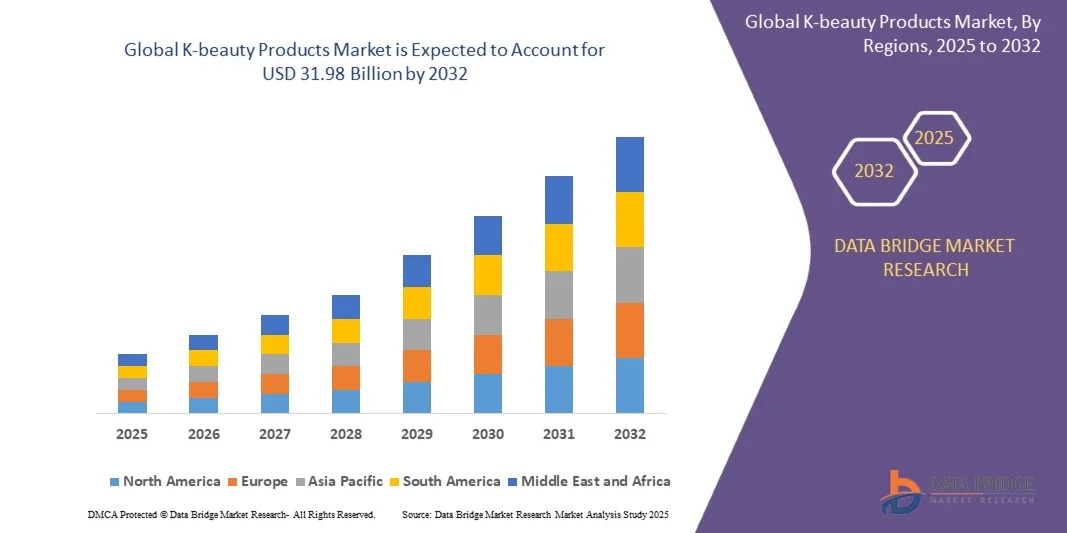
- The global K-beauty products market size was valued at USD 16.9 billion in 2024 and is expected to reach USD 31.98 billion by 2032, at a CAGR of 8.30% during the forecast period
- The market growth is primarily driven by increasing consumer awareness of skincare routines, rising disposable incomes, and a strong preference for innovative, high-quality beauty products
- In addition, the influence of social media, beauty influencers, and digital marketing campaigns is amplifying demand for K-beauty products globally, encouraging product adoption among younger, tech-savvy consumers. These factors collectively contribute to the sustained expansion of the K-beauty products market
What are the Major Takeaways of K-beauty Products Market?
- K-beauty products, including skincare, hair care, and cosmetic solutions, are increasingly recognized for their innovative formulations, natural ingredients, and multifunctional benefits, making them essential in daily beauty routines for both men and women
- The rising popularity of online retail platforms, influencer endorsements, and cross-border e-commerce has further accelerated market adoption, catering to a global audience seeking personalized, high-quality beauty solutions
- North America dominated the K-beauty Products market with the largest revenue share of 43.1% in 2024, driven by a strong preference for high-quality beauty and personal care products, increasing awareness of K-beauty trends, and the widespread availability of online and retail channels
- The Asia-Pacific K-beauty Products market is poised to grow at the fastest CAGR of 9.74% from 2025 to 2032, fueled by rising urbanization, increasing disposable incomes, and rapid expansion of e-commerce and social commerce platforms in countries such as China, Japan, South Korea, and India
- The Skin Care segment dominated the market with the largest revenue share of 62% in 2024, driven by the growing consumer focus on facial health, anti-aging solutions, and personalized skincare routines
Report Scope and K-beauty Products Market Segmentation
|
Attributes |
K-beauty Products Key Market Insights |
|
Segments Covered |
|
|
Countries Covered |
North America
Europe
Asia-Pacific
Middle East and Africa
South America
|
|
Key Market Players |
|
|
Market Opportunities |
|
|
Value Added Data Infosets |
In addition to the insights on market scenarios such as market value, growth rate, segmentation, geographical coverage, and major players, the market reports curated by the Data Bridge Market Research also include in-depth expert analysis, pricing analysis, brand share analysis, consumer survey, demography analysis, supply chain analysis, value chain analysis, raw material/consumables overview, vendor selection criteria, PESTLE Analysis, Porter Analysis, and regulatory framework. |
What is the Key Trend in the K-beauty Products Market?
“Rising Personalization and Tech-Enabled Skincare Solutions”
- A major and accelerating trend in the global K-beauty Products market is the increasing adoption of personalized skincare solutions powered by technology, including AI-driven skin analysis, mobile apps, and smart beauty devices. This trend enables consumers to select products tailored specifically to their skin type, concerns, and lifestyle, enhancing the overall efficacy and user experience
- For instance, AI-enabled skin analyzers in K-beauty apps provide real-time recommendations for serums, moisturizers, and masks based on user-uploaded images or scanned facial data. Leading brands such as Amorepacific and LG Household & Health Care have introduced apps that allow consumers to virtually test and customize skincare routines
- Integration of AR and AI in K-beauty Products enables predictive skincare, helping users track skin progress, optimize routines, and receive notifications for seasonal adjustments. These technologies also allow brands to offer personalized subscription boxes or product bundles, increasing convenience and engagement
- The combination of tech-enabled personalization with traditional K-beauty formulations—such as fermented extracts, botanical infusions, and innovative delivery systems—creates a more interactive and precise skincare experience. Consumers can seamlessly manage their routines, combining beauty devices, serums, and creams in one holistic system
- This trend toward personalization and intelligent product integration is reshaping consumer expectations in the skincare industry. Brands such as Dr. Jart+, COSRX, and Banila Co are leveraging technology to enhance efficacy, engagement, and satisfaction
- The demand for AI-enabled, personalized K-beauty Products is expanding rapidly across both mature and emerging markets, as consumers increasingly value convenience, targeted results, and holistic skin wellness
What are the Key Drivers of K-beauty Products Market?
- The rising consumer awareness of skincare and increasing focus on personal wellness is a primary driver of demand for K-beauty Products. As consumers seek effective and safe solutions for varied skin concerns, innovative formulations and functional benefits become key differentiators
- In March 2025, Amorepacific expanded its smart beauty platform with AI-based skin diagnostics to guide product recommendations, highlighting the integration of technology and personalization. Such initiatives are expected to boost K-beauty market growth during the forecast period
- Growing popularity of online sales channels and direct-to-consumer platforms further supports the market. Personalized quizzes, skin tracking apps, and subscription services allow consumers to access curated products without visiting stores, strengthening adoption of K-beauty innovations
- Convenience of multi-functional and hybrid formulations—such as moisturizers with SPF, serums with antioxidants, or sleeping masks with targeted ingredients—also drives product preference. These solutions save time while providing multiple benefits, appealing to busy consumers
- The global expansion of K-beauty into emerging markets and rising social media influence, particularly through platforms such as Instagram and TikTok, contributes to increased consumer engagement and adoption. Trend-driven purchases and influencer-led tutorials highlight new products and enhance awareness
Which Factor is Challenging the Growth of the K-beauty Products Market?
- Product authenticity and quality remain a key challenge, as counterfeit or substandard products can undermine consumer trust in K-beauty brands. The proliferation of online marketplaces has made it easier for unregulated products to circulate
- Some consumers face difficulty choosing suitable products due to the overwhelming variety of K-beauty offerings, making personalized guidance essential. Without reliable recommendations, dissatisfaction or misuse of products can occur
- The premium pricing of high-tech or imported K-beauty Products can limit adoption among price-sensitive segments, particularly in developing regions. While local alternatives exist, they may lack comparable formulations or innovative technology
- Regulatory compliance and ingredient approvals in different regions can slow down market entry for some brands. Variations in permitted formulations, testing requirements, or labeling standards require careful navigation
- Addressing these challenges through education on product authenticity, transparency in formulations, affordable tech-enabled offerings, and stronger regulatory alignment is crucial for sustained market growth. Companies such as LG Household & Health Care and Dr. Jart+ emphasize trusted sourcing, ingredient transparency, and certified platforms to maintain consumer confidence
How is the K-beauty Products Market Segmented?
The market is segmented on the basis of product type, end-user, and application.
• By Product Type
On the basis of product type, the K-beauty Products market is segmented into Skin Care and Hair Care. The Skin Care segment dominated the market with the largest revenue share of 62% in 2024, driven by the growing consumer focus on facial health, anti-aging solutions, and personalized skincare routines. Products such as moisturizers, serums, facial masks, and sunscreens continue to witness strong demand due to their visible and immediate impact on skin appearance. K-beauty innovations, including fermented extracts, hyaluronic acid formulations, and multi-functional serums, further strengthen consumer adoption.
The Hair Care segment is expected to witness the fastest CAGR of 18% from 2025 to 2032, fueled by the rising popularity of scalp treatments, hair masks, and functional shampoos and conditioners. Hair care products also benefit from influencer-led tutorials, increasing awareness about hair health, styling, and damage repair solutions, particularly among younger demographics.
• By End-User
On the basis of end-user, the K-beauty Products market is segmented into Men and Women. The Women’s segment accounted for the largest market revenue share of 70% in 2024, driven by historically higher engagement with beauty and skincare products, along with strong brand loyalty. Women increasingly seek personalized, multi-functional K-beauty solutions that address anti-aging, hydration, brightening, and acne concerns. Marketing campaigns, influencer promotions, and social media trends further amplify adoption in this segment.
The Men’s segment is anticipated to witness the fastest CAGR of 20% from 2025 to 2032, supported by the rising awareness of men’s skincare routines, grooming products, and hair care solutions. Urbanization, increasing disposable incomes, and the influence of Western grooming trends contribute to this growth. The expansion of dedicated men’s skincare ranges, along with gender-neutral formulations, is helping brands capture this emerging and increasingly lucrative consumer base.
• By Application
On the basis of application, the K-beauty Products market is segmented into Supermarkets and Hypermarkets, Specialty Stores, Online, and Pharmacies. The Online segment dominated the market with the largest revenue share of 55% in 2024, fueled by the convenience of doorstep delivery, wide product variety, and the ability to leverage AI-driven personalized recommendations. E-commerce platforms, brand websites, and social commerce channels allow consumers to explore curated skincare routines, read reviews, and engage in virtual try-ons, increasing adoption.
The Specialty Stores segment is expected to witness the fastest CAGR of 19% from 2025 to 2032, driven by consumer preference for premium K-beauty experiences, in-store consultations, and access to exclusive or newly launched products. Specialty stores also provide immersive shopping experiences, allowing customers to test products firsthand, receive expert guidance, and engage with the latest K-beauty innovations, making them a growing channel for high-value purchases.
Which Region Holds the Largest Share of the K-beauty Products Market?
- North America dominated the K-beauty Products market with the largest revenue share of 43.1% in 2024, driven by a strong preference for high-quality beauty and personal care products, increasing awareness of K-beauty trends, and the widespread availability of online and retail channels
- Consumers in the region highly value product innovation, multifunctional skincare solutions, and premium formulations, along with influencer-led marketing and social media awareness campaigns that fuel demand
- This widespread adoption is further supported by high disposable incomes, technologically savvy consumers, and a growing preference for luxury and personalized beauty experiences, establishing K-beauty Products as a favored choice in both the skincare and haircare segments
U.S. K-beauty Products Market Insight
The U.S. K-beauty Products market captured the largest revenue share of 81% in 2024 within North America, driven by strong online retail penetration, influencer-driven marketing, and rising consumer interest in skincare and cosmetic innovations. U.S. consumers increasingly favor multi-step skincare routines, functional formulations, and cruelty-free products, fueling market growth. The growing demand for personalized beauty experiences and premium product offerings is further supporting expansion in both urban and suburban markets.
Europe K-beauty Products Market Insight
The Europe K-beauty Products market is projected to expand at a substantial CAGR throughout the forecast period, led by increasing awareness of beauty routines, skin health, and adoption of clean and natural formulations. Consumers in countries such as Germany, France, and the U.K. are drawn to innovative products such as sheet masks, essences, and serums, contributing to market penetration. The preference for sustainable and eco-friendly packaging is also fostering the adoption of K-beauty Products across the region.
U.K. K-beauty Products Market Insight
The U.K. K-beauty Products market is anticipated to grow at a noteworthy CAGR, supported by social media-driven awareness, e-commerce adoption, and demand for luxury and high-performance skincare. Retail expansions and specialty beauty stores enhance accessibility, while consumers increasingly prioritize hydration, anti-aging, and multifunctional formulations.
Germany K-beauty Products Market Insight
The Germany K-beauty Products market is expected to expand at a considerable CAGR, driven by consumer preference for innovative cosmetic technologies, ethical sourcing, and cruelty-free products. German consumers value high-quality skincare routines and functional beauty products, encouraging adoption in both retail and online channels. Sustainability trends and the demand for natural ingredients further promote growth in the region.
Which Region is the Fastest Growing Region in the K-beauty Products Market?
The Asia-Pacific K-beauty Products market is poised to grow at the fastest CAGR of 9.74% from 2025 to 2032, fueled by rising urbanization, increasing disposable incomes, and rapid expansion of e-commerce and social commerce platforms in countries such as China, Japan, South Korea, and India. The region’s strong cultural affinity for K-beauty trends, combined with influencer-led marketing and the rapid adoption of skincare routines, is driving consumer demand.
Japan K-beauty Products Market Insight
The Japan K-beauty Products market is gaining momentum due to the population’s high interest in skincare, beauty innovations, and anti-aging solutions. Integration of advanced ingredients and multifunctional formulations drives demand, while the strong retail network and online platforms enhance product accessibility.
China K-beauty Products Market Insight
The China K-beauty Products market accounted for the largest share in Asia-Pacific in 2024, supported by the country’s growing middle class, high internet penetration, and preference for premium beauty products. Urban consumers increasingly adopt skincare routines and cosmetics influenced by K-beauty trends, while affordable pricing and local distribution networks expand accessibility across cities and tier-2/3 regions.
Which are the Top Companies in K-beauty Products Market?
The K-beauty Products industry is primarily led by well-established companies, including:
- Amorepacific Corporation (South Korea)
- LG Household & Health Care Ltd. (South Korea)
- The Face Shop (South Korea)
- Etude House (South Korea)
- Missha (South Korea)
- BANILA CO (South Korea)
- CARVER KOREA CO. (Unilever) (South Korea)
- Able C&C (South Korea)
- Nature Republic (South Korea)
- TolyMoly (South Korea)
- Skinfood (South Korea)
- Holika Holika (South Korea)
- HERA (South Korea)
- Clio (South Korea)
- Peripera (South Korea)
What are the Recent Developments in Global K-beauty Products Market?
- In November 2024, Beauty of Joseon, known as TikTok’s viral K-beauty sensation, set its sights on expanding operations in the U.S., reflecting the brand’s strategy to tap into the international market and increase global awareness
- In August 2024, Tira, a subsidiary of Reliance Industries based in India, launched a new K-beauty brand named Mixsoon in the country, marking its entry into the rapidly growing Indian beauty market and aiming to attract young skincare enthusiasts
- In June 2024, L'Oréal, headquartered in France, introduced the Big Bang Beauty Tech Innovation Program across its North Asia markets, aiming to drive beauty innovation and implement the ‘Beauty Triangle’ strategy in the region, establishing a strong footprint for advanced beauty solutions
- In May 2024, Laneige, based in South Korea, appointed Sara Tendulkar as its brand ambassador while launching the Bouncy and Firm Sleeping Mask, highlighting its commitment to innovative skincare and leveraging celebrity influence to boost brand engagement
- In November 2022, L’Oréal announced the launch of C-Beauty, K-Beauty, and J-Beauty products in collaboration with Shihyo, a Korean brand, featuring 24 herbal ingredients steeped in fermented rice and other Asian techniques, reflecting the company’s strategy to diversify its product portfolio and attract consumers seeking authentic Asian beauty rituals
- In July 2022, Saturday Skin partnered with Nykaa to expand its presence in the Indian market, offering a variety of skincare products via Nykaa’s website and mobile app, enhancing accessibility and consumer reach in the region

- Interactive Data Analysis Dashboard
- Company Analysis Dashboard for high growth potential opportunities
- Research Analyst Access for customization & queries
- Competitor Analysis with Interactive dashboard
- Latest News, Updates & Trend analysis
- Harness the Power of Benchmark Analysis for Comprehensive Competitor Tracking
Data collection and base year analysis are done using data collection modules with large sample sizes. The stage includes obtaining market information or related data through various sources and strategies. It includes examining and planning all the data acquired from the past in advance. It likewise envelops the examination of information inconsistencies seen across different information sources. The market data is analysed and estimated using market statistical and coherent models. Also, market share analysis and key trend analysis are the major success factors in the market report. To know more, please request an analyst call or drop down your inquiry.
The key research methodology used by DBMR research team is data triangulation which involves data mining, analysis of the impact of data variables on the market and primary (industry expert) validation. Data models include Vendor Positioning Grid, Market Time Line Analysis, Market Overview and Guide, Company Positioning Grid, Patent Analysis, Pricing Analysis, Company Market Share Analysis, Standards of Measurement, Global versus Regional and Vendor Share Analysis. To know more about the research methodology, drop in an inquiry to speak to our industry experts.
Data Bridge Market Research is a leader in advanced formative research. We take pride in servicing our existing and new customers with data and analysis that match and suits their goal. The report can be customized to include price trend analysis of target brands understanding the market for additional countries (ask for the list of countries), clinical trial results data, literature review, refurbished market and product base analysis. Market analysis of target competitors can be analyzed from technology-based analysis to market portfolio strategies. We can add as many competitors that you require data about in the format and data style you are looking for. Our team of analysts can also provide you data in crude raw excel files pivot tables (Fact book) or can assist you in creating presentations from the data sets available in the report.