


Keratoacanthoma Market Size
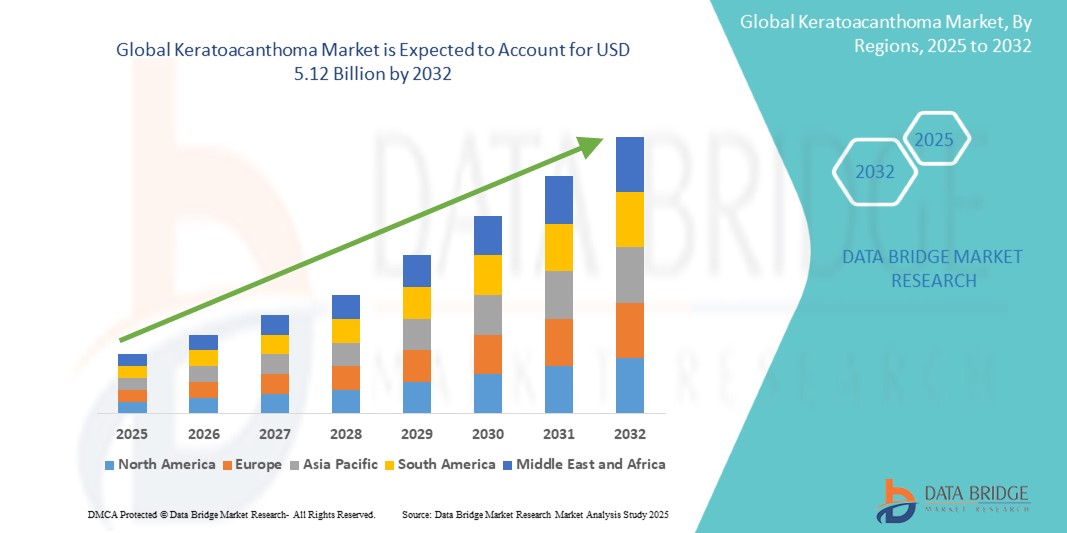
- The global keratoacanthoma market was valued at USD 3.39 billion in 2024 and is expected to reach USD 5.12 billion by 2032
- During the forecast period of 2025 to 2032 the market is likely to grow at a CAGR of 5.28%, primarily driven by growing geriatric population
- This growth is driven by increased exposure to chemical carcinogens and rising prevalence of smoking
Keratoacanthoma Market Analysis
- Keratoacanthoma has become an important focus in the dermatology sector due to its rapid growth pattern and potential to resemble squamous cell carcinoma (SCC), making early diagnosis and treatment essential. The market is witnessing strong clinical attention, with improvements in surgical techniques, non-invasive therapies, and diagnostic imaging tools boosting early detection and better patient outcomes
- The market is primarily driven by the increasing aging population, rising exposure to ultraviolet (UV) radiation and chemical carcinogens, and the growing emphasis on skin cancer awareness programs. In addition, technological advancements in cryotherapy, laser treatment, and minimally invasive surgical options are further supporting the expansion of the keratoacanthoma treatment landscape
- For instance, in the U.S. and Europe, the rising number of skin cancer screening programs and the launch of advanced topical therapies have significantly contributed to early diagnosis and effective treatment of keratoacanthoma, driving overall market growth
- Globally, the keratoacanthoma market is steadily evolving with the integration of artificial intelligence (AI)-based diagnostic tools, personalized treatment approaches, and a strong push towards outpatient dermatological procedures, ensuring continuous innovation and long-term market sustainability
Report Scope and Keratoacanthoma Market Segmentation
|
Attributes |
Keratoacanthoma Key Market Insights |
|
Segments Covered |
|
|
Countries Covered |
North America
Europe
Asia-Pacific
Middle East and Africa
South America
|
|
Key Market Players |
|
|
Market Opportunities |
|
|
Value Added Data Infosets |
In addition to the insights on market scenarios such as market value, growth rate, segmentation, geographical coverage, and major players, the market reports curated by the Data Bridge Market Research also include depth expert analysis, patient epidemiology, pipeline analysis, pricing analysis, and regulatory framework |
Keratoacanthoma Market Trends
“Growing Focus on Early Diagnosis and Non-Invasive Treatment Modalities”
- Increasing awareness campaigns about skin cancer and related conditions are driving the demand for early diagnosis of keratoacanthoma, encouraging patients to seek medical intervention at initial stages
- Dermatology clinics and hospitals are adopting non-invasive treatment modalities such as topical therapies, cryotherapy, and photodynamic therapy to manage keratoacanthoma effectively without extensive surgical procedures
- Technological advancements in dermoscopy, confocal microscopy, and AI-powered skin imaging systems are improving the precision and speed of keratoacanthoma diagnosis and treatment planning
For instance,
- In March 2025, Canfield Scientific launched an AI-powered imaging system to assist dermatologists in early and accurate diagnosis of keratoacanthoma and other skin lesions
- In January 2025, 3M introduced a next-generation cryotherapy device designed for non-invasive removal of early-stage keratoacanthomas
- In October 2024, Fotofinder Systems developed an AI-based dermatoscopy solution to enhance the detection of keratoacanthoma in primary care settings
- As healthcare providers continue to prioritize non-invasive, cost-effective diagnostic and treatment options, the keratoacanthoma market is expected to expand significantly, improving patient outcomes and reducing healthcare costs
Keratoacanthoma Market Dynamics
Driver
“Rising Prevalence of Skin Cancers and UV Exposure-Related Disorders”
- The increasing global burden of skin cancers, driven by higher UV radiation exposure and environmental changes, is boosting the demand for effective keratoacanthoma treatment options
- Public health initiatives advocating sun protection, regular skin screenings, and early lesion detection are raising awareness and driving diagnosis rates
- Pharmaceutical companies are focusing on developing new topical and immunotherapy-based products targeting keratoacanthoma and similar non-melanoma skin cancers
For instance,
- In February 2025, the Skin Cancer Foundation (U.S.) expanded its awareness campaign, emphasizing the risks of keratoacanthoma due to unprotected sun exposure
- In November 2024, Regeneron Pharmaceuticals initiated a clinical study for an investigational topical immunotherapy aimed at treating keratoacanthoma-like lesions
- In August 2024, Leo Pharma launched a public awareness initiative across Europe to encourage early dermatology consultations for suspicious skin lesions
- As the incidence of UV-induced skin disorders rises, the keratoacanthoma market will continue growing, driven by the urgent need for early diagnosis and effective treatment solutions
Opportunity
“Adoption of AI and Machine Learning in Dermatology”
- The integration of artificial intelligence (AI) and machine learning algorithms in dermatology is offering new opportunities for keratoacanthoma diagnosis, risk stratification, and personalized treatment recommendations
- Startups and established med-tech companies are developing AI-powered diagnostic tools that can differentiate keratoacanthoma from malignant skin lesions with high accuracy
- Growing investments in digital health technologies are enabling dermatologists to remotely diagnose and monitor keratoacanthoma, especially in underserved and rural areas
For instance,
- In March 2025, IBM Watson Health partnered with leading dermatology clinics in the U.S. to deploy AI tools for early detection of keratoacanthoma
- In December 2024, Google Health introduced an AI-driven mobile app to assist general practitioners in identifying keratoacanthoma and related skin lesions
- In October 2024, SkinVision secured funding to expand its AI-based skin cancer detection platform across Europe and Asia-Pacific
- As AI-driven tools become more accessible and accurate, the keratoacanthoma market will benefit from enhanced diagnostic capabilities, leading to earlier interventions and better treatment outcomes
Restraint/Challenge
“Difficulty in Differentiating Keratoacanthoma from Squamous Cell Carcinoma”
- Keratoacanthoma’s clinical and histological resemblance to squamous cell carcinoma (SCC) complicates accurate diagnosis, often necessitating invasive biopsy procedures
- Misdiagnosis can lead to either overtreatment or delayed treatment, impacting patient safety and increasing the overall burden on healthcare systems
- The lack of standardized diagnostic guidelines for keratoacanthoma across regions further poses a challenge for consistent clinical management and reimbursement approvals
For instance,
- In February 2025, a dermatology study published in the Journal of Cutaneous Pathology highlighted a 15% misdiagnosis rate between keratoacanthoma and SCC, calling for improved diagnostic protocols
- In November 2024, a leading hospital network in the U.K. launched a training initiative to help dermatologists better distinguish keratoacanthoma from malignant lesions
- In August 2024, the American Academy of Dermatology (AAD) issued updated guidelines emphasizing the need for biopsy confirmation in suspected keratoacanthoma cases
- To overcome this challenge, the keratoacanthoma market must focus on developing more specific biomarkers, advanced imaging techniques, and robust clinical protocols to ensure accurate and timely diagnosis
Keratoacanthoma Market Scope
The market is segmented on the basis of treatment and end-user.
|
Segmentation |
Sub-Segmentation |
|
By Treatment |
|
|
By End-User |
|
Keratoacanthoma Market Regional Analysis
“North America is the Dominant Region in the Keratoacanthoma Market”
- North America dominates the keratoacanthoma market, driven by a growing geriatric population that is more susceptible to skin-related conditions
- Increased exposure to chemical carcinogens, including industrial chemicals and pollutants, is contributing significantly to the market’s expansion in the region
- Rising rates of chain smoking among the population further elevate the risk factors for keratoacanthoma, boosting the demand for effective treatments
- North America’s strong healthcare infrastructure and heightened awareness of skin health are expected to maintain its leadership in the keratoacanthoma market
“Asia-Pacific is projected to register the Highest Growth Rate”
- Asia-Pacific is expected to witness significant growth in the keratoacanthoma market, driven by increasing exposure to chemical carcinogens across the region
- Rapid industrialization and urbanization are leading to higher contact with pollutants and harmful chemicals, elevating the risk of skin-related disorders
- Growing awareness about early diagnosis and treatment, along with improving healthcare access, is supporting the market’s expansion in emerging economies
- Asia-Pacific’s evolving healthcare landscape and rising environmental risk factors are set to position the region as a major growth hub for the keratoacanthoma market
Keratoacanthoma Market Share
The market competitive landscape provides details by competitor. Details included are company overview, company financials, revenue generated, market potential, investment in research and development, new market initiatives, global presence, production sites and facilities, production capacities, company strengths and weaknesses, product launch, product width and breadth, application dominance. The above data points provided are only related to the companies' focus related to market.
The Major Market Leaders Operating in the Market Are:
- Cipla (India)
- GE HealthCare (U.S.)
- Pfizer Inc (U.S.)
- GLENMARK PHARMACEUTICALS LTD (India)
- Sun Pharmaceutical Industries Ltd (India)
- Siemens (Germany)
Latest Developments in Global Keratoacanthoma Market
- In August 2024, Biofrontera AG entered into a partnership with LEO Pharma GmbH to expand the promotion of two key dermatological products, Advantan and Skinoren, across Germany, leveraging Biofrontera’s specialized sales team to enhance treatment accessibility for conditions such as atopic dermatitis and acne vulgaris. This collaboration is expected to strengthen the market presence of both brands and support improved patient outcomes
- In June 2024, Almirall, S.A. introduced Klisyri in Europe to address actinic keratosis across larger field areas, offering patients a topical ointment with tirbanibulin that targets multiple facial and scalp lesions within a convenient five-day treatment window. This launch is set to advance Almirall’s dermatology portfolio and provide a faster, safer treatment option for patients

- Interactive Data Analysis Dashboard
- Company Analysis Dashboard for high growth potential opportunities
- Research Analyst Access for customization & queries
- Competitor Analysis with Interactive dashboard
- Latest News, Updates & Trend analysis
- Harness the Power of Benchmark Analysis for Comprehensive Competitor Tracking
Data collection and base year analysis are done using data collection modules with large sample sizes. The stage includes obtaining market information or related data through various sources and strategies. It includes examining and planning all the data acquired from the past in advance. It likewise envelops the examination of information inconsistencies seen across different information sources. The market data is analysed and estimated using market statistical and coherent models. Also, market share analysis and key trend analysis are the major success factors in the market report. To know more, please request an analyst call or drop down your inquiry.
The key research methodology used by DBMR research team is data triangulation which involves data mining, analysis of the impact of data variables on the market and primary (industry expert) validation. Data models include Vendor Positioning Grid, Market Time Line Analysis, Market Overview and Guide, Company Positioning Grid, Patent Analysis, Pricing Analysis, Company Market Share Analysis, Standards of Measurement, Global versus Regional and Vendor Share Analysis. To know more about the research methodology, drop in an inquiry to speak to our industry experts.
Data Bridge Market Research is a leader in advanced formative research. We take pride in servicing our existing and new customers with data and analysis that match and suits their goal. The report can be customized to include price trend analysis of target brands understanding the market for additional countries (ask for the list of countries), clinical trial results data, literature review, refurbished market and product base analysis. Market analysis of target competitors can be analyzed from technology-based analysis to market portfolio strategies. We can add as many competitors that you require data about in the format and data style you are looking for. Our team of analysts can also provide you data in crude raw excel files pivot tables (Fact book) or can assist you in creating presentations from the data sets available in the report.













