


Lab-Grown Organoids for Drug Testing Market Size
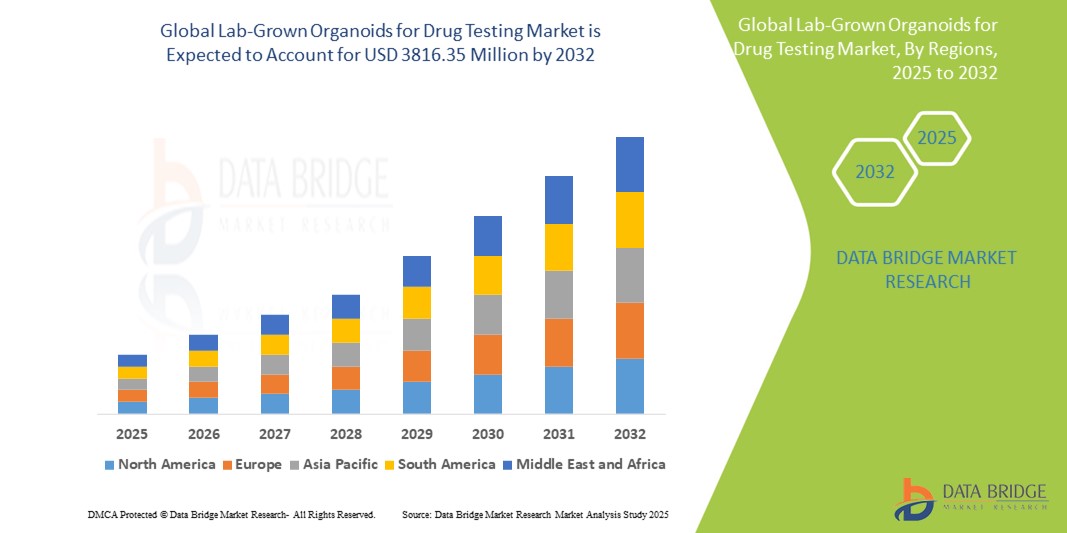
- The global lab-grown organoids for drug testing market size was valued at USD 644.39 million in 2024 and is expected to reach USD 3,816.35 million by 2032, at a CAGR of 24.90% during the forecast period
- This growth is driven by factors such as the increasing demand for personalized medicine and precision therapies, growing focus on reducing animal testing in preclinical studies and advancements in 3d cell culture technologies and stem cell research
Lab-Grown Organoids for Drug Testing Market Analysis
- Lab-grown organoids are innovative 3D cell culture models that closely mimic human organ function, making them valuable tools for drug testing, disease modeling, and personalized medicine
- The demand for lab-grown organoids is significantly driven by the need for more accurate and predictive preclinical testing models, reducing the reliance on animal testing and improving drug development efficiency
- North America is expected to dominate the lab-grown organoids for drug testing market with share of 35.5% due to advanced biotechnology research infrastructure, strong pharmaceutical R&D investments, and early adoption of cutting-edge technologies
- Asia-Pacific is expected to be the fastest growing region in the lab-grown organoids for drug testing market with a share of 16.5% during the forecast period due to increasing healthcare investments, growing awareness about personalized medicine, and expanding biotechnology sector
- The liver organoids segment is expected to dominate the market, with a market share of 43.2%, due to their crucial role in drug metabolism and toxicity studies. As a key tool for pharmaceutical companies in early-stage drug testing, liver organoids closely mimic human liver function, increasing their significance in drug discovery and testing processes. Their ability to replicate human liver function and improve the accuracy of drug testing further contributes to their market dominance
Report Scope and Lab-Grown Organoids for Drug Testing Market Segmentation
|
Attributes |
Lab-Grown Organoids for Drug Testing Key Market Insights |
|
Segments Covered |
|
|
Countries Covered |
North America
Europe
Asia-Pacific
Middle East and Africa
South America
|
|
Key Market Players |
|
|
Market Opportunities |
|
|
Value Added Data Infosets |
In addition to the insights on market scenarios such as market value, growth rate, segmentation, geographical coverage, and major players, the market reports curated by the Data Bridge Market Research also include import export analysis, production capacity overview, production consumption analysis, price trend analysis, climate change scenario, supply chain analysis, value chain analysis, raw material/consumables overview, vendor selection criteria, PESTLE Analysis, Porter Analysis, and regulatory framework. |
Lab-Grown Organoids for Drug Testing Market Trends
“Advancements in Lab-Grown Organoids for Drug Testing”
- One prominent trend in the lab-grown organoids for drug testing market is the increasing use of patient-derived organoids for precision medicine and personalized drug screening
- These advanced 3D cell culture systems closely replicate human organ functions, providing a more accurate and predictive model for drug efficacy and toxicity testing compared to traditional 2D cell cultures or animal models
- For instance, organoids derived from patient tumors can be used to identify the most effective cancer therapies, reducing trial-and-error treatment approaches and improving patient outcomes
- These advancements are transforming drug discovery and development, reducing the time and cost of bringing new drugs to market while enhancing treatment precision and patient safety
Lab-Grown Organoids for Drug Testing Market Dynamics
Driver
“Rising Demand Due to Advancements in Drug Testing and Personalized Medicine”
- The growing need for more accurate and human-relevant drug testing models is significantly driving the demand for lab-grown organoids in the pharmaceutical and biotechnology industries
- Organoids, derived from human stem cells, closely replicate the structure and function of organs, providing a more accurate alternative to animal models for testing drug efficacy and toxicity
- With the rising focus on personalized medicine, lab-grown organoids are increasingly being used to develop patient-specific disease models for better-targeted therapies
For instance,
- In April 2024, researchers at Stanford University developed brain organoids from the stem cells of Timothy syndrome patients, creating personalized models to test gene-targeted therapies for this rare neurological disorder
- As a result of these advancements, the demand for lab-grown organoids in drug discovery and testing continues to rise, improving drug development outcomes and offering tailored therapies
Opportunity
“Expanding Applications in Cancer Drug Discovery and Toxicity Testing”
- Lab-grown organoids are gaining traction in cancer research, allowing for the development of more precise, patient-specific tumor models for drug testing
- These organoids can better mimic the microenvironment of tumors, offering new insights into drug resistance and effectiveness for personalized cancer treatments
- In addition, organoids are increasingly being used for drug toxicity testing, providing more reliable results and reducing the need for animal testing
For instance,
- In 2024, lab-grown liver organoids were used in preclinical studies to test the effects of novel anti-cancer drugs, significantly reducing toxicity-related failures during clinical trials
- This growing use of organoids in cancer and toxicity testing is expected to expand the market further, presenting new opportunities for both research institutions and pharmaceutical companies
Restraint/Challenge
“High Cost and Complexity of Organoid Culturing Techniques”
- The high cost of creating and maintaining lab-grown organoids presents a significant challenge for widespread market adoption, particularly in smaller research institutions and biotech startups
- The complexity involved in culturing organoids, which requires specialized equipment, stem cell expertise, and a controlled environment, can increase the overall expenses associated with their use
For instance,
- A report in 2024 highlighted that the need for specialized labs and equipment to grow organoids has made it difficult for smaller pharmaceutical companies to incorporate them into their drug testing pipelines
- These high costs and technical challenges can limit the growth of the market, particularly in developing regions with fewer resources and infrastructure for advanced drug testing methodologies
Lab-Grown Organoids for Drug Testing Market Scope
The market is segmented on the basis of product type, application, source and end user
|
Segmentation |
Sub-Segmentation |
|
By Product Type |
|
|
By Application |
|
|
By Source |
|
|
By End User |
|
In 2025, the liver organoids is projected to dominate the market with a largest share in product type segment
The liver organoids segment is expected to dominate the lab-grown organoids for drug testing market with the largest share of 43.2% in 2025 due to their crucial role in drug metabolism and toxicity studies. As a key tool for pharmaceutical companies in early-stage drug testing, liver organoids closely mimic human liver function, increasing their significance in drug discovery and testing processes. Their ability to replicate human liver function and improve the accuracy of drug testing further contributes to their market dominance.
The drug discovery and personalized medicine is expected to account for the largest share during the forecast period in application market
In 2025, the drug discovery and personalized medicine segment is expected to dominate the market with the largest market share of 38.3%, owing to its pivotal role in enhancing precision medicine approaches. By using patient-derived organoids, researchers can model individual responses to drugs, enabling the development of targeted therapies with higher efficacy and reduced side effects. The segment's growing adoption by pharmaceutical and biotech companies to accelerate early-stage drug development and improve clinical success rates further drives its leading position in the market.
Lab-Grown Organoids for Drug Testing Market Regional Analysis
“North America Holds the Largest Share in the Lab-Grown Organoids for Drug Testing Market”
- North America dominates the lab-grown organoids for drug testing market, holding approximately 35.5% of the global market share, driven by the presence of leading pharmaceutical and biotechnology companies, advanced research capabilities, and high adoption of cutting-edge technologies
- U.S. holds a significant share of the North American market, representing 25.6% of the global market, due to its strong investment in pharmaceutical research and development, increasing demand for personalized medicine, and the use of organoid models in drug discovery and testing
- The region benefits from well-established healthcare infrastructure and growing partnerships between academic institutions and biotechnology firms, further strengthening the market
- In addition, the increasing focus on precision medicine and drug toxicity testing is fueling market growth across North America
“Asia-Pacific is Projected to Register the Highest CAGR in the Lab-Grown Organoids for Drug Testing Market”
- Asia-Pacific is expected to witness the highest growth rate in the lab-grown organoids for drug testing market, with 16.5% of the global market share, driven by rapid expansion in healthcare infrastructure, increasing investments in research and development, and a growing demand for innovative drug testing solutions
- Countries such as China, India, and Japan are emerging as key markets due to the increasing prevalence of chronic diseases and their expanding pharmaceutical sectors
- Japan, with its advanced research capabilities and strong presence of biotechnology firms, remains a crucial market for lab-grown organoids in drug testing. The country continues to lead in adopting organoid-based models for drug discovery and toxicity testing
- India is projected to register the highest CAGR in the lab-grown organoids for drug testing market, driven by expanding research and academic institutions, growing interest in personalized medicine, and increasing drug testing needs
Lab-Grown Organoids for Drug Testing Market Share
The market competitive landscape provides details by competitor. Details included are company overview, company financials, revenue generated, market potential, investment in research and development, new market initiatives, global presence, production sites and facilities, production capacities, company strengths and weaknesses, product launch, product width and breadth, application dominance. The above data points provided are only related to the companies' focus related to market.
The Major Market Leaders Operating in the Market Are:
- Pfizer (U.S.)
- Novartis AG (Switzerland)
- F. Hoffmann-La Roche Ltd (Switzerland)
- AstraZeneca (U.K.)
- Merck & Co., Inc. (U.S.)
- Sanofi (France)
- Bristol-Myers Squibb Company (U.S.)
- GSK plc (U.K.)
- Lilly (U.S.)
- AbbVie (U.S.)
- Amgen Inc. (U.S.)
- Bayer AG (Germany)
- VML (U.S.)
- Sinai Health (Canada)

- Interactive Data Analysis Dashboard
- Company Analysis Dashboard for high growth potential opportunities
- Research Analyst Access for customization & queries
- Competitor Analysis with Interactive dashboard
- Latest News, Updates & Trend analysis
- Harness the Power of Benchmark Analysis for Comprehensive Competitor Tracking
Data collection and base year analysis are done using data collection modules with large sample sizes. The stage includes obtaining market information or related data through various sources and strategies. It includes examining and planning all the data acquired from the past in advance. It likewise envelops the examination of information inconsistencies seen across different information sources. The market data is analysed and estimated using market statistical and coherent models. Also, market share analysis and key trend analysis are the major success factors in the market report. To know more, please request an analyst call or drop down your inquiry.
The key research methodology used by DBMR research team is data triangulation which involves data mining, analysis of the impact of data variables on the market and primary (industry expert) validation. Data models include Vendor Positioning Grid, Market Time Line Analysis, Market Overview and Guide, Company Positioning Grid, Patent Analysis, Pricing Analysis, Company Market Share Analysis, Standards of Measurement, Global versus Regional and Vendor Share Analysis. To know more about the research methodology, drop in an inquiry to speak to our industry experts.
Data Bridge Market Research is a leader in advanced formative research. We take pride in servicing our existing and new customers with data and analysis that match and suits their goal. The report can be customized to include price trend analysis of target brands understanding the market for additional countries (ask for the list of countries), clinical trial results data, literature review, refurbished market and product base analysis. Market analysis of target competitors can be analyzed from technology-based analysis to market portfolio strategies. We can add as many competitors that you require data about in the format and data style you are looking for. Our team of analysts can also provide you data in crude raw excel files pivot tables (Fact book) or can assist you in creating presentations from the data sets available in the report.













