


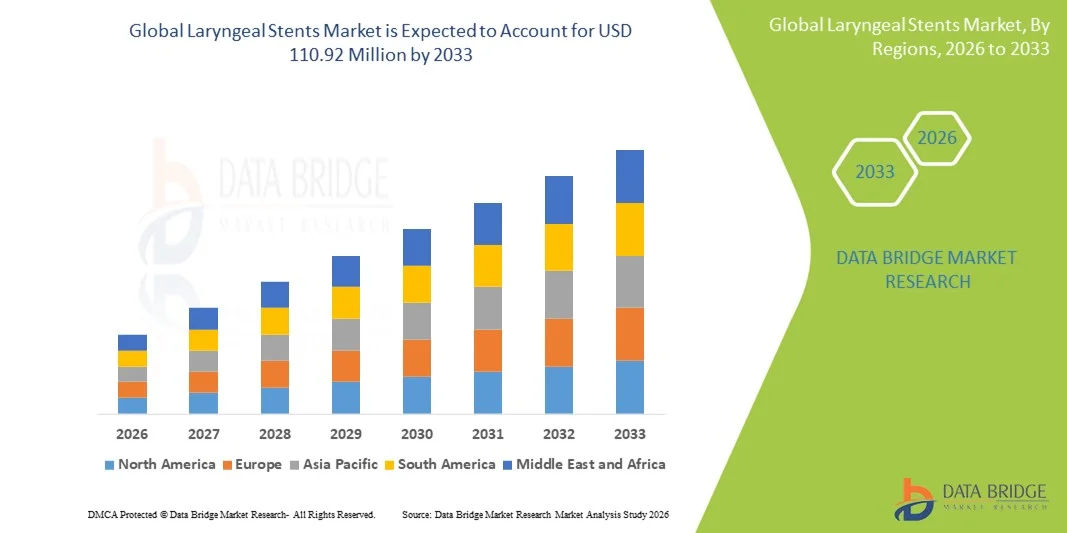
Laryngeal Stents Market Size
- The global laryngeal stents market size was valued at USD 69.07 million in 2025 and is expected to reach USD 110.92 million by 2033, at a CAGR of 6.10% during the forecast period
- The market growth is largely fueled by the rising prevalence of laryngeal disorders (such as laryngeal cancer, stenosis, and post‑surgical airway complications), increasing healthcare expenditure, and ongoing technological advancements in stent design that improve patient outcomes and expand clinical use
- Furthermore, the aging global population, wider adoption of minimally invasive airway management procedures, and expanding healthcare infrastructure in emerging regions are driving demand for effective airway support devices such as laryngeal stents. These converging factors are accelerating the uptake of these specialized medical devices, thereby significantly boosting the industry’s growth
Laryngeal Stents Market Analysis
- Laryngeal stents, specialized medical devices designed to maintain airway patency in patients with laryngeal disorders such as stenosis, trauma, or post-surgical complications, are increasingly vital in advanced ENT care and airway management due to improvements in stent materials and deployment technologies
- The escalating demand for laryngeal stents is primarily fueled by the rising prevalence of laryngeal disorders, growing adoption of minimally invasive airway procedures, and advancements in stent designs that enhance patient comfort, reduce complications, and improve clinical outcomes
- North America dominated the laryngeal stents market with the largest revenue share of 45.9% in 2025, driven by advanced healthcare infrastructure, high awareness of ENT treatments, substantial R&D investment, and strong adoption of innovative stent technologies, with the U.S. leading in the use of self-expandable and silicone stents in major hospitals
- Asia-Pacific is expected to be the fastest growing region in the laryngeal stents market during the forecast period due to rising healthcare expenditure, expanding hospital networks, increasing incidence of laryngeal conditions, and growing adoption of advanced airway management devices in countries such as China and India
- Silicone stents dominated the market with a market share of 52.3% in 2025, reflecting their established clinical use, patient comfort, and ease of deployment in hospitals and surgical centers
Report Scope and Laryngeal Stents Market Segmentation
|
Attributes |
Laryngeal Stents Key Market Insights |
|
Segments Covered |
|
|
Countries Covered |
North America
Europe
Asia-Pacific
Middle East and Africa
South America
|
|
Key Market Players |
|
|
Market Opportunities |
|
|
Value Added Data Infosets |
In addition to the insights on market scenarios such as market value, growth rate, segmentation, geographical coverage, and major players, the market reports curated by the Data Bridge Market Research also include in-depth expert analysis, patient epidemiology, pipeline analysis, pricing analysis, and regulatory framework |
Laryngeal Stents Market Trends
Advancements in Biodegradable and Flexible Stent Technologies
- A significant and accelerating trend in the global laryngeal stents market is the development of biodegradable and flexible stents, which improve patient comfort, reduce complications, and eliminate the need for surgical removal
- For instance, the SILASTIC® biodegradable laryngeal stent offers gradual resorption while maintaining airway patency, reducing repeat procedures for patients with post-surgical airway narrowing
- Flexible stent designs enable better adaptation to patient-specific anatomy, minimizing irritation and improving long-term outcomes, while some self-expandable stents now incorporate advanced coatings to reduce inflammation and migration risks
- The adoption of these innovative stents facilitates improved procedural efficiency for ENT surgeons and better post-operative recovery for patients, enhancing clinical acceptance
- This trend towards patient-centric, minimally invasive, and adaptable stent designs is fundamentally reshaping expectations for airway management, prompting companies such as Novatech and EndoFlex to develop next-generation biodegradable and flexible laryngeal stents
- The demand for stents with enhanced comfort, reduced complications, and simplified follow-up procedures is growing rapidly across hospitals and ambulatory surgical centers, as healthcare providers increasingly prioritize patient outcomes and procedural efficiency
- Integration of imaging-guided placement technologies is gaining traction, allowing precise stent positioning and reducing the risk of migration or injury to surrounding tissue
- Emerging customized 3D-printed stents are creating opportunities for patient-specific airway solutions, enabling better anatomical fit and potentially reducing post-operative complications
Laryngeal Stents Market Dynamics
Driver
Rising Prevalence of Laryngeal Disorders and Surgical Interventions
- The increasing incidence of laryngeal stenosis, trauma, and cancer, coupled with a rise in ENT surgical procedures, is a significant driver for the growing demand for laryngeal stents
- For instance, in March 2025, EndoFlex announced a new biodegradable laryngeal stent designed for post-surgical airway management, targeting hospitals with high volumes of ENT procedures
- As awareness of minimally invasive airway management grows, stents offer advanced features such as self-expansion, reduced irritation, and patient-specific sizing, providing compelling clinical benefits over traditional rigid stents
- Furthermore, the increasing adoption of ENT specialty centers and rising availability of advanced surgical equipment make laryngeal stents an integral component of modern airway management
- The ability to improve patient outcomes, shorten hospital stays, and reduce follow-up procedures are key factors propelling the adoption of laryngeal stents in hospitals and ambulatory surgical centers
- Technological advancements, surgeon training programs, and growing patient awareness further contribute to market growth
- Rising investments by medical device companies in R&D for next-generation stents are accelerating the development of safer and more effective solutions for laryngeal disorders
- Increasing collaborations between hospitals and device manufacturers for clinical trials and post-market studies are enhancing physician confidence and encouraging wider adoption
Restraint/Challenge
Post-Operative Complications and Regulatory Barriers
- Concerns regarding stent migration, granulation tissue formation, and post-operative irritation pose significant challenges to broader adoption of laryngeal stents
- For instance, reports of stent displacement and local tissue reaction have made some surgeons cautious about using certain rigid or metal stents in high-risk patients
- Addressing these complications through improved stent design, coatings, and patient-specific sizing is crucial for broader clinical acceptance. In addition, stringent regulatory approval processes in key markets such as the U.S. and Europe can delay product launches
- While new biodegradable and flexible stents are mitigating some procedural risks, high development costs and lengthy approval timelines can be barriers, particularly for emerging companies
- The relatively high cost of advanced stents compared to conventional airway devices may also limit adoption in price-sensitive hospitals and regions
- Overcoming these challenges through enhanced stent design, post-market clinical evidence, regulatory compliance, and cost optimization will be vital for sustained growth in the laryngeal stents market
- Limited awareness among clinicians in emerging markets regarding advanced stent options can slow market penetration, highlighting the need for training and education programs
- Potential complications in patients with complex airway anatomies may require additional interventions, which can deter hospitals from adopting new stent technologies without robust clinical evidence
Laryngeal Stents Market Scope
The market is segmented on the basis of material, product, and end user.
- By Material
On the basis of material, the laryngeal stents market is segmented into metal stents, silicone stents, and hybrid stents. Silicone Stents dominated the market with the largest revenue share of 52.3% in 2025, driven by their established clinical use, high biocompatibility, and ease of placement and removal in patients. Silicone stents are widely preferred in hospitals and surgical centers due to their flexibility, reduced irritation, and lower risk of tissue damage compared to metal stents. Their compatibility with minimally invasive procedures also makes them favorable for post-surgical airway management. Moreover, silicone stents can be customized to fit patient-specific anatomy, enhancing comfort and reducing complications. The material’s durability and proven track record in ENT applications further solidify its dominance. Hospitals and ambulatory surgical centers often stock silicone stents as the primary choice for routine airway management procedures.
Hybrid Stents are anticipated to witness the fastest growth rate from 2026 to 2033, fueled by the increasing demand for stents that combine the rigidity of metal with the flexibility of silicone. Hybrid stents offer advantages such as improved airway support, reduced migration risk, and enhanced patient comfort. These stents are increasingly used in complex airway cases where neither pure silicone nor metal stents are optimal. The adoption of hybrid stents is also being driven by technological advancements, including coated surfaces that reduce tissue reaction and inflammation. As hospitals and specialized ENT centers seek more versatile solutions, hybrid stents are gaining traction. Rising awareness among surgeons about the benefits of hybrid designs further supports market growth in this subsegment.
- By Product
On the basis of product, the market is segmented into self-expandable stents, non-expandable stents, and balloon-expandable stents. Self-Expandable Stents dominated the market with the largest revenue share of 49.8% in 2025, owing to their ease of deployment and ability to conform to complex airway anatomies. These stents automatically expand to maintain airway patency without requiring additional surgical manipulation, reducing procedure time and risk. Self-expandable stents are widely used in hospitals for post-surgical airway management, stenosis treatment, and trauma cases. Their adaptability to patient-specific anatomy reduces irritation and post-operative complications. The convenience of deployment and minimal requirement for repeat adjustments make them a preferred choice for ENT surgeons. Furthermore, self-expandable stents often provide long-term stability, which enhances patient safety and clinical confidence.
Balloon-Expandable Stents are expected to witness the fastest growth rate from 2026 to 2033, driven by their precision placement and controlled expansion during airway interventions. These stents are increasingly used in pediatric and adult patients where exact sizing is critical. Balloon-expandable stents offer advantages such as targeted deployment, reduced migration risk, and the ability to adjust expansion intra-operatively. Hospitals and surgical centers prefer these stents for complex airway cases requiring high accuracy. Technological improvements, including radiopaque markers and flexible balloon materials, enhance their usability and clinical appeal. The rising adoption of minimally invasive ENT procedures further propels the growth of balloon-expandable stents in the market.
- By End User
On the basis of end user, the market is segmented into hospitals, ambulatory surgical centres, and others. Hospitals dominated the market with the largest revenue share of 57.5% in 2025, due to the high volume of ENT procedures, availability of specialized surgeons, and advanced facilities required for airway management. Hospitals serve as the primary end users for laryngeal stents because they handle complex cases such as laryngeal cancer, post-trauma reconstruction, and severe stenosis. Hospitals prefer stents that are versatile, easy to deploy, and supported by clinical evidence. The presence of dedicated ENT departments and access to diagnostic imaging also facilitates their adoption. Hospitals often stock a wide variety of stent types and materials to address diverse patient needs. The reliability, availability, and established protocols make hospitals the central hub for laryngeal stent utilization.
Ambulatory Surgical Centres are expected to witness the fastest growth rate from 2026 to 2033, driven by the increasing trend of minimally invasive ENT surgeries being performed in outpatient settings. These centers prefer stents that are easy to deploy, safe, and require minimal post-operative care. Rising patient preference for same-day procedures and lower treatment costs compared to hospitals fuels adoption in this subsegment. Ambulatory surgical centers are investing in advanced ENT equipment and staff training, enabling wider use of both self-expandable and hybrid stents. The convenience and efficiency of outpatient procedures contribute to the growing demand. As awareness and availability of specialized stents increase, ambulatory surgical centers are becoming a key growth driver for the market.
Laryngeal Stents Market Regional Analysis
- North America dominated the laryngeal stents market with the largest revenue share of 45.9% in 2025, driven by advanced healthcare infrastructure, high awareness of ENT treatments, substantial R&D investment, and strong adoption of innovative stent technologies, with the U.S. leading in the use of self-expandable and silicone stents in major hospitals
- Hospitals and specialized ENT centers in the region highly value the clinical efficacy, ease of deployment, and patient safety offered by modern stent solutions, including silicone and self-expandable stents
- This widespread adoption is further supported by robust healthcare expenditure, well-established reimbursement frameworks, and growing awareness of minimally invasive airway management, establishing laryngeal stents as a preferred choice for hospitals and surgical centers across the U.S. and Canada
U.S. Laryngeal Stents Market Insight
The U.S. laryngeal stents market captured the largest revenue share of 82% in North America in 2025, fueled by the rising prevalence of laryngeal disorders and advanced ENT surgical procedures. Hospitals and specialty clinics are increasingly prioritizing minimally invasive airway management using silicone and self-expandable stents. The growing preference for patient-specific stents and the integration of advanced stent technologies, such as biodegradable and hybrid designs, further propels the market. In addition, the widespread availability of trained ENT specialists and technologically advanced healthcare infrastructure supports higher adoption. Government initiatives promoting early diagnosis and improved surgical outcomes are also contributing to market expansion. Moreover, increasing awareness among patients and clinicians about post-surgical airway management solutions is strengthening market growth.
Europe Laryngeal Stents Market Insight
The Europe laryngeal stents market is projected to expand at a substantial CAGR during the forecast period, driven by increasing incidence of laryngeal disorders and growing demand for advanced airway management solutions. The presence of well-established ENT specialty hospitals and stringent healthcare quality standards fosters adoption of modern stent technologies. European clinicians prefer stents that enhance patient comfort, reduce complications, and allow minimally invasive procedures. The increase in urbanization and healthcare infrastructure development further supports market growth. Furthermore, government reimbursement policies and clinical awareness programs are promoting the use of silicone and hybrid stents. The region is witnessing significant adoption in hospitals, surgical centers, and specialized ENT clinics.
U.K. Laryngeal Stents Market Insight
The U.K. laryngeal stents market is anticipated to grow at a noteworthy CAGR during the forecast period, driven by rising awareness of ENT disorders and the growing trend of minimally invasive airway surgeries. Concerns regarding post-surgical complications are encouraging hospitals and surgical centers to adopt advanced stent solutions. The U.K.’s well-developed healthcare system, along with robust hospital infrastructure and trained ENT surgeons, supports the adoption of silicone and self-expandable stents. Clinical preference for patient-friendly and easy-to-deploy devices is boosting market growth. Furthermore, ongoing investments in healthcare technology and research are enhancing product availability. The integration of innovative stent technologies into standard surgical protocols is expected to continue stimulating market expansion.
Germany Laryngeal Stents Market Insight
The Germany laryngeal stents market is expected to expand at a considerable CAGR during the forecast period, fueled by increasing awareness of airway disorders and demand for clinically advanced, safe stent solutions. Germany’s advanced hospital infrastructure and focus on high-quality surgical outcomes promote adoption of silicone, metal, and hybrid stents. The country’s emphasis on innovation and research facilitates the integration of biodegradable and flexible stents into ENT procedures. Increasing urbanization and well-equipped surgical centers are further driving market growth. Moreover, clinicians are adopting minimally invasive solutions to reduce post-operative complications. The demand for precision airway management devices aligned with patient-specific anatomy is also rising.
Asia-Pacific Laryngeal Stents Market Insight
The Asia-Pacific laryngeal stents market is poised to grow at the fastest CAGR of 24% during the forecast period of 2026 to 2033, driven by rising prevalence of laryngeal disorders, expanding healthcare infrastructure, and increasing awareness of minimally invasive ENT procedures. Countries such as China, Japan, and India are witnessing growing adoption of silicone and self-expandable stents in hospitals and surgical centers. Government initiatives promoting advanced surgical technologies and ENT specialty care are accelerating market growth. Rising disposable incomes and increasing access to quality healthcare are further boosting adoption. The region is also emerging as a hub for production and distribution of stent technologies, enhancing affordability. Furthermore, the growing number of trained ENT surgeons and awareness campaigns for post-surgical airway management support the rapid expansion of the market.
Japan Laryngeal Stents Market Insight
The Japan laryngeal stents market is gaining momentum due to the country’s high-tech healthcare ecosystem, rising incidence of airway disorders, and increasing demand for patient-friendly stents. Hospitals and surgical centers are adopting advanced stents, including biodegradable and flexible designs, for enhanced post-operative outcomes. The growing number of smart hospitals and integration of medical technologies with ENT procedures further fuels market growth. Japan’s aging population also drives demand for easy-to-use, minimally invasive stent solutions. Clinical emphasis on reducing complications and ensuring precise airway management supports adoption. Moreover, increasing training programs for ENT surgeons are enhancing familiarity with modern stent technologies.
India Laryngeal Stents Market Insight
The India laryngeal stents market accounted for the largest revenue share in Asia-Pacific in 2025, attributed to rising prevalence of laryngeal disorders, expanding healthcare facilities, and increasing number of ENT specialty centers. The country is experiencing rapid adoption of silicone and self-expandable stents in hospitals, ambulatory surgical centers, and private clinics. Government initiatives promoting advanced ENT procedures and awareness campaigns about airway management are driving market growth. Affordable stent options and domestic manufacturing of devices further support adoption. The growing middle class and rising healthcare expenditure also contribute to market expansion. In addition, increasing availability of trained ENT surgeons ensures higher penetration of advanced laryngeal stent technologies.
Laryngeal Stents Market Share
The Laryngeal Stents industry is primarily led by well-established companies, including:
- Boston Scientific Corporation (U.S.)
- Teleflex Incorporated (U.S.)
- Cook (U.S.)
- Medtronic (Ireland)
- Novatech SA (France)
- Merit Medical Systems, Inc. (U.S.)
- BD (U.S.)
- Olympus Corporation (Japan)
- Stryker (U.S.)
- Stöckert GmbH (Germany)
- Hood Laboratories (U.S.)
- Karomed Ltd (U.K.)
- Polaris Medical Inc. (U.S.)
- Endo-Flex GmbH (Germany)
- Stening Srl (Argentina)
- PENTAX Medical (Japan)
- Atos Medical AB (Sweden)
- Summit Medical Group (U.S.)
- C.R. Bard, Inc. (U.S.)
- W.L. Gore & Associates, Inc. (U.S.)
What are the Recent Developments in Global Laryngeal Stents Market?
- In April 2025, industry analysts reported that the lung stent market is expected to expand significantly in coming years due to rising prevalence of respiratory disorders and increased use of minimally invasive procedures, which also drives demand and innovation in airway stents
- In May 2025, Boston Scientific completed the acquisition of Airway Innovations, a company specializing in novel airway stent technologies, expanding its interventional pulmonology and airway management portfolio. This acquisition strengthens Boston Scientific’s position in the airway stent space and signals consolidation in advanced airway device technologies
- In October 2024, the U.S. Food and Drug Administration granted de novo clearance to a novel airway stent covered with human tissue (the AMStent system) designed to keep airway passages open in patients with malignant airway obstruction, representing advancement in biocompatible stent technology relevant to airway support
- In June 2022, Boston Scientific announced a definitive agreement to purchase the majority stake in M.I.Tech Co., Ltd, a Korean manufacturer of non‑vascular, self‑expanding metal stents used in airway and gastrointestinal procedures — a strategic move to expand its airway stent portfolio, indirectly impacting the broader laryngeal/airway stent segment
- In December 2021, a customized approach to laryngeal stenting for airway reconstruction was described in a clinical study published in The Journal of Laryngology & Otology, highlighting use of a modified Montgomery T‑tube laryngeal stent for glottic airway reconstruction to improve airway patency and reduce tissue reaction

- Interactive Data Analysis Dashboard
- Company Analysis Dashboard for high growth potential opportunities
- Research Analyst Access for customization & queries
- Competitor Analysis with Interactive dashboard
- Latest News, Updates & Trend analysis
- Harness the Power of Benchmark Analysis for Comprehensive Competitor Tracking
Data collection and base year analysis are done using data collection modules with large sample sizes. The stage includes obtaining market information or related data through various sources and strategies. It includes examining and planning all the data acquired from the past in advance. It likewise envelops the examination of information inconsistencies seen across different information sources. The market data is analysed and estimated using market statistical and coherent models. Also, market share analysis and key trend analysis are the major success factors in the market report. To know more, please request an analyst call or drop down your inquiry.
The key research methodology used by DBMR research team is data triangulation which involves data mining, analysis of the impact of data variables on the market and primary (industry expert) validation. Data models include Vendor Positioning Grid, Market Time Line Analysis, Market Overview and Guide, Company Positioning Grid, Patent Analysis, Pricing Analysis, Company Market Share Analysis, Standards of Measurement, Global versus Regional and Vendor Share Analysis. To know more about the research methodology, drop in an inquiry to speak to our industry experts.
Data Bridge Market Research is a leader in advanced formative research. We take pride in servicing our existing and new customers with data and analysis that match and suits their goal. The report can be customized to include price trend analysis of target brands understanding the market for additional countries (ask for the list of countries), clinical trial results data, literature review, refurbished market and product base analysis. Market analysis of target competitors can be analyzed from technology-based analysis to market portfolio strategies. We can add as many competitors that you require data about in the format and data style you are looking for. Our team of analysts can also provide you data in crude raw excel files pivot tables (Fact book) or can assist you in creating presentations from the data sets available in the report.













