


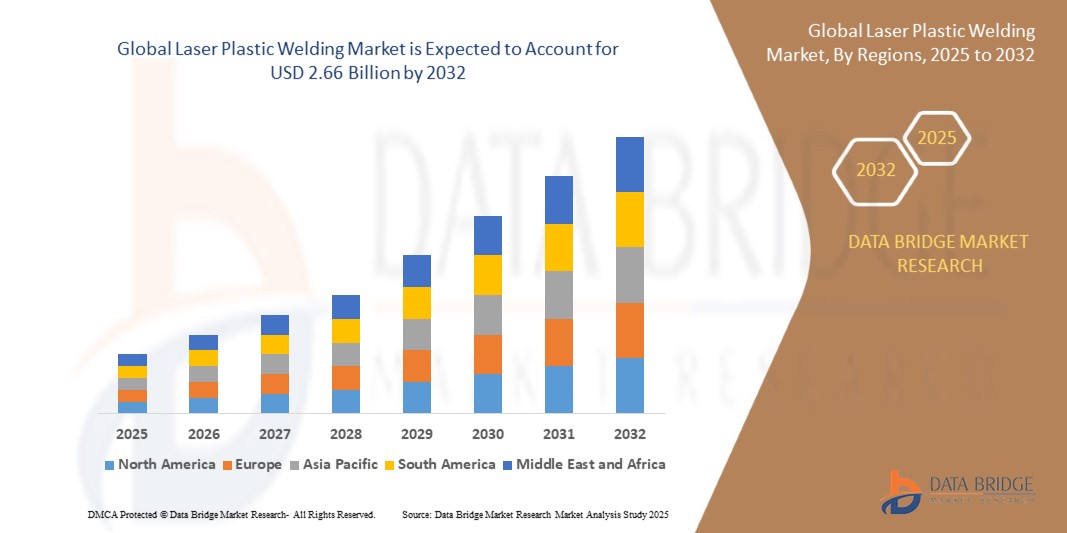
What is the Global Laser Plastic Welding Market Size and Growth Rate?
- The global laser plastic welding market size was valued at USD 1.45 billion in 2024 and is expected to reach USD 2.66 billion by 2032, at a CAGR of 7.86% during the forecast period
- The laser plastic welding market is experiencing notable growth due to its advantages in precision, efficiency, and strength of welds compared to traditional welding methods. The rising demand for high-quality and durable plastic components across various industries such as automotive, medical devices, and electronics has driven the adoption of laser plastic welding technology
- In the automotive sector, the need for lightweight and complex plastic parts that require robust and clean welds has significantly contributed to market expansion. Similarly, in the medical device industry, the technology's ability to create sterile and strong joints is crucial for maintaining high standards of product safety and functionality
What are the Major Takeaways of Laser Plastic Welding Market?
- The automotive industry's shift towards lightweight materials to enhance fuel efficiency and performance is a major driver of the laser plastic welding market. As automakers increasingly seek to reduce vehicle weight without compromising strength and safety, the demand for high-performance plastic components grows
- Laser plastic welding provides a solution by offering strong, clean welds that are essential for the integrity and durability of these lightweight parts. This technology’s ability to efficiently weld complex plastic components makes it crucial for meeting the automotive sector's evolving needs and contributes significantly to the market's growth
- Asia Pacific dominated the laser plastic welding market with the largest revenue share of 42.7% in 2024, driven by rapid industrialization, growing demand for precision manufacturing, and rising adoption of laser-based production technologies in sectors such as automotive, electronics, and healthcare
- Europe is projected to grow at the fastest CAGR of 11.3% during the forecast period from 2025 to 2032, driven by regulatory pressure for sustainable and high-quality manufacturing, especially in automotive, healthcare, and electronics sectors
- The Integrated System segment dominated the market with the largest market revenue share of 58.6% in 2024, owing to the increasing demand for automation, seamless production line integration, and real-time quality monitoring in high-volume manufacturing environments
Report Scope and Laser Plastic Welding Market Segmentation
|
Attributes |
Laser Plastic Welding Key Market Insights |
|
Segments Covered |
|
|
Countries Covered |
North America
Europe
Asia-Pacific
Middle East and Africa
South America
|
|
Key Market Players |
|
|
Market Opportunities |
|
|
Value Added Data Infosets |
In addition to the insights on market scenarios such as market value, growth rate, segmentation, geographical coverage, and major players, the market reports curated by the Data Bridge Market Research also include in-depth expert analysis, pricing analysis, brand share analysis, consumer survey, demography analysis, supply chain analysis, value chain analysis, raw material/consumables overview, vendor selection criteria, PESTLE Analysis, Porter Analysis, and regulatory framework. |
What is the Key Trend in the Laser Plastic Welding Market?
“Smart Manufacturing and AI-Powered Welding Optimization”
- A prominent trend reshaping the laser plastic welding market is the integration of Artificial Intelligence (AI) and Industry 4.0 technologies to enhance precision, quality control, and automation in plastic joining processes. Manufacturers are deploying AI-driven systems to monitor weld quality in real-time and automatically adjust parameters such as laser power, speed, and focal position
- For instance, TRUMPF has developed laser systems equipped with intelligent sensors and AI algorithms that optimize welding conditions, reducing material waste and improving consistency in high-volume production environments. Similarly, Han's Laser is implementing smart process monitoring tools that leverage machine learning for fault detection and predictive maintenance
- AI-enabled systems can learn from historical weld data and environmental variables to fine-tune welding outcomes, significantly improving efficiency and reducing downtime. Such smart platforms are particularly valuable in complex or micro-scale plastic components used in automotive, electronics, and medical devices
- This growing shift toward smart laser welding cells aligns with broader trends in digitalized manufacturing, where real-time analytics and automation are driving competitive advantages. Manufacturers using AI-powered laser plastic welding systems report better throughput, minimized rework, and enhanced traceability
- Companies such as LPKF Laser & Electronics AG and Emerson Electric Co. are also advancing AI-enabled welding solutions with integrated vision systems and quality assurance features to meet the rising demand for zero-defect production
- This trend is set to transform production landscapes, promoting scalable, adaptive, and autonomous plastic welding solutions tailored to modern industrial demands
What are the Key Drivers of Laser Plastic Welding Market?
- The growing demand for high-precision plastic joining in industries such as automotive, electronics, and medical devices is a key driver propelling the laser plastic welding market. These sectors require clean, particulate-free, and strong welds, which laser welding delivers over conventional methods
- For instance, in May 2024, Jenoptik AG introduced a new generation of laser welding machines targeting EV battery enclosures and lightweight automotive parts, showcasing the surge in industry-specific demand
- The shift toward miniaturized electronics and medical wearables has further driven the adoption of laser welding technologies due to their non-invasive, precision-focused capabilities that prevent damage to sensitive components
- Moreover, the move toward automation and cleanroom-compatible processes in advanced manufacturing facilities favors laser welding for its non-contact, contamination-free joining characteristics. The ability to produce hermetically sealed and aesthetically clean welds is particularly crucial in medical device and pharmaceutical packaging applications
- In addition, government regulations promoting recyclability, lightweight materials, and sustainable production are pushing OEMs to adopt advanced welding solutions such as laser plastic welding that ensure energy efficiency and material conservation
Which Factor is challenging the Growth of the Laser Plastic Welding Market?
- One of the critical challenges facing the market is the high capital cost and technical complexity associated with setting up Laser Plastic Welding systems, particularly for small and medium-sized enterprises (SMEs). These systems often require substantial initial investment in lasers, optics, sensors, and automated handling equipment
- For instance, some entry-level systems still exceed $100,000, which can be prohibitive for companies with limited budgets or short-run production needs. In addition, the technical expertise required to operate and maintain high-precision laser systems remains a barrier in developing regions
- The need for trained personnel, complex calibration procedures, and integration with existing manufacturing lines also adds to the adoption friction. For instance, failures in process alignment or weld monitoring can lead to defects in mission-critical components such as medical sensors or EV connectors
- Furthermore, concerns around thermal sensitivity of plastic materials and weldability limitations for certain polymers pose material-specific challenges. Not all plastics are equally laser-weldable, which restricts broader application unless compatible materials are used
- Addressing these hurdles requires cost-efficient system design, wider availability of plug-and-play modules, and robust training programs. Companies such as Sahajanand Laser Technology Limited (SLTL Group) are working to lower entry barriers with modular, scalable, and user-friendly solutions for SMEs
How is the Laser Plastic Welding Market Segmented?
The market is segmented on the basis of type, communication protocol, unlocking mechanism, and application.
• By System
On the basis of system, the laser plastic welding market is segmented into Standalone System and Integrated System. The Integrated System segment dominated the market with the largest market revenue share of 58.6% in 2024, owing to the increasing demand for automation, seamless production line integration, and real-time quality monitoring in high-volume manufacturing environments. Integrated systems enable synchronized operation with robotics, sensors, and vision systems, making them ideal for complex industrial applications.
The Standalone System segment is expected to witness the fastest CAGR from 2025 to 2032, driven by its cost-effectiveness and flexibility for small and medium-sized enterprises (SMEs). Standalone systems are easier to set up, require less infrastructure, and offer a compact solution suitable for limited-scale operations or prototyping.
• By Method
On the basis of method, the laser plastic welding market is segmented into Contour Welding, Quasi-Simultaneous, Simultaneous, Mask Welding, Radial Welding, and Others. The Contour Welding segment held the largest market revenue share of 33.1% in 2024, due to its versatility in welding complex shapes and suitability for small to medium production volumes. It is widely used in automotive electronics and medical devices.
The Simultaneous Welding segment is expected to witness the fastest growth rate during the forecast period, as it ensures uniform heating and precise welding for high-volume, high-quality applications. This method is increasingly favored in safety-critical components where repeatability and strength are crucial.
• By Laser
On the basis of laser type, the market is segmented into CO₂ Laser, Diode Laser, Fibre Laser, and Nd:YAG Laser. The Diode Laser segment dominated the market with a revenue share of 41.8% in 2024, attributed to its high efficiency, compact size, lower cost, and excellent compatibility with plastic materials.
The Fibre Laser segment is anticipated to witness the fastest CAGR from 2025 to 2032, due to its high beam quality, long operational life, and low maintenance requirements. Fibre lasers are increasingly used in precision applications, such as consumer electronics and microfluidics.
• By Application
On the basis of application, the laser plastic welding market is segmented into Component and Films. The Component segment dominated the market in 2024 with the largest market revenue share of 72.4%, driven by its widespread use in manufacturing of housings, connectors, sensors, and casings across automotive, electronics, and medical industries.
The Films segment is projected to witness the fastest growth rate during the forecast period, supported by its increasing demand in packaging, membrane fabrication, and thin-walled product assembly. Laser welding of films offers clean sealing without the need for adhesives, making it ideal for sterile and micro-environmental applications.
• By End User
On the basis of end user, the market is segmented into Electrical and Electronics, Healthcare, Automotive, Consumer Goods, and Others. The Automotive segment led the market with the largest revenue share of 34.9% in 2024, owing to the high demand for lightweight, precise, and durable plastic welding solutions for applications such as sensor housings, lighting, fluid reservoirs, and interior assemblies.
The Healthcare segment is expected to witness the fastest CAGR from 2025 to 2032, as the demand rises for non-invasive, sterile, and micro-precise welding in medical devices, diagnostic tools, and drug delivery systems. Regulatory push for cleanroom manufacturing also drives this segment forward.
Which Region Holds the Largest Share of the Laser Plastic Welding Market?
- Asia Pacific dominated the laser plastic welding market with the largest revenue share of 42.7% in 2024, driven by rapid industrialization, growing demand for precision manufacturing, and rising adoption of laser-based production technologies in sectors such as automotive, electronics, and healthcare
- Countries such as China, Japan, and South Korea are investing heavily in smart manufacturing and automation, which supports the adoption of Laser Plastic Welding systems for clean, accurate, and high-speed plastic joining
- This dominance is further supported by cost-effective manufacturing hubs, government support for industrial digitization, and the increasing use of lightweight plastic components in EVs and medical devices. Laser Plastic Welding is increasingly favored for its contactless, hygienic, and aesthetically clean welds, aligning with rising quality standards
China Laser Plastic Welding Market Insight
The China laser plastic welding market captured the largest revenue share in Asia Pacific in 2024, owing to the country’s booming automotive and electronics industries, widespread use of consumer electronics, and focus on smart factory development. Chinese manufacturers are leading in affordable yet high-performance laser welding systems, making the technology accessible to a broader customer base. In addition, China’s expanding middle class, focus on sustainability, and ongoing smart city projects are pushing demand for advanced, eco-friendly plastic welding solutions.
Japan Laser Plastic Welding Market Insight
The Japan laser plastic welding market is witnessing strong growth due to its technologically mature industrial landscape, high precision manufacturing needs, and rapid adoption of IoT-enabled production tools. Japan’s emphasis on automation, robotics, and compact product design fosters demand for clean, precise welding technologies. The country's aging population and demand for medical devices and wearable electronics are also contributing to increased usage of laser plastic welding systems in healthcare and consumer electronics sectors.
Which Region is the Fastest Growing Region in the Laser Plastic Welding Market?
Europe is projected to grow at the fastest CAGR of 11.3% during the forecast period from 2025 to 2032, driven by regulatory pressure for sustainable and high-quality manufacturing, especially in automotive, healthcare, and electronics sectors. The region is seeing a significant shift towards eco-conscious manufacturing practices, with Laser Plastic Welding favored for its energy efficiency, recyclability support, and cleanroom compatibility. Europe’s advanced industrial base, coupled with growing R&D in lightweight composite materials, further enhances adoption of this technology in diverse applications such as e-mobility, biomedical devices, and smart packaging.
Germany Laser Plastic Welding Market Insight
Germany laser plastic welding market led European adoption in 2024, supported by the country’s strong automotive and machinery sectors, robust infrastructure, and focus on Industry 4.0. Laser Plastic Welding is widely used in producing lightweight parts for EVs and high-performance components in medical and industrial applications. Germany’s push toward digital manufacturing and sustainability is driving demand for clean and efficient joining solutions.
U.K. Laser Plastic Welding Market Insight
U.K. laser plastic welding market is growing steadily, backed by rising demand for automated, flexible production in the healthcare, electronics, and consumer goods sectors. Companies are adopting laser-based technologies to enhance production precision, reduce material waste, and comply with energy-efficient regulations. The integration of AI and machine vision with laser welding systems is also becoming prominent in the U.K.'s high-tech manufacturing landscape.
Which are the Top Companies in Laser Plastic Welding Market?
The laser plastic welding industry is primarily led by well-established companies, including:
- TRUMPF (Germany)
- Han's Laser Technology Industry Group Co., Ltd. (China)
- LPKF Laser & Electronics AG (Germany)
- Jenoptik AG (Germany)
- Emerson Electric Co. (U.S.)
- Nippon Avionics Co., Ltd. (Japan)
- Leister Technologies AG (Switzerland)
- AMADA WELD TECH (Japan)
- DILAS Diodelaser GmbH (Germany)
- CONTROL MICRO SYSTEMS (CMS LASER) (U.S.)
- Scantech Laser Ltd. (U.K.)
- CEMAS Elettra S.r.l. (Italy)
- SEIDENSHA (Japan)
- Dukane Corp. (U.S.)
- bielomatik GmbH (Germany)
- Laserline GmbH (Germany)
- Sahajanand Laser Technology Limited (SLTL Group) (India)
- ACSYS Lasertechnik GmbH (Germany)
- Hamamatsu Photonics K.K. (Japan)
- SPI LASERS LIMITED (U.K.)
What are the Recent Developments in Global Laser Plastic Welding Market?
- In January 2025, Philips introduced its most advanced Sonicare toothbrush, integrating adaptive brushing technology, 62,000 gentle sonic movements per minute, and a patented optical sensing feature. This innovation highlights Philips' continued commitment to enhancing user dental care experiences through precision and intelligent technology
- In October 2024, Polyvance unveiled its latest nitrogen plastic welder, the Nitro-Fuzer Touch, equipped with a large touchscreen interface that simplifies the welding process by offering intuitive control over temperature and gas flow. This launch reflects Polyvance’s focus on operator-friendly designs and precision-driven plastic welding advancements
- In August 2022, Dukane, a global leader in laser bonding technology, strengthened its industry presence by launching a new series of Laser Plastic Welding systems designed for truly particulate-free environments, delivering ultra-precise control with 1 to 2 micrometer accuracy. With models available in three sizes and options for turnkey or rotary side table configurations, Dukane continues to push the boundaries of clean and accurate plastic welding

- Interactive Data Analysis Dashboard
- Company Analysis Dashboard for high growth potential opportunities
- Research Analyst Access for customization & queries
- Competitor Analysis with Interactive dashboard
- Latest News, Updates & Trend analysis
- Harness the Power of Benchmark Analysis for Comprehensive Competitor Tracking
Global Laser Plastic Welding Market, Supply Chain Analysis and Ecosystem Framework
To support market growth and help clients navigate the impact of geopolitical shifts, DBMR has integrated in-depth supply chain analysis into its Global Laser Plastic Welding Market research reports. This addition empowers clients to respond effectively to global changes affecting their industries. The supply chain analysis section includes detailed insights such as Global Laser Plastic Welding Market consumption and production by country, price trend analysis, the impact of tariffs and geopolitical developments, and import and export trends by country and HSN code. It also highlights major suppliers with data on production capacity and company profiles, as well as key importers and exporters. In addition to research, DBMR offers specialized supply chain consulting services backed by over a decade of experience, providing solutions like supplier discovery, supplier risk assessment, price trend analysis, impact evaluation of inflation and trade route changes, and comprehensive market trend analysis.
Data collection and base year analysis are done using data collection modules with large sample sizes. The stage includes obtaining market information or related data through various sources and strategies. It includes examining and planning all the data acquired from the past in advance. It likewise envelops the examination of information inconsistencies seen across different information sources. The market data is analysed and estimated using market statistical and coherent models. Also, market share analysis and key trend analysis are the major success factors in the market report. To know more, please request an analyst call or drop down your inquiry.
The key research methodology used by DBMR research team is data triangulation which involves data mining, analysis of the impact of data variables on the market and primary (industry expert) validation. Data models include Vendor Positioning Grid, Market Time Line Analysis, Market Overview and Guide, Company Positioning Grid, Patent Analysis, Pricing Analysis, Company Market Share Analysis, Standards of Measurement, Global versus Regional and Vendor Share Analysis. To know more about the research methodology, drop in an inquiry to speak to our industry experts.
Data Bridge Market Research is a leader in advanced formative research. We take pride in servicing our existing and new customers with data and analysis that match and suits their goal. The report can be customized to include price trend analysis of target brands understanding the market for additional countries (ask for the list of countries), clinical trial results data, literature review, refurbished market and product base analysis. Market analysis of target competitors can be analyzed from technology-based analysis to market portfolio strategies. We can add as many competitors that you require data about in the format and data style you are looking for. Our team of analysts can also provide you data in crude raw excel files pivot tables (Fact book) or can assist you in creating presentations from the data sets available in the report.













