What is the Livestock Farm Robotics Market Size and Growth Rate?
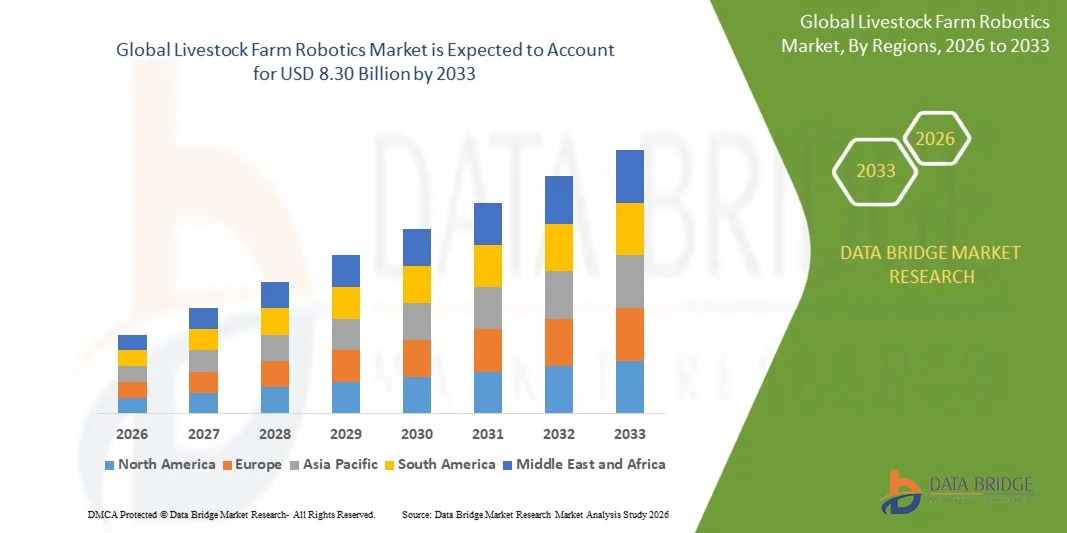
- As per Data Bridge Market Research analysis, the livestock farm robotics market was valued at USD 3.21 billion in 2025 and is projected to reach USD 8.30 billion by 2033, growing at a CAGR of 12.6% from 2026 to 2033.
- The market is experiencing strong growth driven by increasing labor shortages in livestock farming, rising wages and operating costs, growing demand for higher productivity, and the increasing adoption of precision livestock farming technologies. Robotics enables farms to automate repetitive activities while simultaneously collecting animal-level data for better health, nutrition, reproduction, and production management.
- The increasing requirement for continuous livestock monitoring, improved animal welfare, early disease detection, and optimized feed utilization is encouraging dairy, poultry, swine, and cattle producers to invest in robotic technologies. Automated milking remains the most mature application, while feeding, health monitoring, cleaning, and autonomous livestock-management robots are expanding the addressable market. Current research consistently identifies milking robots as the leading robot category because milking is a frequent and highly labor-intensive operation.
Market Size & Forecast
- Global Market Value (2025): USD 3.21 Billion
- Expected Market Value (2033): USD 8.30 Billion
- Forecast CAGR (2026–2033): 12.6%
- Leading Region in 2025: North America
- Fastest Growing Region: Asia-Pacific
What are the Major Takeaways of the Livestock Farm Robotics Market?
- Europe dominated the global livestock farm robotics market with the largest revenue share of 34.72% in 2025, supported by advanced dairy infrastructure, high adoption of automated milking systems, strong agricultural mechanization, and the presence of established livestock-technology companies.
- Asia-Pacific is expected to be the fastest-growing region at a CAGR of 15.4% from 2026 to 2033, fueled by rising livestock production, labor shortages, increasing dairy consumption, modernization of farms, and government-supported agricultural mechanization. The Asia-Pacific milking-robot market is already growing faster than the global market, supported by labor constraints, dairy modernization, and government initiatives.
- The automated milking robots segment led the market with a 52.84% share in 2025, driven by the need to automate frequent milking activities, reduce dependence on skilled labor, improve milking consistency, and enable individual animal monitoring. Milking robots are widely recognized as the largest category within livestock robotics and monitoring markets.
- The feeding robots is projected to register the fastest growth at a CAGR of 15.1% from 2026 to 2033, supported by increasing demand for automated feed preparation, distribution, feed pushing, precision nutrition, and reduction of feed wastage.
- The livestock health & behavior monitoring segment is projected to register the fastest growth at a CAGR of 16.2% from 2026 to 2033, supported by the growing use of computer vision, wearable sensors, thermal imaging, RFID, AI, and machine learning for early disease detection, behavioral analysis, reproductive management, and animal-welfare monitoring.
- Dairy cattle segment is expected to dominate the livestock type category with a market share of 48.62% in 2025, primarily because dairy farms have extensive requirements for automated milking, feeding, health monitoring, cleaning, and herd-management solutions. Independent livestock-monitoring research similarly identifies dairy cattle as the leading livestock category.
- Semi-autonomous is expected to account for the largest autonomy share with a market share of 61.73% in 2025, as livestock producers generally prefer systems that automate repetitive operations while retaining human oversight for animal handling, maintenance, and exception management.
Report Scope and Livestock Farm Robotics Market Segmentation
|
Attributes |
Livestock Farm Robotics Key Market Insights |
|
Segments Covered |
|
|
Countries Covered |
North America
Europe
Asia-Pacific
Middle East and Africa
South America
|
|
Key Market Players |
|
|
Market Opportunities |
|
|
Value Added Data Infosets |
In addition to the insights on market scenarios such as market value, growth rate, segmentation, geographical coverage, and major players, the market reports curated by the Data Bridge Market Research also include import export analysis, production capacity overview, production consumption analysis, price trend analysis, climate change scenario, supply chain analysis, value chain analysis, raw material/consumables overview, vendor selection criteria, PESTLE Analysis, Porter Analysis, and regulatory framework. |
What is the Key Trend in the Livestock Farm Robotics Market?
- Livestock farms are increasingly shifting from standalone automation equipment toward integrated robotic ecosystems that combine robots, sensors, cameras, animal identification, cloud platforms, and farm-management software.
- Automated milking remains the most established robotic application because robotic systems can perform repeated milking operations while collecting information about milk yield, milking frequency, and individual animal conditions. The ability to combine milking automation with herd-management data is strengthening the value proposition of robotic systems.
- For instance, in April 2025, DeLaval launched an updated VMS V300 robotic milking system, a larger milking box and its new Flow-Responsive Milking functionality, with the company reporting customer reductions of up to 40 seconds per cow per milking.
- Robotic feeding is gaining momentum as livestock producers seek to improve feed utilization and reduce labor requirements. Feeding robots can repeatedly deliver feed according to predefined schedules and, in more advanced systems, adapt feeding strategies according to animal production and health data.
- For instance, in October 2024, Trioliet launched the Triomatic WP 2 600 feeding robot, mainly for large-scale livestock farms. The robot has a 6 m³ capacity and approximately 2,000 kg loading capacity, making it suitable for farms with around 600–800 livestock units.
- Autonomous cleaning and manure-management robots are also expanding as farms seek to maintain cleaner housing environments while reducing the manual labor associated with repetitive barn-cleaning activities.
- For instance, in June 2025, JOZ launched Barn-E PRO manure robot, which was redesigned for demanding barn environments and can handle solid floors, straw, sawdust, and deep-litter conditions. It has a 500-liter manure capacity and is designed to reduce the number of cleaning trips while improving reliability and maintenance convenience. Also, JOZ introduced the Moov 2PRO, an upgraded feed-pushing robot. The launches demonstrate the expansion of robotics beyond milking into barn hygiene and feed management.
- The integration of robotics with IoT, RFID, cloud computing, AI, and predictive analytics is creating a transition from task automation toward data-driven autonomous livestock management. Precision livestock farming research highlights the increasing role of IoT, AI, smart sensors, and connected platforms in improving animal health, productivity, welfare, and farm efficiency.
What are the Key Drivers of the Livestock Farm Robotics Market?
- Rising labor shortages and increasing labor costs are among the most important factors driving livestock robotics adoption. Dairy, poultry, and swine operations require repetitive activities throughout the day, making them particularly suitable for automation.
- The growing global demand for milk, meat, and eggs is increasing pressure on livestock producers to improve productivity without proportionally increasing labor requirements. Robotics enables farms to automate repetitive activities and increase operational consistency.
- For instance, in February 2025, DeLaval reported that its VMS Batch Milking system was already operating on 20 farms across 13 countries, with labor shortages and rising costs identified as key reasons for adoption. At Boerderij De Boterpot in the Netherlands, 500 cows are milked using 11 VMS V310 robots, allowing the farm to conduct a third milking without adding staff.
- The expansion of automated milking is a major market driver. Robotic milking provides greater flexibility in milking schedules and reduces the amount of direct operator involvement, while also generating animal-level production information.
- For instance, in April 2025, DeLaval launched an updated VMS V300 robotic milking system. This model includes a larger milking box and its new Flow-Responsive Milking functionality, with the company reporting customer reductions of up to 40 seconds per cow per milking. DeLaval also introduced AI-powered DeLaval InSight vision technology to improve teat-location accuracy. The company subsequently reported that VMS Batch Milking was already being used on farms across 13 countries, demonstrating continued expansion of automated milking.
- Animal welfare and disease prevention are becoming increasingly important. Automated monitoring systems can identify behavioral abnormalities and health changes earlier, allowing farmers and veterinarians to intervene before conditions become severe.
- For instance, in September 2025, DeLaval’s expanded Hamra Farm in Sweden, the 12,000-square-meter expansion includes five robotic milking systems and AI-powered technologies for identifying cows at risk of illness. Automated somatic-cell counting supports milk-quality and udder-health management, while behavioral analysis tracks activity, rumination, and feeding patterns. These technologies demonstrate how livestock robotics is increasingly being used for early health-risk detection and improved animal welfare rather than simply reducing manual labor.
- AI and computer vision are expanding the capabilities of livestock robots beyond simple mechanical automation. Vision systems can identify individual animals, analyze behavior, detect abnormalities, and support autonomous navigation.
- Increasing agricultural modernization in Asia-Pacific, particularly China, Japan, India, Australia, and New Zealand, is opening significant opportunities for livestock robotics. Asia-Pacific's milking-robot market is expected to expand rapidly due to labor shortages, increasing dairy production requirements, modernization, and government agricultural mechanization initiatives.
Which Factors are Challenging the Growth of the Livestock Farm Robotics Market?
- Advanced livestock robots require significant upfront investment, particularly automated milking systems, robotic feeding platforms, autonomous cleaning equipment, sensors, cameras, connectivity infrastructure, and farm-management software.
- High capital expenditure limits adoption among small livestock producers, particularly in developing markets where farms may have limited access to financing and technical support.
- Livestock robotics also requires specialized installation, maintenance, calibration, and technical expertise. Farmers may need trained personnel or external service providers to maintain robotic equipment and interpret the data generated by connected systems.
- Integration with existing farm infrastructure can be challenging. Older barns and conventional milking parlors may require substantial modifications before robotic equipment can be installed efficiently.
- Animal acceptance and behavioral adaptation can also affect deployment. Robotic systems must operate safely around animals while maintaining reliable identification and interaction. This is particularly important for autonomous robots operating freely inside barns.
- Data interoperability and cybersecurity represent additional challenges as livestock farms increasingly connect robots, sensors, cameras, farm-management systems, and cloud platforms.
- Smaller farms can face difficulty achieving attractive returns on investment because the cost of robotic infrastructure may not scale efficiently with small herd sizes. However, the emergence of leasing, shared ownership, and robotics-as-a-service models is expected to gradually reduce this barrier.
How is the Livestock Farm Robotics Market Segmented?
The livestock farm robotics market is segmented on the basis of robot type, livestock type, application, farm size, offering, autonomy level, and end user.
- By Robot Type
On the basis of robot type, the market is segmented into automated milking robots, feeding robots, cleaning & manure management robots, herd monitoring robots, health & disease detection robots, robotic sorting & handling systems, and other livestock robots. The automated milking robots segment dominated the market with an 52.84% share in 2025, owing to the high frequency of milking operations, increasing labor costs, demand for consistent milking performance, and growing adoption of automated milking systems across commercial dairy farms. Automated milking systems can reduce routine labor requirements while providing information related to milk production and individual animal performance.
The feeding robots segment is projected to register the fastest growth at a CAGR of 15.1% from 2026 to 2033, driven by increasing demand for automated feed preparation, transportation, distribution, and feed-pushing operations. Feeding robots allow farms to deliver feed more frequently and consistently while reducing manual labor and potentially minimizing feed waste. Increasing adoption across dairy, swine, and poultry operations is expected to accelerate the segment's expansion.
- By Livestock Type
On the basis of livestock type, the market is segmented into dairy cattle, beef cattle, swine, poultry, sheep & goats, and other livestock. The dairy cattle segment dominated the market with a 48.62% share in 2025, supported by extensive adoption of automated milking systems, robotic feeding, herd monitoring, manure management, and animal-health technologies. Dairy cattle are particularly suitable for robotics because milking, feeding, and monitoring activities are repetitive and require consistent execution.
The poultry segment is projected to register the fastest growth at a CAGR of 14.3% from 2026 to 2033, driven by increasing adoption of automated monitoring, feeding, environmental control, egg-collection, flock surveillance, and disease-detection technologies. Large poultry operations manage thousands or millions of birds, creating strong demand for automated systems capable of continuously monitoring flock conditions. AI-enabled cameras, sensors, and robotics are expected to further improve poultry-farm automation.
- By Application
On the basis of application, the market is segmented into milking management, feeding management, cleaning & manure management, livestock health & behavior monitoring, sorting & handling, environmental monitoring, and other applications. The milking management segment dominated the market with an 42.76% share in 2025, owing to the widespread deployment of robotic milking systems and the repetitive nature of milking activities. Automated milking systems allow animals to be milked according to individual schedules while reducing the need for continuous manual intervention.
The livestock health & behavior monitoring segment is projected to register the fastest growth at a CAGR of 16.2% from 2026 to 2033, driven by increasing demand for early disease detection, continuous behavioral monitoring, reproductive management, and improved animal welfare. Computer vision, thermal imaging, wearable sensors, RFID, IoT, and AI-based analytics are increasingly enabling farmers to identify deviations in animal behavior and health before visible symptoms become severe. The growing use of AI in precision livestock farming is further supporting this trend.
- By Farm Size
On the basis of farm size, the market is segmented into small farms, medium-sized farms, and large farms. The large farms segment is expected to dominate the market with an 56.38% share in 2025, due to higher capital availability, larger livestock populations, greater equipment utilization, and stronger economic incentives for automation. Large dairy, poultry, and swine operations can distribute robotic-equipment costs across higher production volumes, improving the potential return on investment.
The medium-sized farms segment is projected to register the fastest growth at a CAGR of 14.7% from 2026 to 2033, driven by falling technology costs, modular robotic systems, equipment financing, leasing programs, and robotics-as-a-service models. Medium-sized farms are increasingly becoming an important customer base because they require labor-saving technologies but may not have the capital or infrastructure of the largest industrial livestock producers. Adoption of robotic milking among midsized U.S. dairy farms demonstrates the potential for automation beyond the largest operations.
- By Offering
On the basis of offering, the market is segmented into hardware, software, and services. The hardware segment is expected to dominate the market with a 67.41% share in 2025, due to the growing deployment of robotic milking systems, feeding robots, cleaning robots, robotic arms, sensors, cameras, RFID equipment, navigation systems, and control units. Hardware represents the physical automation infrastructure and therefore accounts for the largest proportion of investment in livestock robotics deployments. Research into precision livestock farming also identifies hardware-intensive systems such as robotic milking, precision feeding, sensors, and monitoring equipment as key components of the market.
The software segment is projected to register the fastest growth at a CAGR of 16.4% from 2026 to 2033, driven by increasing demand for AI-based livestock analytics, cloud-connected farm-management platforms, animal identification, predictive health monitoring, robotic fleet management, computer vision, and real-time decision support. Software is increasingly becoming the intelligence layer connecting robots, cameras, sensors, and animal databases, enabling livestock producers to move from basic automation toward predictive and autonomous farm management.
- By Autonomy Level
On the basis of autonomy level, the market is segmented into semi-autonomous and fully autonomous. The semi-autonomous segment is expected to dominate the market with a 61.73% share in 2025, due to its ability to automate repetitive livestock-management tasks while allowing farmers to retain control over animal handling, maintenance, safety, and operational decisions. Semi-autonomous solutions provide a relatively lower-risk transition from conventional manual processes to advanced robotic farming.
The fully autonomous segment is projected to register the fastest growth at a CAGR of 17.8% from 2026 to 2033, driven by advances in AI, machine vision, LiDAR, GNSS, sensor fusion, edge computing, autonomous navigation, and cloud connectivity. Fully autonomous robots are increasingly being developed for feeding, cleaning, monitoring, sorting, and other repetitive livestock activities. Advances in AI-based autonomous navigation are particularly important for robots that must operate safely in dynamic barn environments containing moving animals and farm personnel.
- By End User
On the basis of end user, the market is segmented into commercial livestock farms & producers, dairy farms, poultry farms, swine farms, agricultural cooperatives, livestock service providers, and government & research organizations. The commercial livestock farms & producers segment is expected to dominate the market with a 46.35% share in 2025, due to large-scale adoption of automated milking, feeding, cleaning, animal monitoring, and precision livestock-management systems. Commercial producers have stronger economic incentives to automate because robotics can reduce recurring labor requirements while increasing operational consistency and providing animal-level production data.
The livestock service providers segment is projected to register the fastest growth at a CAGR of 15.8% from 2026 to 2033, driven by the expansion of robotics-as-a-service, managed automation, contract-based livestock monitoring, equipment leasing, and shared robotic infrastructure. These models allow smaller and medium-sized farms to access advanced robotic capabilities without purchasing and maintaining complete robotic systems themselves. Increasing cloud connectivity and remote equipment management are expected to make service-based livestock robotics increasingly practical.
Which Region Holds the Largest Share of the Livestock Farm Robotics Market?
- Europe dominated the livestock farm robotics market and accounted for an estimated 34.72% revenue share in 2025, supported by advanced dairy infrastructure, high adoption of automated milking technologies, established livestock automation manufacturers, high labor costs, and strong emphasis on farm efficiency and animal welfare.
- The region benefits from a mature dairy automation ecosystem, particularly in countries such as the Netherlands, Germany, Denmark, Sweden, France, and the U.K. The presence of leading companies such as Lely, DeLaval, GEA, Fullwood JOZ, and other livestock-technology suppliers supports technology penetration.
- Asia-Pacific is expected to be the fastest-growing region, with an estimated 15.4% CAGR from 2026 to 2033, driven by expanding dairy and livestock production, rising labor costs, agricultural modernization, increasing demand for animal protein, and government support for farm mechanization. The Asia-Pacific milking robots market is already forecast to grow at a faster pace than the global market.
U.K. Livestock Farm Robotics Market Insight
The U.K. livestock farm robotics market is experiencing steady growth, supported by increasing adoption of robotic milking, automated feeding, manure management, and animal-monitoring systems. Labor availability, operating costs, and the need to improve dairy-farm productivity are encouraging farmers to automate repetitive activities. The U.K. also benefits from an established agricultural-technology ecosystem and strong adoption of data-driven livestock management.
Germany Livestock Farm Robotics Market Insight
The Germany livestock farm robotics market is expanding due to the country's strong dairy and livestock industry, advanced engineering capabilities, and high demand for automation. German farms are increasingly adopting robotic milking, feeding, cleaning, and herd-monitoring technologies to reduce labor requirements and improve farm productivity. Germany's strong machinery and industrial-automation ecosystem further supports the development and deployment of sophisticated livestock robotics.
Asia-Pacific Livestock Farm Robotics Market Insight
The Asia-Pacific livestock farm robotics market is expected to witness rapid growth, driven by expanding livestock production, rising demand for dairy and animal protein, labor shortages, increasing farm sizes, and modernization of agricultural infrastructure. China, Japan, India, Australia, and New Zealand represent major opportunities as producers increasingly seek automated solutions for milking, feeding, monitoring, and animal health management. The region's milking-robot market is expected to grow rapidly due to labor shortages and dairy-farm modernization.
Japan Livestock Farm Robotics Market Insight
The Japan livestock farm robotics market is witnessing consistent growth due to labor shortages, an aging agricultural workforce, advanced robotics capabilities, and strong demand for automated dairy and livestock operations. Japanese farms and technology providers are increasingly exploring robotic milking, feeding, monitoring, and autonomous livestock-management solutions. The country's established robotics ecosystem creates opportunities for integrating AI, machine vision, sensors, and autonomous systems into livestock operations.
China Livestock Farm Robotics Market Insight
The China livestock farm robotics market is growing rapidly as livestock producers modernize large-scale dairy, poultry, and swine operations. Increasing labor costs, expansion of commercial farms, government support for agricultural modernization, and growing demand for efficient livestock production are supporting adoption. China also offers significant opportunities for AI-enabled monitoring, autonomous feeding, robotic cleaning, and animal-health management.
North America Livestock Farm Robotics Market Insight
North America represents a major market for livestock robotics due to large-scale commercial dairy operations, labor shortages, advanced agricultural infrastructure, and high technology adoption. The U.S. livestock-monitoring robotics market benefits from industrialized livestock production and increasing investment in precision agriculture.
U.S. Livestock Farm Robotics Market Insight
The U.S. livestock farm robotics market is driven by labor shortages, rising farm labor costs, increasing adoption of automated milking systems, and the need to improve productivity and operational efficiency. Growing use of precision livestock farming, AI, IoT, sensors, and computer vision is supporting advanced animal monitoring and herd management. Increasing focus on animal health and welfare, automated feeding, manure management, continuous livestock monitoring, farm modernization, and investments by large and midsized commercial farms are further supporting market growth.
Canada Livestock Farm Robotics Market Insight
The Canada livestock farm robotics market is primarily driven by labor shortages, increasing agricultural labor costs, and growing demand for automation to improve farm productivity and efficiency. Rising adoption of robotic milking, precision livestock farming, AI-enabled monitoring, IoT, sensors, and automated feeding systems is creating additional growth opportunities. The strong dairy farming base in Quebec and Ontario, increasing focus on animal health and welfare, farm modernization, continuous herd monitoring, cost reduction, and investment in advanced livestock automation technologies are also contributing to market expansion.
Which are the Top Companies in Livestock Farm Robotics Market?
The livestock farm robotics industry is primarily led by well-established companies, including:
- DeLaval (Sweden)
- Lely (Netherlands)
- GEA Group AG (Germany)
- BouMatic (U.S.)
- Dairymaster (Ireland)
- Fullwood JOZ (U.K.)
- Waikato Milking Systems (New Zealand)
- Trioliet B.V. (Netherlands)
- Cormall A/S (Denmark)
- JOZ B.V. (Netherlands)
- AMS Galaxy USA (U.S.)
- System Happel GmbH (Germany)
- HETWIN Automation Systems GmbH (Austria)
- Milkplan S.A. (Greece)
- SAC Christensen & Co. (Denmark)
- Afimilk Ltd. (Israel)
- Nedap N.V. (Netherlands)
- Antelliq/Allflex (France)
- Cainthus (Canada)
- Swine Robotics, Inc. (U.S.)
- AT-Collections B.V. (Netherlands)
What are Latest Developments in Livestock Farm Robotics Market?
- In April 2026, Lely continued expanding its integrated dairy automation ecosystem, with robotic milking, feeding, manure-management, and farm-management technologies increasingly connected through digital platforms. The company's approach reflects the broader industry shift toward combining physical robots with farm data and intelligent management tools.
- In June 2026, GEA continued advancing automated dairy technologies, focusing on robotic milking, herd management, sensor-based monitoring, and integrated dairy-farm automation. The company's technology strategy increasingly emphasizes automation combined with data-driven decision-making.
- In July 2025, BouMatic announced plans to merge with the SAC brand, a Danish company associated with material handling and feeding systems. The move is intended to streamline operations and strengthen BouMatic's portfolio and market position in automated dairy and feeding solutions.
- In October 2024, Trioliet launched the Triomatic WP 2 600, a larger 6 m³ automated feeding robot designed for farms with approximately 600–800 livestock units. The system can be scaled to as many as four robots, supporting farms of up to about 2,500 livestock units. This launch reflects the expansion of robotic feeding into larger commercial dairy farms.
- In January 2024, BouMatic expanded its offering beyond milking automation with a dedicated Feeding and Bedding Solutions portfolio. Its robotic offering includes the Shuttle Eco autonomous feeding robot, which uses battery technology and automated operation to deliver measured quantities of feed throughout the day.

- Interactive Data Analysis Dashboard
- Company Analysis Dashboard for high growth potential opportunities
- Research Analyst Access for customization & queries
- Competitor Analysis with Interactive dashboard
- Latest News, Updates & Trend analysis
- Harness the Power of Benchmark Analysis for Comprehensive Competitor Tracking
Data collection and base year analysis are done using data collection modules with large sample sizes. The stage includes obtaining market information or related data through various sources and strategies. It includes examining and planning all the data acquired from the past in advance. It likewise envelops the examination of information inconsistencies seen across different information sources. The market data is analysed and estimated using market statistical and coherent models. Also, market share analysis and key trend analysis are the major success factors in the market report. To know more, please request an analyst call or drop down your inquiry.
The key research methodology used by DBMR research team is data triangulation which involves data mining, analysis of the impact of data variables on the market and primary (industry expert) validation. Data models include Vendor Positioning Grid, Market Time Line Analysis, Market Overview and Guide, Company Positioning Grid, Patent Analysis, Pricing Analysis, Company Market Share Analysis, Standards of Measurement, Global versus Regional and Vendor Share Analysis. To know more about the research methodology, drop in an inquiry to speak to our industry experts.
Data Bridge Market Research is a leader in advanced formative research. We take pride in servicing our existing and new customers with data and analysis that match and suits their goal. The report can be customized to include price trend analysis of target brands understanding the market for additional countries (ask for the list of countries), clinical trial results data, literature review, refurbished market and product base analysis. Market analysis of target competitors can be analyzed from technology-based analysis to market portfolio strategies. We can add as many competitors that you require data about in the format and data style you are looking for. Our team of analysts can also provide you data in crude raw excel files pivot tables (Fact book) or can assist you in creating presentations from the data sets available in the report.