


What is the Global Low-Carbon Propulsion Market Size and Growth Rate?
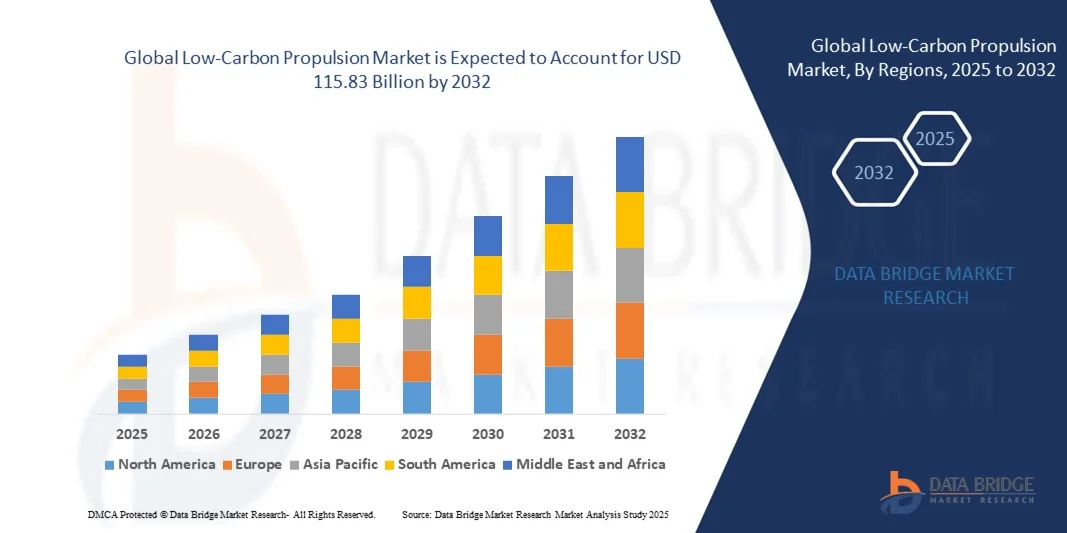
- The global low-carbon propulsion market size was valued at USD 24.31 billion in 2024 and is expected to reach USD 115.83 billion by 2032, at a CAGR of 21.55% during the forecast period
- Increasing preferences of the consumer towards the usages of emission free vehicles and energy efficient transport, volatility in the prices of fuel and vehicle conversions, adoption of stringent regulations on emissions along with increasing trends to reduce emissions are some of the major as well vital factors which will likely to augment the growth of the low-carbon propulsion market
What are the Major Takeaways of Low-Carbon Propulsion Market?
- Development as well as adoption of green vehicles, availability of alternative fuel engine solutions for commercial vehicles along with government support for zero emission technologies which will further contribute by generating immense opportunities that will led to the growth of the low-carbon propulsion market in the above-mentioned projected timeframe
- High cost of technology as well as component along with lack of improved infrastructure for alternative fuel vehicles which will likely to act as market restraints factor for the growth of the low-carbon propulsion
- North America dominated the low-carbon propulsion market with the largest revenue share of 37.21% in 2024, driven by the growing adoption of electric and alternative-fuel vehicles, favorable government policies, and increasing environmental awareness among consumers
- The Europe market is projected to expand at the fastest CAGR of 10.65% during the forecast period, supported by stringent emission regulations, government incentives for EV adoption, and growing environmental awareness
- The Electric segment dominated the market with a revenue share of 45% in 2024, driven by increasing adoption of battery-electric vehicles (BEVs) across passenger and commercial segments, rising government incentives, and global regulatory pressure to reduce carbon emissions
Report Scope and Low-Carbon Propulsion Market Segmentation
|
Attributes |
Low-Carbon Propulsion Key Market Insights |
|
Segments Covered |
|
|
Countries Covered |
North America
Europe
Asia-Pacific
Middle East and Africa
South America
|
|
Key Market Players |
|
|
Market Opportunities |
|
|
Value Added Data Infosets |
In addition to the insights on market scenarios such as market value, growth rate, segmentation, geographical coverage, and major players, the market reports curated by the Data Bridge Market Research also include in-depth expert analysis, pricing analysis, brand share analysis, consumer survey, demography analysis, supply chain analysis, value chain analysis, raw material/consumables overview, vendor selection criteria, PESTLE Analysis, Porter Analysis, and regulatory framework. |
What is the Key Trend in the Low-Carbon Propulsion Market?
Integration of Advanced AI and Smart Connectivity
- A key and accelerating trend in the global low-carbon propulsion market is the increasing integration of artificial intelligence (AI) and smart connectivity systems, including advanced vehicle management platforms and IoT-enabled infrastructure. This combination enhances operational efficiency, predictive maintenance, and real-time energy management, creating smarter and more sustainable transportation solutions
- For instance, several next-generation electric buses and hybrid commercial vehicles integrate AI-based propulsion management that optimizes battery usage, torque delivery, and regenerative braking automatically, improving energy efficiency
- AI-enabled low-carbon propulsion systems allow vehicles to learn driving patterns, optimize routes, and reduce emissions dynamically. Advanced telematics integration provides operators with actionable insights on energy consumption and performance metrics, ensuring both sustainability and operational cost reduction
- The seamless connectivity with smart grids, charging stations, and fleet management platforms facilitates centralized monitoring and control, enabling operators to manage multiple vehicles, schedule charging, and track performance remotely
- This trend of intelligent, connected, and efficient propulsion systems is reshaping expectations in the transport sector. Consequently, companies such as BYD, Tesla, and Proterra are focusing on AI-integrated propulsion solutions to enhance efficiency, connectivity, and sustainability
- The demand for AI-driven and connected low-carbon propulsion systems is expanding rapidly across urban transport, corporate fleets, and commercial mobility solutions, driven by environmental regulations and growing sustainability awareness
What are the Key Drivers of Low-Carbon Propulsion Market?
- Increasing regulatory pressure to reduce greenhouse gas emissions, coupled with the global push for electrification and sustainable mobility, is a major driver for the growing adoption of low-carbon propulsion systems
- For instance, in 2024, several governments introduced incentives for electric and hybrid commercial vehicles, including subsidies for fleet operators and tax benefits for adopting zero-emission propulsion technologies. Such initiatives accelerate market growth
- Rising fuel costs and the need for cost-efficient fleet management are driving the replacement of traditional combustion engines with low-carbon alternatives, offering long-term savings and reduced carbon footprints
- Growing awareness of environmental sustainability among consumers and corporations is increasing adoption across urban transport, public transit, and commercial fleets, making low-carbon propulsion solutions a key component of green mobility initiatives
- Technological advancements, including high-efficiency batteries, lightweight materials, regenerative braking, and AI-based propulsion management, further propel adoption by improving vehicle performance, energy efficiency, and range
- The expansion of charging infrastructure, coupled with government-backed green mobility programs, is facilitating easier deployment of electric and hybrid fleets, supporting both urban and long-haul operations
Which Factor is Challenging the Growth of the Low-Carbon Propulsion Market?
- High initial capital costs of low-carbon propulsion systems, including electric and hybrid powertrains, pose a major barrier to adoption, particularly for small fleet operators and budget-conscious buyers
- Limited charging infrastructure in certain regions, along with range anxiety and concerns over downtime for recharging, restricts the large-scale adoption of electric-powered propulsion solutions
- Technological complexity, including integration with AI, telematics, and battery management systems, can increase maintenance requirements and operational learning curves for fleet operators
- Supply chain constraints, particularly for battery components such as lithium and cobalt, create uncertainties in scaling production, affecting affordability and accessibility of low-carbon vehicles
- Overcoming these challenges requires government incentives, investment in charging infrastructure, development of cost-effective propulsion technologies, and operator education on energy-efficient operations to support sustained growth in the low-carbon propulsion market
How is the Low-Carbon Propulsion Market Segmented?
The market is segmented on the basis of fuel type, electric vehicle, mode, rail application, and vehicle type.
- By Fuel Type
On the basis of fuel type, the low-carbon propulsion market is segmented into Compressed Natural Gas (CNG), Liquefied Natural Gas (LNG), Ethanol, Hydrogen, and Electric. The Electric segment dominated the market with a revenue share of 45% in 2024, driven by increasing adoption of battery-electric vehicles (BEVs) across passenger and commercial segments, rising government incentives, and global regulatory pressure to reduce carbon emissions. Electric propulsion systems offer benefits such as zero tailpipe emissions, lower operational costs, and compatibility with smart charging infrastructure.
The Hydrogen segment is expected to witness the fastest CAGR of 22% from 2025 to 2032, propelled by growing investments in hydrogen fuel cell technology for heavy-duty and long-range applications. Increasing pilot projects, such as hydrogen-powered buses and trucks, are further boosting market adoption and future growth prospects.
- By Electric Vehicle Type
On the basis of electric vehicle type, the market is segmented into Passenger Car, Electric Two-Wheeler, Electric Bus, and Electric Off-Highway Vehicle. The Passenger Car segment held the largest market revenue share of 52% in 2024, led by rising consumer preference for private electric vehicles, improved charging networks, and expanding vehicle model availability from major OEMs. Advanced features such as regenerative braking, AI-assisted energy management, and connected vehicle integration are driving adoption.
The Electric Bus segment is expected to register the fastest CAGR of 20% from 2025 to 2032, owing to urbanization, government-supported clean public transport initiatives, and the push for low-emission city mobility solutions. Several cities are adopting electric bus fleets to reduce air pollution and operational costs, boosting market growth.
- By Mode
On the basis of mode, the low-carbon propulsion market is segmented into Road and Rail. The Road segment dominated the market with a revenue share of 68% in 2024, driven by the widespread deployment of electric and hybrid vehicles in passenger and commercial transport. The segment benefits from expanding EV infrastructure, lower operational costs, and regulatory support for low-emission road vehicles.
The Rail segment is expected to witness the fastest CAGR of 18% from 2025 to 2032, supported by electrification of freight and passenger lines, high-speed rail projects, and increasing investment in sustainable urban mobility. Rail operators are adopting low-carbon propulsion to meet emission reduction targets and improve energy efficiency across long-distance transport.
- By Rail Application
On the basis of rail application, the low-carbon propulsion market is segmented into Passenger and Freight. The Passenger segment dominated the market with a revenue share of 60% in 2024, fueled by increasing demand for cleaner public transportation, high-speed rail networks, and government-led green transport initiatives. Electric and hybrid-powered trains provide lower emissions, reduced noise, and enhanced operational efficiency.
The Freight segment is expected to register the fastest CAGR of 19% from 2025 to 2032, driven by electrification of cargo lines, growing e-commerce logistics requirements, and the shift from diesel locomotives to sustainable alternatives. Rail freight operators are increasingly adopting low-carbon propulsion to meet environmental regulations and reduce fuel costs.
- By Vehicle Type
On the basis of vehicle type, the low-carbon propulsion market is segmented into Heavy-Duty Vehicle and Light-Duty Vehicle. The Light-Duty Vehicle segment held the largest market revenue share of 55% in 2024, supported by rapid adoption of electric cars, urban delivery vans, and last-mile mobility solutions. Technological advancements such as regenerative braking, AI energy optimization, and connected charging further drive adoption.
The Heavy-Duty Vehicle segment is expected to witness the fastest CAGR of 21% from 2025 to 2032, fueled by the increasing electrification of trucks, buses, and commercial vehicles for long-haul and municipal applications. Regulatory pressure and rising fuel costs encourage fleet operators to shift toward low-carbon propulsion solutions for heavy-duty transport.
Which Region Holds the Largest Share of the Low-Carbon Propulsion Market?
- North America dominated the low-carbon propulsion market with the largest revenue share of 37.21% in 2024, driven by the growing adoption of electric and alternative-fuel vehicles, favorable government policies, and increasing environmental awareness among consumers
- Consumers in the region highly value technological innovation, energy efficiency, and eco-friendly transport solutions, making low-carbon propulsion systems a preferred choice for passenger, commercial, and industrial vehicles
- This widespread adoption is further supported by robust infrastructure, high disposable incomes, and strong incentives for electric vehicle purchases, positioning North America as a key hub for low-carbon mobility solutions
U.S. Low-Carbon Propulsion Market Insight
The U.S. market captured the largest revenue share of 81% in North America in 2024, led by increasing electric vehicle adoption, government subsidies for low-emission vehicles, and expanding EV charging infrastructure. Rapid advancements in battery technologies and the integration of connected vehicle systems are further driving market growth. The shift toward sustainable mobility and stricter emission standards also reinforces the adoption of low-carbon propulsion systems across passenger cars, commercial fleets, and public transport.
Which Region is the Fastest Growing Region in the Low-Carbon Propulsion Market?
The Europe market is projected to expand at the fastest CAGR of 10.65% during the forecast period, supported by stringent emission regulations, government incentives for EV adoption, and growing environmental awareness. Rapid urbanization, electrification of public transport, and increasing deployment of alternative-fuel vehicles are driving market penetration. European consumers are attracted to the energy efficiency, lower operational costs, and sustainability offered by low-carbon propulsion solutions. The market is seeing strong growth across passenger vehicles, commercial fleets, and rail applications, with major initiatives in countries such as Germany, France, and the U.K.
U.K. Low-Carbon Propulsion Market Insight
The U.K. low-carbon propulsion market is projected to grow at a significant CAGR, driven by the accelerating adoption of electric vehicles (EVs) and the continuous expansion of supporting infrastructure. Government policies aimed at reducing carbon emissions, including incentives for EV purchases and tax benefits for low-emission vehicles, are bolstering market demand. The development of extensive EV charging networks and the increasing availability of electric commercial fleets are further supporting adoption. Rising consumer awareness regarding sustainability and eco-friendly transportation options is encouraging both individual and corporate users to transition toward low-carbon propulsion technologies, fostering long-term market growth.
Germany Low-Carbon Propulsion Market Insight
Germany’s low-carbon propulsion market is expected to expand at a robust CAGR, supported by strong demand for electric and hydrogen-powered vehicles across passenger, commercial, and public transport sectors. Advanced research and development initiatives in sustainable mobility, coupled with government regulations mandating stricter emission standards, are driving adoption. Germany’s mature automotive industry, well-developed infrastructure, and emphasis on innovation enable seamless integration of low-carbon propulsion technologies. Additionally, initiatives promoting fleet electrification, renewable energy utilization, and smart mobility solutions are accelerating the transition toward greener transportation, positioning Germany as a key leader in the European low-carbon propulsion market.
Which are the Top Companies in Low-Carbon Propulsion Market?
The low-carbon propulsion industry is primarily led by well-established companies, including:
- Tesla (U.S.)
- BYD Company Ltd. (China)
- YUTONG (China)
- Proterra (U.S.)
- Nissan (Japan)
- Bombardier (Canada)
- Siemens (Germany)
- Alstom (France)
- Toyota (Japan)
- Honda Motor Co., Ltd. (Japan)
- HYUNDAI MOTOR GROUP (South Korea)
- MAN Energy Solutions SE (Germany)
- GENERAL ELECTRIC (U.S.)
- NFI Group Inc. (Canada)
- Cummins Inc. (U.S.)
- Nikola Corporation (U.S.)
- Zenith (U.K.)
- Volkswagen AG (Germany)
- AB Volvo (Sweden)
- VDL Groep (Netherlands)
What are the Recent Developments in Global Low-Carbon Propulsion Market?
- In May 2024, Subaru Corporation (Japan), Toyota Motor Corporation (Japan), and Mazda Motor Corporation (Japan) announced a strategic partnership to develop next-generation engines optimized for electrification and carbon neutrality. These engines aim to integrate efficiently with motors, batteries, and other electric drive units while enabling more compact vehicle packaging. The collaboration also seeks to decarbonize internal combustion engines by making them compatible with various carbon-neutral fuels, reinforcing the commitment of all three companies to sustainable mobility and emission reduction
- In May 2024, the German Aerospace Center (DLR) in Cologne finalized its aviation strategy to reduce the carbon and non-carbon footprint of flying. DLR’s plan outlines pathways to achieve climate-neutral aviation by mid-century, focusing on sustainable energy propulsion, climate-optimized flight routes, and innovative aircraft concepts. By collaborating with industry and research institutions, the strategy strengthens Germany’s commitment to a low-carbon aviation future
- In April 2024, Terragia Biofuel secured a USD 6 million seed funding round led by Engine Ventures and Energy Impact Partners (EIP). The funding will accelerate commercialization of Terragia’s biology-based approach to converting cellulosic biomass into ethanol and other products, expand the workforce, and initiate partnerships with major biofuel producers, further advancing sustainable biofuel technologies
- In March 2024, Mitsubishi Heavy Industries, Ltd. (Japan) partnered with Kellogg Brown & Root, Ltd. (KBR, Ltd.) (U.S.) to deliver CO2 capture technology for a low-carbon hydrogen production plant at the Stanlow Manufacturing Complex in northwest England. The project aims to support one of the U.K.’s leading refineries in producing hydrogen with minimal carbon emissions, marking a key step in the U.K.’s energy transition
- In February 2024, Cummins Inc. (U.S.) launched its most efficient heavy-duty diesel engine to date, the X15, as part of the Cummins HELM 15-liter fuel-agnostic platform. The engine is designed to meet U.S. EPA and CARB 2027-aligned regulations at launch, combining fuel flexibility with enhanced efficiency, strengthening Cummins’ position in sustainable heavy-duty powertrain solutions

- Interactive Data Analysis Dashboard
- Company Analysis Dashboard for high growth potential opportunities
- Research Analyst Access for customization & queries
- Competitor Analysis with Interactive dashboard
- Latest News, Updates & Trend analysis
- Harness the Power of Benchmark Analysis for Comprehensive Competitor Tracking
Data collection and base year analysis are done using data collection modules with large sample sizes. The stage includes obtaining market information or related data through various sources and strategies. It includes examining and planning all the data acquired from the past in advance. It likewise envelops the examination of information inconsistencies seen across different information sources. The market data is analysed and estimated using market statistical and coherent models. Also, market share analysis and key trend analysis are the major success factors in the market report. To know more, please request an analyst call or drop down your inquiry.
The key research methodology used by DBMR research team is data triangulation which involves data mining, analysis of the impact of data variables on the market and primary (industry expert) validation. Data models include Vendor Positioning Grid, Market Time Line Analysis, Market Overview and Guide, Company Positioning Grid, Patent Analysis, Pricing Analysis, Company Market Share Analysis, Standards of Measurement, Global versus Regional and Vendor Share Analysis. To know more about the research methodology, drop in an inquiry to speak to our industry experts.
Data Bridge Market Research is a leader in advanced formative research. We take pride in servicing our existing and new customers with data and analysis that match and suits their goal. The report can be customized to include price trend analysis of target brands understanding the market for additional countries (ask for the list of countries), clinical trial results data, literature review, refurbished market and product base analysis. Market analysis of target competitors can be analyzed from technology-based analysis to market portfolio strategies. We can add as many competitors that you require data about in the format and data style you are looking for. Our team of analysts can also provide you data in crude raw excel files pivot tables (Fact book) or can assist you in creating presentations from the data sets available in the report.













