


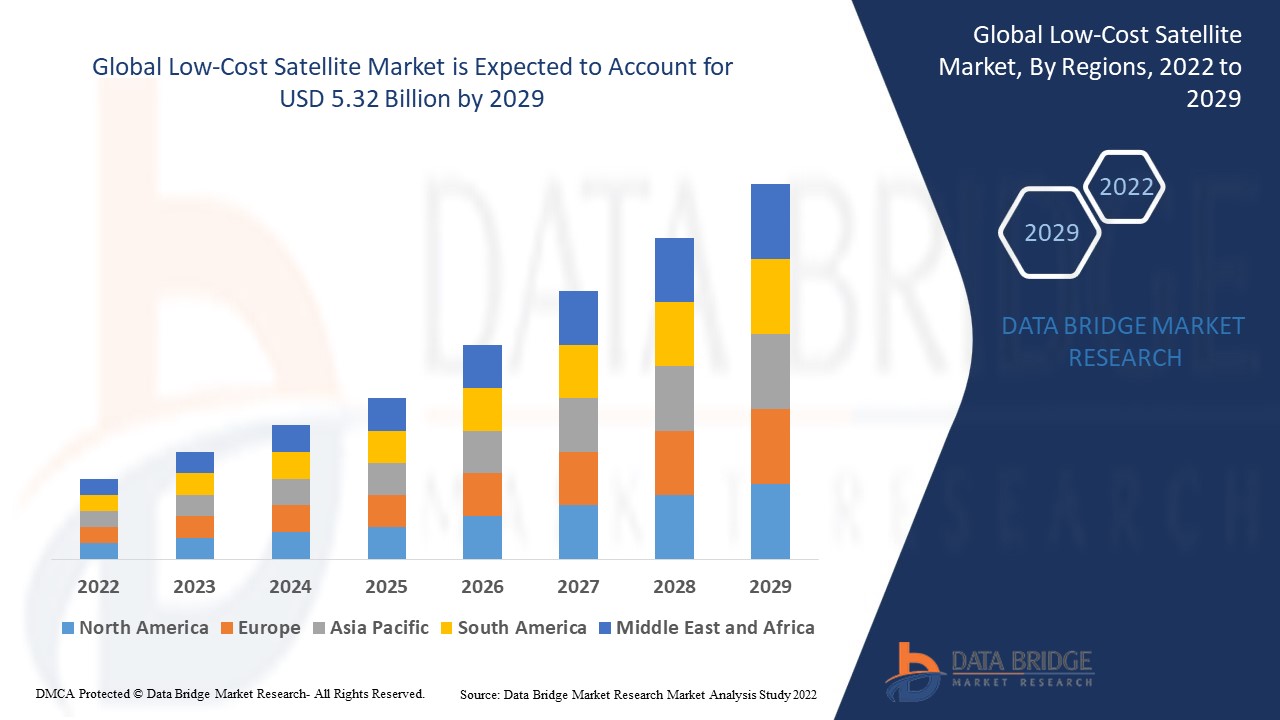
Market Analysis and Insights: Global Low-Cost Satellite Market
Data Bridge Market Research analyses that the low-cost satellite market would exhibit a CAGR of 6.47% for the forecast period. Growing number of terrorist attacks or terrorism in general at airports and railway stations, increased preferences towards software defined payloads for communication satellites, growth and expansion of security and surveillance industry especially in the developing economies and growing public expenditure for the rapid development of internet of things technology are the major factors attributable to the growth of low-cost satellite market. Therefore, the baggage handling system market value would rocket up to USD 5.32 billion by 2029.
From the name itself, it is clear that low-cost satellites are the satellites that are used out of budgetary constraints. The low-cost satellites have similar functioning to high-cost satellite; however, these are deployed for short mission time. The low-cost satellites are more flexible and affordable budgetary alternatives for highly constrained space missions. Further, the low-cost satellites serve as cost efficient platforms for research, development and training operations. Low-cost satellites are generally used by the countries that are allocated with low fund for special programs.
Growth in the level of investments for research and development activities and rising emphasis on the reduction of cost of miniature satellites will foster in growth in the low-cost satellite market value. Rising focus on the deployment of low-cost satellites on low earth orbit (LEO) missions coupled with rising smart city projects or infrastructural development projects will also create lucrative growth opportunities for the low-cost satellite market. Growth in the emergence rate of over the top platform in the television industry and rising penetration of payloads in the telecommunication sector will also foster the low-cost satellite market growth. Growing number of space programs will further carve the way for the growth of the low-cost satellite market.
However, lack of technological expertise in the developing and underdeveloped economies will pose a major challenge to the low-cost satellite market growth rate. High costs involved with technological innovations will hamper the low-cost satellite market growth rate. Further, fluctuations in the prices of raw materials, prevalence of highly dynamic technical environment and high maintenance costs will also restrict the scope of growth for the low-cost satellite market.
This global low-cost satellite market report provides details of new recent developments, trade regulations, import export analysis, production analysis, value chain optimization, market share, impact of domestic and localised market players, analyses opportunities in terms of emerging revenue pockets, changes in market regulations, strategic market growth analysis, market size, category market growths, application niches and dominance, product approvals, product launches, geographic expansions, technological innovations in the market. To gain more info on low-cost satellite market contact Data Bridge Market Research for an Analyst Brief, our team will help you take an informed market decision to achieve market growth.
Global Low-Cost Satellite Market Scope and Market Size
The global low-cost satellite market is segmented on the basis of satellite type, application and end use. The growth amongst these segments will help you analyse meagre growth segments in the industries, and provide the users with valuable market overview and market insights to help them in making strategic decisions for identification of core market applications.
- On the basis of satellite type, the low-cost satellite market is segmented into mini- satellite, micro- satellite and nano- satellite.
- Based on application, the low-cost satellite market is segmented into low-cost communication satellite and low-cost imaging satellite.
- Based on end use, the low-cost satellite market is segmented into military, civil and commercial.
Low-Cost Satellite Market Country Level Analysis
The global low-cost satellite market is analysed and market size insights and trends are provided by country, satellite type, application and end use as referenced above.
The countries covered in the low-cost satellite market report are U.S., Canada and Mexico in North America, Brazil, Argentina and Rest of South America as part of South America, Germany, Italy, U.K., France, Spain, Netherlands, Belgium, Switzerland, Turkey, Russia, Rest of Europe in Europe, Japan, China, India, South Korea, Australia, Singapore, Malaysia, Thailand, Indonesia, Philippines, Rest of Asia-Pacific (APAC) in Asia-Pacific (APAC), South Africa, Saudi Arabia, U.A.E, Israel, Egypt, Rest of Middle East and Africa (MEA) as a part of Middle East and Africa (MEA).
North America dominates the low-cost satellite market and will continue to flourish its trend of dominance during the forecast period owing to the growing adoption of highly advanced technologies, high defense budget allocation and increasing research and development activities. Asia-Pacific region is set to witness unprecedented growth during the forecast period. This is because of the growth and expansion of telecommunication sector in this region and rising proliferation of internet of things technology.
The country section of the low-cost satellite market report also provides individual market impacting factors and changes in regulation in the market domestically that impacts the current and future trends of the market. Data points such as consumption volumes, production sites and volumes, import export analysis, price trend analysis, cost of raw materials, down-stream and upstream value chain analysis are some of the major pointers used to forecast the market scenario for individual countries. Also, presence and availability of global brands and their challenges faced due to large or scarce competition from local and domestic brands, impact of sales channels are considered while providing forecast analysis of the country data.
Competitive Landscape and Low-Cost Satellite Market Share Analysis
The low-cost satellite market competitive landscape provides details by competitor. Details included are company overview, company financials, revenue generated, market potential, investment in research and development, new market initiatives, global presence, production sites and facilities, production capacities, company strengths and weaknesses, product launch, product width and breadth, application dominance. The above data points provided are only related to the companies’ focus related to low-cost satellite market.
The major players operating in the low-cost satellite market report are Raytheon Technologies Corporation, Northrop Grumman., Lockheed Martin Corporation., Boeing., General Dynamics Corporation, BAE Systems., Airbus S.A.S., Leonardo S.p.A., Honeywell International, Inc., Thales Group, Collins Aerospace, Unisys, Palo Alto Networks., F-Secure, L3Harris Technologies, Inc., BALL CORPORATION, General Dynamics Mission Systems, Inc., SpaceQuest Ltd., Terran Orbital Corporation and Dauria Aerospace among others.

- Interactive Data Analysis Dashboard
- Company Analysis Dashboard for high growth potential opportunities
- Research Analyst Access for customization & queries
- Competitor Analysis with Interactive dashboard
- Latest News, Updates & Trend analysis
- Harness the Power of Benchmark Analysis for Comprehensive Competitor Tracking
Table of Content
1 INTRODUCTION
1.1 OBJECTIVES OF THE STUDY
1.2 MARKET DEFINITION
1.3 OVERVIEW OF GLOBAL LOW-COST SATELLITE MARKET
1.4 CURRENCY AND PRICING
1.5 LIMITATION
1.6 MARKETS COVERED
2 MARKET SEGMENTATION
2.1 KEY TAKEAWAYS
2.2 ARRIVING AT THE GLOBAL LOW-COST SATELLITE MARKET
2.2.1 VENDOR POSITIONING GRID
2.2.2 TECHNOLOGY LIFE LINE CURVE
2.2.3 MARKET GUIDE
2.2.4 COMPANY POSITIONING GRID
2.2.5 COMAPANY MARKET SHARE ANALYSIS
2.2.6 MULTIVARIATE MODELLING
2.2.7 TOP TO BOTTOM ANALYSIS
2.2.8 STANDARDS OF MEASUREMENT
2.2.9 VENDOR SHARE ANALYSIS
2.2.10 DATA POINTS FROM KEY PRIMARY INTERVIEWS
2.2.11 DATA POINTS FROM KEY SECONDARY DATABASES
2.3 GLOBAL LOW-COST SATELLITE MARKET: RESEARCH SNAPSHOT
2.4 ASSUMPTIONS
3 MARKET OVERVIEW
3.1 DRIVERS
3.2 RESTRAINTS
3.3 OPPORTUNITIES
3.4 CHALLENGES
4 EXECUTIVE SUMMARY
5 PREMIUM INSIGHT
5.1 PORTERS FIVE FORCES
5.2 REGULATORY STANDARDS
5.3 TECHNOLOGICAL TRENDS
5.4 PATENT ANALYSIS
5.5 CASE STUDY
5.6 VALUE CHAIN ANALYSIS
5.7 COMPANY COMPARITIVE ANALYSIS
6 GLOBAL LOW-COST SATELLITE MARKET, BY SATELLITE TYPE
6.1 OVERVIEW
6.2 MINI SATELLITE
6.3 MICRO SATELLITE
6.4 NANO SATELLITE
6.5 CUBESAT
7 GLOBAL LOW-COST SATELLITE MARKET, BY COMPONENTS
7.1 OVERVIEW
7.2 SOLAR PANEL
7.3 PAYLOAD
7.3.1 TRADITIONAL PAYLOADS
7.3.1.1. OPTICAL & INFRARED
7.3.1.2. HYPERSPECTRAL & MULTISPECTRAL
7.3.1.3. RADAR
7.3.1.4. COMMUNICATION TRANSPONDER
7.3.1.5. OTHERS
7.3.2 SOFTWARE DEFINED PAYLOADS
7.4 CAMERA
7.5 ANNTENA SYSTEM
7.6 PROPULSION SYSTEM
7.6.1 CHEMICAL PROPULSION
7.6.2 ELECTRIC PROPULSION
7.6.3 HYBRID PROPULSION
7.7 OTHERS
8 GLOBAL LOW-COST SATELLITE MARKET, BY ORBIT
8.1 OVERVIEW
8.2 LOW EARTH ORBIT (LEO)
8.3 MEDIUM EARTH ORBIT (MEO)
8.4 GEOSTATIONARY EARTH ORBIT (GEO)
9 GLOBAL LOW-COST SATELLITE MARKET, BY APPLICATION
9.1 OVERVIEW
9.2 COMMUNICATION
9.3 EARTH OBSERVATION
9.4 EDUCATION
9.5 NAVIGATION
9.6 SURVEILLANCE
9.7 OTHERS
10 GLOBAL LOW-COST SATELLITE MARKET, BY FREQUENCY BAND
10.1 OVERVIEW
10.2 L BAND
10.3 S BAND
10.4 C BAND
10.5 X BAND
10.6 KU BAND
10.7 K BAND
10.8 KA BAND
11 GLOBAL LOW-COST SATELLITE MARKET, BY END USER
11.1 OVERVIEW
11.2 MILITARY
11.3 GOVERNMENT
11.4 COMMERCIAL FIRMS
11.5 OTHERS
12 GLOBAL LOW-COST SATELLITE MARKET, BY GEOGRAPHY
GLOBAL LOW-COST SATELLITE MARKET, (ALL SEGMENTATION PROVIDED ABOVE IS REPRESENTED IN THIS CHAPTER BY COUNTRY)
12.1 NORTH AMERICA
12.1.1 U.S.
12.1.2 CANADA
12.1.3 MEXICO
12.2 EUROPE
12.2.1 GERMANY
12.2.2 FRANCE
12.2.3 U.K.
12.2.4 ITALY
12.2.5 SPAIN
12.2.6 RUSSIA
12.2.7 TURKEY
12.2.8 BELGIUM
12.2.9 NETHERLANDS
12.2.10 NORWAY
12.2.11 FINLAND
12.2.12 SWITZERLAND
12.2.13 DENMARK
12.2.14 SWEDEN
12.2.15 POLAND
12.2.16 REST OF EUROPE
12.3 ASIA PACIFIC
12.3.1 JAPAN
12.3.2 CHINA
12.3.3 SOUTH KOREA
12.3.4 INDIA
12.3.5 AUSTRALIA
12.3.6 NEW ZEALAND
12.3.7 SINGAPORE
12.3.8 THAILAND
12.3.9 MALAYSIA
12.3.10 INDONESIA
12.3.11 PHILIPPINES
12.3.12 TAIWAN
12.3.13 VIETNAM
12.3.14 REST OF ASIA PACIFIC
12.4 SOUTH AMERICA
12.4.1 BRAZIL
12.4.2 ARGENTINA
12.4.3 REST OF SOUTH AMERICA
12.5 MIDDLE EAST AND AFRICA
12.5.1 SOUTH AFRICA
12.5.2 EGYPT
12.5.3 SAUDI ARABIA
12.5.4 U.A.E
12.5.5 OMAN
12.5.6 BAHRAIN
12.5.7 ISRAEL
12.5.8 KUWAIT
12.5.9 QATAR
12.5.10 REST OF MIDDLE EAST AND AFRICA
12.6 KEY PRIMARY INSIGHTS: BY MAJOR COUNTRIES
13 GLOBAL LOW-COST SATELLITE MARKET,COMPANY LANDSCAPE
13.1 COMPANY SHARE ANALYSIS: GLOBAL
13.2 COMPANY SHARE ANALYSIS: NORTH AMERICA
13.3 COMPANY SHARE ANALYSIS: EUROPE
13.4 COMPANY SHARE ANALYSIS: ASIA PACIFIC
13.5 MERGERS & ACQUISITIONS
13.6 NEW PRODUCT DEVELOPMENT AND APPROVALS
13.7 EXPANSIONS
13.8 REGULATORY CHANGES
13.9 PARTNERSHIP AND OTHER STRATEGIC DEVELOPMENTS
14 GLOBAL LOW-COST SATELLITE MARKET, SWOT & DBMR ANALYSIS
15 GLOBAL LOW-COST SATELLITE MARKET, COMPANY PROFILE
15.1 THALES
15.1.1 COMPANY SNAPSHOT
15.1.2 REVENUE ANALYSIS
15.1.3 PRODUCT PORTFOLIO
15.1.4 RECENT DEVELOPMENT
15.2 SIERRA NEVADA CORPORATION (SNC)
15.2.1 COMPANY SNAPSHOT
15.2.2 REVENUE ANALYSIS
15.2.3 PRODUCT PORTFOLIO
15.2.4 RECENT DEVELOPMENT
15.3 PLANET LABS PBC
15.3.1 COMPANY SNAPSHOT
15.3.2 REVENUE ANALYSIS
15.3.3 PRODUCT PORTFOLIO
15.3.4 RECENT DEVELOPMENT
15.4 GOMSPACE
15.4.1 COMPANY SNAPSHOT
15.4.2 REVENUE ANALYSIS
15.4.3 PRODUCT PORTFOLIO
15.4.4 RECENT DEVELOPMENT
15.5 BLUE CANYON TECHNOLOGIES
15.5.1 COMPANY SNAPSHOT
15.5.2 REVENUE ANALYSIS
15.5.3 PRODUCT PORTFOLIO
15.5.4 RECENT DEVELOPMENT
15.6 DAURIA AEROSPACE
15.6.1 COMPANY SNAPSHOT
15.6.2 REVENUE ANALYSIS
15.6.3 PRODUCT PORTFOLIO
15.6.4 RECENT DEVELOPMENT
15.7 SPIRE GLOBAL
15.7.1 COMPANY SNAPSHOT
15.7.2 REVENUE ANALYSIS
15.7.3 PRODUCT PORTFOLIO
15.7.4 RECENT DEVELOPMENT
15.8 AXELSPACE CORPORATION
15.8.1 COMPANY SNAPSHOT
15.8.2 REVENUE ANALYSIS
15.8.3 PRODUCT PORTFOLIO
15.8.4 RECENT DEVELOPMENT
15.9 SWARM
15.9.1 COMPANY SNAPSHOT
15.9.2 REVENUE ANALYSIS
15.9.3 PRODUCT PORTFOLIO
15.9.4 RECENT DEVELOPMENT
15.1 GEOOPTICS, INC.
15.10.1 COMPANY SNAPSHOT
15.10.2 REVENUE ANALYSIS
15.10.3 PRODUCT PORTFOLIO
15.10.4 RECENT DEVELOPMENT
15.11 LOCKHEED MARTIN CORPORATION
15.11.1 COMPANY SNAPSHOT
15.11.2 REVENUE ANALYSIS
15.11.3 PRODUCT PORTFOLIO
15.11.4 RECENT DEVELOPMENT
15.12 HEAD AEROSPACE GROUP
15.12.1 COMPANY SNAPSHOT
15.12.2 REVENUE ANALYSIS
15.12.3 PRODUCT PORTFOLIO
15.12.4 RECENT DEVELOPMENT
15.13 SPACEX
15.13.1 COMPANY SNAPSHOT
15.13.2 REVENUE ANALYSIS
15.13.3 PRODUCT PORTFOLIO
15.13.4 RECENT DEVELOPMENT
15.14 ONEWEB.NET.
15.14.1 COMPANY SNAPSHOT
15.14.2 REVENUE ANALYSIS
15.14.3 PRODUCT PORTFOLIO
15.14.4 RECENT DEVELOPMENT
15.15 OHB SE
15.15.1 COMPANY SNAPSHOT
15.15.2 REVENUE ANALYSIS
15.15.3 PRODUCT PORTFOLIO
15.15.4 RECENT DEVELOPMENT
15.16 ST ENGINEERING
15.16.1 COMPANY SNAPSHOT
15.16.2 REVENUE ANALYSIS
15.16.3 PRODUCT PORTFOLIO
15.16.4 RECENT DEVELOPMENT
15.17 NORTHROP GRUMMAN
15.17.1 COMPANY SNAPSHOT
15.17.2 REVENUE ANALYSIS
15.17.3 PRODUCT PORTFOLIO
15.17.4 RECENT DEVELOPMENT
15.18 L3HARRIS TECHNOLOGIES, INC.
15.18.1 COMPANY SNAPSHOT
15.18.2 REVENUE ANALYSIS
15.18.3 PRODUCT PORTFOLIO
15.18.4 RECENT DEVELOPMENT
15.19 MITSUBISHI ELECTRIC CORPORATION
15.19.1 COMPANY SNAPSHOT
15.19.2 REVENUE ANALYSIS
15.19.3 PRODUCT PORTFOLIO
15.19.4 RECENT DEVELOPMENT
15.2 SURREY SATELLITE TECHNOLOGY LTD
15.20.1 COMPANY SNAPSHOT
15.20.2 REVENUE ANALYSIS
15.20.3 PRODUCT PORTFOLIO
15.20.4 RECENT DEVELOPMENT
15.21 MAXAR TECHNOLOGIES
15.21.1 COMPANY SNAPSHOT
15.21.2 REVENUE ANALYSIS
15.21.3 PRODUCT PORTFOLIO
15.21.4 RECENT DEVELOPMENT
15.22 BALL CORPORATION
15.22.1 COMPANY SNAPSHOT
15.22.2 REVENUE ANALYSIS
15.22.3 PRODUCT PORTFOLIO
15.22.4 RECENT DEVELOPMENT
15.23 ALBA ORBITAL LIMITED
15.23.1 COMPANY SNAPSHOT
15.23.2 REVENUE ANALYSIS
15.23.3 PRODUCT PORTFOLIO
15.23.4 RECENT DEVELOPMENT
15.24 TERRAN ORBITAL CORPORATION
15.24.1 COMPANY SNAPSHOT
15.24.2 REVENUE ANALYSIS
15.24.3 PRODUCT PORTFOLIO
15.24.4 RECENT DEVELOPMENT
15.25 ENDUROSAT
15.25.1 COMPANY SNAPSHOT
15.25.2 REVENUE ANALYSIS
15.25.3 PRODUCT PORTFOLIO
15.25.4 RECENT DEVELOPMENT
NOTE: THE COMPANIES PROFILED IS NOT EXHAUSTIVE LIST AND IS AS PER OUR PREVIOUS CLIENT REQUIREMENT. WE PROFILE MORE THAN 100 COMPANIES IN OUR STUDY AND HENCE THE LIST OF COMPANIES CAN BE MODIFIED OR REPLACED ON REQUEST
16 CONCLUSION
17 QUESTIONNAIRE
18 RELATED REPORTS
19 ABOUT DATA BRIDGE MARKET RESEARCH

Data collection and base year analysis are done using data collection modules with large sample sizes. The stage includes obtaining market information or related data through various sources and strategies. It includes examining and planning all the data acquired from the past in advance. It likewise envelops the examination of information inconsistencies seen across different information sources. The market data is analysed and estimated using market statistical and coherent models. Also, market share analysis and key trend analysis are the major success factors in the market report. To know more, please request an analyst call or drop down your inquiry.
The key research methodology used by DBMR research team is data triangulation which involves data mining, analysis of the impact of data variables on the market and primary (industry expert) validation. Data models include Vendor Positioning Grid, Market Time Line Analysis, Market Overview and Guide, Company Positioning Grid, Patent Analysis, Pricing Analysis, Company Market Share Analysis, Standards of Measurement, Global versus Regional and Vendor Share Analysis. To know more about the research methodology, drop in an inquiry to speak to our industry experts.
Data Bridge Market Research is a leader in advanced formative research. We take pride in servicing our existing and new customers with data and analysis that match and suits their goal. The report can be customized to include price trend analysis of target brands understanding the market for additional countries (ask for the list of countries), clinical trial results data, literature review, refurbished market and product base analysis. Market analysis of target competitors can be analyzed from technology-based analysis to market portfolio strategies. We can add as many competitors that you require data about in the format and data style you are looking for. Our team of analysts can also provide you data in crude raw excel files pivot tables (Fact book) or can assist you in creating presentations from the data sets available in the report.













