


Low Rolling Resistance Tire Market Size
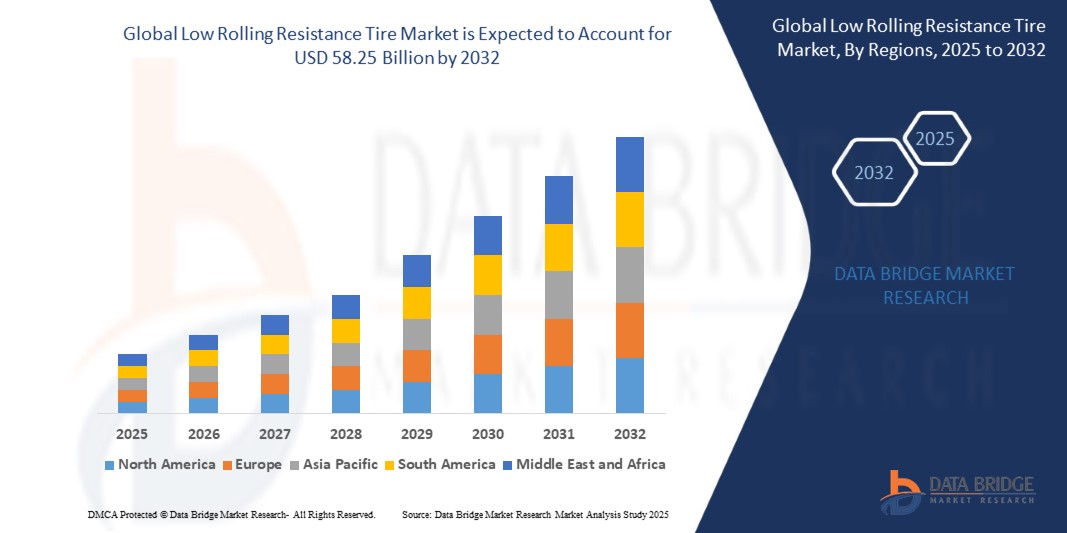
- The global low rolling resistance tire market was valued at USD 22.70 billion in 2024 and is expected to reach USD 58.25 billion by 2032
- During the forecast period of 2025 to 2032 the market is such as to grow at a CAGR of 12.50%, primarily driven by the increasing demand for fuel-efficient vehicles
- This growth is driven by factors such as rising awareness about fuel economy and environmental sustainability in the automotive industry
Low Rolling Resistance Tire Market Analysis
- The low rolling resistance tire market is witnessing robust growth as more consumers and businesses seek fuel-efficient solutions to reduce operational costs and environmental impact
- Automotive manufacturers are increasingly focusing on integrating low rolling resistance tires into their vehicles, especially electric and hybrid models, to enhance energy efficiency and reduce carbon emissions
- The demand for low rolling resistance tires is driven by the automotive sector's ongoing efforts to meet stricter government regulations on fuel efficiency and emissions standards
- The market is also seeing a rise in the adoption of these tires in commercial vehicles, particularly in the freight and logistics industries, as they offer improved fuel economy and lower maintenance costs
- For instance, companies such as Michelin and Bridgestone have introduced innovative low rolling resistance tire technologies that offer better performance, extended tire life, and lower rolling resistance, making them a popular choice among consumers and fleet owners
Report Scope and Low Rolling Resistance Tire Market Segmentation
|
Attributes |
Low Rolling Resistance Tire Key Market Insights |
|
Segments Covered |
|
|
Countries Covered |
North America
Europe
Asia-Pacific
Middle East and Africa
South America
|
|
Key Market Players |
|
|
Market Opportunities |
|
|
Value Added Data Infosets |
In addition to the market insights such as market value, growth rate, market segments, geographical coverage, market players, and market scenario, the market report curated by the Data Bridge Market Research team includes in-depth expert analysis, import/export analysis, pricing analysis, production consumption analysis, and pestle analysis. |
Low Rolling Resistance Tire Market Trends
“Impact of Electric Vehicles and Innovation”
- The growing shift toward electric vehicles is significantly influencing the low rolling resistance tire market as these tires are critical for maximizing energy efficiency and extending battery life
- Technological advancements in tire manufacturing are focusing on improving the balance between low rolling resistance and tire performance, offering better durability and safety features
- Consumers are increasingly aware of the environmental impact of fuel consumption, driving the demand for low rolling resistance tires that help reduce fuel consumption and lower carbon footprints
- The market is witnessing the introduction of tires specifically designed for commercial fleets, focusing on optimizing fuel economy for long-haul transport and logistics
- For instance, major tire manufacturers are now incorporating advanced compounds and tread designs to enhance low rolling resistance without compromising on grip and handling, making them more appealing to both individual and fleet customers
- In conclusion, the evolving demand for electric vehicles, coupled with advancements in tire technology and growing environmental consciousness, is driving the expansion of the low rolling resistance tire market.
Low Rolling Resistance Tire Market Dynamics
Driver
“Increasing Demand for Fuel Efficiency”
- A key driver for the growth of the low rolling resistance tire market is the increasing demand for fuel efficiency, driven by rising fuel prices and stricter environmental regulations
- Low rolling resistance tires help reduce the energy required to roll the tire, resulting in lower fuel consumption, which is crucial for both individual consumers and commercial fleets seeking cost savings
- In the automotive sector, consumers are opting for low rolling resistance tires to improve the fuel economy of their vehicles, particularly with a growing emphasis on sustainability and environmental awareness
- The adoption of low rolling resistance tires is increasing in the automotive industry, including OEMs and tire replacement markets, as they help meet fuel efficiency regulations and sustainability targets
- Commercial fleet owners, such as those in trucking and logistics, are incorporating these tires to enhance operational efficiency and reduce fuel costs, while governments are incentivizing the use of eco-friendly tires to support greener transportation options
Opportunity
“Growth of Electric Vehicles”
- The rapid growth of the electric vehicle market presents a significant opportunity for the low rolling resistance tire market as more electric vehicles require tires that reduce rolling resistance to enhance their efficiency
- As electric vehicle adoption accelerates, the demand for specialized tires that improve vehicle range and complement performance characteristics such as weight, torque, and powertrain efficiency is expected to rise
- Low rolling resistance tires are crucial for electric vehicles because they help extend the driving range per charge, which is a key concern for EV users, driving the need for these tires in the market
- Tire manufacturers are already adapting to this trend by developing tires optimized for electric vehicles, focusing on factors that influence energy efficiency and sustainability
- The automotive industry's push for sustainability and emission reduction aligns with the growing adoption of low rolling resistance tires, further boosting demand as manufacturers collaborate with electric vehicle producers to meet specific performance requirements
Restraint/Challenge
“Higher Cost of Low Rolling Resistance Tires”
- A key challenge for the low rolling resistance tire market is the higher cost of manufacturing and purchasing these tires due to the advanced materials and technologies involved in their production
- Low rolling resistance tires are typically more expensive than standard tires, which can discourage price-sensitive consumers and businesses from adopting them, particularly in markets where tire costs are a critical factor in purchasing decisions
- The initial investment for low rolling resistance tires may be seen as too high, despite the long-term fuel savings and environmental benefits they offer, which can hinder adoption among individuals and fleet owners focused on short-term expenses
- Tire manufacturers face increased production costs related to sourcing specific materials such as silica and using advanced manufacturing techniques to reduce rolling resistance, making it difficult to lower the price point of these tires
- The higher price of low rolling resistance tires may limit their adoption in developing countries or among businesses that are not yet prioritizing fuel efficiency or sustainability, posing a challenge to the market’s growth, especially in price-sensitive sectors
Low Rolling Resistance Tire Market Scope
The market is segmented on the basis of type, vehicle type, width vehicle, sales channel, and application.
|
Segmentation |
Sub-Segmentation |
|
By Type |
|
|
By Vehicle Type |
|
|
By Width Vehicle |
|
|
By sales channel
|
|
|
By Application |
|
Low Rolling Resistance Tire Market Regional Analysis
“Asia-Pacific is the Dominant Region in the Low Rolling Resistance Tire Market”
- Asia-Pacific is expected to dominate the low rolling resistance tire market in revenue with market share of 40.5%, driven by the significant increase in electric vehicle (EV) sales across the region
- China is the dominant country in the Asia-Pacific region for the low rolling resistance tire market, primarily due to its massive automotive industry and rapid adoption of electric vehicles (EVs)
- Rapid industrialization, urbanization, and a growing automotive sector in countries like China and India are boosting demand for energy-efficient tire solutions
- Government policies and initiatives promoting eco-friendly and fuel-efficient technologies further support the adoption of low rolling resistance tires
- The increasing consumer preference for cost-effective, eco-friendly vehicles, alongside rising environmental awareness, strengthens the market for low rolling resistance tires in the region
“North America is Projected to Register the Highest Growth Rate”
- North America is anticipated to be the fastest-growing region in the low rolling resistance tire market with 39% market share during the forecast period, driven by an increase in awareness about timely vehicle maintenance
- The U.S. is the dominant country in the North American low rolling resistance tire market, benefiting from its strong automotive industry and a growing demand for fuel-efficient and eco-friendly vehicles
- The rising automotive sector, coupled with a growing focus on improving fuel efficiency and reducing carbon emissions, is expected to propel the market growth
- Stringent environmental regulations and a shift toward sustainable transportation solutions further encourage the adoption of low rolling resistance tires in the region
- Increased fuel prices and heightened consumer awareness of environmental issues are pushing more consumers toward low rolling resistance tire options
Low Rolling Resistance Tire Market Share
The market competitive landscape provides details by competitor. Details included are company overview, company financials, revenue generated, market potential, investment in research and development, new market initiatives, global presence, production sites and facilities, production capacities, company strengths and weaknesses, product launch, product width and breadth, application dominance. The above data points provided are only related to the companies' focus related to market.
The Major Market Leaders Operating in the Market Are:
- Bridgestone Corporation (Japan)
- The Goodyear Tire & Rubber Company (U.S.)
- Sumitomo Rubber Industries, Ltd (Japan)
- Pirelli & C. S.p.A. (Italy)
- Hankook Tire & Technology (South Korea)
- MICHELIN (France)
- Continental AG (Germany)
- Trelleborg AB (publ) (Sweden)
- The Yokohama Rubber Co. Ltd (Japan)
- APOLLO TYRES LTD (India)
- Maxxis International–USA. (U.S.)
- Marangoni S.p.A (Italy)
- MRF Limited (India)
- Cooper Tire & Rubber Company (U.S.)
- Toyo Tire & Rubber Co. Ltd. (Japan)
- KUMHO TIRE (South Korea)
- Nokian Tyres plc. (Finland)
Latest Developments in Global Low Rolling Resistance Tire Market
- In November 2021, Cabot Corporation launched its new PropelR E8 engineered reinforcing material, designed to improve the performance of low rolling resistance tires. The innovation is expected to enhance tire efficiency by reducing rolling resistance while maintaining strength and durability, aligning with the growing demand for environmentally friendly and fuel-efficient automotive solutions.
- In August 2021, Continental announced the launch of its new tire technology designed to optimize rolling resistance. This innovation aims to reduce fuel consumption and CO2 emissions, supporting the automotive industry's transition to more sustainable practices. The technology is expected to enhance the performance of vehicles while contributing to environmental goals
- In March 2021, Michelin launched two new truck tires, designed to improve fuel efficiency and reduce carbon emissions. These tires are part of Michelin’s commitment to providing solutions that support the transition to more sustainable transportation. The new models feature advanced technology aimed at lowering rolling resistance, offering fleet operators a way to enhance fuel economy and reduce environmental impact
- In 2021, The Goodyear Tire & Rubber Company started processes to acquire Cooper Tire & Rubber Company for a total enterprise value of around US$ 2.5 billion. The transaction will increase Goodyear’s product offering by joining two portfolios of balancing brands, whereas making a stronger US-based manufacturers with augmented presence in retail and distribution channels across the LUV product and light trucks segments
- In 2021, Bridgestone Corporation decided to spend US$ 9.3 million to launch a revolutionary equipment for assured facilities at Shimonoseki Plant, which manufacture tires for construction and mining vehicles. The installation process will start from 2022 and will be finished by 2025 to increase the company’s production system in terms of eco-friendliness, disaster preparedness, safety, quality and productivity

- Interactive Data Analysis Dashboard
- Company Analysis Dashboard for high growth potential opportunities
- Research Analyst Access for customization & queries
- Competitor Analysis with Interactive dashboard
- Latest News, Updates & Trend analysis
- Harness the Power of Benchmark Analysis for Comprehensive Competitor Tracking
Data collection and base year analysis are done using data collection modules with large sample sizes. The stage includes obtaining market information or related data through various sources and strategies. It includes examining and planning all the data acquired from the past in advance. It likewise envelops the examination of information inconsistencies seen across different information sources. The market data is analysed and estimated using market statistical and coherent models. Also, market share analysis and key trend analysis are the major success factors in the market report. To know more, please request an analyst call or drop down your inquiry.
The key research methodology used by DBMR research team is data triangulation which involves data mining, analysis of the impact of data variables on the market and primary (industry expert) validation. Data models include Vendor Positioning Grid, Market Time Line Analysis, Market Overview and Guide, Company Positioning Grid, Patent Analysis, Pricing Analysis, Company Market Share Analysis, Standards of Measurement, Global versus Regional and Vendor Share Analysis. To know more about the research methodology, drop in an inquiry to speak to our industry experts.
Data Bridge Market Research is a leader in advanced formative research. We take pride in servicing our existing and new customers with data and analysis that match and suits their goal. The report can be customized to include price trend analysis of target brands understanding the market for additional countries (ask for the list of countries), clinical trial results data, literature review, refurbished market and product base analysis. Market analysis of target competitors can be analyzed from technology-based analysis to market portfolio strategies. We can add as many competitors that you require data about in the format and data style you are looking for. Our team of analysts can also provide you data in crude raw excel files pivot tables (Fact book) or can assist you in creating presentations from the data sets available in the report.













