


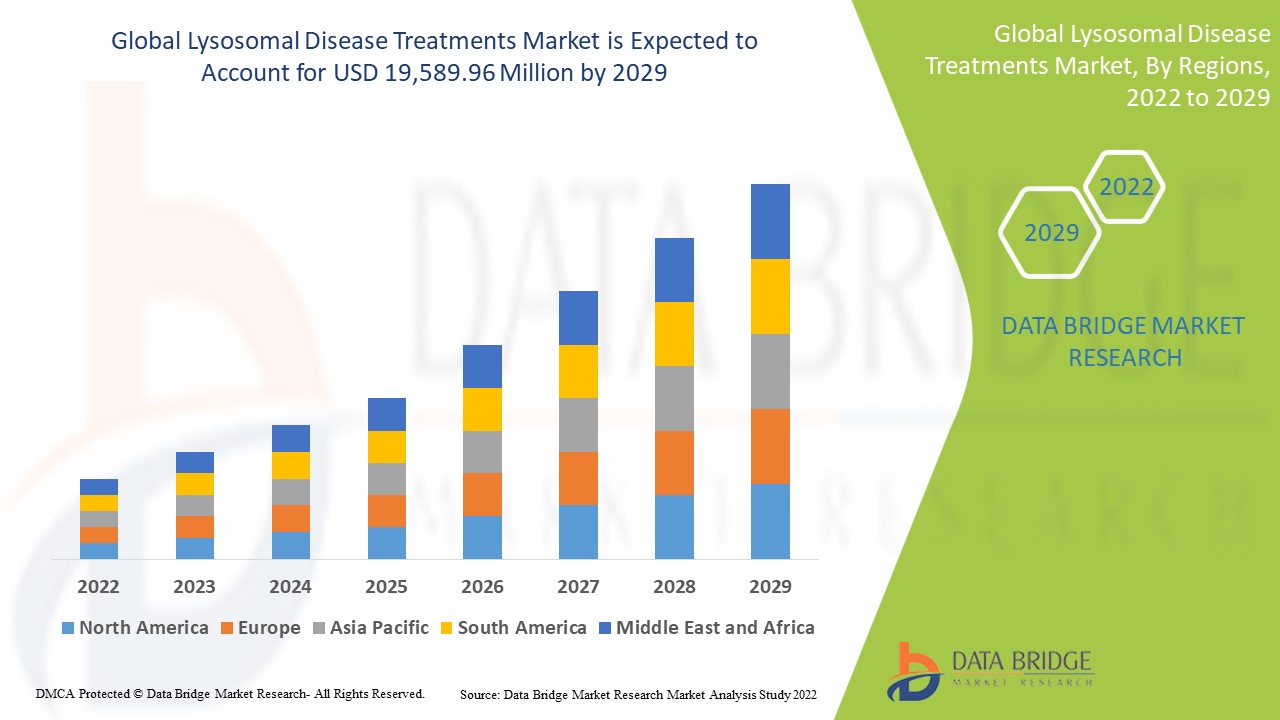
Lysosomal Disease Treatments Market Analysis
Lysosomal storage disorders are inherited metabolic disorders marked by an abnormal accumulation of numerous harmful chemicals in the body's cells as a result of enzyme shortages. There are roughly 50 of these ailments in all, and they can affect the skeleton, brain, skin, heart, and central nervous system, among other bodily components. There are still more lysosomal storage disorders being discovered. While clinical trials for potential treatments for some of these disorders are presently underway, many lysosomal storage diseases currently lack an approved medication.
Lysosomal Disease Treatments Market Size
Global lysosomal disease treatments market size was valued at USD 11.89 billion in 2024 and is projected to reach USD 26.42 billion by 2032, with a CAGR of 10.50% during the forecast period of 2025 to 2032.
Report Scope and Market Segmentation
|
Attributes |
Lysosomal Disease Treatments Key Market Insights |
|
Segmentation |
|
|
Countries Covered |
U.S., Canada and Mexico in North America, Germany, France, U.K., Netherlands, Switzerland, Belgium, Russia, Italy, Spain, Turkey, Rest of Europe in Europe, China, Japan, India, South Korea, Singapore, Malaysia, Australia, Thailand, Indonesia, Philippines, Rest of Asia-Pacific (APAC) in the Asia-Pacific (APAC), Saudi Arabia, U.A.E, South Africa, Egypt, Israel, Rest of Middle East and Africa (MEA) as a part of Middle East and Africa (MEA), Brazil, Argentina and Rest of South America as part of South America |
|
Key Market Players |
Novartis AG (Switzerland), Johnson & Johnson Private Limited (U.S.), Teva Pharmaceutical Industries Ltd. (Ireland), Merck & Co., Inc. (U.S.), Allergan (Ireland), Pfizer Inc. (U.S.), GlaxoSmithKline plc (U.K.), Sanofi (France), Merck KGaA (Germany), Abbott (U.S.), Boehringer Ingelheim International GmbH. (Germany), Takeda Pharmaceutical Company Limited (Japan), Amicus Therapeutics, Inc. (U.S.), Moderna, Inc. (U.S.),Greenovation Biotech GmbH (Germany), Biomarin (U.S.), JCR Pharmaceuticals Co., Ltd (Japan), ISU ABXIS (South Korea), Idorsia Pharmaceuticals Ltd (Switzerland), AVROBIO, Inc. (U.S.), Resverlogix Corp. (Canada), Enzyvant (U.S.), CHIESI Farmaceutici SpA (Italy) |
|
Market Opportunities |
|
Lysosomal Disease Treatments Market Definition
Lysosomal disease, also known as lysosomal storage disease, is a rare hereditary metabolic disease. It is caused by faulty or mutant metabolism, which results in the lack or deficiency of enzymes, resulting in an abnormal build-up of material in various body cells. If done before the age of two, bone marrow transplantation (BMT) is successful in preventing progressive mental retardation in children with MPS IH (Hurler disease). For those with Gaucher disease type I, enzyme replacement therapy (ERT) has been shown to be successful. Anemia and low platelet counts have improved, liver and spleen enlargement has decreased significantly, and skeletal abnormalities have improved. Individuals with Gaucher disease types II and III who get ERT also see improvements in these systemic signs.
Lysosomal Disease Treatments Market Dynamics
Drivers
- Rising prevalence of lysosomal disease
The rising prevalence of lysosomal disease will act as a major driver that will result in the expansion of the market's growth rate. According to the National Center for Biotechnology Information, the prevalence of Fabry disease in white, male populations was 1:17,000 to 1:117,000 in January 2020, according to a report updated by the National Center for Biotechnology Information. Atypical presentations were related with roughly 1:1000 to 1:3000 males and 1:6000 to 1:40,000 females, whereas classic Fabry disease mutations were seen in around 1:22,000 to 1:40,000 males.
- Increasing investment for healthcare infrastructure
Another significant factor influencing the growth rate of lysosomal disease treatments market is the rising healthcare expenditure which helps in improving its infrastructure. Also, various government organizations aims to improve the healthcare infrastructure by increasing funding and this will further influence the market dynamics.
Furthermore, surging number of government initiatives to spread awareness and rising adoption rate of early diagnosis will result in the expansion of lysosomal disease treatments market. Along with this, rising level of disposable income and growing government favourable initiatives will enhance the market's growth rate.
Opportunities
- Rise in R&D activities
The market's growth is fueled by growing number of research and development activities. This will provide beneficial opportunities for the lysosomal disease treatments market growth. For instance, biodistribution studies in LSD models provide evidence for the theory that the RTB-lectin transports corrective doses of enzymes across the blood–brain barrier for the treatment of central nervous system pathologies, according to researchers from BioStrategies LC, State University (U.S.).
Moreover, the market's growth is fueled by investment to develop advanced technologies and increase the number of emerging markets. These factors will provide beneficial opportunities for the lysosomal disease treatments market growth.
Restraints/Challenges
- High cost associated with the treatment
The high cost associated with the treatment will obstruct the growth rate of lysosomal disease treatments market during the forecast period of 2025-2032. For instance, Forbes Index ranked Elaprase as one of the most costly pharmaceuticals, costing US$ 375,000 per year, while Naglazyme costs US$ 365,000 per patient per year.
On the other hand, the lack of healthcare infrastructure in developing economies and the dearth of skilled professionals will challenge the lysosomal disease treatments market. Additionally, lack of awareness among people and poor reimbursement policies will restrain and further impede the growth rate of the market during the forecast period of 2025-2032.
This lysosomal disease treatments market report provides details of new recent developments, trade regulations, import-export analysis, production analysis, value chain optimization, market share, impact of domestic and localized market players, analyses opportunities in terms of emerging revenue pockets, changes in market regulations, strategic market growth analysis, market size, category market growths, application niches and dominance, product approvals, product launches, geographic expansions, technological innovations in the market. To gain more info on the lysosomal disease treatments market contact Data Bridge Market Research for an Analyst Brief, our team will help you take an informed market decision to achieve market growth.
Patient Epidemiology Analysis
Lysosomal storage disorders are thought to affect one out of every 5,000 live births on average. Despite the fact that the individual diseases are uncommon, the group as a whole affects a large number of people worldwide. Certain populations are more prone to certain diseases than others. The Ashkenazi Jewish population, for instance, has a higher prevalence of Gaucher and Tay-Sachs disorders.
Lysosomal disease treatments market also provides you with detailed market analysis for patient analysis, prognosis and cures. Prevalence, incidence, mortality, adherence rates are some of the data variables that are available in the report. Direct or indirect impact analyses of epidemiology to market growth are analysed to create a more robust and cohort multivariate statistical model for forecasting the market in the growth period.
Lysosomal Disease Treatments Market Scope
The lysosomal disease treatments market is segmented on the basis of type, treatment, route of administration, end-users and distribution channel. The growth amongst these segments will help you analyze meagre growth segments in the industries and provide the users with a valuable market overview and market insights to help them make strategic decisions for identifying core market applications.
Type
- Fabry Disease
- Tay-Sachs Disease
- Others
Treatment
- Enzyme Replacement Therapy
- Stem Cell Transplantation
- Others
Route of Administration
- Oral
- Parenteral
- Others
End-Users
- Hospitals
- Specialty Clinics
- Homecare
- Others
Distribution Channel
- Hospital Pharmacy
- Retail Pharmacy
- Online Pharmacy
- Others
Lysosomal Disease Treatments Market Regional Analysis
The lysosomal disease treatments market is analyzed and market size insights and trends are provided by country, type, treatment, route of administration, end-users and distribution channel as referenced above.
The countries covered in the lysosomal disease treatments market report are U.S., Canada and Mexico in North America, Germany, France, U.K., Netherlands, Switzerland, Belgium, Russia, Italy, Spain, Turkey, Rest of Europe in Europe, China, Japan, India, South Korea, Singapore, Malaysia, Australia, Thailand, Indonesia, Philippines, Rest of Asia-Pacific (APAC) in the Asia-Pacific (APAC), Saudi Arabia, U.A.E, South Africa, Egypt, Israel, Rest of Middle East and Africa (MEA) as a part of Middle East and Africa (MEA), Brazil, Argentina and Rest of South America as part of South America
North America dominates the lysosomal disease treatments market because of the rising healthcare expenditure and highly sophisticated medical facilities in this region. Additionally, growing focus of major key players in research and development activities for lysosomal disease treatments will further propel the market's growth rate in this region.
Europe is expected to be the fastest-growing region during the forecast period of 2025-2032 due to the presence of key market players. Also, the development of healthcare infrastructure and high diagnostic rate will further propel the market's growth rate in this region.
The country section of the report also provides individual market impacting factors and changes in regulation in the market domestically that impacts the current and future trends of the market. Data points like down-stream and upstream value chain analysis, technical trends and porter's five forces analysis, case studies are some of the pointers used to forecast the market scenario for individual countries. Also, the presence and availability of global brands and their challenges faced due to large or scarce competition from local and domestic brands, impact of domestic tariffs and trade routes are considered while providing forecast analysis of the country data.
Lysosomal Disease Treatments Market Share
The lysosomal disease treatments market competitive landscape provides details by competitor. Details included are company overview, company financials, revenue generated, market potential, investment in research and development, new market initiatives, global presence, production sites and facilities, production capacities, company strengths and weaknesses, product launch, product width and breadth, application dominance. The above data points provided are only related to the companies' focus related to lysosomal disease treatments market.
Lysosomal Disease Treatments Market Leaders Operating in the Market Are:
- Novartis AG (Switzerland)
- Johnson & Johnson Private Limited (U.S.)
- Teva Pharmaceutical Industries Ltd. (Ireland)
- Merck & Co., Inc. (U.S.)
- Allergan (Ireland)
- Pfizer Inc. (U.S.)
- GlaxoSmithKline plc (U.K.)
- Sanofi (France)
- Merck KGaA (Germany)
- Abbott (U.S.)
- Boehringer Ingelheim International GmbH. (Germany)
- Takeda Pharmaceutical Company Limited (Japan)
- Amicus Therapeutics, Inc. (U.S.)
- Moderna, Inc. (U.S.)
- Greenovation Biotech GmbH (Germany)
- Biomarin (U.S.)
- JCR Pharmaceuticals Co., Ltd (Japan)
- ISU ABXIS (South Korea)
- Idorsia Pharmaceuticals Ltd (Switzerland)
- AVROBIO, Inc. (U.S.)
- Resverlogix Corp. (Canada)
- Enzyvant (U.S.)
- CHIESI Farmaceutici SpA (Italy)

- Interactive Data Analysis Dashboard
- Company Analysis Dashboard for high growth potential opportunities
- Research Analyst Access for customization & queries
- Competitor Analysis with Interactive dashboard
- Latest News, Updates & Trend analysis
- Harness the Power of Benchmark Analysis for Comprehensive Competitor Tracking
Data collection and base year analysis are done using data collection modules with large sample sizes. The stage includes obtaining market information or related data through various sources and strategies. It includes examining and planning all the data acquired from the past in advance. It likewise envelops the examination of information inconsistencies seen across different information sources. The market data is analysed and estimated using market statistical and coherent models. Also, market share analysis and key trend analysis are the major success factors in the market report. To know more, please request an analyst call or drop down your inquiry.
The key research methodology used by DBMR research team is data triangulation which involves data mining, analysis of the impact of data variables on the market and primary (industry expert) validation. Data models include Vendor Positioning Grid, Market Time Line Analysis, Market Overview and Guide, Company Positioning Grid, Patent Analysis, Pricing Analysis, Company Market Share Analysis, Standards of Measurement, Global versus Regional and Vendor Share Analysis. To know more about the research methodology, drop in an inquiry to speak to our industry experts.
Data Bridge Market Research is a leader in advanced formative research. We take pride in servicing our existing and new customers with data and analysis that match and suits their goal. The report can be customized to include price trend analysis of target brands understanding the market for additional countries (ask for the list of countries), clinical trial results data, literature review, refurbished market and product base analysis. Market analysis of target competitors can be analyzed from technology-based analysis to market portfolio strategies. We can add as many competitors that you require data about in the format and data style you are looking for. Our team of analysts can also provide you data in crude raw excel files pivot tables (Fact book) or can assist you in creating presentations from the data sets available in the report.












