


What is the Malt Extracts Market Size and Growth Rate?
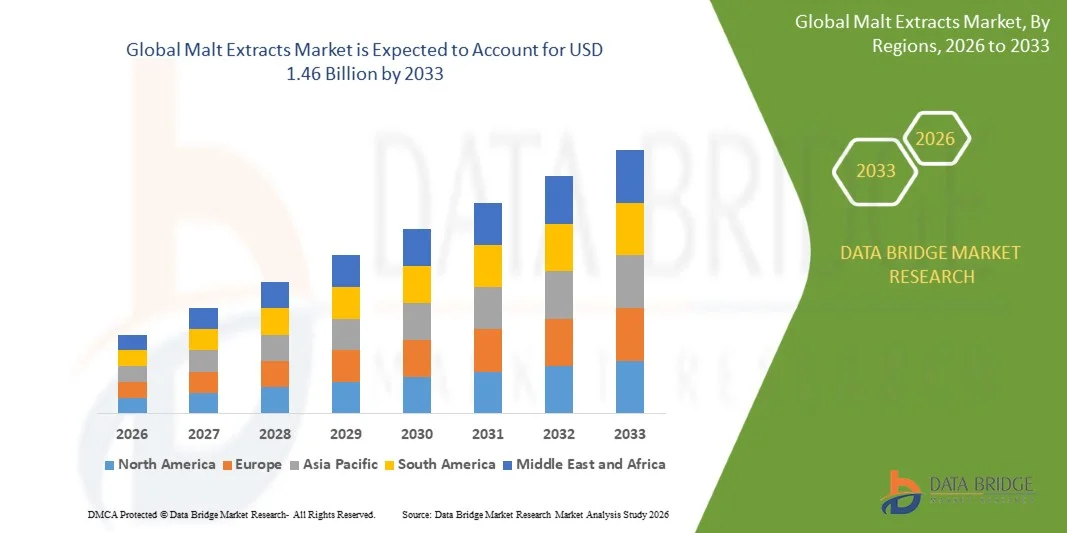
- As per Data Bridge Market Research analysis, the malt extracts market was valued at USD 1.07 billion in 2025 and is projected to reach USD 1.46 billion by 2033, growing at a CAGR of 4.00% from 2026 to 2033.
- The market is experiencing consistent growth driven by rising demand for natural and clean-label ingredients, increasing consumption of craft beer and specialty beverages, and expanding applications of malt extracts across food, beverages, pharmaceuticals, and nutraceutical products.
- The growing consumer preference for natural sweeteners and functional food ingredients, combined with the expanding bakery and craft brewing industries, is encouraging manufacturers to adopt malt extracts as flavoring, coloring, sweetening, and nutritional ingredients. Liquid and dry malt extracts are gaining wider use because they provide convenient processing, distinctive flavor, and functional benefits, while increasing demand for fortified and health-oriented products is further supporting market expansion
Market Size & Forecast
- Global Market Value (2025): USD 1.07 Billion
- Expected Market Value (2033): USD 1.46 billion
- Forecast CAGR (2026–2033): 4.00%
- Leading Region in 2025: North America
- Fastest Growing Region: Asia Pacific
What are the Major Takeaways of the Malt Extracts Market?
- North America dominated the malt extracts market with the largest revenue share of 38.4% in 2025, supported by strong demand for malt-based beverages, established brewing and food-processing industries, and growing consumer preference for natural and clean-label ingredients.
- Asia-Pacific is expected to be the fastest-growing region at a CAGR of 6.0% from 2026 to 2033, fueled by rising consumption of processed foods and beverages, expanding bakery and brewing industries, and increasing demand for natural sweetening and flavoring ingredients.
- The conventional segment led the market with a 68% share in 2025, driven by its broad availability, established production infrastructure, and relatively lower cost.
- Organic are the fastest-growing nature type, projected to register a CAGR of 6.9%, reflecting the surge in consumer preference for natural, minimally processed, and clean-label ingredients
- The liquid malt extract segment dominated the type category with a 55.8% revenue share in 2025, led by its ease of handling, excellent solubility, and extensive use across brewing, bakery, confectionery, and beverage manufacturing.
- Barley accounted for 61.5% of the market share in 2025, preferred by breweries and food manufacturers because of its favorable malting characteristics, high enzyme content, reliable extract yield, and established global supply chain.
- The dry segment is the fastest-growing form category, with a CAGR of 5.0%, driven by longer shelf life, convenient transportation, easier storage, and suitability for powdered food formulations.
Report Scope and Malt Extracts Market Segmentation
|
Attributes |
Malt Extracts Key Market Insights |
|
Segments Covered |
|
|
Countries Covered |
North America
Europe
Asia-Pacific
Middle East and Africa
South America
|
|
Key Market Players |
|
|
Market Opportunities |
|
|
Value Added Data Infosets |
|
What is the Key Trend in the Malt Extracts Market?
- The growing shift toward clean-label, natural, and minimally processed ingredients is increasing the use of malt extracts as natural sweeteners, flavor enhancers, browning agents, and colorants across bakery, confectionery, cereals, and beverage formulations.
- For instance, in April 2024, Univar Solutions expanded its partnership with Meurens Natural to offer cereal extracts, including barley malt, for dairy, bakery, and beverage applications, highlighting growing demand for clean-label, natural, and multifunctional ingredients.
- Malt extracts are increasingly being incorporated into plant-based foods, functional beverages, and nutrition-focused products, where manufacturers seek natural sweetness and nutritional functionality without relying heavily on synthetic additives.
- Product innovation is also expanding toward specialty malt extracts with customized sweetness, color, flavor, solubility, and nutritional characteristics, allowing ingredient manufacturers to serve more specialized food and beverage applications.
- For instance, in April 2024, Muntons launched PlantMalt, a range of grain malts and liquid and powdered malt extracts developed for plant-based foods, providing clean-label solutions for flavor, texture, color, and mouthfeel in meat alternatives
- As food and beverage manufacturers increasingly prioritize natural formulations, functional nutrition, and ingredient transparency, the adoption of malt extracts is expected to expand beyond traditional brewing into bakery, plant-based foods, functional beverages, and nutritional products.
What are the Key Drivers of the Malt Extracts Market?
- The rising consumer preference for natural sweeteners and clean-label food ingredients is significantly increasing demand for malt extracts, which provide sweetness, flavor, color, and functional properties while supporting simpler ingredient declarations.
- For instance, in April 2024, Univar Solutions expanded its partnership with Meurens Natural to offer cereal extracts, including barley malt, for food and beverage applications, responding to growing demand for natural and clean-label ingredients.
- The expanding consumption of functional and malt-based beverages is further supporting market growth, particularly as manufacturers develop products combining malt-derived ingredients with vitamins, minerals, protein, and other nutritional components.
- For instance, in September 2025, Soufflet Malt introduced malt-based concentrates for soft drinks, including sodas, iced teas, and energy drinks, using only malt and water to provide natural taste and nutritional functionality without added sugars or artificial additives.
- With food manufacturers increasingly seeking versatile natural ingredients that combine sensory, nutritional, and functional benefits, malt extracts will remain important across beverages, bakery, confectionery, cereals, and emerging health-oriented food applications.
Which Factors are Challenging the Growth of the Malt Extracts Market?
- Malt extracts depend heavily on the availability and quality of malting barley, making the market vulnerable to drought, excessive rainfall, heat stress, pre-harvest sprouting, and other climate-related disruptions affecting agricultural production.
- For instance, in September 2024, Reuters reported that U.S. barley acreage had fallen by 22% year-on-year, while barley stocks on farms increased 51% to their highest level since 2010, as weaker beer consumption reduced demand for malting barley and pressured farmers and maltsters.
- These climatic fluctuations can reduce barley yields, alter grain quality, increase procurement costs, and create difficulties for maltsters in maintaining consistent raw-material specifications required for reliable malt extract production.
- For instance, in November 2025, Simpsons Malt reported that drought and heatwave conditions affected the U.K. spring barley harvest, with screenings reaching as high as 30% in some areas, creating quality challenges for barley destined for malting.
- The increasing frequency of weather extremes is therefore creating additional supply-chain and cost pressures for malt extract manufacturers, particularly when producers must secure sufficient high-quality barley while maintaining consistent extract performance and pricing.
How is the Malt Extracts Market Segmented?
The malt extracts market is segmented on the basis of nature, type, source, form, and application.
- By Nature
On the basis of nature, the malt extracts market is segmented into organic and conventional. The conventional segment dominated the market with 68% share in 2025, owing to its broad availability, established production infrastructure, and relatively lower cost. Conventional malt extracts are extensively used across large-scale brewing, bakery, confectionery, and processed-food manufacturing. Their established supply chains allow manufacturers to obtain consistent quantities of malt-based ingredients for industrial production. The segment also benefits from widespread consumer familiarity and established processing technologies. Its extensive application across mainstream food and beverage products continues to support its dominant position.
The organic segment is projected to register the fastest growth at a CAGR of 6.9% during the forecast period, driven by increasing consumer preference for natural, minimally processed, and clean-label ingredients. Organic malt extracts are increasingly being incorporated into premium bakery products, cereals, beverages, and health-oriented food formulations. Manufacturers are responding to demand for ingredients with recognizable and transparent sourcing credentials. The segment is also benefiting from the expansion of organic food retail and premium product categories. Increasing awareness of sustainable agricultural practices is further supporting interest in organically sourced grains. Growing demand for certified organic ingredients is expected to accelerate adoption among food and beverage manufacturers.
- By Type
On the basis of type, the market is segmented into liquid malt extract, dry malt extract, specialty malt extract, diastatic malt extract, non-diastatic malt extract, and brewery-grade malt extract. The liquid malt extract segment dominated the market with a 55.8% share in 2025, supported by its ease of handling, excellent solubility, and extensive use across brewing, bakery, confectionery, and beverage manufacturing. Liquid extracts can be incorporated directly into formulations, simplifying production processes and reducing additional processing requirements. They provide consistent sweetness, color, flavor, and fermentable sugars. Breweries particularly value their convenient handling and compatibility with established production systems. Their broad industrial application continues to make liquid malt extract the leading type globally.
The specialty malt extract segment is projected to register the fastest growth at a CAGR of 7.2% during the forecast period, driven by increasing demand for differentiated flavors, colors, nutritional characteristics, and functional properties. Specialty extracts enable manufacturers to develop premium and customized food and beverage formulations. Their adoption is increasing in craft brewing, premium bakery products, functional foods, and specialty beverages. Manufacturers are increasingly seeking malt ingredients capable of delivering both sensory and functional benefits. Premiumization across food and beverage categories is creating additional opportunities for specialty products. Rising demand for customized formulations is expected to further accelerate segment expansion.
- By Source
On the basis of source, the market is segmented into barley, wheat, rice, and rye. The barley segment dominated the market with a 61.5% share in 2025, reflecting barley's established position as the primary raw material for malt production. Barley provides favorable malting characteristics and produces the sugars, enzymes, flavors, and colors required across numerous malt extract applications. It is extensively utilized by breweries and food manufacturers worldwide. Well-established barley cultivation and malting infrastructure also support reliable raw-material availability. The strong association between barley malt and brewing further reinforces its leadership. Its established supply chain and broad industrial acceptance continue to support the segment's dominant position.
The rye segment is projected to register the fastest growth at a CAGR of 5.9% during the forecast period, supported by increasing demand for distinctive grain flavors and specialty malt formulations. Rye malt extracts provide spicy, earthy, and complex sensory characteristics that appeal to craft brewers and specialty food manufacturers. Their use is expanding in premium brewing and bakery products where differentiated flavor profiles are increasingly valued. Rye also provides manufacturers with an alternative grain source for product innovation beyond conventional barley formulations. Growing consumer interest in diverse grains is creating additional opportunities for rye-based ingredients. Expansion of craft beverage and premium food categories is expected to support continued growth in this segment.
- By Form
On the basis of form, the market is segmented into dry and liquid. The liquid segment dominated the market with 56% share in 2025, supported by its high solubility, convenient incorporation, and extensive utilization in brewing, bakery, confectionery, and beverage production. Liquid malt extracts can be directly added to manufacturing formulations without requiring a separate dissolution process. They provide consistent flavor, sweetness, color, and fermentable content. Their ready-to-use characteristics make them particularly attractive to commercial breweries and industrial food manufacturers. Existing processing infrastructure is also well suited to liquid extract utilization. These advantages continue to make liquid the leading form of malt extracts globally.
The dry segment is projected to register the fastest growth at a CAGR of 5.0% during the forecast period, driven by longer shelf life, convenient transportation, easier storage, and suitability for powdered food formulations. Dry malt extracts are increasingly used in bakery mixes, confectionery products, nutritional formulations, and specialty beverages. Their lower moisture content facilitates handling and precise ingredient dosing during industrial production. The form also reduces storage and transportation challenges compared with liquid products. Growing demand for shelf-stable and convenient food ingredients is supporting adoption. Increasing use in premixes and specialized formulations is expected to further strengthen the segment's growth prospects.
- By Application
On the basis of application, the market is segmented into bakery, confectionery, beverages, and food. The beverages segment dominated the market with 83% share in 2025, supported by extensive utilization of malt extracts in beer, malt-based beverages, and other beverage formulations. Malt extracts provide fermentable sugars, natural sweetness, distinctive flavor, and color, making them highly suitable for beverage manufacturing. The continued expansion of craft brewing is strengthening demand for malt-based ingredients. Non-alcoholic and functional malt beverages are also broadening applications beyond traditional brewing. Increasing demand for premium and differentiated beverages is further supporting the segment. These factors collectively reinforce beverages as the leading application category.
The beverages segment is also projected to remain the fastest-growing application category at a CAGR of 7.9% during the forecast period, driven by increasing craft beer production, premium beverage consumption, and rising demand for malt-based functional and non-alcoholic drinks. Malt extracts provide natural flavor, color, sweetness, and nutritional characteristics that align with evolving beverage formulation requirements. Manufacturers are increasingly experimenting with specialty malt profiles to differentiate products. Emerging markets are also expanding their beverage-processing capacity and malt-based product offerings. Growing consumer interest in natural and functional beverages is creating additional demand. Continued innovation across alcoholic and non-alcoholic beverage categories is expected to sustain strong growth
Which Region Holds the Largest Share of the Malt Extracts Market?
- North America dominated the malt extracts market with the largest revenue share of 38.4% in 2025, supported by strong demand for malt-based beverages, established brewing and food-processing industries, and growing consumer preference for natural and clean-label ingredients.
- The region also benefits from a well-developed craft brewing sector, rising demand for specialty and functional beverages, and expanding applications of malt extracts across bakery, confectionery, cereals, and nutritional products. Strong food and beverage manufacturing capabilities and growing consumer preference for natural ingredients continue to strengthen North America’s leadership position in the global malt extracts market.
U.S. Malt Extracts Market Insight
The U.S. malt extracts market is witnessing strong growth due to rising demand for natural sweeteners, clean-label ingredients, and malt-based food and beverage products. The country’s mature brewing industry, along with increasing consumption of craft beer and specialty beverages, is driving demand for liquid and dry malt extracts across commercial and artisanal applications. In addition, growing use of malt extracts in bakery, confectionery, cereals, and nutritional products is expanding their application base. Increasing consumer preference for naturally derived ingredients and premium food products is further accelerating adoption among U.S. manufacturers.
Asia-Pacific Malt Extracts Market Insight
The Asia-Pacific malt extracts market is expected to witness rapid growth, driven by expanding food and beverage manufacturing, rising disposable incomes, and increasing consumption of processed and convenience foods across countries such as China, India, and Japan. Growing demand for bakery products, malt-based beverages, and clean-label ingredients is supporting regional market expansion. In addition, increasing investments in food-processing infrastructure, expanding craft beverage production, and growing consumer interest in natural and functional ingredients are accelerating malt extract adoption across commercial and industrial applications.
Japan Malt Extracts Market Insight
The Japan malt extracts market is witnessing consistent growth due to rising demand for natural food ingredients, premium beverages, and innovative functional food products. Food and beverage manufacturers are increasingly incorporating malt extracts into bakery products, confectionery, cereals, beverages, and nutritional formulations to provide natural sweetness, flavor, and color. Moreover, increasing consumer preference for clean-label and high-quality ingredients, combined with Japan’s advanced food-processing capabilities, is further contributing to market growth.
China Malt Extracts Market Insight
The China malt extracts market is growing rapidly, driven by expanding food and beverage production, rising urbanization, and increasing consumer demand for processed and premium food products. Growing adoption of malt extracts in bakery, confectionery, beverages, and nutritional products is significantly boosting market demand. In addition, increasing craft beverage consumption, rising awareness of natural ingredients, and rapid development of modern food-processing technologies are positioning China as one of the fastest-growing markets for malt extracts globally.
U.K. Malt Extracts Market Insight
The U.K. malt extracts market is experiencing steady growth, supported by strong demand from the brewing, bakery, confectionery, and specialty food industries. Increasing adoption of natural and clean-label ingredients and growing interest in craft beer and premium malt-based beverages are contributing to market growth. Furthermore, the expansion of plant-based and functional food products, together with increasing use of specialty malt extracts for flavor and color enhancement, is strengthening the U.K.'s position as an important market for malt-based ingredients.
Germany Malt Extracts Market Insight
The Germany malt extracts market is expanding steadily due to the country’s strong brewing industry, advanced food-processing capabilities, and increasing demand for natural and specialty ingredients. Breweries, bakeries, confectionery manufacturers, and food producers are increasingly utilizing malt extracts for sweetness, flavor, color, and functional properties. Continuous innovation in specialty and organic malt ingredients, along with growing consumer preference for clean-label products and premium beverages, is further driving market growth in Germany.
Which are the Top Companies in Malt Extracts Market?
The malt extracts industry is primarily led by well-established companies, including:
- Briess Malt & Ingredients (U.S.)
- Muntons Plc (U.K.)
- Malt Products Corporation (U.S.)
- Meurens Natural (Belgium)
- MALTEUROP (France)
- IREKS GmbH (Germany)
- Edme Limited (U.K.)
- Pure Malt Products Limited (U.K.)
- PMV Maltings Pvt. Ltd. (India)
- IMPERIAL MALTS LIMITED (India)
- Weyermann Malz (Germany)
- Viking Malt (Finland)
- Palatia Malz GmbH (Germany)
- Castle Malting (Belgium)
- BESTMALZ (Germany)
- Titan Biotech Limited (India)
- Boortmalt (Belgium)
- Dingemans Mouterij (Belgium)
- Simpsons Malt Limited (U.K.)
- The Swaen B.V. (Netherlands)
What are Latest Developments in Malt Extracts Market?
- In March 2025, Muntons launched Climate Positive Malt at BeerX 2025 in Liverpool, introducing a lower-carbon malt produced through low-carbon malting and sustainable barley-farming practices. The product offers up to 30% lower carbon emissions per tonne compared with the U.K. malt average, supporting brewers seeking to reduce the environmental footprint of their products. The launch demonstrates how sustainability is becoming an important area of innovation within the malt ingredients industry.
- In December 2024, Malt Products Corporation launched MaltRite Cocoa, a whole-grain malted barley ingredient designed to partially replace cocoa powder in bakery formulations. The ingredient can replace up to 50% of cocoa powder in products such as brownies, chocolate cakes, and cookies while contributing to moisture retention, texture, mouthfeel, and shelf life. The development highlights the expansion of malt-derived ingredients into food applications beyond traditional brewing.
- In October 2024, SupplySide Food & Beverage Journal highlighted the expanding use of malt extract as a multifunctional food ingredient, noting its ability to contribute sweetness, flavor, color, texture, and nutritional characteristics. The article specifically featured Briess Malt & Ingredients and emphasized how malt extract is being used beyond traditional brewing, particularly in food formulations.
- In January 2022, The Guardian highlighted the growing culinary use of malt extract beyond brewing, reporting its use by professional chefs in desserts such as crème brûlée, ice cream, and chocolate preparations for its distinctive malt flavor and texture-enhancing properties. This provides evidence of malt extract expanding into premium culinary and food applications.
- In May 2021, Muntons officially launched its Premium Alcohol Free Malt Extract for commercial brewers in the U.K. and international markets. The product was developed specifically to support alcohol-free beer production while providing brewers with a malt-based ingredient suited to the requirements of this emerging beverage category. The launch demonstrated how malt extract manufacturers were responding to increasing innovation in alcohol-free brewing and diversification within the beverage market.

- Interactive Data Analysis Dashboard
- Company Analysis Dashboard for high growth potential opportunities
- Research Analyst Access for customization & queries
- Competitor Analysis with Interactive dashboard
- Latest News, Updates & Trend analysis
- Harness the Power of Benchmark Analysis for Comprehensive Competitor Tracking
Global Malt Extracts Market, Supply Chain Analysis and Ecosystem Framework
To support market growth and help clients navigate the impact of geopolitical shifts, DBMR has integrated in-depth supply chain analysis into its Global Malt Extracts Market research reports. This addition empowers clients to respond effectively to global changes affecting their industries. The supply chain analysis section includes detailed insights such as Global Malt Extracts Market consumption and production by country, price trend analysis, the impact of tariffs and geopolitical developments, and import and export trends by country and HSN code. It also highlights major suppliers with data on production capacity and company profiles, as well as key importers and exporters. In addition to research, DBMR offers specialized supply chain consulting services backed by over a decade of experience, providing solutions like supplier discovery, supplier risk assessment, price trend analysis, impact evaluation of inflation and trade route changes, and comprehensive market trend analysis.
Data collection and base year analysis are done using data collection modules with large sample sizes. The stage includes obtaining market information or related data through various sources and strategies. It includes examining and planning all the data acquired from the past in advance. It likewise envelops the examination of information inconsistencies seen across different information sources. The market data is analysed and estimated using market statistical and coherent models. Also, market share analysis and key trend analysis are the major success factors in the market report. To know more, please request an analyst call or drop down your inquiry.
The key research methodology used by DBMR research team is data triangulation which involves data mining, analysis of the impact of data variables on the market and primary (industry expert) validation. Data models include Vendor Positioning Grid, Market Time Line Analysis, Market Overview and Guide, Company Positioning Grid, Patent Analysis, Pricing Analysis, Company Market Share Analysis, Standards of Measurement, Global versus Regional and Vendor Share Analysis. To know more about the research methodology, drop in an inquiry to speak to our industry experts.
Data Bridge Market Research is a leader in advanced formative research. We take pride in servicing our existing and new customers with data and analysis that match and suits their goal. The report can be customized to include price trend analysis of target brands understanding the market for additional countries (ask for the list of countries), clinical trial results data, literature review, refurbished market and product base analysis. Market analysis of target competitors can be analyzed from technology-based analysis to market portfolio strategies. We can add as many competitors that you require data about in the format and data style you are looking for. Our team of analysts can also provide you data in crude raw excel files pivot tables (Fact book) or can assist you in creating presentations from the data sets available in the report.













