


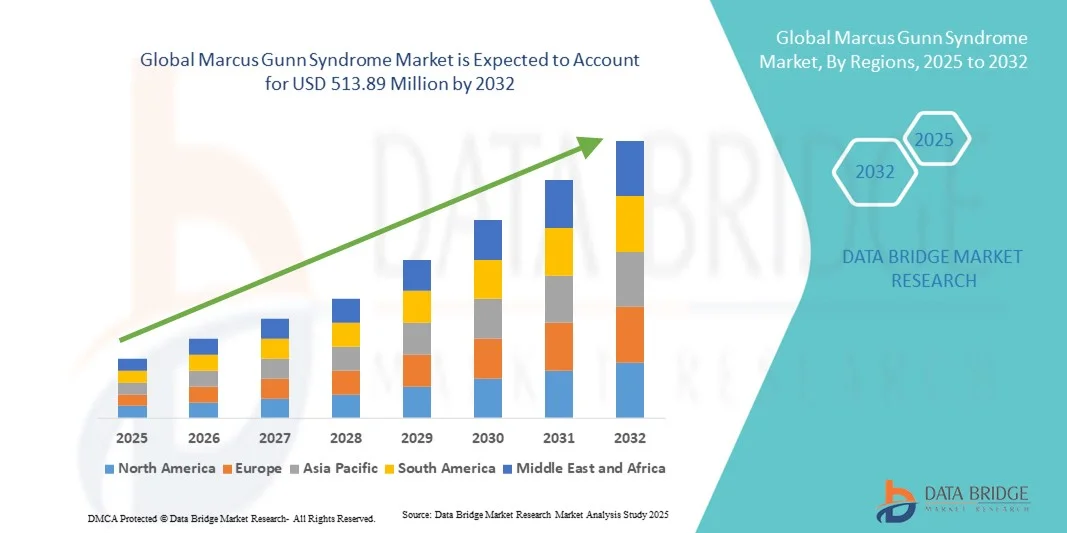
Marcus Gunn Syndrome Market Size
- The global Marcus Gunn Syndrome market size was valued at USD 375.50 million in 2024 and is expected to reach USD 513.89 million by 2032, at a CAGR of 4.0% during the forecast period
- The market growth is primarily driven by increasing awareness and early diagnosis of congenital eye movement disorders, alongside advances in ophthalmic imaging and surgical correction techniques that improve treatment outcomes
- In addition, the rising prevalence of congenital cranial dysinnervation disorders (CCDDs) and ongoing research into neuro-ophthalmic abnormalities are fostering product innovation and therapeutic development, which are collectively propelling the growth of the Marcus Gunn Syndrome market
Marcus Gunn Syndrome Market Analysis
- Marcus Gunn Syndrome, a rare congenital eye movement disorder marked by involuntary eyelid motion (jaw-winking phenomenon), is gaining growing medical attention due to improvements in diagnostic imaging, clinical genetics, and pediatric ophthalmology
- The market growth is primarily driven by increasing awareness and early detection of congenital ptosis-related disorders, along with advancements in corrective therapies that enhance both aesthetic and functional outcomes
- North America dominated the Marcus Gunn Syndrome market with the largest revenue share of 39.5% in 2024, supported by strong healthcare infrastructure, the presence of specialized neuro-ophthalmic centers, and early adoption of innovative diagnostic and treatment approaches across the U.S. and Canada
- The Asia-Pacific region is expected to be the fastest-growing market during the forecast period due to rising healthcare expenditure, improved accessibility to specialized ophthalmic care, and growing awareness among pediatric patients and caregivers
- The mechanical treatment segment dominated the Marcus Gunn Syndrome market with a market share of 47.3% in 2024, driven by the effectiveness of surgical correction techniques such as levator muscle suspension and frontalis sling procedures, which provide long-term improvement in eyelid symmetry and function
Report Scope and Marcus Gunn Syndrome Market Segmentation
|
Attributes |
Marcus Gunn Syndrome Key Market Insights |
|
Segments Covered |
|
|
Countries Covered |
North America
Europe
Asia-Pacific
Middle East and Africa
South America
|
|
Key Market Players |
|
|
Market Opportunities |
|
|
Value Added Data Infosets |
In addition to the insights on market scenarios such as market value, growth rate, segmentation, geographical coverage, and major players, the market reports curated by the Data Bridge Market Research also include in-depth expert analysis, patient epidemiology, pipeline analysis, pricing analysis, and regulatory framework |
Marcus Gunn Syndrome Market Trends
Advancement in Neuro-ophthalmic Diagnostics and Surgical Precision
- A significant and accelerating trend in the global Marcus Gunn Syndrome market is the integration of advanced neuro-ophthalmic imaging and surgical precision tools, enabling earlier diagnosis and improved treatment outcomes for patients
- For instance, the adoption of high-resolution MRI and digital eye-tracking systems helps clinicians detect abnormal cranial nerve pathways more accurately, enhancing diagnostic precision and patient monitoring
- The incorporation of 3D imaging and AI-assisted diagnostic platforms enables detailed visualization of ocular and muscular anomalies, supporting more personalized treatment planning and better surgical decision-making
- Furthermore, innovations in minimally invasive corrective surgeries and the use of robotic-assisted microsurgical techniques are reducing postoperative complications and improving functional recovery for affected patients
- The seamless collaboration between ophthalmologists, neurologists, and genetic researchers facilitates a multidisciplinary approach to understanding disease etiology and improving clinical outcomes
- This trend toward technologically advanced, patient-centered care is reshaping the treatment landscape, encouraging companies and research institutions to develop innovative diagnostic devices and targeted therapies for Marcus Gunn Syndrome
- The demand for diagnostic and surgical solutions offering greater accuracy, safety, and customization is growing rapidly across hospitals and specialty clinics, as healthcare providers emphasize early intervention and precision-based treatment strategies
Marcus Gunn Syndrome Market Dynamics
Driver
Increasing Awareness and Advancements in Diagnostic and Treatment Approaches
- The rising awareness of congenital cranial dysinnervation disorders (CCDDs) and improvements in diagnostic imaging and treatment techniques are significant drivers propelling the growth of the Marcus Gunn Syndrome market
- For instance, in February 2024, research collaborations among major ophthalmic institutes and universities focused on refining MRI-based neural mapping to identify cranial nerve miswiring in early developmental stages
- As healthcare professionals become more informed about congenital eye movement disorders, early diagnosis and intervention rates are increasing, enhancing patient outcomes and quality of life
- Furthermore, the development of AI-supported ophthalmic software and improved surgical instruments allows clinicians to plan and execute procedures with higher precision and safety
- The increasing adoption of personalized treatment strategies and interdisciplinary collaboration across ophthalmology and neurology are key factors strengthening market expansion globally
- The rising preference for mechanical corrective treatments, combined with greater accessibility to advanced care centers, further contributes to overall market growth
Restraint/Challenge
Limited Awareness in Emerging Regions and High Cost of Advanced Treatment
- The lack of awareness and access to specialized diagnostic facilities in low- and middle-income countries poses a significant challenge to the broader diagnosis and treatment of Marcus Gunn Syndrome
- For instance, limited healthcare infrastructure and the scarcity of trained neuro-ophthalmologists in developing regions restrict early detection and intervention opportunities
- The high cost associated with advanced imaging, surgical correction, and post-operative care further limits accessibility for patients in underserved markets
- Furthermore, the rarity of the condition leads to low clinical prioritization and limited funding for large-scale research, delaying innovation and therapy availability
- As a result, many cases remain underdiagnosed or untreated, particularly in rural and resource-constrained settings, hampering overall market penetration
- Overcoming these challenges through expanded screening programs, training initiatives, and cost-effective treatment options will be critical for sustainable market growth worldwide
Marcus Gunn Syndrome Market Scope
The market is segmented on the basis of symptoms, treatment, and end users.
- By Symptoms
On the basis of symptoms, the Marcus Gunn Syndrome market is segmented into eyelid droops (ptosis), amblyopia, strabismus, and others. The Eyelid Droops (Ptosis) segment dominated the market with the largest revenue share in 2024, as ptosis is the most prevalent clinical feature associated with Marcus Gunn Syndrome. Patients experiencing congenital eyelid drooping are often the first to be diagnosed, making this symptom a key diagnostic indicator for clinicians. The growing availability of surgical correction techniques and ophthalmic assessments has strengthened demand for ptosis management solutions. Increased awareness among pediatric ophthalmologists and parents regarding early detection further supports this segment’s dominance. Moreover, continuous advancements in corrective surgical methods, such as frontalis suspension and levator muscle resection, are improving treatment efficacy for ptosis-associated cases.
The Amblyopia segment is expected to witness the fastest growth rate from 2025 to 2032, driven by rising awareness of visual developmental issues linked with Marcus Gunn Syndrome. Amblyopia, commonly referred to as “lazy eye,” often develops as a secondary symptom due to unequal visual stimulation. Growing emphasis on early vision screening programs and non-invasive therapies, including patching and corrective lenses, is propelling this segment. The integration of advanced vision therapy devices and pediatric visual training systems is also contributing to improved clinical outcomes, positioning amblyopia treatment as a key area of focus for ophthalmic specialists globally.
- By Treatment
On the basis of treatment, the Marcus Gunn Syndrome market is segmented into mechanical treatment, non-mechanical treatment, and others. The Mechanical Treatment segment dominated the market with the largest revenue share of 47.3% in 2024, primarily due to the effectiveness of surgical corrective procedures in treating the jaw-winking phenomenon. These treatments include levator muscle disinsertion, frontalis sling operations, and other mechanical repositioning techniques that deliver long-term results. The precision and lasting aesthetic improvement offered by surgical interventions make them the most preferred approach among ophthalmic surgeons. The increasing availability of advanced microsurgical tools and refined techniques in specialized clinics further drives the adoption of mechanical treatments. In addition, insurance coverage for congenital corrective surgeries in developed regions supports this segment’s sustained dominance.
The Non-mechanical Treatment segment is anticipated to register the fastest CAGR during the forecast period, fueled by the growing adoption of conservative and non-invasive therapies. These include the use of optical correction, vision therapy, and behavioral training to manage associated visual disorders such as amblyopia and strabismus. Non-mechanical approaches are gaining popularity among pediatric patients and caregivers seeking less invasive alternatives. The expansion of tele-ophthalmology services and digital eye-tracking platforms is enabling personalized therapy programs, further boosting this segment’s growth. Continuous research into neuromuscular retraining and neuroplasticity-based therapies is expected to expand non-mechanical treatment options in the coming years.
- By End Users
On the basis of end users, the Marcus Gunn Syndrome market is segmented into hospitals, eye specialty clinics, cosmetic surgery clinics, medical spas, and others. The Hospitals segment dominated the market in 2024, accounting for the largest revenue share due to their access to advanced diagnostic tools, multidisciplinary care teams, and skilled ophthalmic surgeons. Hospitals serve as the primary setting for both diagnosis and surgical treatment of Marcus Gunn Syndrome, handling complex cases that require integrated neurological and ophthalmic expertise. Government and private investments in healthcare infrastructure, coupled with increasing pediatric patient referrals, have strengthened hospital-based treatment adoption. The availability of advanced imaging modalities such as MRI and CT scans within hospital settings further enhances diagnostic accuracy and procedural success rates.
The Eye Specialty Clinics segment is expected to experience the fastest growth rate from 2025 to 2032, supported by the growing demand for specialized and patient-centered ophthalmic care. These clinics offer tailored diagnostic and treatment services, focusing exclusively on eye movement disorders and congenital ptosis correction. Rising consumer preference for minimally invasive and outpatient procedures has accelerated the shift toward eye specialty centers. Many clinics are integrating advanced imaging, teleconsultation, and AI-based assessment tools to provide precise and efficient care. In addition, partnerships between specialty clinics and academic institutions for research and training are fostering innovation and expanding access to high-quality care globally.
Marcus Gunn Syndrome Market Regional Analysis
- North America dominated the Marcus Gunn Syndrome market with the largest revenue share of 39.5% in 2024, supported by strong healthcare infrastructure, the presence of specialized neuro-ophthalmic centers, and early adoption of innovative diagnostic and treatment approaches across the U.S. and Canada
- Patients in the region benefit from the availability of cutting-edge diagnostic imaging tools, experienced neuro-ophthalmologists, and innovative surgical correction techniques that enhance treatment precision and recovery outcomes
- This widespread clinical advancement is further supported by strong healthcare funding, ongoing research collaborations among leading U.S. and Canadian medical institutions, and increased awareness of congenital cranial dysinnervation disorders, positioning North America as the key hub for Marcus Gunn Syndrome diagnosis and treatment
U.S. Marcus Gunn Syndrome Market Insight
The U.S. Marcus Gunn Syndrome market captured the largest revenue share of 82% in 2024 within North America, fueled by early diagnosis rates, advanced healthcare facilities, and access to specialized neuro-ophthalmic experts. Patients are increasingly benefitting from cutting-edge imaging techniques, genetic testing, and refined surgical procedures that improve both function and aesthetics. The growing emphasis on congenital disorder awareness campaigns and early pediatric screening programs further supports market expansion. Moreover, strong research collaborations between universities and ophthalmic centers are driving innovations in diagnostic and corrective methods.
Europe Marcus Gunn Syndrome Market Insight
The Europe Marcus Gunn Syndrome market is projected to expand at a substantial CAGR throughout the forecast period, driven by increasing investment in rare disease research and a growing number of specialized ophthalmic clinics. Heightened awareness of congenital eye movement disorders and the availability of advanced surgical and non-surgical correction methods are accelerating adoption. European healthcare systems’ emphasis on early diagnosis, combined with widespread access to pediatric ophthalmology services, supports strong market growth. In addition, integration of AI-assisted imaging and precision surgery tools in Germany, France, and the U.K. is further enhancing treatment outcomes.
U.K. Marcus Gunn Syndrome Market Insight
The U.K. Marcus Gunn Syndrome market is anticipated to grow at a noteworthy CAGR during the forecast period, driven by improved access to pediatric ophthalmic services and strong public health initiatives supporting rare disease management. The country’s established healthcare infrastructure, under the National Health Service (NHS), ensures availability of both diagnostic and corrective treatment options. Furthermore, the U.K.’s active participation in clinical research on congenital cranial dysinnervation disorders enhances early intervention rates. Growing patient education and specialist training programs are expected to further accelerate market expansion.
Germany Marcus Gunn Syndrome Market Insight
The Germany Marcus Gunn Syndrome market is expected to expand at a considerable CAGR during the forecast period, supported by the nation’s robust medical research ecosystem and focus on precision healthcare. Germany’s hospitals and ophthalmic centers are increasingly adopting advanced imaging modalities and surgical navigation systems for improved diagnostic and treatment accuracy. The presence of key research institutes engaged in neuro-muscular disorder studies further contributes to market development. Moreover, strong reimbursement policies and growing awareness of pediatric eye disorders support steady adoption of corrective treatments.
Asia-Pacific Marcus Gunn Syndrome Market Insight
The Asia-Pacific Marcus Gunn Syndrome market is poised to grow at the fastest CAGR of 24% during 2025–2032, driven by increasing healthcare investments, expanding pediatric populations, and greater awareness of congenital eye movement disorders in countries such as China, Japan, and India. Rapid improvements in ophthalmic care infrastructure, coupled with government efforts to strengthen rare disease treatment frameworks, are propelling growth. The region’s focus on affordable diagnostics and tele-ophthalmology platforms is improving access to specialized care. Furthermore, collaborations between hospitals and research institutes are fostering innovation in non-invasive diagnostic tools and early treatment solutions.
Japan Marcus Gunn Syndrome Market Insight
The Japan Marcus Gunn Syndrome market is gaining traction due to the country’s advanced medical technology landscape and high awareness of congenital ocular conditions. Japanese healthcare providers emphasize precision diagnosis and minimally invasive surgical correction, supported by robust investments in AI-based imaging and microsurgery. The aging ophthalmic workforce and expanding pediatric programs are encouraging the adoption of early detection and intervention methods. Moreover, the integration of neuro-ophthalmic research within Japan’s national healthcare strategy is strengthening treatment accessibility and quality across major cities.
India Marcus Gunn Syndrome Market Insight
The India Marcus Gunn Syndrome market accounted for the largest market revenue share in Asia Pacific in 2024, supported by the country’s expanding healthcare infrastructure and increasing focus on pediatric ophthalmology. Growing awareness campaigns, medical tourism, and availability of cost-effective surgical options are driving demand. The government’s “National Rare Disease Policy” and initiatives promoting early screening in children are further aiding diagnosis and treatment rates. In addition, the rising number of specialized eye hospitals and clinics, coupled with growing collaborations between local and global healthcare institutions, is accelerating market growth in India.
Marcus Gunn Syndrome Market Share
The Marcus Gunn Syndrome industry is primarily led by well-established companies, including:
- Bausch + Lomb (U.S.)
- Alcon (Switzerland)
- Johnson & Johnson Services, Inc. (U.S.)
- Carl Zeiss AG (Germany)
- TOPCON CORPORATION (Japan)
- NIDEK CO., LTD. (Japan)
- Leica Microsystems (Germany)
- Haag-Streit (Switzerland)
- Santen Pharmaceutical (Japan)
- EssilorLuxottica (France)
- CooperCompanies (U.S.)
- Glaukos Corporation (U.S.)
- STAAR Surgical (U.S.)
- Lumenis (Israel)
- HEINE Optotechnik GmbH & Co. KG (Germany)
- MedOne Surgical, Inc. (U.S.)
- Innovia Medical (U.S.)
- Freudenberg Medical (Switzerland)
- RxSight (U.S.)
- BVI Medical (U.S.)
What are the Recent Developments in Global Marcus Gunn Syndrome Market?
- In April 2025, researchers published a groundbreaking study titled “Expanding the genetics and phenotypes of ocular mis-innervation disorders including Marcus Gunn jaw-winking syndrome” in Journal of AAPOS (Elsevier). The study identified new genotype–phenotype relationships within congenital cranial dysinnervation disorders (CCDDs), significantly advancing understanding of the genetic underpinnings of Marcus Gunn Syndrome (MGJWS)
- In March 2025, a detailed systematic review titled “Surgical Interventions for Management of Marcus Gunn Jaw-Winking Phenomenon” was published in Cureus Journal of Medical Science. The review analyzed global data on levator excision, frontalis suspension, and bilateral levator resection, assessing outcomes, complications, and patient satisfaction. It underscored how newer microsurgical techniques have improved postoperative symmetry and reduced recurrence rates, particularly through early intervention in pediatric cases
- In June 2023, the Journal of Child Neurology published an extensive retrospective study titled “Marcus Gunn Jaw-Winking Syndrome: A 74-Year Review”. This paper reviewed hundreds of documented cases from the past seven decades, identifying evolving diagnostic and therapeutic trends. It highlighted the shift from purely cosmetic correction to functional, neuro-based treatment models, integrating electromyography (EMG) and imaging for surgical precision
- In February 2023, a hospital-based clinical study published in the Latin American Journal of Ophthalmology analyzed 198 congenital ptosis cases, finding that 11.6% exhibited Marcus Gunn jaw-winking phenomenon. The research provided valuable insight into the regional prevalence of MGJWS and highlighted the need for early visual screening to prevent secondary complications such as amblyopia and strabismus
- In January 2023, researchers reported a familial case of Marcus Gunn Jaw-Winking Syndrome without associated ptosis in two successive generations in European Journal of Medical Case Reports (EJMCR). This case challenged the conventional understanding that MGJWS always presents with congenital ptosis. Genetic sequencing indicated a possible hereditary mutation pattern, suggesting that MGJWS may have dominant inheritance traits in select cases

- Interactive Data Analysis Dashboard
- Company Analysis Dashboard for high growth potential opportunities
- Research Analyst Access for customization & queries
- Competitor Analysis with Interactive dashboard
- Latest News, Updates & Trend analysis
- Harness the Power of Benchmark Analysis for Comprehensive Competitor Tracking
Data collection and base year analysis are done using data collection modules with large sample sizes. The stage includes obtaining market information or related data through various sources and strategies. It includes examining and planning all the data acquired from the past in advance. It likewise envelops the examination of information inconsistencies seen across different information sources. The market data is analysed and estimated using market statistical and coherent models. Also, market share analysis and key trend analysis are the major success factors in the market report. To know more, please request an analyst call or drop down your inquiry.
The key research methodology used by DBMR research team is data triangulation which involves data mining, analysis of the impact of data variables on the market and primary (industry expert) validation. Data models include Vendor Positioning Grid, Market Time Line Analysis, Market Overview and Guide, Company Positioning Grid, Patent Analysis, Pricing Analysis, Company Market Share Analysis, Standards of Measurement, Global versus Regional and Vendor Share Analysis. To know more about the research methodology, drop in an inquiry to speak to our industry experts.
Data Bridge Market Research is a leader in advanced formative research. We take pride in servicing our existing and new customers with data and analysis that match and suits their goal. The report can be customized to include price trend analysis of target brands understanding the market for additional countries (ask for the list of countries), clinical trial results data, literature review, refurbished market and product base analysis. Market analysis of target competitors can be analyzed from technology-based analysis to market portfolio strategies. We can add as many competitors that you require data about in the format and data style you are looking for. Our team of analysts can also provide you data in crude raw excel files pivot tables (Fact book) or can assist you in creating presentations from the data sets available in the report.












