


Marketing Calendar Software Market Size
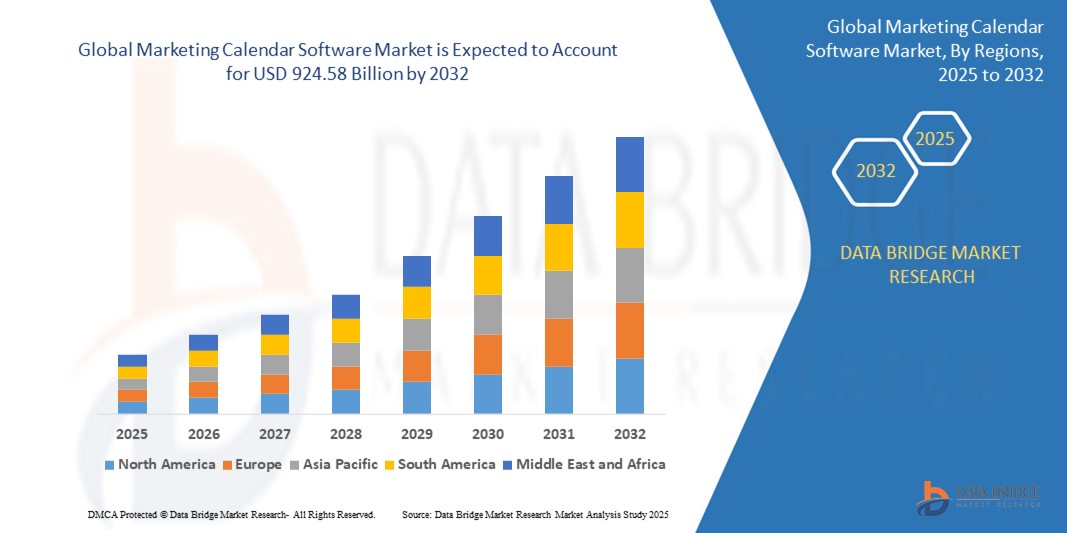
- The global marketing calendar software market size was valued at USD 428.2 billion in 2024 and is expected to reach USD 924.58 billion by 2032, at a CAGR of 10.10% during the forecast period
- This growth is driven by factors such as the increasing demand for automation and integration of marketing activities, the rising adoption of cloud-based solutions, and the need for better data analytics and reporting capabilities
Marketing Calendar Software Market Analysis
- The marketing calendar software market is experiencing steady growth as businesses increasingly adopt digital solutions to manage and optimize their marketing strategies. The integration of marketing calendar tools with other business applications enhances workflow efficiency and supports seamless collaboration across teams
- The market is witnessing a shift towards cloud-based platforms, allowing businesses of all sizes to access scalable and flexible solutions. This transition enables companies to easily update and manage marketing schedules while reducing operational costs and increasing productivity
- North America is expected to dominate the marketing calendar software market due to its advanced technological infrastructure, high demand for innovative marketing tools, and the presence of leading software companies
- Asia-Pacific is expected to be the fastest growing region in the marketing calendar software market during the forecast period due to rapid digital transformation, increasing SME adoption, and rising internet penetration
- The cloud-based segment is expected to dominate the marketing calendar software market with the largest share of 65.5% in 2025 due to its scalability, ease of remote access, lower upfront costs, and real-time collaboration capabilities that support distributed and hybrid teams effectively
Report Scope and Marketing Calendar Software Market Segmentation
|
Attributes |
Marketing Calendar Software Key Market Insights |
|
Segments Covered |
|
|
Countries Covered |
North America
Europe
Asia-Pacific
Middle East and Africa
South America
|
|
Key Market Players |
|
|
Market Opportunities |
|
|
Value Added Data Infosets |
In addition to the market insights such as market value, growth rate, market segments, geographical coverage, market players, and market scenario, the market report curated by the Data Bridge Market Research team includes in-depth expert analysis, import/export analysis, pricing analysis, production consumption analysis, and pestle analysis. |
Marketing Calendar Software Market Trends
“Shift Towards Cloud-Based Solutions in Marketing Calendar Software”
- Cloud-based marketing calendar software is increasingly gaining popularity due to its scalability, flexibility, and cost-effectiveness. It allows businesses to access tools and data from anywhere, promoting remote work and collaboration
- Companies are adopting cloud solutions to centralize marketing efforts, eliminating the need for multiple disconnected systems
- For instance, global brands such as Coca-Cola and Unilever have integrated cloud-based platforms to streamline their marketing activities
- The demand for real-time updates and the ability to collaborate across different locations is driving the shift. Cloud-based software offers real-time synchronization of marketing schedules, ensuring teams stay on the same page
- Cloud-based tools allow businesses to reduce infrastructure costs
- For instance, companies such as HubSpot and Monday.com have introduced cloud solutions that enable small and medium-sized enterprises to optimize marketing calendars without significant upfront investments
- Increased adoption of Artificial Intelligence (AI) in cloud-based solutions further enhances the software’s ability to predict trends and optimize marketing schedules based on data insights. This trend is becoming more prevalent across industries
Marketing Calendar Software Market Dynamics
Driver
“Increasing Need for Streamlined Marketing Operations”
- Businesses are seeking streamlined and centralized marketing operations due to the complexity of managing campaigns across various digital platforms
- For instance, a retail brand running promotions on social media, email, and e-commerce platforms benefits from a unified scheduling tool
- Marketing calendar software offers structured planning, scheduling, and tracking in one place, reducing redundancy and saving time
- For instance, a startup managing weekly newsletters and influencer collaborations can avoid overlapping efforts using a centralized calendar
- These tools promote better team collaboration and transparency, ensuring all departments stay aligned with campaign timelines and objectives
- Centralized platforms are essential in the era of omnichannel marketing, where consistency across platforms is critical for brand image
- Integration with customer relationship management, email marketing, and analytics software enhances productivity and continuous performance tracking
Opportunity
“Rising Demand among Small and Medium Enterprises (SMEs)”
- Small and medium enterprises are shifting to digital marketing and need affordable, scalable tools to manage their campaigns efficiently
- For instance, a boutique clothing store or a local digital agency may use marketing calendar software to plan and track seasonal promotions
- Limited team size and resources make it essential for SMEs to stay organized and consistent, which marketing calendar tools support effectively
- The rise of software-as-a-service platforms allows SMEs to adopt these solutions without large infrastructure costs or IT dependency
- Cloud-based tools designed for SMEs often come with user-friendly interfaces, automation options, and real-time collaboration features
- For instance, a local cafe using a cloud-based tool can coordinate social media posts and email newsletters without professional IT support
- This shift creates a significant opportunity for vendors to build SME-specific solutions that drive measurable results and operational growth
Restraint/Challenge
“Data Security and Privacy Concerns”
- Data security and privacy remain major concerns as businesses rely on cloud-based platforms to manage sensitive marketing information
- The exchange of strategic plans and customer data over digital systems raises the risk of unauthorized access and data breaches
- For instance, a marketing agency managing confidential campaign details for multiple clients may face legal issues if a breach occurs
- Compliance with strict data protection regulations such as the General Data Protection Regulation is a growing responsibility for software users
- Third-party integrations, while useful, can expose businesses to additional risks if those connected tools lack strong security features
- For instance, a business using a poorly secured third-party analytics plugin could unknowingly open a backdoor for cyberattacks
- Industries such as finance and healthcare are particularly cautious, slowing adoption due to the need for higher data protection standards
Marketing Calendar Software Market Scope
The market is segmented on the basis of type, application, team size, functionality, pricing model, end-user industry.
|
Segmentation |
Sub-Segmentation |
|
By Type |
|
|
By Application |
|
|
By Team Size |
|
|
By Functionality |
|
|
By Pricing Model |
|
|
By End-user Industry |
|
In 2025, the cloud-based is projected to dominate the market with a largest share in type segment
The cloud-based segment is expected to dominate the marketing calendar software market with the largest share of 65.5% in 2025 due to its scalability, ease of remote access, lower upfront costs, and real-time collaboration capabilities that support distributed and hybrid teams effectively
The planning is expected to account for the largest share during the forecast period in application market
In 2025, the planning segment is expected to dominate the market with the largest market share of 34.8% due to its role in helping businesses strategically organize, align, and streamline their marketing activities for better execution and measurable outcomes
Marketing Calendar Software Market Regional Analysis
“North America Holds the Largest Share in the Marketing Calendar Software Market”
- North America is the dominating region in the marketing calendar software market, holding approximately 40% of the global market share
- The region's dominance is attributed to the widespread adoption of digital marketing strategies across industries such as retail, IT, and healthcare
- The presence of major market players such as Asana, Monday.com, and Smartsheet enhances the region's market position
- North America's advanced IT infrastructure and high internet penetration support the growth and adoption of marketing calendar software
- The integration of AI and machine learning in marketing tools provides a competitive edge to software providers in this region
“Asia-Pacific is Projected to Register the Highest CAGR in the Marketing Calendar Software Market”
- Asia-Pacific is the fastest-growing region in the marketing calendar software market, accounting for approximately 20% of the global market share
- Rapid digitalization in emerging economies such as India and China drives the adoption of marketing calendar software
- Government initiatives such as Digital India and China's Internet Plus strategy encourage businesses to adopt digital tools
- The increasing availability of high-speed internet and the growing trend of remote working support the adoption of marketing calendar software in the region
- The proliferation of small and medium-sized enterprises embracing digital marketing strategies contributes to market growth
Marketing Calendar Software Market Share
The market competitive landscape provides details by competitor. Details included are company overview, company financials, revenue generated, market potential, investment in research and development, new market initiatives, global presence, production sites and facilities, production capacities, company strengths and weaknesses, product launch, product width and breadth, application dominance. The above data points provided are only related to the companies' focus related to market.
The Major Market Leaders Operating in the Market Are:
- Sprout Social, Inc. (U.S.)
- Formagrid, Inc. (U.S.)
- Asana, Inc. (U.S.)
- Google LLC (U.S.)
- Microsoft Corporation (U.S.)
- HubSpot, Inc. (U.S.)
- Nifty Technologies, Inc. (U.S.)
- Smartsheet Inc. (U.S.)
- CoSchedule LLC (U.S.)
- Planable Inc. (U.K.)
- Wrike, Inc. (U.S.)
- Atlassian Corporation Plc (U.S.)
- Basecamp, LLC (U.S.)

- Interactive Data Analysis Dashboard
- Company Analysis Dashboard for high growth potential opportunities
- Research Analyst Access for customization & queries
- Competitor Analysis with Interactive dashboard
- Latest News, Updates & Trend analysis
- Harness the Power of Benchmark Analysis for Comprehensive Competitor Tracking
Data collection and base year analysis are done using data collection modules with large sample sizes. The stage includes obtaining market information or related data through various sources and strategies. It includes examining and planning all the data acquired from the past in advance. It likewise envelops the examination of information inconsistencies seen across different information sources. The market data is analysed and estimated using market statistical and coherent models. Also, market share analysis and key trend analysis are the major success factors in the market report. To know more, please request an analyst call or drop down your inquiry.
The key research methodology used by DBMR research team is data triangulation which involves data mining, analysis of the impact of data variables on the market and primary (industry expert) validation. Data models include Vendor Positioning Grid, Market Time Line Analysis, Market Overview and Guide, Company Positioning Grid, Patent Analysis, Pricing Analysis, Company Market Share Analysis, Standards of Measurement, Global versus Regional and Vendor Share Analysis. To know more about the research methodology, drop in an inquiry to speak to our industry experts.
Data Bridge Market Research is a leader in advanced formative research. We take pride in servicing our existing and new customers with data and analysis that match and suits their goal. The report can be customized to include price trend analysis of target brands understanding the market for additional countries (ask for the list of countries), clinical trial results data, literature review, refurbished market and product base analysis. Market analysis of target competitors can be analyzed from technology-based analysis to market portfolio strategies. We can add as many competitors that you require data about in the format and data style you are looking for. Our team of analysts can also provide you data in crude raw excel files pivot tables (Fact book) or can assist you in creating presentations from the data sets available in the report.













