


What is the Medical Composite Market Size and Overview?
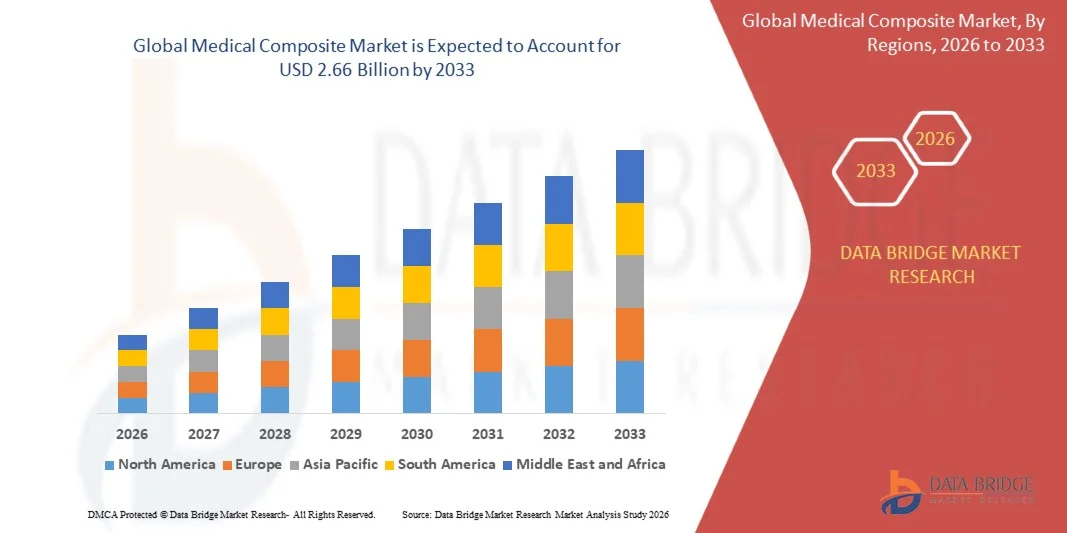
As per Data Bridge Market Research analysis the Medical Composite Market was valued at USD 1.38 billion in 2025 and is projected to reach USD 2.66 billion by 2033, growing at a CAGR of 8.55% from 2026 to 2033. The market is experiencing strong growth driven by increasing demand for lightweight, biocompatible, and high-strength materials across medical devices, implants, orthopedic prosthetics, and diagnostic equipment. Rising focus on patient safety, minimally invasive procedures, and improved treatment outcomes is further accelerating the adoption of advanced composite materials in healthcare applications.
The growing prevalence of chronic diseases, aging global population, and expanding healthcare infrastructure are significantly boosting demand for high-performance medical composites. These materials are increasingly used in orthopedic implants, dental applications, and imaging equipment due to their superior strength-to-weight ratio, corrosion resistance, and compatibility with human tissue. In addition, continuous advancements in polymer matrix composites and fiber-reinforced materials are further supporting innovation and expanding their use in next-generation medical technologies.
Market Size & Forecast
- Global Market Value (2025): USD 1.38 Billion
- Expected Market Value (2033): USD 2.66 Billion
- Forecast CAGR (2026–2033): 8.55%
- Leading Region in 2025: North America
- Fastest Growing Region: Asia-Pacific
What are the Major Takeaways of Medical Composite Market?
- North America dominated the medical composite market with the largest revenue share of 39.6% in 2025, supported by strong healthcare infrastructure, high adoption of advanced medical technologies, increasing orthopedic procedures, and the presence of leading medical device manufacturers.
-
Asia-Pacific is expected to be the fastest-growing region, recording a CAGR of 9.1% from 2026 to 2033. Growth is driven by expanding healthcare infrastructure, rising medical tourism, increasing healthcare expenditure, and growing adoption of advanced implantable and prosthetic solutions in countries such as China, India, and Japan.
- The carbon fiber segment held the largest market revenue share of approximately 52.3% in 2025 driven by its superior strength-to-weight ratio, high biocompatibility, and increasing use in orthopedic implants, prosthetics, and surgical instruments. Carbon fiber composites are widely preferred in medical applications due to their radiolucency, corrosion resistance, and ability to reduce patient recovery time while improving device durability.
- The ceramic fiber segment is projected to register the fastest growth at a CAGR of 9.4% from 2026 to 2033, driven by rising demand in dental applications, bone repair systems, and advanced implant coatings. Increasing adoption in regenerative medicine and minimally invasive procedures is further accelerating segment expansion.
- The composite body implants segment held the largest market revenue share of approximately 41.6% in 2025 driven by increasing demand for orthopedic implants, spinal fixation devices, and trauma repair systems. Growing prevalence of musculoskeletal disorders and rising aging population are further supporting adoption of composite-based implant solutions.
- The diagnostic imaging segment is projected to register the fastest growth at a CAGR of 10.2% from 2026 to 2033, driven by increasing use of MRI and CT-compatible composite materials that reduce imaging interference while maintaining structural integrity. Expanding investments in advanced medical imaging systems and precision diagnostics are further accelerating segment growth globally.
Report Scope and Medical Composite Market Segmentation
Attributes |
Medical Composite Key Market Insights |
|
Segments Covered |
· By Type: Ceramic Fiber, Carbon Fiber, and Others · By Application: Composite Body Implants, Dental, Diagnostic Imaging, Surgical Instruments, and Others |
|
Countries Covered |
North America · U.S. · Canada · Mexico Europe · Germany · France · U.K. · Netherlands · Switzerland · Belgium · Russia · Italy · Spain · Turkey · Rest of Europe Asia-Pacific · China · Japan · India · South Korea · Singapore · Malaysia · Australia · Thailand · Indonesia · Philippines · Rest of Asia-Pacific Middle East and Africa · Saudi Arabia · U.A.E. · South Africa · Egypt · Israel · Rest of Middle East and Africa South America · Brazil · Argentina · Rest of South America |
|
Key Market Players |
• 3M (U.S.) |
|
Market Opportunities |
• Expansion Of Orthopedic And Dental Implant Applications |
|
Value Added Data Infosets |
In addition to the insights on market scenarios such as market value, growth rate, segmentation, geographical coverage, and major players, the market reports curated by the Data Bridge Market Research also include import export analysis, production capacity overview, production consumption analysis, price trend analysis, climate change scenario, supply chain analysis, value chain analysis, raw material/consumables overview, vendor selection criteria, PESTLE Analysis, Porter Analysis, and regulatory framework. |
What is the Key Trend in the Medical Composite Market?
Trend: Growth In Lightweight Biocompatible Materials And Advanced Patient-Centric Medical Device Applications
Increasing demand for lightweight, high-strength, and biocompatible materials across orthopedic, dental, cardiovascular, and diagnostic applications is driving adoption of medical composites. Traditional metallic implants and conventional polymers are increasingly being replaced due to higher weight, limited biointegration, and longer recovery times, encouraging healthcare providers to shift toward composite-based solutions with improved mechanical performance and patient compatibility.
In modern orthopedic and dental applications, fiber-reinforced polymer composites are widely used in implants, prosthetics, and surgical instruments, For instance in spinal cages and dental restorations where high strength-to-weight ratio and corrosion resistance significantly improve patient outcomes and reduce post-surgical complications. In diagnostic imaging systems, composite materials are increasingly used in MRI and CT scanner components to reduce interference while maintaining structural integrity.
The rapid expansion of minimally invasive surgical procedures and personalized healthcare solutions is also increasing demand for advanced composites capable of enabling precision-based medical device design. In addition, regenerative medicine and prosthetic development are adopting bioresorbable composite materials for improved healing and tissue integration. Industry data from 2025 indicates that carbon fiber-reinforced medical composites reduced implant weight by approximately 30–45% compared to traditional titanium-based components, improving patient mobility and recovery efficiency.
Medical Composite Market Dynamics
Key Market Driver: Rising Demand For Advanced Implantable And Diagnostic Medical Devices
Healthcare systems worldwide are increasingly focused on improving patient outcomes, reducing recovery time, and enhancing surgical precision, driving strong demand for advanced medical composite materials. These materials offer high strength, corrosion resistance, and biocompatibility, making them ideal for use in implants, prosthetics, and imaging systems
Medical device manufacturers are increasingly integrating composite materials into orthopedic implants, dental structures, and cardiovascular devices, For instance to improve durability, reduce rejection rates, and enhance long-term performance in human body applications.
Similarly, rising investments in healthcare infrastructure and medical technology innovation are accelerating adoption of composites in diagnostic equipment and surgical tools. Clinical studies in Europe and North America during 2024 reported up to 20–35% improvement in implant longevity and reduced post-operative complications after the adoption of advanced fiber-reinforced composite materials in orthopedic applications.
Key Restraint/Challenge: High Material Costs And Complex Manufacturing Processes
The medical composite market faces challenges due to high production costs associated with advanced fiber materials, biocompatible resins, and precision manufacturing processes. These costs significantly increase the overall price of medical devices, limiting adoption in cost-sensitive healthcare systems and developing regions.
In addition, complex fabrication techniques such as automated fiber placement, curing processes, and stringent regulatory compliance requirements increase production time and limit scalability. Ensuring consistent biocompatibility and meeting strict medical certification standards further adds to development complexity.
Industry assessments indicate that advanced medical composite materials can increase device manufacturing costs by approximately 25–40% compared to conventional materials, creating affordability challenges for widespread adoption in public healthcare systems.
Key Market Opportunity: Expansion Of Personalized Medicine And Advanced Prosthetic Solutions
Rapid growth in personalized healthcare, regenerative medicine, and advanced prosthetic technologies is creating significant opportunities for medical composites. Increasing demand for patient-specific implants and lightweight prosthetic solutions is driving adoption of customizable composite-based materials.
Medical composites are being widely used in prosthetics, orthopedic implants, and dental restorations, For instance to improve patient comfort, enhance mobility, and enable customized anatomical fitting through 3D printing and digital design technologies.
In addition, advancements in bioresorbable composites and smart biomaterials are expanding applications in tissue engineering and drug delivery systems. Industry reports from 2025 indicate that patients using composite-based prosthetics experienced up to 25–30% improvement in mobility efficiency and reduced rehabilitation time compared to conventional prosthetic materials.
How is the Medical Composite Market Segmented?
The market is segmented on the basis of type and application.
- By Type
On the basis of type, the Medical Composite Market is segmented into ceramic fiber, carbon fiber, and others. The carbon fiber segment held the largest market revenue share of approximately 52.3% in 2025 driven by its superior strength-to-weight ratio, high biocompatibility, and increasing use in orthopedic implants, prosthetics, and surgical instruments. Carbon fiber composites are widely preferred in medical applications due to their radiolucency, corrosion resistance, and ability to reduce patient recovery time while improving device durability.
The ceramic fiber segment is projected to register the fastest growth at a CAGR of 9.4% from 2026 to 2033, driven by rising demand in dental applications, bone repair systems, and advanced implant coatings. Increasing adoption in regenerative medicine and minimally invasive procedures is further accelerating segment expansion.
- By Application
On the basis of application, the market is segmented into composite body implants, dental, diagnostic imaging, surgical instruments, and others. The composite body implants segment held the largest market revenue share of approximately 41.6% in 2025 driven by increasing demand for orthopedic implants, spinal fixation devices, and trauma repair systems. Growing prevalence of musculoskeletal disorders and rising aging population are further supporting adoption of composite-based implant solutions.
The diagnostic imaging segment is projected to register the fastest growth at a CAGR of 10.2% from 2026 to 2033, driven by increasing use of MRI and CT-compatible composite materials that reduce imaging interference while maintaining structural integrity. Expanding investments in advanced medical imaging systems and precision diagnostics are further accelerating segment growth globally.
Medical Composite Market Regional Analysis
North America Medical Composite Market Insight
North America dominated the medical composite market with the largest revenue share of 39.6% in 2025, supported by strong demand for advanced healthcare devices, orthopedic implants, and diagnostic systems, along with high adoption of biocompatible and lightweight materials. Healthcare providers in the region highly value the strength, radiolucency, and corrosion resistance offered by medical composites in applications such as prosthetics, surgical instruments, and implantable devices. This widespread adoption is further supported by advanced healthcare infrastructure, high healthcare expenditure, and strong presence of leading medical device manufacturers, establishing medical composites as a key material solution in modern healthcare systems.
U.S. Medical Composite Market Insight
The U.S. medical composite market captured the largest revenue share within North America in 2025, driven by rapid growth in orthopedic surgeries, increasing adoption of advanced prosthetics, and rising demand for minimally invasive medical procedures. Manufacturers are increasingly integrating carbon fiber and polymer-based composites in implants and diagnostic equipment to enhance performance and patient outcomes. In addition, strong investment in medical technology innovation and growing demand for personalized healthcare solutions are further accelerating market expansion across the country.
Europe Medical Composite Market Insight
The Europe medical composite market is expected to witness the fastest growth rate from 2026 to 2033, primarily driven by increasing demand for advanced healthcare materials, rising aging population, and strong focus on minimally invasive surgical procedures. European healthcare systems are increasingly adopting biocompatible composites in orthopedic and dental applications to improve treatment efficiency and reduce recovery time. In addition, strong regulatory support for medical innovation and growing investments in healthcare infrastructure are further supporting market expansion across the region.
U.K. Medical Composite Market Insight
The U.K. medical composite market is expected to witness strong growth from 2026 to 2033, driven by increasing demand for advanced orthopedic implants, expanding private healthcare sector, and rising adoption of lightweight medical materials. Healthcare providers are focusing on improving patient outcomes through advanced prosthetics and surgical tools made from high-performance composites. In addition, growing emphasis on healthcare modernization and digital medical technologies is further supporting market growth across the country.
Germany Medical Composite Market Insight
The Germany medical composite market is expected to witness significant growth from 2026 to 2033, fueled by strong medical device manufacturing capabilities, high demand for orthopedic and dental solutions, and increasing focus on precision healthcare technologies. Medical composites are widely used in implants, diagnostic equipment, and surgical instruments due to their durability and biocompatibility. Germany’s strong healthcare infrastructure and emphasis on innovation are further accelerating adoption across hospitals and medical device manufacturers.
Asia-Pacific Medical Composite Market Insight
The Asia-Pacific medical composite market is expected to witness the fastest growth rate from 2026 to 2033, supported by rapid healthcare infrastructure development, rising medical tourism, and increasing demand for advanced medical devices in countries such as China, India, and Japan. Growing awareness of advanced treatment options and increasing healthcare expenditure are significantly boosting adoption of composite-based implants and prosthetics. In addition, expanding domestic medical device manufacturing is further strengthening regional market growth.
Japan Medical Composite Market Insight
The Japan medical composite market is expected to witness steady growth from 2026 to 2033 due to high demand for advanced medical technologies, aging population, and strong focus on precision healthcare solutions. Medical composites are increasingly used in orthopedic implants, prosthetics, and diagnostic systems due to their lightweight and biocompatible properties. Japan’s advanced healthcare system and emphasis on minimally invasive procedures are further supporting adoption across medical applications.
China Medical Composite Market Insight
The China medical composite market accounted for the largest market revenue share in Asia-Pacific in 2025, attributed to rapid healthcare infrastructure expansion, growing middle-class population, and increasing demand for advanced medical treatments. China is witnessing strong adoption of composite-based medical devices in orthopedic, dental, and diagnostic applications. In addition, government support for healthcare modernization and strong domestic manufacturing capabilities are further accelerating market growth across the country.
Medical Composite Market Share
The Medical Composite industry is primarily led by well-established companies, including:
- 3M (U.S.)
- Toray Industries, Inc. (Japan)
- CeramTec GmbH (Germany)
- Dentsply Sirona (U.S.)
- Royal DSM (Netherlands)
- SGL Carbon (Germany)
- Mitsubishi Chemical Corporation (Japan)
- Avient (U.S.)
- Composiflex (U.S.)
- Polygon Company (India)
- ACP Composites, Inc.(U.S.)
- Icotec ag (Switzerland)
- IDI Composites International (U.S.)
- Kulzer GmbH (Germany)
- Zeus Industrial Products, Inc. (U.S.)
Latest Developments in Medical Composite Market
- In February 2025, Zimmer Biomet received European Commission marketing authorization for its composite spinal implant system, enabling commercial rollout of advanced minimally invasive spinal fusion solutions. This approval is expected to strengthen the company’s presence in the European orthopedic market and accelerate adoption of composite-based spinal implants, improving patient recovery outcomes and surgical efficiency.
- In May 2024, Teijin Limited completed the acquisition of Arbonite LLC, a U.S.-based manufacturer of high-performance composite materials, to expand its medical composites portfolio. This strategic acquisition is expected to enhance Teijin’s technological capabilities in lightweight and high-strength materials, strengthen its supply chain, and expand its footprint in the global medical device materials market.
- In March 2024, 3M and Medtronic entered a strategic collaboration to co-develop advanced biocomposites for orthopedic applications. This partnership is expected to combine 3M’s expertise in advanced materials with Medtronic’s medical device innovation, enabling the development of next-generation implants with improved durability, biocompatibility, and clinical performance.
- In January 2024, Stryker Corporation received FDA approval for its Tritanium Acetabular System, a new composite hip implant designed for improved strength and biocompatibility. This development is expected to enhance patient outcomes in hip replacement procedures, reduce implant failure rates, and strengthen Stryker’s competitive position in the orthopedic implant market.

- Interactive Data Analysis Dashboard
- Company Analysis Dashboard for high growth potential opportunities
- Research Analyst Access for customization & queries
- Competitor Analysis with Interactive dashboard
- Latest News, Updates & Trend analysis
- Harness the Power of Benchmark Analysis for Comprehensive Competitor Tracking
Global Medical Composites Market, Supply Chain Analysis and Ecosystem Framework
To support market growth and help clients navigate the impact of geopolitical shifts, DBMR has integrated in-depth supply chain analysis into its Global Medical Composites Market research reports. This addition empowers clients to respond effectively to global changes affecting their industries. The supply chain analysis section includes detailed insights such as Global Medical Composites Market consumption and production by country, price trend analysis, the impact of tariffs and geopolitical developments, and import and export trends by country and HSN code. It also highlights major suppliers with data on production capacity and company profiles, as well as key importers and exporters. In addition to research, DBMR offers specialized supply chain consulting services backed by over a decade of experience, providing solutions like supplier discovery, supplier risk assessment, price trend analysis, impact evaluation of inflation and trade route changes, and comprehensive market trend analysis.
Data collection and base year analysis are done using data collection modules with large sample sizes. The stage includes obtaining market information or related data through various sources and strategies. It includes examining and planning all the data acquired from the past in advance. It likewise envelops the examination of information inconsistencies seen across different information sources. The market data is analysed and estimated using market statistical and coherent models. Also, market share analysis and key trend analysis are the major success factors in the market report. To know more, please request an analyst call or drop down your inquiry.
The key research methodology used by DBMR research team is data triangulation which involves data mining, analysis of the impact of data variables on the market and primary (industry expert) validation. Data models include Vendor Positioning Grid, Market Time Line Analysis, Market Overview and Guide, Company Positioning Grid, Patent Analysis, Pricing Analysis, Company Market Share Analysis, Standards of Measurement, Global versus Regional and Vendor Share Analysis. To know more about the research methodology, drop in an inquiry to speak to our industry experts.
Data Bridge Market Research is a leader in advanced formative research. We take pride in servicing our existing and new customers with data and analysis that match and suits their goal. The report can be customized to include price trend analysis of target brands understanding the market for additional countries (ask for the list of countries), clinical trial results data, literature review, refurbished market and product base analysis. Market analysis of target competitors can be analyzed from technology-based analysis to market portfolio strategies. We can add as many competitors that you require data about in the format and data style you are looking for. Our team of analysts can also provide you data in crude raw excel files pivot tables (Fact book) or can assist you in creating presentations from the data sets available in the report.













