


Medical Lifting Sling Market Size
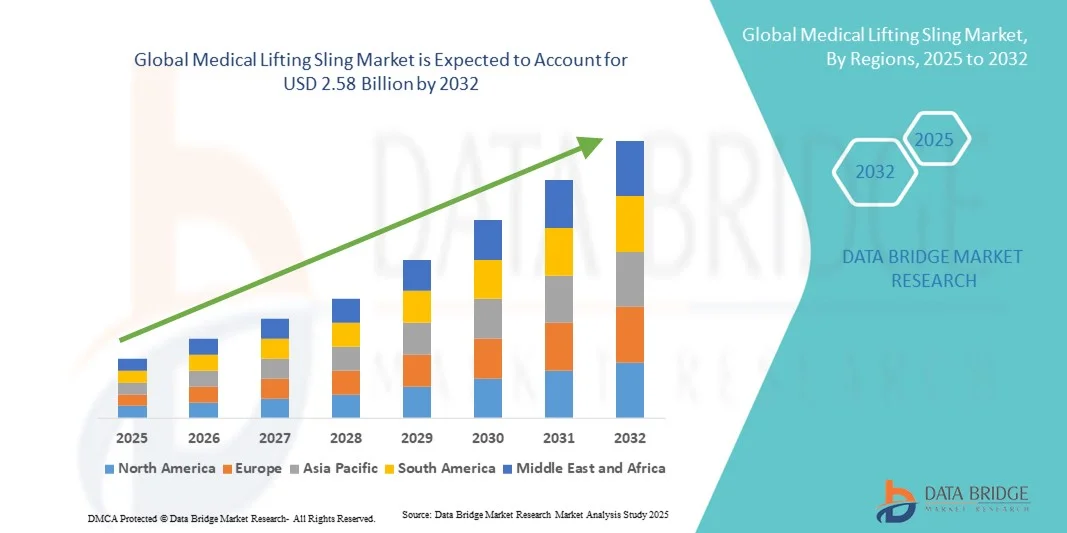
- The global medical lifting sling market size was valued at USD 1.12 billion in 2024 and is expected to reach USD 2.58 billion by 2032, at a CAGR of 11.00% during the forecast period
- The market growth is largely fueled by the increasing demand for safe patient handling solutions in hospitals, nursing homes, and home healthcare settings, driven by the aging global population and rising prevalence of chronic diseases
- Furthermore, technological advancements in sling materials and designs, including ergonomic features and smart sensors, along with the need to reduce caregiver injuries, are establishing medical lifting slings as essential tools in modern patient care. These converging factors are accelerating the adoption of medical lifting sling solutions, thereby significantly boosting the industry's growth
Medical Lifting Sling Market Analysis
- Medical lifting slings, designed to assist in the safe transfer and positioning of patients, are increasingly vital components of modern healthcare settings, including hospitals, nursing homes, and home care, due to their ability to reduce caregiver injuries, enhance patient comfort, and improve operational efficiency
- The escalating demand for medical lifting slings is primarily fueled by the aging global population, rising prevalence of chronic diseases, and growing focus on patient safety and ergonomics among healthcare providers
- North America dominated the medical lifting sling market with the largest revenue share of 38.5% in 2024, supported by well-established healthcare infrastructure, stringent safety regulations, and high adoption of patient handling solutions, with the U.S. witnessing substantial growth due to increasing investments in hospitals and long-term care facilities, alongside innovations in sling materials and smart designs
- Asia-Pacific is expected to be the fastest-growing region in the medical lifting sling market during the forecast period due to expanding healthcare facilities, rising geriatric population, and increasing healthcare expenditure
- Universal sling segment dominated the medical lifting sling market with a market share of 42.6% in 2024, driven by its versatility, ease of use, and compatibility with a wide range of patient lifting devices
Report Scope and Medical Lifting Sling Market Segmentation
|
Attributes |
Medical Lifting Sling Key Market Insights |
|
Segments Covered |
|
|
Countries Covered |
North America
Europe
Asia-Pacific
Middle East and Africa
South America
|
|
Key Market Players |
|
|
Market Opportunities |
|
|
Value Added Data Infosets |
In addition to the insights on market scenarios such as market value, growth rate, segmentation, geographical coverage, and major players, the market reports curated by the Data Bridge Market Research also include in-depth expert analysis, pricing analysis, brand share analysis, consumer survey, demography analysis, supply chain analysis, value chain analysis, raw material/consumables overview, vendor selection criteria, PESTLE Analysis, Porter Analysis, and regulatory framework. |
Medical Lifting Sling Market Trends
Integration of Smart Sensors for Enhanced Patient Safety
- A significant and accelerating trend in the global medical lifting sling market is the incorporation of smart sensors and IoT-enabled monitoring, allowing real-time tracking of patient position and movement, thereby improving safety and reducing caregiver strain
- For instance, the SmartLift Sling integrates weight and motion sensors to alert caregivers if a patient is improperly positioned or at risk of a fall, enhancing proactive patient handling
- These intelligent slings can communicate with hospital management systems to provide usage logs, monitor sling wear and tear, and optimize patient transfer workflows, improving operational efficiency and reducing injury risks
- The seamless integration of smart slings with electronic health records (EHR) and hospital monitoring systems facilitates centralized oversight of patient mobility and safety, creating a connected healthcare environment
- This trend towards technologically advanced, data-driven, and patient-centric sling solutions is reshaping healthcare provider expectations, prompting manufacturers such as Arjo and Guldmann to develop sensor-enabled slings with automated alerts and real-time monitoring capabilities
- The demand for smart lifting slings with integrated safety monitoring is growing rapidly across hospitals, nursing homes, and home care settings, as healthcare providers increasingly prioritize patient safety and workflow optimization
Medical Lifting Sling Market Dynamics
Driver
Rising Geriatric Population and Chronic Disease Prevalence
- The increasing global aging population and rising incidence of chronic illnesses such as arthritis, stroke, and mobility disorders are key drivers for the growing demand for medical lifting slings
- For instance, in March 2024, Hill-Rom introduced a new line of ergonomic slings specifically designed for elderly patients in long-term care facilities, highlighting the growing need for safe patient handling solutions
- Medical lifting slings reduce caregiver injuries, improve patient comfort, and facilitate safer transfers, making them essential in hospitals, nursing homes, and home healthcare environments
- Furthermore, increasing awareness among healthcare providers about workplace safety and patient handling best practices is contributing to higher adoption of lifting slings across healthcare institutions
- The combination of demographic trends, safety regulations, and ergonomic innovations is fueling market growth, positioning lifting slings as indispensable tools in modern patient care
Restraint/Challenge
High Cost and Limited Awareness in Emerging Regions
- The relatively high cost of advanced medical lifting slings, particularly those with smart sensors or specialized designs, poses a challenge to widespread adoption, especially in emerging economies with budget constraints
- For instance, hospitals in some Southeast Asian countries have limited adoption of sensor-enabled slings due to initial investment requirements and lack of reimbursement policies
- Insufficient awareness and training among healthcare staff regarding the benefits and proper use of lifting slings further restricts their market penetration in certain regions
- In addition, regulatory compliance and certification requirements for medical devices vary across regions, making market entry and scaling more complex for manufacturers
- Overcoming these challenges through cost-effective solutions, caregiver training programs, and streamlined regulatory approvals will be crucial to sustaining market growth and expanding adoption globally
Medical Lifting Sling Market Scope
The market is segmented on the basis of product, material, usage type, and end-user.
- By Product
On the basis of product, the medical lifting sling market is segmented into transfer slings, universal slings, hammock slings, standing slings, seating slings, toileting slings, bariatric slings, and other slings. The universal sling segment dominated the market with the largest revenue share of 42.6% in 2024, driven by its versatility and compatibility with a wide range of patient lifting devices. Universal slings are widely preferred in hospitals and elderly care facilities because they can accommodate patients of varying sizes and mobility levels, making transfers safer and more efficient. The ease of use, ability to reduce caregiver injuries, and availability in multiple materials further contribute to its leading position. In addition, these slings often integrate with modern hoist systems, enabling streamlined patient handling workflows and reducing operational time. Their broad applicability across multiple care settings ensures consistent demand and steady market growth.
The transfer sling segment is anticipated to witness the fastest growth rate of 9.2% from 2025 to 2032, fueled by the increasing need for specialized patient transfer solutions in hospitals and home care facilities. Transfer slings are specifically designed for safe lateral and vertical patient movement, minimizing the risk of falls or strain injuries. Growing awareness of patient safety protocols and the adoption of ergonomically designed transfer slings are key factors driving this growth. Technological innovations, including padded support and integrated sensors, enhance user comfort and operational efficiency. Rising investment in long-term care facilities and home healthcare is also boosting adoption, particularly in regions with aging populations. The combination of safety, comfort, and regulatory support positions transfer slings as a rapidly expanding subsegment.
- By Material
On the basis of material, the medical lifting sling market is segmented into nylon slings, padded slings, mesh slings, canvas slings, and other materials. The nylon sling segment dominated the market with a share of 45% in 2024, owing to its strength, durability, and ease of cleaning. Nylon slings are highly resistant to wear and tear, making them ideal for frequent use in hospitals and elderly care facilities. Their lightweight design facilitates easier handling by caregivers while maintaining patient safety. Nylon’s resistance to moisture and chemicals ensures long-term usability and hygiene compliance. Compatibility with various hoist systems and multiple size options further reinforces its dominance. Healthcare providers prefer nylon slings for their proven reliability and low maintenance requirements.
The padded sling segment is expected to witness the fastest CAGR of 9.5% during the forecast period, driven by increasing demand for patient comfort and pressure injury prevention. Padded slings offer enhanced cushioning and support during transfers, reducing discomfort and the risk of skin irritation. Growing awareness of patient-centered care and the adoption of ergonomic lifting solutions in hospitals and home care settings are fueling market growth. Manufacturers are increasingly developing hybrid designs combining padding with smart materials for better weight distribution and stability. Rising investments in premium healthcare facilities are also encouraging adoption. Padded slings are particularly favored in sensitive care scenarios, such as transferring elderly or immobilized patients.
- By Usage Type
On the basis of usage type, the medical lifting sling market is segmented into disposable slings and reusable slings. The reusable sling segment dominated the market with the largest share of 68% in 2024, driven by cost-effectiveness, sustainability, and adaptability for repeated use in hospitals and long-term care facilities. Reusable slings can be sanitized and maintained for multiple patient transfers, making them ideal for high-traffic healthcare environments. Their durability and compatibility with standard lifting devices enhance operational efficiency while reducing procurement costs. Regulatory guidelines supporting hygiene and infection control in healthcare facilities further boost the use of reusable slings. Reusable slings also allow customization in size, material, and design, accommodating diverse patient requirements.
The disposable sling segment is anticipated to witness the fastest growth rate of 10% from 2025 to 2032, driven by increasing demand in home care and short-term care settings. Disposable slings reduce the risk of cross-contamination, ensure hygiene compliance, and provide convenience for caregivers with minimal maintenance. Growing adoption in outpatient care, temporary hospital setups, and home-based rehabilitation programs is fueling this trend. Manufacturers are developing cost-effective, biodegradable, and lightweight disposable slings to address sustainability concerns. The rising preference for infection control, particularly in post-pandemic healthcare protocols, is accelerating adoption. Disposable slings are increasingly considered a practical solution for transient care requirements.
- By End-User
On the basis of end-user, the medical lifting sling market is segmented into hospitals, home care facilities, elderly care facilities, and others. The hospitals segment dominated the market with the largest share of 50% in 2024, due to high patient volumes, stringent safety regulations, and the need for efficient patient transfer systems. Hospitals prioritize lifting slings to minimize caregiver injuries, improve patient comfort, and comply with occupational safety standards. Adoption is further driven by integration with hoist systems and technological innovations, such as padded and sensor-enabled slings. Hospitals also provide specialized training to staff, enhancing sling utilization and effectiveness. The high turnover of patients and diverse mobility needs create a continuous demand for reliable lifting solutions.
The home care facilities segment is expected to witness the fastest CAGR of 11% during the forecast period, fueled by the increasing preference for aging in place and rising demand for at-home patient mobility solutions. Home care facilities and private caregivers are investing in lightweight, easy-to-use slings that facilitate safe patient transfers without extensive equipment. Rising awareness among families about caregiver safety and patient comfort is boosting adoption. Technological advancements, including portable and foldable sling designs, make them ideal for home environments with limited space. Supportive government initiatives promoting home healthcare services further enhance market growth. Home care adoption is expected to continue accelerating due to demographic and lifestyle trends.
Medical Lifting Sling Market Regional Analysis
- North America dominated the medical lifting sling market with the largest revenue share of 38.5% in 2024, supported by well-established healthcare infrastructure, stringent safety regulations, and high adoption of patient handling solutions, with the U.S. witnessing substantial growth due to increasing investments in hospitals and long-term care facilities, alongside innovations in sling materials and smart designs
- Healthcare providers in the region prioritize slings that enhance caregiver safety, improve patient comfort, and comply with occupational safety regulations, making them essential in hospitals, elderly care facilities, and home care settings
- This strong adoption is further supported by the aging population, increasing prevalence of chronic diseases, and rising investments in long-term care and rehabilitation facilities, positioning medical lifting slings as a standard component of modern patient care across North America
U.S. Medical Lifting Sling Market Insight
The U.S. medical lifting sling market captured the largest revenue share of 40% in 2024 within North America, fueled by the increasing geriatric population and rising prevalence of chronic and mobility-related conditions. Healthcare providers are prioritizing slings that enhance patient safety, reduce caregiver injuries, and improve operational efficiency. The growing adoption of advanced patient handling solutions in hospitals, rehabilitation centers, and long-term care facilities further propels the market. In addition, technological advancements such as padded designs, ergonomic features, and sensor-enabled slings are significantly contributing to market growth. Government initiatives supporting safe patient handling and occupational safety compliance also reinforce demand.
Europe Medical Lifting Sling Market Insight
The Europe medical lifting sling market is projected to expand at a substantial CAGR throughout the forecast period, driven by stringent healthcare regulations and the need for safe patient handling in hospitals, elderly care facilities, and home care environments. Rising urbanization, coupled with increasing awareness of caregiver safety and patient comfort, is fostering the adoption of lifting slings. European healthcare providers are also focused on ergonomic and technologically advanced sling designs to reduce workplace injuries. The market is witnessing growth across both new healthcare facility constructions and upgrades to existing infrastructures. Regional emphasis on high-quality patient care further supports adoption.
U.K. Medical Lifting Sling Market Insight
The U.K. medical lifting sling market is anticipated to grow at a noteworthy CAGR during the forecast period, driven by increasing home care and elderly care demand alongside rising awareness of caregiver safety. Concerns regarding workplace injuries and patient comfort are encouraging hospitals and care facilities to adopt advanced sling solutions. The U.K.’s robust healthcare infrastructure, combined with strong domestic and international supply chains, is expected to continue stimulating market growth. Integration with hoist systems, ergonomic designs, and reusable slings are particularly favored. Rising government and private initiatives promoting occupational safety further reinforce adoption.
Germany Medical Lifting Sling Market Insight
The Germany medical lifting sling market is expected to expand at a considerable CAGR during the forecast period, fueled by increasing awareness of patient safety, caregiver protection, and ergonomic healthcare solutions. Germany’s well-developed healthcare infrastructure, emphasis on innovation, and strict occupational safety standards promote sling adoption in hospitals, rehabilitation centers, and elderly care facilities. Advanced sling designs, including sensor-enabled and padded slings, are gaining traction. Integration with hoist systems and compliance with EU safety standards are key growth drivers. The preference for reliable, high-quality solutions aligns with local consumer expectations and regulatory requirements.
Asia-Pacific Medical Lifting Sling Market Insight
The Asia-Pacific medical lifting sling market is poised to grow at the fastest CAGR of 11% during the forecast period, driven by increasing urbanization, rising geriatric population, and expanding healthcare facilities in countries such as China, Japan, and India. Government initiatives supporting home healthcare and long-term care infrastructure are accelerating sling adoption. Technological advancements, including lightweight, foldable, and sensor-enabled slings, enhance accessibility and usability. Rising awareness of patient safety and caregiver ergonomics is boosting demand across hospitals, elderly care facilities, and home care settings. The region’s growing manufacturing capabilities also improve affordability and availability.
Japan Medical Lifting Sling Market Insight
The Japan medical lifting sling market is gaining momentum due to rapid urbanization, a high-tech healthcare environment, and increasing elderly population. Demand is driven by the need for safe, easy-to-use, and ergonomic patient transfer solutions in hospitals, nursing homes, and home care facilities. Integration with hoist systems and the adoption of sensor-enabled slings for monitoring patient position are fueling growth. The market emphasizes quality, safety, and technological innovation to cater to both residential and commercial healthcare settings. Japan’s focus on preventive care and occupational safety supports continued adoption of advanced sling solutions.
India Medical Lifting Sling Market Insight
The India medical lifting sling market accounted for the largest market revenue share in Asia-Pacific in 2024, attributed to the expanding elderly population, rising chronic disease prevalence, and growing home healthcare services. Increasing awareness of caregiver safety and patient comfort is driving demand for both reusable and disposable slings. The government’s promotion of smart healthcare infrastructure and private investment in elderly care facilities further propels growth. Affordable sling options, combined with domestic manufacturing capabilities, enhance accessibility for residential, commercial, and long-term care settings. Rapid urbanization and a growing middle class continue to support market expansion.
Medical Lifting Sling Market Share
The Medical Lifting Sling industry is primarily led by well-established companies, including:
- Hoyer Lifts (U.S.)
- V. Guldmann A/S (Denmark)
- Arjo (Sweden)
- Bestcare Inc. (U.S.)
- Vancare (U.S.)
- Hillrom (U.S.)
- John Preston & Co (Belfast) Ltd (Sweden)
- Invacare International Holdings Corp. (U.S.)
- Joerns Healthcare (U.S.)
- Medline Industries, Inc. (U.S.)
- Prism Medical (Canada)
- Drive Medical (U.S.)
- Romedic (Sweden)
- Snug Seat (U.K.)
- Rehabmart, LLC (U.S.)
- Silvalea Ltd (U.K.)
- Winncare (France)
- Human Care (Sweden)
- novacare GmbH (Germany)
What are the Recent Developments in Global Medical Lifting Sling Market?
- In October 2024, the U.S. Occupational Safety and Health Administration (OSHA) and the National Institute for Occupational Safety and Health (NIOSH) jointly updated their Safe Patient Handling and Mobility (SPHM) guidelines. This regulatory news, although not a product launch, is a major development as it emphasizes the mandatory recommended use of mechanical lifting devices and, by extension, compatible patient lift slings, particularly in nursing homes
- In June 2023, Joerns Healthcare, a prominent healthcare equipment and technology company, announced a collaboration with Winncare, a leading European mobility solutions provider. The partnership aims to introduce Winncare’s moving and handling product range, including their Lifting Cushion products, to the U.S. market
- In May 2023, SSM Health introduced the LIFTsmart Program to enhance safe patient handling practices. This program involved providing slings, lateral transfers and repositioning aids, lifts, and standing/raising aids to patients. It highlights a major, real-world trend and investment by a provider to increase the use of slings and lifting equipment for patient and caregiver safety
- In April 2023, Etac AB, a key industry player, extended its range of Molift UnoSlings designed specifically for single-patient use. The expansion includes slings for various situations and transfers, such as supine transfers, seated transfers, and gait training. This launch addresses the rising industry focus on infection control by providing a disposable alternative to reusable slings, helping healthcare facilities reduce the risk of cross-contamination
- In January 2023, Winncare Introduces Complete Supine Transfer System Winncare, a major medical device manufacturer, introduced the new complete Supine Transfer System. This system is designed to help lift patients safely and quickly, featuring a portable and convenient design. This product launch addresses the need for faster, safer, and more user-friendly solutions for patients who require horizontal movement

- Interactive Data Analysis Dashboard
- Company Analysis Dashboard for high growth potential opportunities
- Research Analyst Access for customization & queries
- Competitor Analysis with Interactive dashboard
- Latest News, Updates & Trend analysis
- Harness the Power of Benchmark Analysis for Comprehensive Competitor Tracking
Data collection and base year analysis are done using data collection modules with large sample sizes. The stage includes obtaining market information or related data through various sources and strategies. It includes examining and planning all the data acquired from the past in advance. It likewise envelops the examination of information inconsistencies seen across different information sources. The market data is analysed and estimated using market statistical and coherent models. Also, market share analysis and key trend analysis are the major success factors in the market report. To know more, please request an analyst call or drop down your inquiry.
The key research methodology used by DBMR research team is data triangulation which involves data mining, analysis of the impact of data variables on the market and primary (industry expert) validation. Data models include Vendor Positioning Grid, Market Time Line Analysis, Market Overview and Guide, Company Positioning Grid, Patent Analysis, Pricing Analysis, Company Market Share Analysis, Standards of Measurement, Global versus Regional and Vendor Share Analysis. To know more about the research methodology, drop in an inquiry to speak to our industry experts.
Data Bridge Market Research is a leader in advanced formative research. We take pride in servicing our existing and new customers with data and analysis that match and suits their goal. The report can be customized to include price trend analysis of target brands understanding the market for additional countries (ask for the list of countries), clinical trial results data, literature review, refurbished market and product base analysis. Market analysis of target competitors can be analyzed from technology-based analysis to market portfolio strategies. We can add as many competitors that you require data about in the format and data style you are looking for. Our team of analysts can also provide you data in crude raw excel files pivot tables (Fact book) or can assist you in creating presentations from the data sets available in the report.













