


What is the Medical Penlight Market Size and Growth Rate?
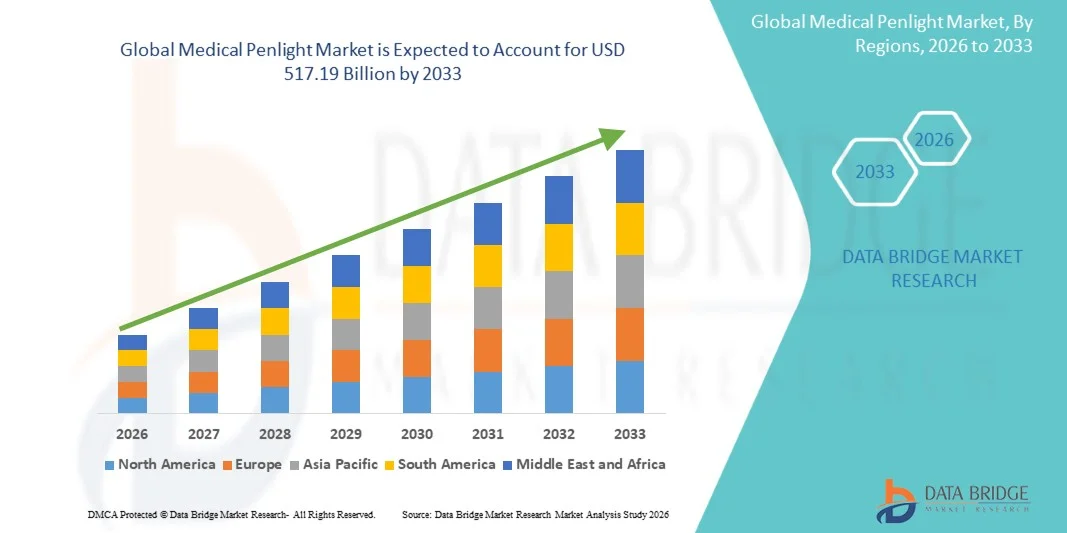
- As per Data Bridge Market Research analysis, the medical penlight market was valued at USD 297.66 million in 2025 and is projected to reach USD 517.19 million by 2033, growing at a CAGR of 7.15% from 2026 to 2033.
- The market is experiencing consistent growth driven by the utility of medical penlights in diagnosing and assessing eye and ear conditions, increasing demand for portable diagnostic tools, and technological advances in LED lighting. Medical professionals rely on penlights because of their compact size, ease of use, and focused illumination, which support detailed examinations of the pupils, eyes, ears, throat, and other sensitive areas.
- The increasing prevalence of vision impairment and hearing loss, alongside the expansion of healthcare facilities and demand for rapid patient assessment, is supporting market growth. At the same time, the adoption of LED-based medical penlights, rechargeable devices, reusable products, and portable diagnostic tools is creating additional opportunities across hospitals, clinics, diagnostic centers, and emergency medical settings
Market Size & Forecast
- Global Market Value (2025): USD 297.66 Million
- Expected Market Value (2033): USD 517.19 Million
- Forecast CAGR (2026–2033): 7.15%
- Leading Region in 2025: North America
- Fastest Growing Region: Asia Pacific
What are the Major Takeaways of the Medical Penlight Market?
- North America dominated the medical penlights market with the largest revenue share of 36.8% in 2025, supported by the rising prevalence of eye and ENT disorders, including cataracts, glaucoma, and hearing loss, which increases demand for precise diagnostic tools.
- Asia-Pacific is expected to be the fastest-growing region at a CAGR of 7.9% from 2026 to 2033, fueled by the rising number of ENT and ophthalmologic hospitals, increased investment in healthcare infrastructure, and the expansion of specialized facilities
- The LED medical penlights segment led the market with a 64.8% share in 2025, driven by higher energy efficiency, brighter and more consistent illumination, and increasing adoption of rechargeable and portable examination devices across hospitals, clinics, and emergency-care settings.
- Medical penlights with incandescent bulb are the fastest-growing type, projected to register a CAGR of 6.5%, reflecting the surge in demand for cost-effective and easily accessible basic examination devices, particularly across emerging healthcare facilities
- The white light segment dominated the light output type category with a 79.1% revenue share in 2025, led by its broad applicability in routine clinical examinations, particularly pupil assessment, throat examination, general physical examination, and neurological assessment,
- Disposable accounted for 57.0% of the market share in 2025, preferred by hospitals, clinics, emergency departments, and other high-patient-volume healthcare facilities
- The reusable segment is the fastest-growing usability category, with a CAGR of 9.4%, driven by increasing demand for cost-effective, durable, and environmentally sustainable examination devices.
Report Scope and Medical Penlight Market Segmentation
|
Attributes |
Medical Penlight Key Market Insights |
|
Segments Covered |
|
|
Countries Covered |
North America
Europe
Asia-Pacific
Middle East and Africa
South America
|
|
Key Market Players |
|
|
Market Opportunities |
|
|
Value Added Data Infosets |
|
What is the Key Trend in the Medical Penlight Market?
- Healthcare professionals are increasingly adopting LED medical penlights because they provide superior illumination, energy efficiency, durability, portability, and focused light for routine clinical examinations across healthcare settings worldwide today for clinicians.
- For instance, in January 2025, a study published in Medicine evaluated pupillary penlight visual assessment against transorbital sonography in 140 patients with traumatic brain injury, demonstrating continued clinical use of penlight-based pupillary assessment while newer objective technologies are being evaluated
- White light remains important because it closely mimics natural daylight, enabling visualization of tissue color, pupil response.
- Healthcare facilities favor reusable penlights because they provide durability, support sterilization protocols, reduce medical waste, and lower replacement costs over time.
- For instance, in April 2022, a study published in the Journal of Hand Surgery Asian-Pacific Volume compared penlight and smartphone transillumination, reporting 100% sensitivity, 75% specificity, and 88% accuracy for penlight examination, demonstrating continued clinical utility of penlights for diagnostic assessment.
- As healthcare providers prioritize diagnostic precision, infection control, portability, and cost effectiveness, demand for LED and reusable medical penlights is expected to increase across hospitals, clinics, diagnostic centers, emergency settings, and other healthcare environments globally and point-of-care care settings.
What are the Key Drivers of the Medical Penlight Market?
- The rising prevalence of eye and ear conditions has significantly increased demand for portable medical penlights used to assess pupils, eye responses, ear canals, throat, and other sensitive areas during routine examinations and settings.
- For instance, in April 2022, a study published in the Journal of Hand Surgery Asian-Pacific Volume compared a conventional penlight with a smartphone flashlight for transillumination of simulated soft-tissue masses and found that the penlight achieved 100% sensitivity, 75% specificity, and 88% overall accuracy, supporting continued use of penlights as a practical diagnostic adjunct.
- Hospitals, clinics, and diagnostic centers are integrating compact penlights into clinical workflows because portability, focused illumination, and ease of use support rapid patient assessment and diagnosis.
- For instance, in August 2022, a study published in PLOS ONE compared standard manual pupillary assessment using a penlight with quantitative pupillometry in critically ill cardiac patients, supporting the continued clinical use of penlights while highlighting demand for more objective pupil assessment technologies
- With healthcare systems increasingly emphasizing portable diagnosis and efficient examination tools, medical penlights will remain important for routine assessment, screening, and point-of-care clinical examination across healthcare settings worldwide and consistently
Which Factors are Challenging the Growth of the Medical Penlight Market?
- Manual pupil assessment with penlights can involve subjective interpretation, creating demand for automated technologies and limiting reliance on conventional examination methods in environments.
- For instance, in September 2024, a study published in the American Journal of Medicine reported that evidence increasingly supports quantitative pupillometry over subjective examination with flashlight or penlight, while noting that pupillometers had become standard of care in many hospitals across six continents, creating a technology-based substitute for conventional penlights.
- These limitations can reduce adoption among institutions seeking standardized, quantitative measurements, particularly where automated pupillometry offers.
- The growing availability of low-cost generic flashlights is increasing price competition, particularly in price-sensitive healthcare markets, where basic consumer LED products can substitute for entry-level medical penlights.
- Increasing battery-waste regulations and photobiological safety requirements can raise product-development, testing, redesign, and compliance costs for manufacturers, particularly for disposable battery-powered penlights in regulated markets today.
- For instance, in July 2023, a study published in Neurotrauma Reports evaluated a smartphone-based pupillometry application against the NeurOptics automated pupillometer for severe traumatic brain injury assessment, demonstrating the growing development of digital alternatives for quantitative pupillary-light-reflex measurement and potentially increasing substitution pressure on conventional penlight assessment.
- The increasing availability of automated pupillometers and smartphone-based assessment technologies may constrain conventional penlight demand, particularly where healthcare providers prioritize quantitative measurements
How is the Medical Penlight Market Segmented?
The medical penlight market is segmented on the basis of type, light output, usability, application, and end user.
- By Type
On the basis of type, the medical penlight market is segmented into LED medical penlights and medical penlights with incandescent bulbs. The LED medical penlights segment dominated the market with a 64.8% revenue share in 2025, LED penlights have become the preferred option because they provide brighter and more consistent illumination than conventional incandescent models. Their lower power consumption provides longer battery life, which is particularly important for healthcare professionals who use penlights repeatedly throughout the day. LED technology also offers longer operating life and lower heat generation, improving both durability and user comfort. These devices are extensively used for pupil examination, throat examination, neurological assessment, and general clinical examination. Increasing availability of rechargeable LED penlights is further improving their convenience and reducing recurring battery costs.
The medical penlights with incandescent bulb segment is projected to register fastest growth at 6.5% CAGR during the forecast period. This growth is primarily associated with continued replacement demand in cost-sensitive healthcare environments. Incandescent penlights remain attractive where basic illumination is sufficient and healthcare providers prioritize low initial purchase costs. Their simple construction makes them easy to operate and maintain without advanced electronic components. They also remain familiar to healthcare professionals who have traditionally used conventional examination lights. Demand is expected to be supported by smaller clinics, developing healthcare facilities, and markets where replacement of existing incandescent equipment occurs gradually.
- By Light Output
On the basis of light output, the medical penlight market is segmented into white light, blue light, red light, green light, and UV light. The white light segment dominated the market with a 79.1% share in 2025, White light is widely preferred because it provides versatile illumination for routine clinical examinations. It is extensively used for assessing pupil response, examining the throat and oral cavity, and conducting general physical examinations. The broad applicability of white light allows one penlight to be used across multiple medical procedures. Improvements in LED technology have also increased brightness, beam uniformity, energy efficiency, and color accuracy. Healthcare facilities therefore generally prioritize white-light penlights when purchasing multipurpose examination devices. The combination of clinical versatility, widespread availability, and established physician preference continues to make white light the largest segment.
The red light segment is projected to register the fastest growth at 7% CAGR from 2026 to 2033, making it the fastest-growing light-output segment despite its considerably smaller current market size. Red light is increasingly attractive for specialized examinations because it can provide useful illumination in low-light environments while being less disruptive to patients during certain assessments. It has applications in emergency settings and selected ophthalmic and dermatological examinations. Advances in LED technology are allowing manufacturers to provide more precise wavelength control and adjustable light intensity. The development of multifunctional penlights with different illumination modes is further expanding the potential use of red light. Healthcare professionals are also showing increasing interest in specialized lighting for particular examination conditions.
- By Usability
On the basis of usability, the medical penlight market is segmented into disposable and reusable penlights. The disposable segment dominated the market with a 57.0% share in 2025. Disposable penlights are extensively adopted because they provide a ready-to-use examination solution and can be discarded after patient use. Their single-use nature reduces the risk of cross-contamination between patients and minimizes the need for cleaning or sterilization. This is particularly beneficial in emergency departments, high-volume clinics, and other environments with frequent patient examinations. Disposable models also simplify clinical workflows because healthcare workers do not need to allocate time for device reprocessing. Advances in low-cost LED manufacturing have improved the brightness and reliability of disposable models. Increasing emphasis on infection prevention and hygienic clinical practices continues to support their widespread use.
The reusable segment is projected to be the fastest-growing usability segment, with an estimated CAGR of 9.4% through 2033. Reusable penlights are benefiting from increasing healthcare efforts to reduce recurring procurement costs and medical waste. Rechargeable models eliminate the need for frequent battery replacement and can provide a lower total cost of ownership over their operating life. Sustainability initiatives are also encouraging healthcare facilities to reconsider the extensive use of single-use examination accessories. Modern reusable LED penlights can provide long operating lives while maintaining consistent illumination quality. Their durability makes them particularly attractive to physicians and healthcare institutions that perform repeated examinations. Increasing availability of USB-rechargeable and high-efficiency models is further improving their practicality.
- By Application
On the basis of application, the medical penlight market is segmented into pupil examination, throat examination, general examination, and neurological assessment. The general examination segment dominated the market with 45% share in 2025. General examination includes routine visual inspection, preliminary patient assessment, wound inspection, and other basic clinical procedures. Penlights are particularly valuable in these examinations because they provide portable illumination without requiring large diagnostic equipment. Their compact form allows physicians, nurses, and paramedics to keep them readily available during routine patient assessments. General examinations occur across primary care, emergency departments, outpatient clinics, and hospital wards, creating a broad base of demand. The versatility of the application allows one device to support multiple examination activities
The neurological assessment segment is projected to register the fastest growth at 7.2% CAGR during the forecast period. Neurological assessment frequently requires rapid evaluation of pupil size, symmetry, and reaction to light, making penlights an important bedside tool. Growing awareness of neurological disorders and increasing emphasis on early neurological evaluation are supporting demand. Stroke-care programs and emergency medical services are also increasing the need for rapid neurological assessment equipment. Penlights offer healthcare professionals a simple and portable method for repeatedly assessing neurological status. They are particularly useful in emergency departments for patients with suspected stroke, head trauma, altered consciousness, or other acute neurological conditions. Improvements in LED brightness and beam precision are further improving their usefulness for pupil-response assessment.
- By End User
On the basis of end user, the medical penlight market is segmented into hospitals & clinics, diagnostic centers, and others. The hospitals & clinics segment dominated the market with 70.2% share in 2025. Hospitals and clinics use medical penlights across emergency departments, outpatient units, intensive-care facilities, general wards, and physician offices. Their broad application across routine and emergency examinations creates sustained demand for these devices. Healthcare professionals such as physicians, nurses, paramedics, and emergency personnel frequently use penlights as part of standard examination procedures. Hospitals also require multiple devices because examinations take place simultaneously across different departments and patient rooms. The relatively low acquisition cost allows facilities to maintain sufficient inventory without significant capital expenditure.
The diagnostic centers segment is projected to be the fastest-growing end-user segment at a 7.3% CAGR from 2026 to 2033, Growth is being supported by the expansion of outpatient diagnostic services and decentralized healthcare delivery. Diagnostic centers increasingly perform preliminary physical assessments alongside laboratory testing and imaging procedures. Medical penlights provide an inexpensive and portable tool for basic visual and neurological examinations before patients undergo additional diagnostic procedures. Their compact size also makes them convenient for facilities with limited examination space. The increasing number of independent diagnostic centers and specialty outpatient facilities is expanding the potential customer base.
Which Region Holds the Largest Share of the Medical Penlight Market?
- North America dominated the medical penlights market with the largest revenue share of 36.8% in 2025, supported by the rising prevalence of eye and ENT disorders, including cataracts, glaucoma, and hearing loss, which increases demand for precise diagnostic tools.
- The region also benefits from increasing demand for precise diagnostic tools for conditions such as cataracts, glaucoma, and hearing loss, alongside strong adoption across hospitals and clinics. The United States leads the regional market, while advanced healthcare infrastructure and a growing focus on early diagnosis and treatment continue to strengthen North America's leadership position in the global medical penlight market.
U.S. Medical Penlight Market Insight
The U.S. medical penlight market is witnessing steady growth due to increasing investment in ENT care and expansion of hospitals and specialized healthcare facilities. The country’s advanced healthcare infrastructure supports widespread use of portable diagnostic tools across hospitals, clinics, emergency care, and specialized practices. Rising prevalence of eye and ENT disorders, including cataracts, glaucoma, and hearing-related conditions, is creating continued demand for penlights used during clinical examinations. According to the National Eye Institute, cataracts currently affect approximately 24 million Americans, highlighting the substantial need for routine eye assessment. Medical penlights are particularly useful for pupil examination and assessing eye-related abnormalities because of their compact size and focused illumination. Increasing emphasis on early diagnosis and treatment is therefore supporting continued adoption across U.S. healthcare settings
Asia-Pacific Medical Penlight Market Insight
The Asia-Pacific medical penlight market is expected to witness rapid growth, driven by the rising number of ENT and ophthalmologic hospitals and increasing investment in healthcare infrastructure. Expansion of specialized healthcare facilities is creating greater demand for portable diagnostic tools used in ophthalmology and otolaryngology. The region's growing healthcare infrastructure is also improving access to diagnostic services and increasing the use of compact examination devices. In India, the number of cataract surgeries surpassed 8.3 million during 2022–2023, demonstrating the substantial scale of ophthalmic care requirements. China and Japan are also important markets because of their large patient populations and increasing need for eye and ear examinations. Increasing healthcare awareness and expansion of specialized medical facilities are further supporting adoption of medical penlights across the region.
Japan Medical Penlight Market Insight
The Japan medical penlight market is witnessing consistent growth due to the high prevalence of visual impairments and the country's need for reliable diagnostic tools. Glaucoma represents 24.3% of visual impairment cases in Japan, while diabetic retinopathy, degenerative myopia, age-related macular degeneration, and cataracts also contribute substantially to visual impairment. Together, these conditions account for approximately 75% of the cases identified in the cited market research. This significant ophthalmic disease burden creates demand for basic examination tools capable of supporting pupil assessment and other visual examinations. Japan's healthcare system also places strong emphasis on early detection and regular medical assessment. Medical penlights provide healthcare professionals with compact, easily accessible illumination for routine examinations. The combination of ophthalmic disease burden and demand for efficient diagnostic tools is supporting the Japanese market.
China Medical Penlight Market Insight
The China medical penlight market is growing rapidly, driven by expanding healthcare infrastructure, a large visually impaired population, and increasing demand for ophthalmic examinations. China represents approximately 20% of the global visually impaired population, creating substantial requirements for accessible eye-care services and diagnostic equipment. In addition, approximately 66.8% of China's population is expected to have myopia by 2050, highlighting the growing importance of regular eye examinations and early detection. The country's expanding healthcare system is increasing the availability of specialized medical services, including ophthalmology and ENT care. LED medical penlights are also becoming increasingly important because they provide efficient and consistent illumination for clinical examinations. Growing healthcare awareness and the modernization of medical facilities are consequently supporting demand for portable diagnostic devices such as medical penlights.
U.K. Medical Penlight Market Insight
The U.K. medical penlight market is experiencing steady growth, supported by advancements in LED technology, increasing healthcare spending, and rising demand for efficient diagnostic tools. Medical penlights are particularly useful in emergency care and general practice because they provide portable illumination for rapid clinical examinations. The U.K. also has a notable incidence of eye-related injuries requiring assessment in primary-care settings. Research cited by Grand View Research indicates approximately 3.2 corneal injuries and 2.7 foreign-body incidents per 1,000 people annually presenting in primary care settings in the U.K. These conditions increase the importance of readily available examination tools for evaluating ocular injuries. Growing preference for ergonomic, energy-efficient, and sustainable medical devices is further supporting product adoption
Germany Medical Penlight Market Insight
The Germany medical penlight market is expanding steadily due to the country's advanced healthcare infrastructure, demand for high-quality diagnostic tools, and growing preference for portable and energy-efficient devices. Germany's established healthcare network provides broad opportunities for medical penlights across hospitals, clinics, emergency services, and specialist practices. The adoption of LED technology is supporting demand because LED penlights provide efficient illumination and longer operating life for repeated clinical examinations. Increasing preference for ergonomic designs is also improving the practicality of penlights for healthcare professionals. Germany's strong medical research sector and emphasis on precision diagnostic equipment further support adoption of advanced examination devices. Growing interest in sustainable and energy-efficient healthcare products is also encouraging the transition toward modern LED-based penlights.
Which are the Top Companies in Medical Penlight Market?
The medical penlight industry is primarily led by well-established companies, including:
- American Diagnostic Corporation (U.S.)
- BV Medical (U.S.)
- MedSource Labs (U.S.)
- MDF Instruments (U.S.)
- Good-Lite Co (U.S.)
- Prestige Medical (U.S.)
- Streamlight Inc. (U.S.)
- GF Health Products, Inc. (U.S.)
- Wenzhou Caretek Medical Device Co., Ltd. (China)
- Zhejiang Honsun Medical Technology Co., Ltd. (China)
- Boen Healthcare Co., Ltd. (China)
- Kimetec GmbH (Germany)
- LUXAMED GmbH & Co. KG (Germany)
- Rudolf Riester GmbH (Germany)
- Kirchner & Wilhelm GmbH + Co KG (Germany)
- SPENGLER MEDICAL (France)
- PT. Sugih Instrumendo Abadi (Indonesia)
- BIC Medical (Japan)
- Medline Industries, LP (U.S.)
- Zhejiang Honsun Medical Technology Co., Ltd. (China)
What are Latest Developments in Medical Penlight Market?
- In June 2025, PIPI Medical highlighted its disposable medical penlight as a clinical examination tool featuring bright LED illumination and a hygienic single-use design. The company described the device as lightweight and portable for use in hospitals, clinics, emergency settings, and home care. The penlight provides a focused white beam for applications including pupil-response assessment, throat and oral-cavity inspection, and skin observation. Its medical-grade plastic construction is designed to provide lightweight durability while supporting single-use clinical workflows.
- In October 2023, Streamlight introduced the Stylus HAZ-LO penlight, a compact LED penlight designed for professional use in hazardous environments. The product delivers 105 lumens from a white LED and provides a focused beam for portable illumination. It is rated for Class I, Division 1 hazardous locations and incorporates an impact- and chemical-resistant construction for demanding working conditions.
- In September 2023, Streamlight launched the Stylus Pro HAZ-LO, a new intrinsically safe penlight designed for professionals working in hazardous environments. The penlight uses a high-power white LED producing 105 lumens and provides a 39-meter beam distance with a runtime of 2.25 hours. Its Class I, Division 1 safety rating, impact- and chemical-resistant construction, and IPX7 waterproof rating were designed for demanding work environments. The product also features a push-button tail switch and replaceable metal pocket clip.
- In October 2022, Aspen Surgical completed its acquisition of Symmetry Surgical, expanding its portfolio of surgical and specialty medical products. Symmetry Surgical provided surgical instrumentation, electrosurgical products, and minimally invasive surgical devices serving multiple specialties and care settings. Aspen described the acquisition as an expansion of its portfolio and commercial capabilities across acute and non-acute healthcare settings. The transaction is relevant to the medical examination and surgical-device landscape because Aspen Surgical is also identified among companies active in medical penlights and disposable medical products.
- In December 2022, Binghamton University's Decker College of Nursing and Health Sciences expanded its clinical-training equipment requirements to include professional medical assessment kits containing a diagnostic penlight. The kits provided undergraduate nursing students with essential examination equipment, including a professional-level stethoscope, blood-pressure unit, diagnostic penlight, bandage scissors, and Kelly hemostatic clamp.

- Interactive Data Analysis Dashboard
- Company Analysis Dashboard for high growth potential opportunities
- Research Analyst Access for customization & queries
- Competitor Analysis with Interactive dashboard
- Latest News, Updates & Trend analysis
- Harness the Power of Benchmark Analysis for Comprehensive Competitor Tracking
Data collection and base year analysis are done using data collection modules with large sample sizes. The stage includes obtaining market information or related data through various sources and strategies. It includes examining and planning all the data acquired from the past in advance. It likewise envelops the examination of information inconsistencies seen across different information sources. The market data is analysed and estimated using market statistical and coherent models. Also, market share analysis and key trend analysis are the major success factors in the market report. To know more, please request an analyst call or drop down your inquiry.
The key research methodology used by DBMR research team is data triangulation which involves data mining, analysis of the impact of data variables on the market and primary (industry expert) validation. Data models include Vendor Positioning Grid, Market Time Line Analysis, Market Overview and Guide, Company Positioning Grid, Patent Analysis, Pricing Analysis, Company Market Share Analysis, Standards of Measurement, Global versus Regional and Vendor Share Analysis. To know more about the research methodology, drop in an inquiry to speak to our industry experts.
Data Bridge Market Research is a leader in advanced formative research. We take pride in servicing our existing and new customers with data and analysis that match and suits their goal. The report can be customized to include price trend analysis of target brands understanding the market for additional countries (ask for the list of countries), clinical trial results data, literature review, refurbished market and product base analysis. Market analysis of target competitors can be analyzed from technology-based analysis to market portfolio strategies. We can add as many competitors that you require data about in the format and data style you are looking for. Our team of analysts can also provide you data in crude raw excel files pivot tables (Fact book) or can assist you in creating presentations from the data sets available in the report.













