Global Medical Smart Textile Market
Market Size in USD Billion
CAGR :
% 
 USD
1.75 Billion
USD
2.85 Billion
2025
2033
USD
1.75 Billion
USD
2.85 Billion
2025
2033
 Forecast Period Forecast Period |
2026 –2033 |
 Market Size (Base Year) Market Size (Base Year) |
USD 1.75 Billion |
 Market Size (Forecast Year) Market Size (Forecast Year) |
USD 2.85 Billion |
 CAGR CAGR |
% |
| Major Markets Players |
|
Medical Smart Textile Market Size
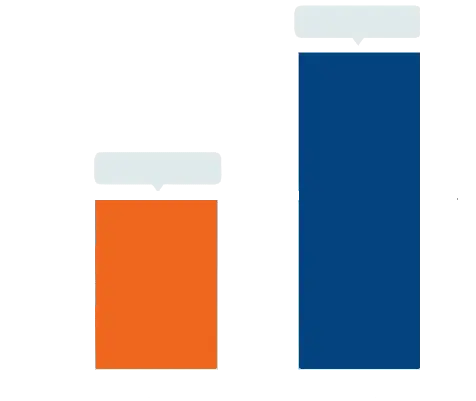
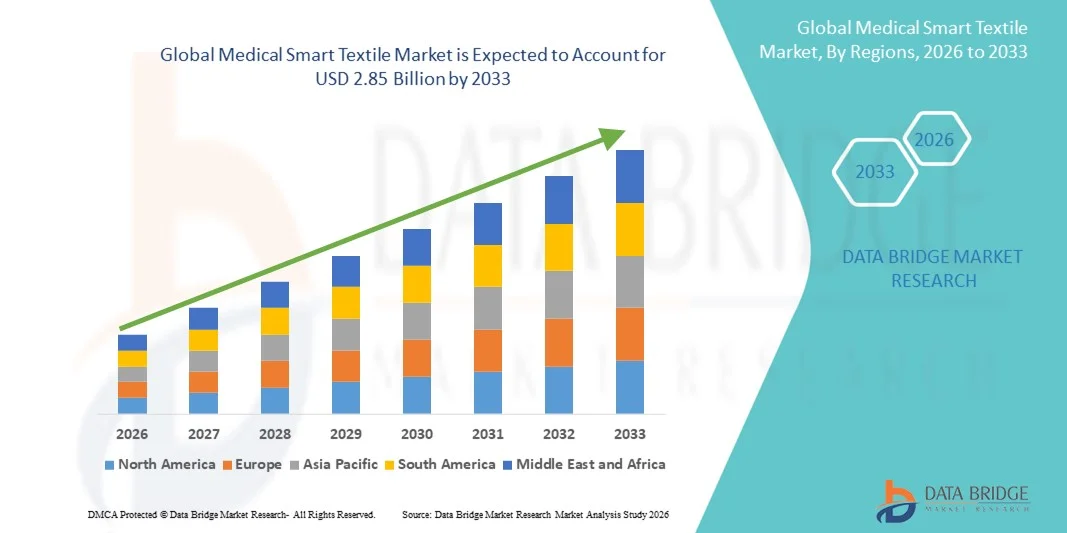
- The global medical smart textile market size was valued at USD 1.75 billion in 2025 and is expected to reach USD 2.85 billion by 2033, at a CAGR of 6.33% during the forecast period
- The market growth is largely driven by increasing adoption of advanced wearable healthcare technologies and the integration of smart sensors and connectivity into medical textiles, enabling continuous patient monitoring across hospital, homecare, and rehabilitation settings
- Furthermore, rising demand for real-time health monitoring, improved patient comfort, and data-driven clinical decision-making is positioning medical smart textiles as a critical component of next-generation healthcare solutions. These converging factors are accelerating the adoption of medical smart textiles, thereby significantly boosting the market’s growth trajectory
Medical Smart Textile Market Analysis
- Medical smart textiles, which integrate advanced technologies such as sensors, conductive materials, and smart fabrics into healthcare textiles, are emerging as vital components of modern medical and wellness systems due to their ability to enable continuous monitoring, therapeutic support, and enhanced patient comfort across clinical and non-clinical settings
- The growing demand for medical smart textiles is primarily driven by the rising burden of chronic diseases, increasing focus on preventive and personalized healthcare, and rapid adoption of wearable and connected medical technologies
- North America dominated the medical smart textile market with the largest revenue share of 38.7% in 2025, supported by well-established healthcare infrastructure, strong R&D activities, and early adoption of innovative medical technologies, with the U.S. leading deployments in bio-monitoring, post-operative care, and rehabilitation applications
- Asia-Pacific is expected to be the fastest-growing region in the medical smart textile market during the forecast period, driven by expanding healthcare access, rising healthcare expenditure, increasing awareness of digital health solutions, and rapid technological advancements across emerging economies
- The bio-monitoring segment dominated the medical smart textile market with a market share of 42.1% in 2025, driven by its widespread adoption for continuous physiological monitoring, remote patient management, and early detection of health anomalies across hospitals, homecare, and long-term care environments
Report Scope and Medical Smart Textile Market Segmentation
|
Attributes |
Medical Smart Textile Key Market Insights |
|
Segments Covered |
|
|
Countries Covered |
North America
Europe
Asia-Pacific
Middle East and Africa
South America
|
|
Key Market Players |
|
|
Market Opportunities |
|
|
Value Added Data Infosets |
In addition to the insights on market scenarios such as market value, growth rate, segmentation, geographical coverage, and major players, the market reports curated by the Data Bridge Market Research also include in-depth expert analysis, patient epidemiology, pipeline analysis, pricing analysis, and regulatory framework |
Medical Smart Textile Market Trends
Integration of AI, Sensors, and Connected Healthcare Platforms
- A significant and accelerating trend in the global medical smart textile market is the integration of artificial intelligence (AI), advanced textile sensors, and connected healthcare platforms to enable continuous, real-time health monitoring and improved clinical decision-making
- For instance, smart garments embedded with textile-based ECG, temperature, and motion sensors are increasingly being integrated with cloud platforms and mobile health applications, allowing clinicians to remotely monitor patient conditions and receive actionable insights
- AI-enabled medical smart textiles support features such as pattern recognition in physiological data, early anomaly detection, and personalized health insights. For instance, certain smart compression garments use AI algorithms to analyze muscle activity and recovery trends in rehabilitation patients
- The seamless integration of medical smart textiles with digital health ecosystems allows centralized management of patient data alongside electronic health records, wearable devices, and remote monitoring systems, creating a unified and data-driven healthcare environment
- This trend toward intelligent, adaptive, and connected medical textiles is reshaping expectations for patient monitoring, preventive care, and post-treatment management. Consequently, companies are developing AI-integrated smart fabrics capable of predictive analytics and automated health alerts
- The demand for AI- and sensor-integrated medical smart textiles is growing rapidly across hospitals, homecare, and wellness settings, as healthcare providers increasingly prioritize continuous monitoring, early intervention, and personalized treatment approaches
- The convergence of smart textiles with telemedicine platforms is further expanding their role in decentralized healthcare delivery and long-term patient engagement
Medical Smart Textile Market Dynamics
Driver
Rising Demand for Continuous Monitoring and Personalized Healthcare
- The increasing prevalence of chronic diseases, aging populations, and the growing emphasis on personalized and preventive healthcare are major drivers accelerating demand for medical smart textiles
- For instance, healthcare providers are increasingly adopting bio-monitoring smart textiles in post-operative care and chronic disease management to enable continuous tracking of vital signs outside traditional clinical environments
- As healthcare systems shift toward value-based care models, medical smart textiles offer advantages such as early detection of complications, reduced hospital readmissions, and improved patient outcomes through real-time data collection
- Furthermore, the rapid expansion of remote patient monitoring and home healthcare services is positioning medical smart textiles as essential tools for enabling non-invasive, long-term health surveillance
- The increasing acceptance of wearable medical technologies, combined with advancements in smart fabric durability and comfort, is further driving adoption across hospitals, rehabilitation centers, and homecare settings
- Rising healthcare digitization initiatives and government support for digital health infrastructure are also encouraging the deployment of smart textile-based monitoring solutions
- Moreover, growing awareness among clinicians and patients regarding the benefits of continuous, real-time health data is strengthening demand for medical smart textiles across care settings
Restraint/Challenge
Skin Compatibility Issues and Regulatory Approval Complexity
- Concerns related to skin irritation, long-term wear comfort, and biocompatibility of smart textile materials pose challenges to widespread adoption, particularly for patients requiring prolonged or continuous use
- For instance, prolonged exposure to conductive fibers or embedded sensors can cause discomfort or allergic reactions in sensitive patients, raising concerns among healthcare providers and regulators
- In addition, stringent regulatory requirements for medical devices, including safety validation, clinical testing, and compliance with healthcare standards, can increase development timelines and costs for medical smart textile manufacturers
- Addressing these challenges through improved material innovation, rigorous clinical validation, and early regulatory engagement will be critical to ensuring sustained adoption and long-term market growth
- The lack of standardized testing protocols for medical smart textiles across regions can further complicate regulatory approval and market entry
- Moreover, concerns related to data privacy, cybersecurity, and secure handling of patient-generated health data may limit adoption if not adequately addressed through robust compliance measures
Medical Smart Textile Market Scope
The market is segmented on the basis of technology, application, and end user.
- By Technology
On the basis of technology, the medical smart textile market is segmented into smart fabric technology, textile sensors, wearable technology, and joining technology. The textile sensors segment dominated the market with the largest revenue share of 36.5% in 2025, driven by their critical role in continuous physiological monitoring. Textile sensors embedded in garments enable real-time tracking of vital signs such as heart rate, respiration, and body temperature, providing actionable insights for clinicians. Hospitals and rehabilitation centers increasingly adopt sensor-based textiles to improve patient care while reducing manual monitoring efforts. Their ability to integrate seamlessly with wearable devices and cloud platforms enhances remote patient monitoring capabilities. Furthermore, textile sensors are compatible with various medical applications, including bio-monitoring, therapy, and post-surgery recovery. The segment benefits from technological advancements improving sensitivity, flexibility, and durability, reinforcing its market dominance.
The wearable technology segment is anticipated to witness the fastest growth rate of 23.1% from 2026 to 2033, fueled by rising adoption of connected health devices and homecare monitoring. Wearable smart textiles provide non-invasive, continuous monitoring for chronic disease management, elderly care, and fitness-based therapy programs. Their integration with AI and mobile health applications allows real-time alerts and predictive health insights. The convenience and comfort offered by wearable systems encourage adoption among patients and healthcare providers. In addition, the trend toward telemedicine and remote care is driving demand for wearable medical textiles in both clinical and non-clinical environments. Innovation in lightweight, flexible, and washable wearables further supports the segment’s rapid growth trajectory.
- By Application
On the basis of application, the market is segmented into bio-monitoring, surgery, hygiene, drug-release systems, therapy and wellness, and others. The bio-monitoring segment dominated the market with the largest revenue share of 42.1% in 2025, due to its critical importance in continuous health assessment and chronic disease management. Bio-monitoring textiles allow real-time tracking of vital signs such as ECG, blood oxygen, and temperature, reducing the need for frequent hospital visits. Hospitals and homecare providers are increasingly integrating bio-monitoring textiles into patient care programs to improve early detection of health anomalies. Remote monitoring capabilities enable better chronic care management, reducing readmission rates and healthcare costs. Their compatibility with cloud-based analytics and AI systems further enhances personalized healthcare delivery. Strong clinical evidence supporting improved patient outcomes continues to drive adoption in hospitals and rehabilitation centers.
The therapy and wellness segment is expected to witness the fastest CAGR of 22.7% from 2026 to 2033, driven by rising awareness of preventive healthcare and non-invasive therapeutic solutions. Smart textiles designed for therapy and wellness include compression garments, posture-correcting fabrics, and heat therapy textiles for pain management. Integration with wearable technology and mobile apps allows users to track therapy effectiveness and adjust treatments as needed. The growing interest in home-based wellness and physiotherapy solutions is expanding the adoption of this segment. In addition, advancements in material technology, such as flexible sensors and adaptive fabrics, enhance the comfort, durability, and effectiveness of therapy-oriented smart textiles. Demand is further strengthened by an increasing elderly population seeking convenient and accessible wellness solutions.
- By End User
On the basis of end user, the market is segmented into hospitals and clinics, academic and industrial research, and others. The hospitals and clinics segment dominated the market with the largest revenue share of 45.3% in 2025, supported by high adoption of smart textiles for patient monitoring, post-operative care, and rehabilitation. Hospitals integrate medical smart textiles into patient management systems to reduce manual monitoring workload and improve clinical efficiency. Continuous health data collection enables early diagnosis and personalized treatment plans. The segment also benefits from increasing investment in healthcare infrastructure and technology adoption in developed regions. Moreover, hospitals leverage connected smart textiles for long-term monitoring of chronic diseases, improving patient outcomes and reducing readmission rates. Strong clinical validation and proven efficacy further reinforce the dominance of this end-user segment.
The academic and industrial research segment is expected to witness the fastest growth rate of 21.9% from 2026 to 2033, driven by increasing R&D activities in smart textile innovation and material science. Universities, research institutes, and industrial labs are exploring advanced fabric sensors, wearable devices, and bio-compatible materials for new healthcare applications. Research initiatives focus on integrating AI, IoT, and telemedicine capabilities into medical textiles. Collaborations with hospitals and healthcare startups facilitate pilot projects and clinical trials, accelerating adoption. In addition, rising funding for digital health and wearable innovation is boosting research output and technology commercialization. This segment benefits from continuous development of prototypes, patents, and scalable solutions, driving long-term growth in the market.
Medical Smart Textile Market Regional Analysis
- North America dominated the medical smart textile market with the largest revenue share of 38.7% in 2025, supported by well-established healthcare infrastructure, strong R&D activities, and early adoption of innovative medical technologies, with the U.S. leading deployments in bio-monitoring, post-operative care, and rehabilitation applications
- Healthcare providers and hospitals in the region increasingly rely on medical smart textiles for continuous bio-monitoring, post-operative care, and rehabilitation, benefiting from seamless integration with electronic health records and digital health platforms
- This widespread adoption is further supported by high healthcare expenditure, strong R&D investments, and a technologically savvy population, positioning medical smart textiles as essential tools for improving patient outcomes and personalized healthcare delivery
U.S. Medical Smart Textile Market Insight
The U.S. medical smart textile market captured the largest revenue share of 82% in 2025 within North America, fueled by the rapid adoption of wearable health devices and the increasing demand for remote patient monitoring. Hospitals and homecare providers are prioritizing continuous bio-monitoring and post-operative care using AI- and sensor-integrated smart garments. The growing focus on personalized healthcare, coupled with strong healthcare infrastructure and technological adoption, further propels the market. Moreover, integration with mobile health applications and electronic health records is significantly enhancing the functionality and appeal of medical smart textiles in the U.S.
Europe Medical Smart Textile Market Insight
The Europe medical smart textile market is projected to expand at a substantial CAGR throughout the forecast period, primarily driven by increasing investment in digital health solutions and the growing need for continuous patient monitoring in hospitals and clinics. Rising urbanization and the prevalence of chronic diseases are fostering adoption, while European healthcare providers value the improved efficiency, patient comfort, and data-driven insights offered by medical smart textiles. The region is experiencing significant growth across rehabilitation, therapy, and wellness applications, with hospitals and research institutions integrating smart textiles into both new care programs and existing workflows.
U.K. Medical Smart Textile Market Insight
The U.K. medical smart textile market is anticipated to grow at a noteworthy CAGR during the forecast period, driven by the expanding use of wearable healthcare technologies and a focus on patient-centered care. Concerns regarding hospital-acquired conditions and the need for real-time monitoring are encouraging healthcare providers to adopt continuous monitoring solutions. The U.K.’s emphasis on digital health, strong research capabilities, and robust healthcare infrastructure are expected to further stimulate market growth. In addition, integration with telemedicine platforms and connected health ecosystems supports the widespread deployment of medical smart textiles in both clinical and homecare settings.
Germany Medical Smart Textile Market Insight
The Germany medical smart textile market is expected to expand at a considerable CAGR during the forecast period, fueled by the country’s strong focus on healthcare innovation, technology adoption, and patient safety. Germany’s well-developed healthcare infrastructure, combined with increasing awareness of preventive care, promotes the adoption of smart textiles in hospitals, rehabilitation centers, and wellness programs. Integration with electronic health records and wearable monitoring systems is becoming increasingly prevalent, enabling real-time data collection and remote patient management. Consumers and healthcare providers favor secure, efficient, and technologically advanced smart textile solutions aligned with stringent healthcare standards.
Asia-Pacific Medical Smart Textile Market Insight
The Asia-Pacific medical smart textile market is poised to grow at the fastest CAGR of 25% from 2026 to 2033, driven by increasing healthcare digitization, rising disposable incomes, and technological advancements in countries such as China, Japan, and India. Growing awareness of remote patient monitoring and wearable health technologies is boosting adoption across hospitals, clinics, and homecare services. Furthermore, the region’s emergence as a manufacturing hub for smart textiles is making these solutions more affordable and accessible to a broader consumer base. Government initiatives supporting digital healthcare and smart hospital programs are further accelerating market growth.
Japan Medical Smart Textile Market Insight
The Japan medical smart textile market is gaining momentum due to the country’s technologically advanced healthcare infrastructure, high adoption of wearable devices, and aging population. The demand for continuous monitoring, post-operative care, and elderly care solutions is driving market growth. Integration of smart textiles with IoT-enabled health devices and telemedicine platforms is facilitating improved patient outcomes. Japan’s focus on preventive care, coupled with its culture of technology adoption, is fueling the expansion of medical smart textile applications in both residential and clinical settings.
India Medical Smart Textile Market Insight
The India medical smart textile market accounted for the largest market revenue share in Asia-Pacific in 2025, attributed to rapid urbanization, a growing middle class, and increasing adoption of digital health technologies. Hospitals, clinics, and homecare providers are leveraging medical smart textiles for bio-monitoring, rehabilitation, and therapy applications. The government’s push toward smart healthcare initiatives and telemedicine programs is supporting market expansion. Affordable smart textile solutions, combined with strong domestic manufacturing capabilities and rising health awareness, are key factors propelling growth in India’s medical smart textile market.
Medical Smart Textile Market Share
The Medical Smart Textile industry is primarily led by well-established companies, including:
- Hexoskin (Canada)
- AiQ Smart Clothing (Taiwan)
- BioSerenity (France)
- Chronolife (France)
- Sensoria Health (U.S.)
- Vista Medical (Canada)
- Siren (U.S.)
- Gentherm (U.S.)
- 3TEKS (Turkey)
- Camira Fabrics (U.K.)
- Schoeller Switzerland (Switzerland)
- Pireta (Netherlands)
- Adidas International (Germany)
- Jabil (U.S.)
- DuPont (U.S.)
- Toray Industries (Japan)
- Xenoma (Japan)
- LifeSense Group B.V. (Netherlands)
- Textronics, Inc. (U.S.)
- Ohmatex ApS (Denmark)
What are the Recent Developments in Global Medical Smart Textile Market?
- In August 2025, scientists demonstrated a full computing system embedded into a single fiber of clothing, marking a breakthrough for smart textile capabilities that can process health data directly on fabric and withstand washing advancing wearable medical textiles toward on‑body real‑time analysis without external hardware
- In July 2025, researchers led by He et al. at Tsinghua University unveiled a groundbreaking fabric‑based electrochemical biosensing smart textile system that can autonomously trigger sweat production using low‑current iontophoresis and perform real‑time biomarker analysis without requiring physical activity expanding wearable health monitoring applications into passive, continuous clinical surveillance and personalized diagnostics
- In April 2025, researchers from Caltech and the Keck School of Medicine of USC demonstrated an advanced smart bandage called iCares that continuously samples wound fluid biomarkers in human patients and provides real‑time data to help monitor and accelerate healing of chronic wounds, marking a significant step toward clinical use of smart wound‑care textiles
- In April 2025, the Textile Innovation Podcast highlighted that Clothing 2.0 developed patented yarn that infuses consistent doses of medicine, vitamins, and supplements into reusable healing garments, and announced recent collaboration with Marena Group to create post‑surgical compression garments combining medical textile innovation with therapeutic delivery
- In July 2024, researchers reported significant progress in smart textile wearable garments that use 3D microfiber‑based electrodes to improve ECG and EMG physiological monitoring, demonstrating real‑time multimodal signal capture even during activities such as cycling and swimming advancing clinical viability for smart medical garments
SKU-
Get online access to the report on the World's First Market Intelligence Cloud

- Interactive Data Analysis Dashboard
- Company Analysis Dashboard for high growth potential opportunities
- Research Analyst Access for customization & queries
- Competitor Analysis with Interactive dashboard
- Latest News, Updates & Trend analysis
- Harness the Power of Benchmark Analysis for Comprehensive Competitor Tracking
Research Methodology
Data collection and base year analysis are done using data collection modules with large sample sizes. The stage includes obtaining market information or related data through various sources and strategies. It includes examining and planning all the data acquired from the past in advance. It likewise envelops the examination of information inconsistencies seen across different information sources. The market data is analysed and estimated using market statistical and coherent models. Also, market share analysis and key trend analysis are the major success factors in the market report. To know more, please request an analyst call or drop down your inquiry.
The key research methodology used by DBMR research team is data triangulation which involves data mining, analysis of the impact of data variables on the market and primary (industry expert) validation. Data models include Vendor Positioning Grid, Market Time Line Analysis, Market Overview and Guide, Company Positioning Grid, Patent Analysis, Pricing Analysis, Company Market Share Analysis, Standards of Measurement, Global versus Regional and Vendor Share Analysis. To know more about the research methodology, drop in an inquiry to speak to our industry experts.
Customization Available
Data Bridge Market Research is a leader in advanced formative research. We take pride in servicing our existing and new customers with data and analysis that match and suits their goal. The report can be customized to include price trend analysis of target brands understanding the market for additional countries (ask for the list of countries), clinical trial results data, literature review, refurbished market and product base analysis. Market analysis of target competitors can be analyzed from technology-based analysis to market portfolio strategies. We can add as many competitors that you require data about in the format and data style you are looking for. Our team of analysts can also provide you data in crude raw excel files pivot tables (Fact book) or can assist you in creating presentations from the data sets available in the report.