


What is the Memristor Market Size and Growth Rate?
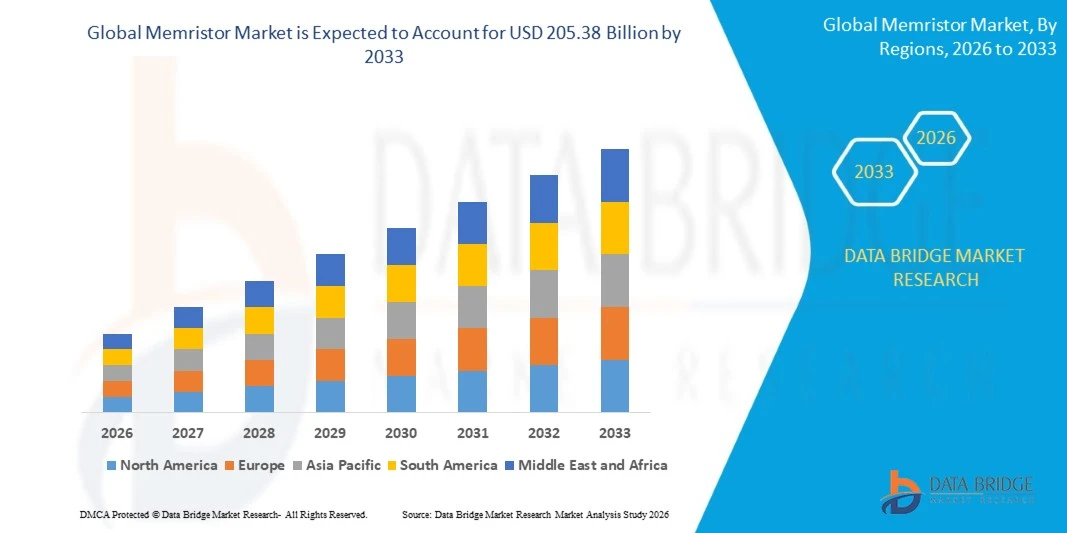
- As per Data Bridge Market Research analysis, the memristor market was valued at USD 27.80 billion in 2025 and is projected to reach USD 205.38 billion by 2033, growing at a CAGR of 28.40% from 2026 to 2033.
- The global memristor market is experiencing consistent growth driven by rising demand for advanced memory technologies, increasing adoption of neuromorphic computing, and expanding deployment of non-volatile memory solutions across consumer electronics, data centers, automotive systems, and industrial applications.
- The increasing demand for high-speed data processing and energy-efficient computing, combined with advancements in artificial intelligence, edge computing, and next-generation semiconductor technologies, is compelling technology companies and semiconductor manufacturers to adopt advanced memristor-based solutions. Memristors and next-generation memory architectures are increasingly gaining attention as alternatives to conventional memory technologies, offering high data storage density, low power consumption, faster switching speeds, and improved processing efficiency for emerging computing applications.
Market Size & Forecast
- Global Market Value (2025): USD 27.80 Billion
- Expected Market Value (2033): USD 205.38 Billion
- Forecast CAGR (2026–2033): 28.40%
- Leading Region in 2025: Asia-Pacific
- Fastest Growing Region: North America
What are the Major Takeaways of the Memristor Market?
- Asia-Pacific dominated the Memristor market with the largest revenue share of 53.3% in 2025, supported by strong semiconductor manufacturing capabilities, increasing investments in advanced memory technologies, rapid adoption of artificial intelligence and edge computing, and growing demand for high-density and energy-efficient memory solutions across China, Japan, South Korea, and Taiwan.
- North America is expected to be the fastest-growing region at a CAGR of 30.1% from 2026 to 2033, fueled by increasing investments in artificial intelligence and neuromorphic computing, rising adoption of in-memory computing architectures, strong semiconductor research and development activities, and growing demand for energy-efficient computing and advanced data-storage technologies.
- The molecular and ionic film memristor segment led the market with a 59.1% share in 2025, driven by high scalability, low power consumption, compact device architecture, high-density memory capabilities, and increasing suitability for next-generation non-volatile memory and neuromorphic computing applications.
- The molecular and ionic film memristor segment is the fastest-growing type, projected to register a CAGR of 32.1%, reflecting increasing investments in advanced semiconductor architectures, rising demand for high-density memory, and expanding adoption of memristor-based computing and artificial intelligence applications.
- The spin-based and magnetic memristor segment dominated the technology category with a 40.2% revenue share in 2025, supported by increasing demand for high-speed switching, non-volatile operation, low-power computing, and advanced memory architectures for artificial intelligence, data processing, and next-generation semiconductor devices.
- Consumer electronics accounted for 31.6% of the market share in 2025, supported by growing demand for energy-efficient memory, faster data processing, compact electronic architectures, on-device artificial intelligence, smartphones, wearables, smart devices, and other connected consumer products.
- The neuromorphic and biological systems segment is the fastest-growing application category, with a CAGR of 36.2%, driven by increasing demand for brain-inspired computing, low-power artificial intelligence, edge processing, autonomous systems, robotics, and real-time data processing capabilities.
Report Scope and Memristor Market Segmentation
|
Attributes |
Memristor Key Market Insights |
|
Segments Covered |
|
|
Countries Covered |
North America
Europe
Asia-Pacific
Middle East and Africa
South America
|
|
Key Market Players |
|
|
Market Opportunities |
|
|
Value Added Data Infosets |
In addition to the insights on market scenarios such as market value, growth rate, segmentation, geographical coverage, and major players, the market reports curated by the Data Bridge Market Research also include in-depth expert analysis, geographically represented company-wise production and capacity, network layouts of distributors and partners, detailed and updated price trend analysis and deficit analysis of supply chain and demand. |
What is the Key Trend in the Memristor Market?
- Semiconductor manufacturers and technology companies are increasingly focusing on memristor-based architectures for in-memory computing, neuromorphic computing, and AI workloads, as memristors can combine data storage and computation within the same device and reduce data movement between memory and processors.
- For instance, in July 2025, Weebit Nano demonstrated an edge-AI application running on a 1Mb ReRAM module in silicon, highlighting the growing use of resistive memory technologies for energy-efficient edge intelligence and AI processing.
- Memristor-based crossbar arrays are gaining attention because they can perform parallel matrix-vector multiplication, a fundamental operation in many AI models, supporting the development of compact and energy-efficient neuromorphic hardware.
- The industry is also moving toward commercial integration of embedded ReRAM and memristive technologies into semiconductor products, with technology developers increasingly working with foundries and integrated device manufacturers to qualify their technologies for production.
- For instance, in January 2026, Weebit Nano reported that it had secured licensing agreements with onsemi and Texas Instruments and that its embedded ReRAM technology was being integrated into several next-generation products, demonstrating increasing movement from laboratory development toward commercial semiconductor applications.
- As demand for AI, edge computing, IoT, and energy-efficient data processing continues to increase, the adoption of memristors in neuromorphic processors, non-volatile memory, and compute-in-memory architectures is expected to accelerate, strengthening their role in next-generation semiconductor systems.
What are the Key Drivers of the Memristor Market?
- The rapid growth of artificial intelligence, machine learning, and edge computing is increasing demand for memory technologies that can process data closer to where it is stored, reducing data movement, latency, and energy consumption.
- For instance, in April 2025, IBM researchers and collaborators published an analysis in Nature describing the growing memristor industry, highlighting AI and IoT as important forces behind the development of more compact, energy-efficient, and higher-performing computing and memory systems.
- Increasing demand for high-speed, non-volatile memory is encouraging semiconductor companies to investigate memristive technologies as alternatives or complements to conventional memory architectures, particularly for embedded memory, data-intensive computing, and emerging storage applications.
- The growing requirement for energy-efficient computing in edge devices, autonomous systems, IoT platforms, and intelligent electronics is further supporting demand for memristors because their ability to combine memory and computation can reduce the energy associated with repeated data transfers.
- For instance, in July 2025, Weebit Nano reported successful operation of an edge-AI application on a 1Mb ReRAM module fabricated through its semiconductor ecosystem, demonstrating the potential of embedded resistive memory for AI processing at the edge.
- With AI workloads becoming increasingly data-intensive and semiconductor architectures moving toward in-memory and neuromorphic computing, memristors are expected to gain importance as a technology for improving computing efficiency, memory density, and processing performance.
What Factors are Challenging the Growth of the Memristor Market?
- Memristor commercialization continues to face challenges related to device-to-device variability, cycle-to-cycle switching variation, endurance, data retention, and reliability, which can affect consistent performance when devices are scaled to large arrays.
- For instance, a 2025 study published in Chaos, Solitons & Fractals identified cycle-to-cycle variability as a major factor hindering the use of memristors in large-scale commercial applications and examined approaches for improving switching uniformity through different dielectric structures.
- These technical limitations can make it difficult to achieve the uniform switching behavior, high endurance, long retention, and manufacturing consistency required for high-volume semiconductor production.
- Manufacturing and integration requirements also create challenges because memristor technologies must be compatible with CMOS manufacturing processes and back-end-of-line semiconductor integration, while maintaining acceptable thermal budgets, yield, and process repeatability.
- For instance, in July 2025, research published in ACS Applied Electronic Materials highlighted high-voltage electroforming, external current-compliance requirements, device variability, limited endurance, and data-retention issues as continuing barriers to large-scale memristor adoption, although the study demonstrated a forming-free crossbar architecture to address some of these limitations.
- The need to improve fabrication uniformity, reliability, CMOS compatibility, testing, and cost-effective mass production therefore continues to restrict broader commercialization, particularly for large-scale memory arrays and neuromorphic computing systems.
How is the Memristor Market Segmented?
The memristor market is segmented on the basis of type, technology, application, and end-user industry.
- By Type
On the basis of type, the memristor market is segmented into molecular and ionic film memristor and spin-based and magnetic memristor. The molecular and ionic film memristor segment dominated the market with a 59.1% share in 2025, driven by its high scalability, low power consumption, compact architecture, and suitability for high-density memory applications. Molecular and ionic film-based devices are increasingly being explored for next-generation non-volatile memory, neuromorphic computing, and artificial intelligence applications. Their ability to support multiple resistance states enables efficient data storage and processing while reducing energy consumption. Increasing research into resistive switching materials, including metal oxides and emerging molecular materials, is further supporting technological development. Growing demand for energy-efficient semiconductor architectures is also strengthening adoption of molecular and ionic film memristors.
The molecular and ionic film memristor segment is projected to register the fastest growth at a CAGR of 32.1% from 2026 to 2033, supported by increasing investments in advanced semiconductor architectures, high-density memory technologies, and memristor-based artificial intelligence applications. The technology's potential for compact device integration and low-power operation is creating opportunities across edge computing, neuromorphic processors, and embedded memory. Increasing development of advanced resistive switching materials and fabrication techniques is improving device performance and scalability. Rising demand for processing large volumes of data with lower energy consumption is further accelerating research and commercialization.
- By Technology
On the basis of technology, the memristor market is segmented into molecular and ionic thin film, spin-based and magnetic memristor, hybrid CMOS-memristor, 3D crosspoint, and others. The spin-based and magnetic memristor segment dominated the market with a 40.2% revenue share in 2025, supported by increasing demand for high-speed switching, non-volatile operation, low-power computing, and advanced memory architectures. Spin-based and magnetic technologies can retain stored information without continuous power, making them suitable for energy-efficient memory and computing applications. Increasing research into spintronic devices and magnetic materials is expanding their potential across artificial intelligence, data processing, and next-generation semiconductor systems. Their compatibility with high-performance computing architectures is also supporting industry interest.
The 3D crosspoint segment is expected to witness significant growth from 2026 to 2033, driven by increasing demand for high-density memory architectures, efficient data storage, and advanced computing systems. Three-dimensional crosspoint architectures enable memory cells to be arranged in vertically stacked configurations, supporting higher storage density within a smaller physical footprint. Growing requirements for processing large datasets in artificial intelligence, data centers, and edge-computing environments are increasing interest in high-density memory technologies. Advances in semiconductor fabrication and three-dimensional integration are further improving the scalability of these architectures. Increasing investments in next-generation non-volatile memory are expected to support adoption of 3D crosspoint technologies during the forecast period.
- By Application
On the basis of application, the memristor market is segmented into non-volatile memory, neuromorphic and biological systems, programmable logic and signal processing, emerging data storage, and others. The non-volatile memory segment accounted for a significant share of the market in 2025, supported by increasing demand for high-density, low-power, and fast memory technologies across consumer electronics, automotive systems, industrial equipment, and computing devices. Memristors can retain information without continuous power, making them suitable for applications requiring persistent data storage. Their compact structure and potential for multi-level data storage are also supporting their development as alternatives or complements to conventional memory technologies. Increasing demand for faster and more energy-efficient semiconductor devices is further supporting adoption.
The neuromorphic and biological systems segment is projected to register the fastest growth at a CAGR of 36.2% from 2026 to 2033, driven by increasing demand for brain-inspired computing, low-power artificial intelligence, edge processing, autonomous systems, robotics, and real-time data processing. Memristors can reproduce synaptic behavior and support adaptive computing architectures, making them suitable for neuromorphic systems. Their ability to perform memory and computational functions within the same architecture can reduce data movement and improve energy efficiency. Increasing investments in AI hardware, autonomous devices, and edge intelligence are strengthening demand for memristor-based neuromorphic technologies. Continued research into artificial synapses and hardware-based neural networks is expected to accelerate adoption.
- By End-User Industry
On the basis of end-user industry, the memristor market is segmented into consumer electronics, IT and telecommunications, automotive, healthcare, industrial automation, defense and aerospace, and others. The consumer electronics segment dominated the market with a 31.6% share in 2025, supported by growing demand for energy-efficient memory, faster data processing, compact electronic architectures, smartphones, wearables, smart devices, and on-device artificial intelligence. Memristor technologies can provide high-density memory in compact device architectures while supporting lower-power operation. Increasing integration of AI capabilities into consumer devices is creating demand for memory technologies capable of supporting local data processing. Growing adoption of connected and intelligent electronic products is further supporting market growth.
The IT and telecommunications segment is expected to witness strong growth from 2026 to 2033, driven by increasing data generation, artificial intelligence workloads, edge computing, cloud infrastructure, and demand for energy-efficient data processing. Memristor-based memory and compute-in-memory architectures can reduce data movement between processors and memory, potentially improving processing efficiency for data-intensive workloads. Increasing deployment of AI and machine-learning applications in data centers is strengthening interest in high-performance and low-power memory architectures. Rising demand for edge computing is also creating opportunities for compact memristor-based processing and storage solutions. Continued investments in advanced semiconductor technologies and next-generation computing infrastructure are expected to support adoption across IT and telecommunications applications.
Which Region Holds the Largest Share of the Memristor Market?
- Asia-Pacific dominated the memristor market with the largest revenue share of 53.3% in 2025, supported by strong semiconductor manufacturing capabilities, increasing investments in advanced memory technologies, rapid adoption of artificial intelligence and edge computing, and growing demand for high-density and energy-efficient memory solutions across China, Japan, South Korea, and Taiwan.
- The region also benefits from the presence of major semiconductor manufacturers, expanding electronics production, increasing investments in next-generation memory technologies, and growing adoption of AI-enabled computing infrastructure. Rising demand for non-volatile memory, neuromorphic computing, and advanced semiconductor architectures is further strengthening Asia-Pacific's position in the global memristor market.
U.S. Memristor Market Insight
The U.S. memristor market is witnessing strong growth due to increasing investments in artificial intelligence, neuromorphic computing, in-memory computing, and advanced semiconductor technologies. The country's established semiconductor research ecosystem and presence of major technology and electronics companies are supporting development and commercialization of memristor-based memory and computing solutions. In addition, increasing demand for energy-efficient data processing, edge computing, and next-generation memory architectures is accelerating adoption across data centers, consumer electronics, and advanced computing applications.
Asia-Pacific Memristor Market Insight
The Asia-Pacific memristor market dominated the global market in 2025, supported by strong semiconductor manufacturing capabilities and increasing investments in advanced memory technologies. Countries such as China, Japan, South Korea, and Taiwan are increasingly investing in artificial intelligence, edge computing, semiconductor fabrication, and next-generation memory architectures. Growing demand for high-density, low-power memory across consumer electronics, telecommunications, automotive systems, and industrial applications is further supporting regional market expansion.
Japan Memristor Market Insight
The Japan memristor market is witnessing consistent growth due to strong semiconductor research capabilities, advanced electronics manufacturing, and increasing investments in next-generation memory and neuromorphic computing technologies. The country's established automotive, consumer electronics, robotics, and industrial automation industries are creating opportunities for energy-efficient and high-density memory solutions. Increasing research into memristive devices, artificial intelligence hardware, and brain-inspired computing is further supporting market development.
China Memristor Market Insight
The China memristor market is growing rapidly, driven by expanding semiconductor manufacturing capabilities, increasing investments in artificial intelligence, and rising demand for advanced memory technologies. Growing development of domestic semiconductor technologies and increasing deployment of AI, edge computing, consumer electronics, and intelligent automotive systems are creating opportunities for memristor-based solutions. In addition, increasing demand for high-density and energy-efficient memory architectures is supporting the adoption of memristor technologies across China's rapidly expanding electronics ecosystem.
U.K. Memristor Market Insight
The U.K. memristor market is experiencing steady growth, supported by increasing research and development in artificial intelligence, neuromorphic computing, advanced semiconductor technologies, and emerging memory architectures. Universities, research organizations, and technology companies are increasingly exploring memristor applications in brain-inspired computing, in-memory processing, and energy-efficient AI hardware. Growing demand for advanced computing technologies and continued investment in semiconductor innovation are contributing to market development in the U.K.
Germany Memristor Market Insight
The Germany memristor market is expanding steadily due to its strong automotive, industrial automation, semiconductor, and advanced electronics sectors. Increasing demand for energy-efficient computing and memory technologies in automotive electronics, industrial systems, robotics, and intelligent manufacturing is supporting adoption. In addition, growing investments in artificial intelligence, edge computing, and advanced semiconductor architectures are creating opportunities for memristor-based memory and computing solutions in Germany.
Which are the Top Companies in Memristor Market?
The memristor industry is primarily led by well-established companies, including:
- Crossbar Inc. (U.S.)
- IBM Corporation (U.S.)
- Knowm Inc. (U.S.)
- Samsung Electronics Co., Ltd. (South Korea)
- Intel Corporation (U.S.)
- Micron Technology, Inc. (U.S.)
- Panasonic Holdings Corporation (Japan)
- Sony Group Corporation (Japan)
- Western Digital Corporation (U.S.)
- SK hynix Inc. (South Korea)
- Weebit Nano Ltd. (Israel)
- Fujitsu Limited (Japan)
- Toshiba Corporation (Japan)
- Everspin Technologies, Inc. (U.S.)
- STMicroelectronics N.V. (Switzerland)
- Avalanche Technology, Inc. (U.S.)
- Renesas Electronics Corporation (Japan)
- Taiwan Semiconductor Manufacturing Company Limited (Taiwan)
- Honeywell International Inc. (U.S.)
- Hewlett Packard Enterprise Company (U.S.)
What are Latest Developments in Memristor Market?
- In January 2026, Weebit Nano reported the achievement of its 2025 commercial targets, including licensing agreements with major semiconductor companies and continued integration of its embedded ReRAM technology into next-generation products. The development highlights increasing commercialization of resistive memory technologies and growing industry interest in integrating memristor-based memory into advanced semiconductor products.
- In July 2025, Weebit Nano demonstrated an edge-AI application operating on a 1Mb ReRAM module in silicon, highlighting the potential of resistive memory technology for energy-efficient artificial intelligence processing at the edge. The demonstration reflects the increasing integration of memristive memory with AI and edge-computing architectures.
- In April 2025, IBM Research and collaborators published research examining the development of the memristor industry and its potential applications in artificial intelligence, Internet of Things, and energy-efficient computing. The research highlighted growing interest in memristor-based architectures for combining memory and processing functions and reducing data movement in emerging computing systems.
- In September 2024, Weebit Nano announced progress in the commercialization and integration of its embedded ReRAM technology, supporting its use in semiconductor designs and advanced memory applications. The development demonstrates increasing efforts to integrate resistive memory into standard semiconductor manufacturing processes.
- In November 2023, Crossbar continued advancing its ReRAM technology for high-density non-volatile memory and neuromorphic computing applications, highlighting the increasing focus on memristor-based architectures for artificial intelligence, data storage, and energy-efficient computing.

- Interactive Data Analysis Dashboard
- Company Analysis Dashboard for high growth potential opportunities
- Research Analyst Access for customization & queries
- Competitor Analysis with Interactive dashboard
- Latest News, Updates & Trend analysis
- Harness the Power of Benchmark Analysis for Comprehensive Competitor Tracking
Global Memristor Market, Supply Chain Analysis and Ecosystem Framework
To support market growth and help clients navigate the impact of geopolitical shifts, DBMR has integrated in-depth supply chain analysis into its Global Memristor Market research reports. This addition empowers clients to respond effectively to global changes affecting their industries. The supply chain analysis section includes detailed insights such as Global Memristor Market consumption and production by country, price trend analysis, the impact of tariffs and geopolitical developments, and import and export trends by country and HSN code. It also highlights major suppliers with data on production capacity and company profiles, as well as key importers and exporters. In addition to research, DBMR offers specialized supply chain consulting services backed by over a decade of experience, providing solutions like supplier discovery, supplier risk assessment, price trend analysis, impact evaluation of inflation and trade route changes, and comprehensive market trend analysis.
Data collection and base year analysis are done using data collection modules with large sample sizes. The stage includes obtaining market information or related data through various sources and strategies. It includes examining and planning all the data acquired from the past in advance. It likewise envelops the examination of information inconsistencies seen across different information sources. The market data is analysed and estimated using market statistical and coherent models. Also, market share analysis and key trend analysis are the major success factors in the market report. To know more, please request an analyst call or drop down your inquiry.
The key research methodology used by DBMR research team is data triangulation which involves data mining, analysis of the impact of data variables on the market and primary (industry expert) validation. Data models include Vendor Positioning Grid, Market Time Line Analysis, Market Overview and Guide, Company Positioning Grid, Patent Analysis, Pricing Analysis, Company Market Share Analysis, Standards of Measurement, Global versus Regional and Vendor Share Analysis. To know more about the research methodology, drop in an inquiry to speak to our industry experts.
Data Bridge Market Research is a leader in advanced formative research. We take pride in servicing our existing and new customers with data and analysis that match and suits their goal. The report can be customized to include price trend analysis of target brands understanding the market for additional countries (ask for the list of countries), clinical trial results data, literature review, refurbished market and product base analysis. Market analysis of target competitors can be analyzed from technology-based analysis to market portfolio strategies. We can add as many competitors that you require data about in the format and data style you are looking for. Our team of analysts can also provide you data in crude raw excel files pivot tables (Fact book) or can assist you in creating presentations from the data sets available in the report.













