


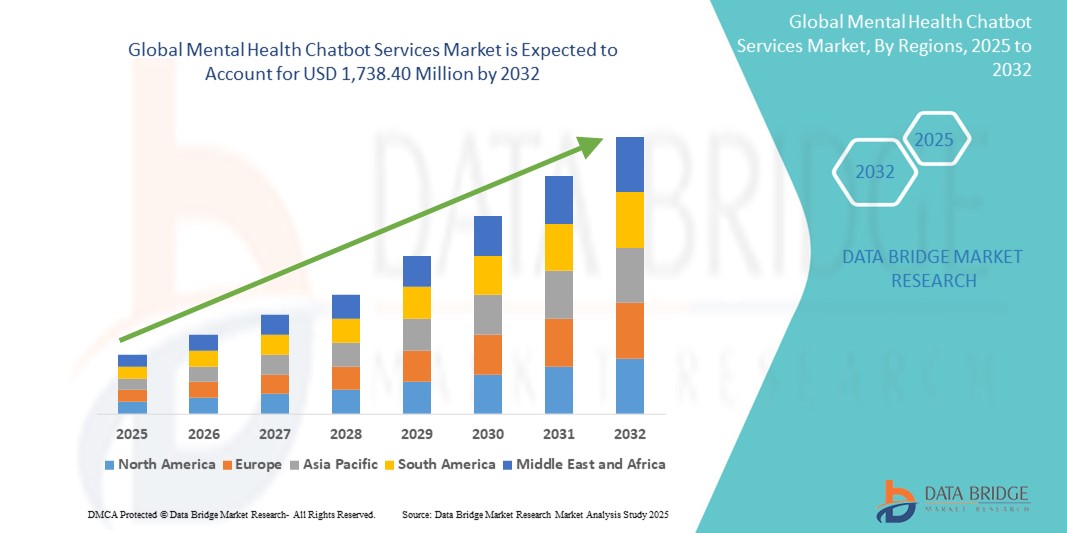
Mental Health Chatbot Services Market Size
- The global mental health chatbot services market size was valued at USD 568.46 Million in 2024 and is expected to reach USD 1,738.40 Million by 2032, at a CAGR of 15.00% during the forecast period
- The market growth is largely fueled by the growing adoption and technological progress within artificial intelligence and natural language processing (NLP), leading to enhanced personalization and real-time support capabilities in mental health chatbot services across clinical and non-clinical settings
- Furthermore, rising consumer demand for accessible, stigma-free, and scalable mental health support is establishing chatbot-based services as a vital component of digital mental healthcare delivery. These converging factors are accelerating the uptake of mental health chatbot services solutions, thereby significantly boosting the industry's growth
Mental Health Chatbot Services Market Analysis
- Mental health chatbot services, offering AI-powered conversational support for mental well-being, are becoming increasingly vital components of digital healthcare ecosystems across both clinical and non-clinical settings due to their 24/7 availability, anonymity, and scalability in providing mental health support
- The escalating demand for mental health chatbot services is primarily fueled by increasing global mental health concerns, a shortage of licensed therapists, growing smartphone penetration, and rising awareness about digital mental health interventions
- North America dominated the mental health chatbot services market with the largest revenue share of 40.01% in 2024, characterized by early adoption of digital health tools, high mental health awareness, supportive reimbursement policies, and a strong presence of leading technology firms. The U.S. saw notable growth in mental health chatbot usage across universities, corporate wellness programs, and direct-to-consumer platforms
- Asia-Pacific is projected to be the fastest growing region in the mental health chatbot services market during the forecast period, with a CAGR of 23.5% from 2025 to 2032, driven by rising smartphone usage, increasing mental health awareness, expanding internet infrastructure, and the push for affordable healthcare solutions in countries such as India, China, and Southeast Asian nations
- The cloud-based deployment segment dominated the mental health chatbot services market with a market share of 69.4% in 2024, owing to its easy scalability, reduced upfront infrastructure costs, and seamless remote access capabilities. Cloud-based platforms are increasingly preferred by healthcare providers and mental wellness app developers for their flexibility, cost-efficiency, and ability to support large-scale user engagement across geographies
Report Scope and Mental Health Chatbot Services Market Segmentation
|
Attributes |
Mental Health Chatbot Services Key Market Insights |
|
Segments Covered |
|
|
Countries Covered |
North America
Europe
Asia-Pacific
Middle East and Africa
South America
|
|
Key Market Players |
• Woebot Health (U.S.) |
|
Market Opportunities |
|
|
Value Added Data Infosets |
In addition to the insights on market scenarios such as market value, growth rate, segmentation, geographical coverage, and major players, the market reports curated by the Data Bridge Market Research also include in-depth expert analysis, pricing analysis, brand share analysis, consumer survey, demography analysis, supply chain analysis, value chain analysis, raw material/consumables overview, vendor selection criteria, PESTLE Analysis, Porter Analysis, and regulatory framework. |
Mental Health Chatbot Services Market Trends
“Enhanced Convenience Through Intelligent Conversational Interfaces”
- A significant and accelerating trend in the global mental health chatbot services market is the advancement of intelligent conversational interfaces that deliver more personalized, responsive, and accessible support to users. These interfaces are increasingly capable of engaging users in natural, empathetic dialogue while offering mental health guidance anytime, anywhere
- For instance, leading mental health chatbots now utilize adaptive response systems to tailor support based on the user's emotional state, offering suggestions for mindfulness exercises, stress reduction techniques, or professional escalation based on real-time analysis
- Intelligent chatbot systems can recognize behavioral patterns and provide proactive check-ins, recommend resources, or escalate to a live counselor when needed. This allows for ongoing engagement with users between therapy sessions and supports early intervention for those at risk
- Integration with wearable devices and digital health records is enabling mental health chatbots to offer more contextualized support. For instance, if a user's smartwatch indicates elevated heart rate or disrupted sleep patterns, the chatbot can offer targeted mental wellness tips or stress-relief exercises
- The seamless incorporation of mental health chatbot services into mobile health platforms, teletherapy apps, and digital wellness programs is centralizing access to psychological support. Users can now manage mood tracking, therapy reminders, journaling, and coping strategies all within a single app interface
- This trend toward more intelligent, empathetic, and accessible digital companions is redefining how mental health care is delivered. As a result, mental health chatbot providers are rapidly evolving their offerings to support multilingual interaction, cultural sensitivity, and regulatory compliance, enabling broader adoption in both developed and emerging markets
Mental Health Chatbot Services Market Dynamics
Driver
“Growing Need Due to Rising Mental Health Awareness and Digital Therapeutics Adoption”
- The increasing prevalence of mental health issues among diverse populations, coupled with the accelerating adoption of digital health solutions, is a significant driver for the heightened demand for mental health chatbot services
- For instance, in April 2024, Wysa, a leading mental health platform, partnered with the U.K. National Health Service (NHS) to expand access to AI-driven mental health support, offering cognitive behavioral therapy (CBT) and emotional support via chatbot interfaces. Such strategies by key players are expected to drive the Mental Health Chatbot Services industry growth over the forecast period
- As individuals become more aware of their mental well-being and seek non-judgmental, accessible support tools, chatbot services offer benefits such as 24/7 availability, anonymity, self-help guidance, and scalable therapy options—providing a compelling supplement or alternative to traditional mental health care
- Furthermore, the growing demand for immediate emotional support, reduced stigma associated with seeking help, and the convenience of app-based mental health resources are making chatbot services an essential component of holistic digital healthcare ecosystems. These solutions also enable early screening, symptom tracking, and guided interventions across various emotional and psychological conditions
- The convenience of on-demand access, multilingual support, and the ability to integrate chatbots with electronic health records (EHRs) or wearables are key factors propelling adoption across patient populations, universities, workplaces, and remote healthcare settings. Additionally, the growing prevalence of stress, anxiety, depression, and substance use disorders is fueling rapid market expansion
Restraint/Challenge
“Concerns Regarding Data Privacy and Limited Diagnostic Capabilities”
- Concerns surrounding the data privacy and security of AI-based tools pose a significant challenge to broader adoption of mental health chatbot services. These platforms handle sensitive personal and psychological information, making them targets for data breaches or misuse, which can erode user trust
- For instance, controversies around AI platforms mishandling health data or failing to comply with privacy laws (such as HIPAA or GDPR) have raised caution among users and regulatory authorities
- Addressing these privacy concerns through end-to-end encryption, transparent consent mechanisms, secure cloud infrastructure, and adherence to regulatory frameworks is critical for fostering trust. Companies such as Woebot Health and Wysa emphasize strict data governance and ethical AI practices to reassure users
- Another major restraint is the limited diagnostic capability of mental health chatbots compared to licensed professionals. While helpful for preliminary support, many chatbots cannot replace comprehensive clinical evaluations, and there's concern about the overreliance on automated tools without human oversight
- In addition, the perception that AI-based support lacks empathy or contextual understanding may hinder adoption among users preferring human interaction
- Overcoming these challenges through advanced NLP, hybrid human-AI systems, clinical validation studies, and clearer positioning as supplemental tools rather than replacements will be vital for sustained market growth and broader acceptance
Mental Health Chatbot Services Market Scope
The market is segmented on the basis of type, deployment mode, technology, age group, application, end user, and distribution channel.
• By Type
On the basis of type, the mental health chatbot services market is segmented into Cognitive Behavioral Therapy (CBT) Chatbots, Emotionally Intelligent Chatbots, Self-help Chatbots, Symptom Checker Chatbots, and Others.
The Cognitive Behavioral Therapy (CBT) Chatbots segment dominated the market with the largest revenue share of 41.8% in 2024, due to its proven effectiveness in managing depression and anxiety.
The Emotionally Intelligent Chatbots segment is projected to witness the fastest CAGR of 20.5% from 2025 to 2032, owing to increasing demand for empathetic, human-such as interaction experiences.
• By Deployment Mode
On the basis of deployment mode, the mental health chatbot services market is segmented into Cloud-Based and On-Premise.
The Cloud-Based segment held the largest market share of 69.4% in 2024, driven by easy scalability, lower upfront costs, and remote access capabilities.
The On-Premise segment is expected to grow steadily, especially among institutions prioritizing data security and compliance.
• By Technology
On the basis of technology, the mental health chatbot services market is segmented into machine learning, natural language processing (NLP), deep learning, and others. The natural language processing (NLP) segment led with a market share of 44.6% in 2024, as NLP is essential for human-such as chatbot interactions.
The Deep Learning segment is expected to grow at the highest CAGR of 18.7% during 2025–2032, due to enhanced capabilities in sentiment analysis and personalization.
• By Age Group
On the basis of age group, the mental health chatbot services market is segmented into pediatric, adult, and geriatric. The adult segment dominated the market with a revenue share of 63.2% in 2024, as working-age adults increasingly seek mental wellness solutions online.
The geriatric segment is projected to grow at the fastest CAGR of 17.1% during 2025–2032, driven by rising loneliness, anxiety, and chronic mental health needs among older populations.
• By Application
On the basis of application, the mental health chatbot services market is segmented into stress & anxiety management, depression management, sleep disorders, substance use disorders, and others. Stress & anxiety management held the largest market share of 38.9% in 2024, reflecting the global rise in work-life stress and burnout.
Sleep disorders is projected to register the highest CAGR of 19.6% during 2025–2032, due to growing use of chatbot-led relaxation and sleep behavior therapy.
• By End User
On the basis of end user, the mental health chatbot services market is segmented into hospitals & clinics, mental health professionals, academic & research institutes, homecare users, and others. The homecare users segment led the market with a share of 46.8% in 2024, supported by increased app-based therapy use and mental health self-monitoring.
The hospitals & clinics segment is expected to expand at a CAGR of 15.3% during 2025–2032, as chatbots are increasingly integrated into hybrid care models.
• By Distribution Channel
On the basis of distribution channel, the mental health chatbot services market is segmented into direct sales, app stores, web-based platforms, and others. App Stores accounted for the largest share of 49.5% in 2024, driven by the dominance of mobile platforms and easy accessibility.
Web-Based Platforms are projected to grow at the highest CAGR of 16.9% during 2025–2032, particularly among institutional and desktop users.
Mental Health Chatbot Services Market Regional Analysis
- North America dominated the mental health chatbot services market with the largest revenue share of 40.1% in 2024, driven by growing demand for accessible mental healthcare, the proliferation of digital therapeutics, and the early adoption of AI-powered solutions in behavioral health support
- Consumers in the region are increasingly utilizing chatbot services for round-the-clock mental health support, mood tracking, therapy reminders, and guided interventions for conditions such as anxiety, depression, and stress
- High healthcare spending, favorable reimbursement models for digital therapeutics, and a strong presence of leading AI and health-tech firms further strengthen market growth across North America
U.S. Mental Health Chatbot Services Market Insight
The U.S. mental health chatbot services market accounted for 81% of North America's market revenue in 2024, fueled by widespread acceptance of mental wellness apps, strong insurance integration for digital therapy tools, and the surge in telepsychiatry. The growing preference for personalized, confidential, and on-demand emotional support—especially among Gen Z and millennial users—is driving high chatbot engagement. Strategic partnerships between healthcare providers and tech platforms are also supporting scalability and innovation.
Europe Mental Health Chatbot Services Market Insight
The Europe’s mental health chatbot services market is projected to expand at a substantial CAGR of 18.6% from 2025 to 2032, driven by the growing prevalence of mental health disorders, rising awareness about digital mental healthcare, and national health services increasingly integrating AI tools. Countries such as Germany, France, and the U.K. are pioneering mental health digitization, supported by strong data protection frameworks and a cultural shift toward destigmatizing therapy.
U.K. Mental Health Chatbot Services Market Insight
The U.K. mental health chatbot services market is anticipated to grow at a CAGR of 17.2% during the forecast period, supported by NHS partnerships with chatbot developers, increased mental health funding, and high smartphone penetration. Digital cognitive behavioral therapy (CBT) tools and chatbot-based mood trackers are widely adopted among young adults and students, driving user engagement and platform expansion.
Germany Mental Health Chatbot Services Market Insight
The Germany mental health chatbot services market is expected to expand at a CAGR of 16.8% during the forecast period, driven by its progressive DiGA (Digital Health Applications) policy framework, which enables the prescription of digital therapeutics such as mental health chatbots. Germany’s regulatory clarity and high mental health service demand are enabling faster adoption in clinical settings.
Asia-Pacific Mental Health Chatbot Services Market Insight
The Asia-Pacific mental health chatbot services market is projected to grow at the fastest CAGR of 23.5% from 2025 to 2032, driven by rising mental health awareness, rapid smartphone adoption, and the integration of mental health chatbot solutions into super apps and health platforms. Government initiatives in countries such as India and China to improve mental wellness through digital tools are further accelerating adoption.
Japan Mental Health Chatbot Services Market Insight
The Japan’s mental health chatbot services market is gaining traction due to its aging population and growing acceptance of digital healthcare. With a 2024 market share of 6.7% in Asia-Pacific, chatbots are increasingly used in elder care for cognitive support, loneliness reduction, and appointment reminders, contributing to the country’s mental wellness initiatives.
China Mental Health Chatbot Services Market Insight
The China mental health chatbot services market led the Asia-Pacific market with a 2024 revenue share of 28.5%, supported by its large tech-savvy population, rising incidence of stress-related disorders, and the integration of chatbot features into popular wellness and e-commerce platforms. Domestic developers are actively tailoring multilingual, culturally relevant chatbots to meet growing demand across urban and semi-urban regions.
Mental Health Chatbot Services Market Share
The mental health chatbot services industry is primarily led by well-established companies, including:
- Woebot Health (U.S.)
- Wysa (U.K.)
- Tess – X2AI (U.S.)
- Talkspace (U.S.)
- Ginger – Headspace Health (U.S.)
- Youper (U.S.)
- Replika (U.S.)
- HealthTap (U.S.)
- Spring Health (U.S.)
- 7 Cups (U.S.)
- Therachat (U.S.)
- BetterHelp (U.S.)
- Soul Machines (New Zealand)
- Gaia AG (Germany)
- Sympatient (Germany)
- Woebot Labs Inc. (U.S.)
- Serenity (India)
- TalkLife (U.K.)
- AiMei (China)
- Mindstrong Health (U.S.)
Latest Developments in Global Mental Health Chatbot Services Market
- In April 2023, Wysa, one of the leading mental health chatbot platforms, announced its partnership with the UK's National Health Service (NHS) to provide AI-driven mental health support to young people and adults. This strategic collaboration demonstrates growing institutional trust in chatbot-based mental health tools and highlights Wysa’s role in driving digital mental health innovation at scale

- Interactive Data Analysis Dashboard
- Company Analysis Dashboard for high growth potential opportunities
- Research Analyst Access for customization & queries
- Competitor Analysis with Interactive dashboard
- Latest News, Updates & Trend analysis
- Harness the Power of Benchmark Analysis for Comprehensive Competitor Tracking
Data collection and base year analysis are done using data collection modules with large sample sizes. The stage includes obtaining market information or related data through various sources and strategies. It includes examining and planning all the data acquired from the past in advance. It likewise envelops the examination of information inconsistencies seen across different information sources. The market data is analysed and estimated using market statistical and coherent models. Also, market share analysis and key trend analysis are the major success factors in the market report. To know more, please request an analyst call or drop down your inquiry.
The key research methodology used by DBMR research team is data triangulation which involves data mining, analysis of the impact of data variables on the market and primary (industry expert) validation. Data models include Vendor Positioning Grid, Market Time Line Analysis, Market Overview and Guide, Company Positioning Grid, Patent Analysis, Pricing Analysis, Company Market Share Analysis, Standards of Measurement, Global versus Regional and Vendor Share Analysis. To know more about the research methodology, drop in an inquiry to speak to our industry experts.
Data Bridge Market Research is a leader in advanced formative research. We take pride in servicing our existing and new customers with data and analysis that match and suits their goal. The report can be customized to include price trend analysis of target brands understanding the market for additional countries (ask for the list of countries), clinical trial results data, literature review, refurbished market and product base analysis. Market analysis of target competitors can be analyzed from technology-based analysis to market portfolio strategies. We can add as many competitors that you require data about in the format and data style you are looking for. Our team of analysts can also provide you data in crude raw excel files pivot tables (Fact book) or can assist you in creating presentations from the data sets available in the report.













