


What is the Metamaterials Market Size and Growth Rate?
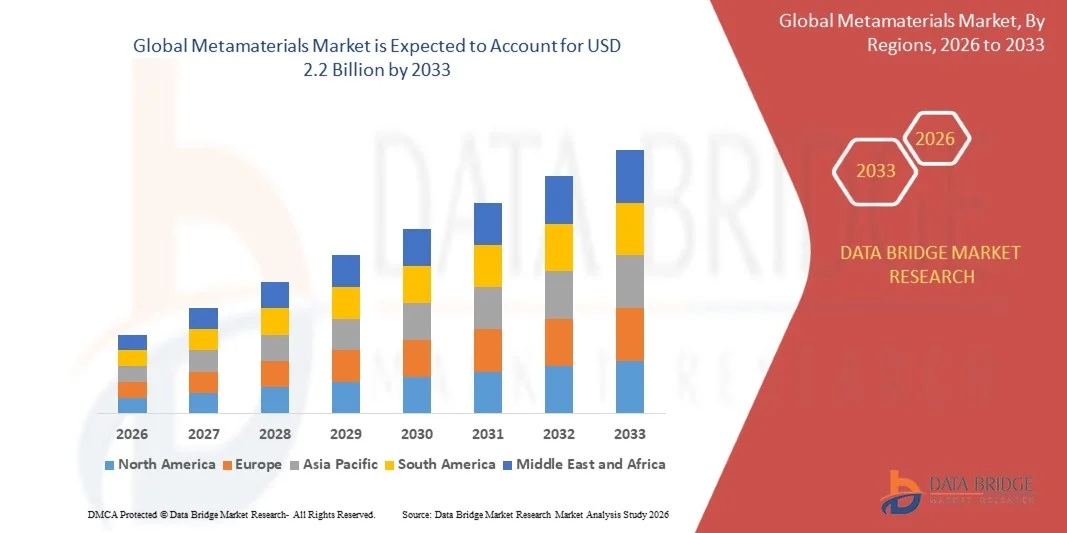
As per Data Bridge Market Research Analysis the Metamaterials Market was valued at USD 1.56 billion in 2025 and is projected to reach USD 2.2 billion by 2033, growing at a CAGR of 20.40% from 2026 to 2033. Metamaterials are artificially engineered materials designed to manipulate electromagnetic, acoustic, or optical waves through precisely engineered structures rather than their intrinsic chemical composition, enabling unprecedented control over wave propagation.
The market is experiencing steady growth driven by increasing demand for advanced materials in telecommunications, particularly for 5G and next-generation networks. Metamaterials enhance signal strength, improve bandwidth efficiency, and reduce electromagnetic interference, making them indispensable for next-generation communication technologies. The aerospace and defense sectors further accelerate market growth through the adoption of metamaterials for stealth technology, advanced radar systems, and electromagnetic shielding.
Market Size & Forecast
- Global Market Value (2025): USD 1.56 Billion
- Expected Market Value (2033): USD 2.2 Billion
- Forecast CAGR (2026–2033): 20.40%
- Leading Region in 2025: North America
- Fastest Growing Region: Asia Pacific
What are the Major Takeaways of Metamaterials Market?
-
North America accounted for the largest revenue share in 2025, holding 40.0% of the market. Driven by strong defense spending, advanced telecommunications infrastructure, and significant R&D investments.
-
Asia Pacific is expected to be the fastest-growing region during the forecast period, fueled by rapid industrialization, increasing 5G deployment, and growing adoption of advanced materials in consumer electronics and automotive sectors.
- The Electromagnetic product segment held the largest market share of approximately 29.2% in 2025, driven by its versatile applications in antennas and frequency-selective surfaces.
- Antennas represented the largest application segment with a share of approximately 44.8% in 2025, reflecting the growing demand for metamaterial-based antenna solutions in telecommunications.
- Consumer Electronics accounted for the largest end-use segment in 2025, driven by the proliferation of smartphones, wearables, and flexible electronic devices.
- The development of metamaterial-based antennas for 5G and 6G networks is a key trend, enabling millimeter-wave transmission with ultra-thin form factors.
- Advancements in nanotechnology and additive manufacturing are reducing fabrication costs and enabling volume production of metamaterial components.
- The market faces challenges including high fabrication costs, limited standardization, and lack of awareness about the benefits of metamaterials.
Report Scope and Metamaterials Market Segmentation
|
Attributes |
Metamaterials Key Market Insights |
|
Segments Covered |
|
|
Countries Covered |
North America · U.S. · Canada · Mexico Europe · Germany · France · U.K. · Netherlands · Switzerland · Belgium · Russia · Italy · Spain · Turkey · Rest of Europe Asia-Pacific · China · Japan · India · South Korea · Singapore · Malaysia · Australia · Thailand · Indonesia · Philippines · Rest of Asia-Pacific Middle East and Africa · Saudi Arabia · U.A.E. · South Africa · Egypt · Israel · Rest of Middle East and Africa South America · Brazil · Argentina · Rest of South America |
|
Key Market Players |
· Kymeta Corporation (U.S.) · Echodyne Corp. (U.S.) · Pivotal Commware (U.S.) · Lumotive (U.S.) · Radi-Cool, Inc. (U.S.) · Metalenz, Inc. (U.S.) · Evolv Technology (U.S.) · Metamagnetics (U.S.) · Meta Materials Inc. (Canada) · NKT Photonics A/S (Denmark) · TeraView Limited (UK) · Sonobex (UK) · Greenerwave (France) · ALCAN Systems GmbH i.L. (Germany) · Ceravision Ltd. (UK) · MediWise Ltd. (UK) · EMAG Technologies (U.S.) · Multiwave Technologies AG (Switzerland) · Kuangchi Science (China) · Xi'an Tianhe Applied Metamaterials (China) · Phoebus Optoelectronics (China) · NIL Technology (NILT) (Denmark) · Metawave (U.S.) |
|
Market Opportunities |
· Expansion of 5G and 6G network infrastructure driving demand for metamaterial-based antennas · Growing adoption in autonomous vehicles for advanced radar and LiDAR systems · Increasing applications in medical imaging and diagnostic devices · Development of energy-efficient and sustainable metamaterial solutions for renewable energy · Advancements in additive manufacturing and nanofabrication enabling cost-effective production |
|
Value Added Data Infosets |
In addition to the insights on market scenarios such as market value, growth rate, segmentation, geographical coverage, and major players, the market reports curated by the Data Bridge Market Research also include import export analysis, production capacity overview, production consumption analysis, price trend analysis, climate change scenario, supply chain analysis, value chain analysis, raw material/consumables overview, vendor selection criteria, PESTLE Analysis, Porter Analysis, and regulatory framework. |
What is the Key Trend in the Metamaterials Market?
Trend: Advancements in Nanotechnology and Additive Manufacturing
Layer-by-layer additive methods now build graded index profiles that vary continuously across a surface, giving engineers a toolbox for tailoring phase, amplitude, and polarization locally. Such precision accelerates the insertion of metamaterials into structural health monitors, biomedical implants, and automotive radar housings. Early production trials using 3D-printed interlocking blocks to create frequency-selective absorbers reached 99.5% absorptivity while reducing tooling steps. These breakthroughs lower entry barriers and make volume output feasible for mainstream device makers over the medium term.
Metamaterials Market Dynamics
Key Market Driver: Increasing Demand for Advanced Telecommunications
A primary driver of the metamaterials market is the increasing demand for advanced materials in telecommunications, particularly for 5G and beyond. Metamaterials play a critical role in enhancing signal strength, improving bandwidth efficiency, and reducing electromagnetic interference, making them indispensable for next-generation communication technologies. The development of metamaterial-based antennas for 5G and 6G networks is creating substantial demand, as these materials enable millimeter-wave transmission with ultra-thin form factors and multi-gigabit throughput. The global rollout of 5G infrastructure and the early development of 6G networks are expected to sustain market growth throughout the forecast period.
Key Restraint/Challenge: High Fabrication Costs and Limited Standardization
A significant challenge facing the metamaterials market is the high cost of fabrication and limited standardization. The complexity of synthesizing metamaterials, which requires precise nanoscale structures, contributes to elevated production costs. Additionally, the lack of standardized manufacturing processes and performance benchmarks creates uncertainty for potential adopters. Complex wave-physics concepts deter decision-makers in sectors without dedicated R&D budgets. While rapid advances in additive manufacturing and nanofabrication are narrowing these constraints, cost remains a barrier to widespread adoption, particularly in price-sensitive applications and emerging markets.
Key Market Opportunity: Expansion of 5G/6G Infrastructure and Autonomous Vehicles
The expansion of 5G and 6G network infrastructure presents significant opportunities for the metamaterials market. Metamaterial-based antennas are enabling millimeter-wave transmission with ultra-thin form factors, supporting the densification of high-band networks worldwide. Additionally, the growing adoption of autonomous vehicles is creating demand for advanced radar and LiDAR systems, where metamaterials enable compact, high-performance sensing solutions. The development of energy-efficient and sustainable metamaterial solutions for renewable energy applications, such as solar panels and wind turbines, further expands market opportunities. Advances in additive manufacturing and nanofabrication are expected to reduce production costs and enable wider adoption across multiple industries.
How is the Metamaterials Market Segmented?
The Metamaterials market is segmented on the basis of product, application, and end use.
- Product
On the basis of product, the Metamaterials Market is segmented into electromagnetic, terahertz, photonic, tunable, frequency selective surface, and non-linear. The electromagnetic segment held the largest market share of approximately 29.2% in 2025, driven by its versatile role in antennas and frequency-selective surfaces. Electromagnetic metamaterials are widely used in telecommunications, radar systems, and defense applications due to their ability to control electromagnetic wave propagation. Terahertz metamaterials are gaining traction in security screening and medical imaging applications, where they enable high-resolution imaging and spectroscopy. Photonic metamaterials are increasingly adopted in optical applications, including superlenses and cloaking devices. Tunable metamaterials allow dynamic control over wave propagation, enabling reconfigurable devices for next-generation communication systems. Frequency selective surfaces are used in filters and reflectors for wireless communication and radar applications. Non-linear metamaterials are emerging in advanced applications requiring harmonic generation and wave mixing capabilities.
- Application
On the basis of application, the Metamaterials Market is segmented into antenna, absorber, superlens, cloaking devices, and others. Antennas represented the largest application segment with a share of approximately 44.8% in 2025, driven by the growing demand for metamaterial-based antenna solutions in telecommunications. Metamaterial antennas offer enhanced performance, reduced size, and improved beam steering capabilities compared to conventional designs. The absorber segment includes radar-absorbing materials used in stealth technology and electromagnetic interference reduction. Superlenses enable imaging beyond the diffraction limit, with applications in medical diagnostics and semiconductor inspection. Cloaking devices, while still largely in research stages, represent a significant future opportunity for the market. Other applications include sensors, filters, and waveguides in various industries.
- End Use
On the basis of end use, the Metamaterials Market is segmented into aerospace & defense, medical, automotive, consumer electronics, energy & power, and others. Consumer electronics accounted for the largest end-use segment in 2025, driven by the proliferation of smartphones, wearables, and flexible electronic devices. The aerospace & defense segment is the second-largest end user, with metamaterials used in stealth technology, advanced radar systems, and electromagnetic shielding. The automotive segment is growing due to increasing adoption of advanced radar and LiDAR systems for autonomous vehicles. The medical segment is emerging as a key growth area, with metamaterials enabling advanced imaging and diagnostic devices. The Energy & Power segment is expanding with the use of metamaterials in renewable energy systems for improved efficiency.
Metamaterials Market Regional Analysis
North America Metamaterials Market Insight
North America accounted for the largest revenue share in 2025. The region's leadership is driven by strong defense spending, advanced telecommunications infrastructure, and significant R&D investments. The United States is at the forefront of metamaterials development, with key players such as Kymeta Corporation, Echodyne Corp., Pivotal Commware, Lumotive, and Radi-Cool, Inc. headquartered in the country. The U.S. Department of Defense and other federal agencies continue to invest heavily in metamaterials research for stealth technology, advanced radar systems, and communication applications. The region's strong venture capital funding for advanced materials startups and favorable regulatory environment for technology innovation are further accelerating market growth.
Europe Metamaterials Market Insight
Europe represents a significant market for metamaterials, supported by strong research institutions, advanced manufacturing capabilities, and growing demand from the aerospace and defense sectors. Key players such as TeraView Limited (UK), NKT Photonics A/S (Denmark), and Greenerwave (France) are headquartered in Europe, strengthening the region's market position. The region's focus on innovation, sustainability, and compliance with regulatory standards is shaping the European metamaterials landscape. The European Union's Horizon Europe program and various national research initiatives are providing substantial funding for metamaterials research and development. The automotive industry's shift toward autonomous vehicles is also driving demand for metamaterials in radar and LiDAR applications.
Asia-Pacific Metamaterials Market Insight
Asia-Pacific is expected to be the fastest-growing region in the metamaterials market during the forecast period. The region's rapid growth is fueled by rapid industrialization, increasing 5G deployment, and growing adoption of advanced materials in consumer electronics and automotive sectors. China is emerging as a key player, with significant investments in metamaterials research and manufacturing. Companies such as Kuangchi Science and Xi'an Tianhe Applied Metamaterials are strengthening the region's market position. Japan and South Korea are also witnessing growing adoption of metamaterials in telecommunications and electronics applications. The proliferation of 5G networks and the development of 6G technology in the region are creating substantial demand for metamaterial-based antennas and components.
Latin America Metamaterials Market Insight
Latin America represents an emerging market for metamaterials, with growing demand influenced by increasing investments in telecommunications infrastructure and defense modernization. Countries such as Brazil and Mexico are witnessing gradual adoption of advanced materials in telecommunications and aerospace applications. The region's expanding telecommunications sector and growing awareness of advanced materials are creating opportunities for metamaterial applications. However, market growth is currently constrained by limited regulatory frameworks, higher technology costs compared to developed regions, and fragmented policy support. The development of regional supply chains and partnerships with global metamaterial technology providers is expected to accelerate market growth.
Middle East & Africa Metamaterials Market Insight
The Middle East and Africa region represents a nascent market for metamaterials, with demand primarily concentrated in the GCC countries and South Africa. Governments across the region are increasing investments in advanced technologies and defense modernization to diversify their economies. The UAE and Saudi Arabia are investing in telecommunications infrastructure and defense capabilities, creating opportunities for metamaterial applications. South Africa is gradually adopting advanced materials to support the growing demand for telecommunications and defense technologies. Increasing investments from global technology providers and the availability of low-cost energy in the region are improving the commercial viability of metamaterial projects. However, relatively low adoption of advanced materials, limited manufacturing infrastructure, and high costs continue to restrain market growth.
Metamaterials Market Share
The Metamaterials industry is primarily led by well-established companies, including:
- Kymeta Corporation (U.S.)
- Echodyne Corp. (U.S.)
- Pivotal Commware (U.S.)
- Lumotive (U.S.)
- Radi-Cool, Inc. (U.S.)
- Metalenz, Inc. (U.S.)
- Evolv Technology (U.S.)
- Metamagnetics (U.S.)
- Meta Materials Inc. (Canada)
- NKT Photonics A/S (Denmark)
- TeraView Limited (UK)
- Sonobex (UK)
- Greenerwave (France)
- ALCAN Systems GmbH i.L. (Germany)
- Ceravision Ltd. (UK)
- MediWise Ltd. (UK)
- EMAG Technologies (U.S.)
- Multiwave Technologies AG (Switzerland)
- Kuangchi Science (China)
- Xi'an Tianhe Applied Metamaterials (China)
- Phoebus Optoelectronics (China)
- NIL Technology (NILT) (Denmark)
- Metawave (U.S.)
Latest Developments in Metamaterials Market
- In July 2026, Echodyne Corp. announced that its new 86,350-square-foot manufacturing facility in Kirkland, Washington will produce more than 30,000 counter-drone radars annually. The $40 million investment expands production capacity across its EchoShield, EchoFlight, and EchoGuard product lines to meet rapidly growing global demand. The facility is expected to employ more than 200 people at full capacity.
- In May 2026, Lumotive and Adaps Photonics enabled a 180° solid-state LiDAR platform at 30 frames per second for autonomous systems. The system delivers real-time tracking of fast-moving objects and reduces the overall cost of ownership by lowering the number of sensors required to meet advanced safety and autonomy requirements.
- In April 2026, Echodyne Corp. introduced EchoShield®, a software-defined cognitive 4D radar based on its patented Metamaterials Electronically Scanned Array (MESA) technology. The medium-range pulse-Doppler radar operates in the Ku-band between 15.4 and 16.6 GHz and supports airspace, ground, and coastal deployments. The system achieves angular tracking accuracy of less than 0.5 degrees in both azimuth and elevation.
- In April 2026, Lumotive debuted the world's first 2D photonic beamforming chip operating across three infrared wavelengths commonly used in LiDAR and photonics: 905 nm, 1310 nm, and 1550 nm. The company's LCM-based reference design enables a fully solid-state 180° LiDAR platform for outdoor autonomy.
- In February 2026, Kymeta Corporation and Japan Display Inc. (JDI) announced a master supply agreement to develop and supply glass substrates for a next-generation multi-band metasurface aperture. The collaboration will deliver the industry's first multi-band metasurface terminal enabling concurrent operation across Ku- and Ka-band satellite frequencies. The Ku/Ka terminal will initially address defense demands, including requirements from the U.S. Department of Defense and U.S. Space Force.
- In January 2026, Kymeta Corporation partnered with iRocket to integrate its metamaterial-based satellite communication technology into missile interceptor systems supporting the Golden Dome program. The collaboration leverages Kymeta's multi-orbit broadband user terminals to provide resilient communications for next-generation defense applications.
- In November 2025, Greenerwave secured €15 million in Series B funding to accelerate the deployment of its reconfigurable intelligent surfaces (RIS) for 5G and 6G networks. The funding will support the company's production expansion and commercial deployment of its adaptive metasurface technology for telecommunications infrastructure across Europe.
- In July 2025, Metalenz and STMicroelectronics signed an expanded licensing agreement allowing STM to continue manufacturing metasurface optics based on Metalenz intellectual property in its 300 mm semiconductor fabrication facilities. Since introducing the technology commercially in 2022, Metalenz and STM have shipped over 140 million metasurface optics integrated into STM's FlightSense VL53 series direct Time-of-Flight modules. The global market for metasurface optics is projected to reach $2 billion by 2029.

- Interactive Data Analysis Dashboard
- Company Analysis Dashboard for high growth potential opportunities
- Research Analyst Access for customization & queries
- Competitor Analysis with Interactive dashboard
- Latest News, Updates & Trend analysis
- Harness the Power of Benchmark Analysis for Comprehensive Competitor Tracking
Global Metamaterials Market, Supply Chain Analysis and Ecosystem Framework
To support market growth and help clients navigate the impact of geopolitical shifts, DBMR has integrated in-depth supply chain analysis into its Global Metamaterials Market research reports. This addition empowers clients to respond effectively to global changes affecting their industries. The supply chain analysis section includes detailed insights such as Global Metamaterials Market consumption and production by country, price trend analysis, the impact of tariffs and geopolitical developments, and import and export trends by country and HSN code. It also highlights major suppliers with data on production capacity and company profiles, as well as key importers and exporters. In addition to research, DBMR offers specialized supply chain consulting services backed by over a decade of experience, providing solutions like supplier discovery, supplier risk assessment, price trend analysis, impact evaluation of inflation and trade route changes, and comprehensive market trend analysis.
Data collection and base year analysis are done using data collection modules with large sample sizes. The stage includes obtaining market information or related data through various sources and strategies. It includes examining and planning all the data acquired from the past in advance. It likewise envelops the examination of information inconsistencies seen across different information sources. The market data is analysed and estimated using market statistical and coherent models. Also, market share analysis and key trend analysis are the major success factors in the market report. To know more, please request an analyst call or drop down your inquiry.
The key research methodology used by DBMR research team is data triangulation which involves data mining, analysis of the impact of data variables on the market and primary (industry expert) validation. Data models include Vendor Positioning Grid, Market Time Line Analysis, Market Overview and Guide, Company Positioning Grid, Patent Analysis, Pricing Analysis, Company Market Share Analysis, Standards of Measurement, Global versus Regional and Vendor Share Analysis. To know more about the research methodology, drop in an inquiry to speak to our industry experts.
Data Bridge Market Research is a leader in advanced formative research. We take pride in servicing our existing and new customers with data and analysis that match and suits their goal. The report can be customized to include price trend analysis of target brands understanding the market for additional countries (ask for the list of countries), clinical trial results data, literature review, refurbished market and product base analysis. Market analysis of target competitors can be analyzed from technology-based analysis to market portfolio strategies. We can add as many competitors that you require data about in the format and data style you are looking for. Our team of analysts can also provide you data in crude raw excel files pivot tables (Fact book) or can assist you in creating presentations from the data sets available in the report.













