


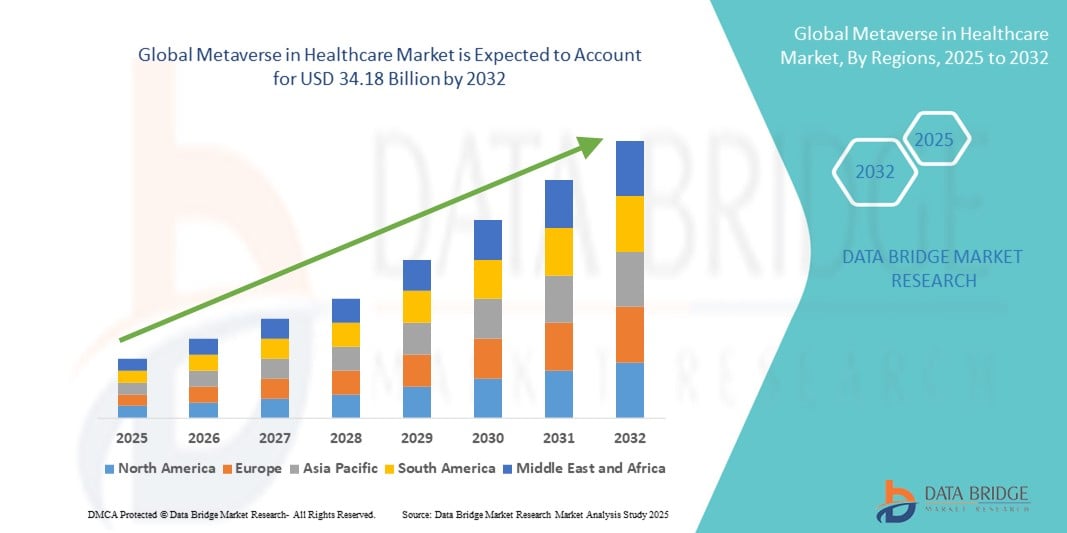
Metaverse in Healthcare Market Size
- The global metaverse in healthcare market size was valued at USD 11.57 billion in 2024 and is expected to reach USD 34.18 billion by 2032, at a CAGR of 14.50% during the forecast period
- The market growth is largely fueled by the growing adoption and technological progress within virtual reality (VR), augmented reality (AR), blockchain, and AI-powered healthcare platforms—collectively forming the foundation of the metaverse in healthcare. This transformation is leading to increased digitalization across clinical training, diagnostics, treatment planning, and patient engagement in both hospital and homecare settings
- Furthermore, rising demand for remote healthcare access, immersive medical education, and virtual collaboration among healthcare professionals is positioning metaverse technologies as transformative tools in modern medicine. These converging factors are accelerating the uptake of metaverse in healthcare solutions, thereby significantly boosting the industry’s growth
Metaverse in Healthcare Market Analysis
- The metaverse in healthcare market, encompassing the use of virtual, augmented, and mixed reality environments to enhance medical education, telehealth, and patient engagement, is becoming a transformative force in both clinical and non-clinical applications due to its ability to offer immersive, real-time experiences
- The rising adoption of advanced technologies such as AR/VR, blockchain, and AI, combined with growing demand for remote healthcare delivery, enhanced training platforms, and patient-centric solutions, is significantly driving growth in the metaverse in healthcare market
- North America dominated the metaverse in healthcare market with the largest revenue share of 42.6% in 2024, driven by the early integration of metaverse technologies into telemedicine, robust digital infrastructure, and favorable regulatory environments. The U.S. led the region’s growth, with hospitals and medical schools adopting virtual reality for surgical simulations, therapy, and remote diagnostics
- Asia-Pacific is expected to be the fastest-growing region in the metaverse in healthcare market during the forecast period, owing to increasing investment in digital healthcare ecosystems, rising awareness of virtual health tools, and large tech-savvy populations in countries such as China, Japan, and India
- The hardware segment dominated the metaverse in healthcare market with the largest revenue share of 62.4% in 2024, driven by widespread use of VR headsets, AR devices, and haptic equipment in diagnostics and training
Report Scope and Metaverse in Healthcare Market Segmentation
|
Attributes |
Metaverse in Healthcare Key Market Insights |
|
Segments Covered |
|
|
Countries Covered |
North America
Europe
Asia-Pacific
Middle East and Africa
South America
|
|
Key Market Players |
|
|
Market Opportunities |
|
|
Value Added Data Infosets |
In addition to the insights on market scenarios such as market value, growth rate, segmentation, geographical coverage, and major players, the market reports curated by the Data Bridge Market Research also include in-depth expert analysis, pricing analysis, brand share analysis, consumer survey, demography analysis, supply chain analysis, value chain analysis, raw material/consumables overview, vendor selection criteria, PESTLE Analysis, Porter Analysis, and regulatory framework. |
Metaverse in Healthcare Market Trends
Expanding Capabilities Through Digital Intelligence and Interoperability
- A significant and accelerating trend in the global metaverse in healthcare market is the deepening integration of intelligent systems and virtual platforms with healthcare services, including diagnosis, treatment, and patient engagement. This convergence is enhancing user experience, clinical efficiency, and remote accessibility
- For instance, solutions such as XRHealth and ImmersiveTouch enable virtual clinics and surgical simulations that integrate with wearables and voice interfaces for real-time interaction and monitoring. These platforms allow healthcare providers to create immersive virtual consultations and training environments
- Intelligent systems within the metaverse are being trained to detect patient behavior, suggest clinical interventions, and trigger alerts when anomalies are observed. For instance, platforms are increasingly utilizing behavioral pattern recognition to optimize therapy sessions or patient rehabilitation in VR environments
- The integration of metaverse environments with centralized digital health systems enables seamless management of medical records, treatment plans, and live patient interactions in a unified space. Patients and providers can connect through virtual clinics that also link with electronic health records (EHRs), cloud platforms, and other smart healthcare devices
- This transformation toward smarter, more intuitive, and fully immersive platforms is reshaping expectations in healthcare delivery, enabling everything from virtual reality exposure therapy (VRET) to remote surgeries and mental wellness applications
- As a result, companies such as NVIDIA, Siemens Healthineers, GE Healthcare, and Meta are investing heavily in metaverse-enabling technologies—including digital twins, medical imaging visualization, and extended reality—designed to offer more personalized, efficient, and accessible care experiences across diverse medical use cases
Metaverse in Healthcare Market Dynamics
Driver
Growing Need Due to Rising Demand for Digital Transformation and Remote Healthcare Solutions
- The increasing demand for digital transformation in healthcare delivery, coupled with the rapid adoption of virtual care platforms, is significantly driving the growth of the metaverse in healthcare market. Providers are turning to immersive technologies for enhanced patient engagement, virtual diagnostics, and remote collaboration
- For instance, in April 2024, Apollo Hospitals Group launched its virtual care service, “Apollo Virtual Clinic,” powered by metaverse and AR/VR technologies. The platform enables real-time consultations, remote monitoring, and immersive treatment experiences, underscoring a growing trend in virtual-first healthcare delivery
- As patients and clinicians seek more accessible, personalized, and tech-driven healthcare services, the metaverse offers advanced tools such as 3D anatomical visualization, VR-based therapy, and digital twins for treatment simulation—representing a major upgrade from traditional telehealth methods
- Furthermore, the increased prevalence of chronic conditions, mental health challenges, and geographic healthcare disparities are fueling the adoption of virtual reality therapy, remote rehabilitation, and virtual counseling platforms, all integrated within the healthcare metaverse
- The ability to interact in immersive, secure digital environments using avatars, along with the integration of EHR systems and wearable data, is driving rapid uptake of metaverse technologies by hospitals, medical schools, and research institutions globally
Restraint/Challenge
Concerns Regarding Data Security, Technical Complexity, and High Deployment Costs
- Concerns surrounding data privacy and cybersecurity in metaverse-based healthcare platforms pose a significant barrier to mass adoption. As these systems handle sensitive health information in virtual and cloud environments, they are vulnerable to data breaches, identity theft, and regulatory violations
- For instance, incidents involving breaches of medical data in virtual reality simulations have raised questions about HIPAA compliance and patient safety within immersive environments. These concerns impact the pace of adoption in highly regulated healthcare markets such as the U.S. and Europe
- Addressing these issues requires end-to-end encryption, blockchain-enabled identity verification, and stringent compliance protocols. Companies such as Wipro and NVIDIA are investing in secure metaverse architecture to ensure platform trustworthiness
- In addition, the high initial investment in AR/VR hardware, skilled IT support, and infrastructure integration (e.g., EHR, PACS) makes it difficult for smaller healthcare providers or underfunded institutions to implement metaverse solutions at scale
- Although costs are decreasing with advances in immersive hardware and open-source platforms, the perception of metaverse systems as “luxury” or experimental still slows adoption—especially in price-sensitive and rural markets
- To overcome these challenges, stakeholders must focus on open standards, affordable access models, continuous user education, and robust security frameworks to ensure sustainable growth in the Metaverse in Healthcare market
Metaverse in Healthcare Market Scope
The market is segmented on the basis of component, technology, device, and end user.
- By Component
On the basis of component, the metaverse in healthcare market is segmented into hardware and software. The hardware segment dominated the market with the largest revenue share of 62.4% in 2024, driven by widespread use of VR headsets, AR devices, and haptic equipment in diagnostics and training.
The software segment is projected to expand at the fastest CAGR of 26.3% from 2025 to 2032, owing to the rise of metaverse-based collaboration platforms, AI-powered simulation software, and advanced data visualization tools.
- By Technology
On the basis of technology, the market is segmented into virtual reality, augmented reality, mixed reality, and artificial intelligence. The virtual reality segment held the largest revenue share of 38.7% in 2024, due to its effectiveness in immersive training, pain management, and mental health applications.
The artificial intelligence segment is expected to register the highest CAGR of 27.5% from 2025 to 2032, supported by its role in predictive analytics, personalized care, and digital twin development.
- By Device
On the basis of device, the market is segmented into VR Headsets, AR Devices, and Mixed Reality Platforms. The VR Headsets segment dominated with a revenue share of 46.1% in 2024, fueled by their role in hands-on learning and therapy sessions.
The Mixed Reality Platforms segment is anticipated to grow at the fastest CAGR of 25.9% from 2025 to 2032, driven by adoption in real-time surgical planning, interactive diagnostics, and virtual patient interactions.
- By End User
On the basis of end user, the market is segmented into medical training and educational modules, diagnosis, treatment, designing ORs, surgical training, remote monitoring, and others. The medical training and educational modules segment captured the largest share of 34.5% in 2024, as VR and AR tools are increasingly integrated into curricula and CME programs.
The remote monitoring segment is expected to grow at the fastest CAGR of 28.1% during 2025–2032, due to rising demand for continuous patient engagement, telepresence tools, and virtual nursing.
Metaverse in Healthcare Market Regional Analysis
- North America dominated the metaverse in healthcare market with the largest revenue share of 42.6% in 2024, driven by the rapid digitalization of healthcare systems, widespread adoption of telemedicine, and growing investments in immersive technologies for medical training and treatment
- The region’s leadership is supported by high healthcare expenditure, a strong presence of major technology companies, and favorable regulatory support for virtual health solutions
- Healthcare providers across the U.S. and Canada are increasingly integrating AR/VR and AI-powered platforms into clinical workflows, medical education, and mental health therapy—driving further expansion of the metaverse in healthcare market
U.S. Metaverse in Healthcare Market Insight
The U.S. metaverse in healthcare market captured the largest revenue share of 77% within North America in 2024, driven by rising consumer demand for virtual health experiences, immersive therapy platforms, and real-time patient engagement tools. Widespread implementation of remote patient monitoring, along with the growing deployment of virtual hospitals and training simulators by institutions such as Mayo Clinic and Cedars-Sinai, is fueling market growth. Integration with AI, wearable data, and digital twins further strengthens the U.S.'s position as the dominant player in the region.
Europe Metaverse in Healthcare Market Insight
The Europe metaverse in healthcare market is projected to expand at a significant CAGR during the forecast period, supported by a strong emphasis on patient privacy, evolving healthcare regulations such as GDPR, and the adoption of advanced technologies for training, diagnostics, and remote consultation. The demand for metaverse-enabled mental health therapy, physiotherapy, and virtual surgical training is rapidly increasing across countries such as Germany, France, and the U.K., positioning Europe as a fast-maturing market for healthcare metaverse adoption.
U.K. Metaverse in Healthcare Market Insight
The U.K. metaverse in healthcare market is anticipated to grow at a noteworthy CAGR, driven by the NHS's push for digital transformation and the use of VR for pain management, PTSD treatment, and cognitive behavioral therapy (CBT). Rising investments from health-tech startups and public-private partnerships are accelerating innovation. The market is further supported by the country’s growing ecosystem of VR developers and academic research institutions exploring medical applications of immersive technologies.
Germany Metaverse in Healthcare Market Insight
The Germany metaverse in healthcare market is expected to expand at a robust CAGR, driven by its leadership in medical device innovation, high standards for data security, and rising adoption of telehealth solutions. Hospitals and universities are actively investing in VR-based simulation training and remote care platforms, while digital therapeutics are gaining popularity among both providers and patients. Emphasis on sustainability and precision medicine is also boosting demand for metaverse integration in diagnostic and treatment planning.
Asia-Pacific Metaverse in Healthcare Market Insight
The Asia-Pacific metaverse in healthcare market is poised to grow at the fastest CAGR of 24% from 2025 to 2032, fueled by rising healthcare needs, increasing penetration of smartphones and internet, and government initiatives promoting healthcare digitization. China, Japan, and India are leading the regional adoption, with use cases ranging from medical education and surgical planning to mental health therapy and chronic disease management. The expanding middle-class population and growing health awareness are making virtual care solutions increasingly popular.
Japan Metaverse in Healthcare Market Insight
The Japan metaverse in healthcare market is gaining momentum due to its aging population, high level of technological sophistication, and strong cultural acceptance of innovation. Applications such as virtual elder care, remote rehabilitation, and immersive surgical simulations are growing rapidly. The integration of metaverse platforms with Japan’s already advanced robotic and AI systems is expected to drive unique growth opportunities in the coming years.
China Metaverse in Healthcare Market Insight
The China metaverse in healthcare market held the largest revenue share within Asia-Pacific in 2024, driven by rapid urbanization, strong government support for digital healthcare infrastructure, and a booming consumer market for smart devices. Major hospitals and research centers are adopting AR/VR technologies for remote diagnosis, medical education, and mental health support. Local tech giants such as Alibaba and Tencent are heavily investing in virtual healthcare platforms, accelerating the country’s leadership in the Asia-Pacific market.
Metaverse in Healthcare Market Share
The Metaverse in Healthcare industry is primarily led by well-established companies, including:
- Microsoft (U.S.)
- NVIDIA Corporation (U.S.)
- XRHealth (U.S.)
- CAE Inc. (Canada)
- Koninklijke Philips N.V. (Netherlands)
- Immersive Touch, Inc. (U.S.)
- Wipro (India)
- Siemens Healthineers AG (Germany)
- Medtronic plc (Ireland)
- GE HealthCare (U.S.)
- Intuitive Surgical (U.S.)
- 8Chili, Inc. (U.S.)
- MindMaze (Switzerland)
- AccuVein, Inc. (U.S.)
- EON Reality (U.S.)
- Brainlab AG (Germany)
- Novarad Corporation (U.S.)
- Oodles Technologies (India)
- CMR Surgical (U.K.)
- Merative (U.S.)
- BioflightVR (U.S.)
- WorldViz, Inc. (U.S.)
- Google (U.S.)
- Oculus (Meta Platforms, Inc.) (U.S.)
- Augmedics (U.S.)
Latest Developments in Global Metaverse in Healthcare Market
- In February 2024, CAE Inc. launched the CAE Mediverse, a virtual reality (VR) training and collaboration platform designed for immersive medical education across healthcare institutions globally. The platform enables students and clinicians to practice procedures in a metaverse-like setting, replacing traditional physical simulations with digital environments
- In April 2025, the European Economic and Social Committee (EESC) adopted a strategic opinion on the integration of robotics and metaverse technologies in healthcare. The policy emphasizes ethical standards, equitable access, and infrastructure support to safely implement emerging metaverse-based medical solutions across the EU

- Interactive Data Analysis Dashboard
- Company Analysis Dashboard for high growth potential opportunities
- Research Analyst Access for customization & queries
- Competitor Analysis with Interactive dashboard
- Latest News, Updates & Trend analysis
- Harness the Power of Benchmark Analysis for Comprehensive Competitor Tracking
Data collection and base year analysis are done using data collection modules with large sample sizes. The stage includes obtaining market information or related data through various sources and strategies. It includes examining and planning all the data acquired from the past in advance. It likewise envelops the examination of information inconsistencies seen across different information sources. The market data is analysed and estimated using market statistical and coherent models. Also, market share analysis and key trend analysis are the major success factors in the market report. To know more, please request an analyst call or drop down your inquiry.
The key research methodology used by DBMR research team is data triangulation which involves data mining, analysis of the impact of data variables on the market and primary (industry expert) validation. Data models include Vendor Positioning Grid, Market Time Line Analysis, Market Overview and Guide, Company Positioning Grid, Patent Analysis, Pricing Analysis, Company Market Share Analysis, Standards of Measurement, Global versus Regional and Vendor Share Analysis. To know more about the research methodology, drop in an inquiry to speak to our industry experts.
Data Bridge Market Research is a leader in advanced formative research. We take pride in servicing our existing and new customers with data and analysis that match and suits their goal. The report can be customized to include price trend analysis of target brands understanding the market for additional countries (ask for the list of countries), clinical trial results data, literature review, refurbished market and product base analysis. Market analysis of target competitors can be analyzed from technology-based analysis to market portfolio strategies. We can add as many competitors that you require data about in the format and data style you are looking for. Our team of analysts can also provide you data in crude raw excel files pivot tables (Fact book) or can assist you in creating presentations from the data sets available in the report.













