What is the Microbial Agricultural Inoculants Market Size and Growth Rate?
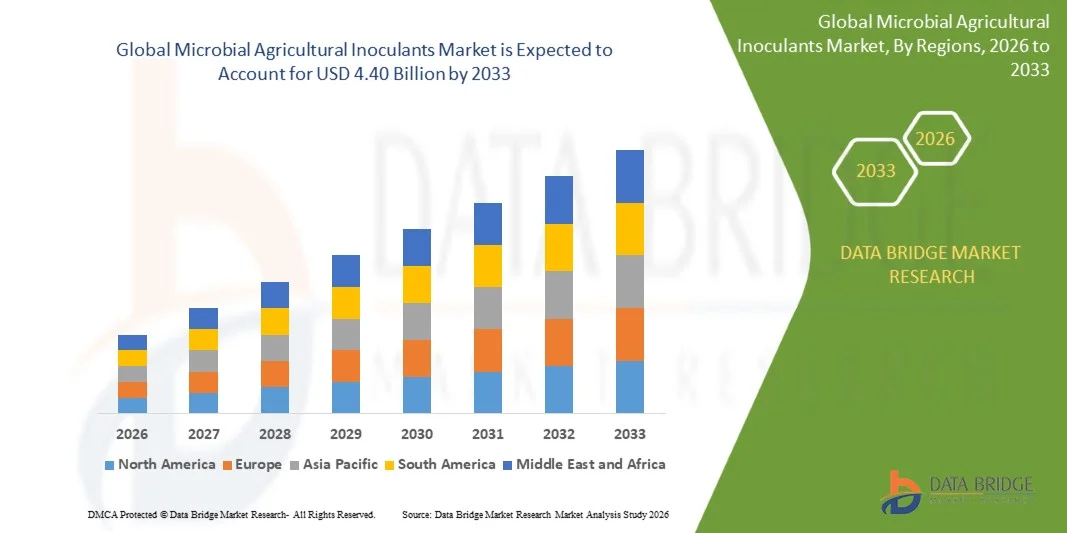
- As per Data Bridge Market Research analysis the microbial agricultural inoculants market was valued at USD 3.03 billion in 2025 and is projected to reach USD 4.40 billion by 2033, growing at a CAGR of 4.80% from 2026 to 2033.
- The market is experiencing steady growth driven by increasing adoption of sustainable agricultural practices, rising demand for bio-based crop inputs, and growing awareness of the benefits of microbial inoculants in improving soil health, nutrient availability, and crop productivity.
- The growing need to reduce dependence on synthetic fertilizers and pesticides, along with government initiatives promoting sustainable farming and environmentally friendly agricultural inputs, is encouraging farmers and agricultural producers to adopt microbial agricultural inoculants.
Market Size & Forecast
- Market Value (2025): USD 3.03 Billion
- Expected Market Value (2033): USD 4.40 Billion
- Forecast CAGR (2026–2033): 4.80%
- Leading Region in 2025: North America
- Fastest Growing Region: Asia-Pacific
What are the Major Takeaways of the Microbial Agricultural Inoculants Market?
- North America microbial agricultural inoculants market is expected to account for a significant revenue share in 2025, supported by increasing adoption of sustainable agriculture, rising demand for biological crop inputs, and growing emphasis on soil health.
- Asia-Pacific microbial agricultural inoculants market is expected to witness the fastest growth rate from 2026 to 2033, supported by increasing agricultural production, rising demand for sustainable farming, and growing awareness of biological crop inputs in countries such as India, China, and Japan.
- The plant growth promoting microorganisms segment held the largest market revenue share in 2025 driven by increasing adoption of beneficial microbes that improve nutrient availability, root development, and crop productivity. These microorganisms are widely used to enhance plant growth, improve soil health, and reduce dependence on synthetic agricultural inputs.
- The biocontrol agents segment is projected to register the fastest growth at a CAGR from 2026 to 2033, driven by rising demand for biological crop protection solutions and increasing concerns regarding chemical pesticide residues. Growing adoption of microbial-based pest and disease management solutions is accelerating segment expansion.
- The bacterial inoculants segment held the largest market revenue share in 2025 driven by their widespread use in nitrogen fixation, nutrient solubilization, and plant growth promotion. Bacterial inoculants are increasingly adopted across major crops due to their effectiveness in improving nutrient utilization and supporting sustainable agricultural production.
- The fungal inoculants segment is projected to register the fastest growth at a CAGR from 2026 to 2033, driven by increasing adoption of mycorrhizal fungi and other beneficial fungal strains for improving nutrient and water uptake. Rising emphasis on soil health and biological farming practices is accelerating segment expansion.
Report Scope and Microbial Agricultural Inoculants Market Segmentation
Attributes |
Microbial Agricultural Inoculants Key Market Insights |
|
Segments Covered |
|
|
Countries Covered |
North America
Europe
Asia-Pacific
Middle East and Africa
South America
|
|
Key Market Players |
|
|
Market Opportunities |
|
|
Value Added Data Infosets |
In addition to the insights on market scenarios such as market value, growth rate, segmentation, geographical coverage, and major players, the market reports curated by the Data Bridge Market Research also include import export analysis, production capacity overview, production consumption analysis, price trend analysis, climate change scenario, supply chain analysis, value chain analysis, raw material/consumables overview, vendor selection criteria, PESTLE Analysis, Porter Analysis, and regulatory framework. |
What is the Key Trend in the Microbial Agricultural Inoculants Market?
- Agricultural input companies are increasingly developing multi-strain microbial inoculants that combine beneficial bacteria and fungi to improve nutrient availability, root development, and overall crop performance while supporting sustainable farming practices.
- For instance, in January 2025, ADAMA and Groundwork BioAg announced an exclusive commercial agreement to offer Rootella mycorrhizal inoculants to Chinese farmers, targeting improved crop yields and soil health while reducing dependence on synthetic fertilizers.
- Microbial seed treatments and soil inoculants are increasingly being formulated to improve the availability and uptake of essential nutrients such as nitrogen, phosphorus, and potassium.
- For instance, Novonesis' QuickRoots microbial seed inoculant combines Bacillus amyloliquefaciens and Trichoderma virens to improve phosphate availability and support greater root volume and nutrient uptake across crops including soybean, corn, and wheat.
- As agricultural producers increasingly prioritize soil health, nutrient-use efficiency, and reduced chemical inputs, the development of advanced microbial formulations and multi-microbe inoculants is expected to accelerate, strengthening their role in sustainable crop production.
What are the Key Drivers of the Microbial Agricultural Inoculants Market?
- The growing emphasis on sustainable agriculture and improving nutrient-use efficiency is significantly increasing demand for microbial inoculants that can enhance soil fertility, nutrient availability, and crop productivity while reducing reliance on conventional agricultural inputs.
- For instance, in August 2026, ICAR-NBAIM transferred three biofertilizer , BioNPK, BioGrow, and BioPhos, to BhuMicroGen Agrinoculants for commercial production and wider dissemination among farmers, supporting improved soil health, nutrient-use efficiency, and sustainable crop production.
- Increasing commercialization of microbial products is also expanding their adoption across large agricultural areas, as companies demonstrate their applicability through field-scale deployments and partnerships with fertilizer and agricultural input providers.
- For instance, in March 2025, BiOWiSH Technologies announced that its BiOWiSH Crop Liquid microbial fertilizer technology had been applied to more than 10 million acres worldwide, with partnerships involving major agricultural companies supporting its broader adoption.
- With increasing investment in biological agricultural inputs, technology commercialization, and sustainable nutrient management, microbial inoculants are expected to become increasingly important in modern crop production systems.
Which Factors are Challenging the Growth of the Microbial Agricultural Inoculants Market?
- Regulatory requirements, product validation, and inconsistent field performance can challenge the widespread adoption of microbial agricultural inoculants, particularly because product efficacy may vary according to soil conditions, crop types, climate, and application practices.
- These challenges increase the need for scientific validation, standardized formulations, reliable microbial strains, and clear regulatory frameworks before products can achieve broad commercial acceptance.
- For instance, in September 2025, the Government of India stated that only 146 biostimulant products had been included in Schedule VI of the Fertilizer Control Order, while provisional registration for biostimulant products became invalid after June 16, 2025.
- In addition, India’s Ministry of Agriculture emphasized in July 2025 that biostimulants should be approved based on scientific validation and directed ICAR to assess their effectiveness for farmers, highlighting the importance of credible efficacy data for market development.
- The need for regulatory compliance, consistent field efficacy, and scientifically validated performance continues to create barriers for microbial inoculant manufacturers, particularly smaller companies, potentially slowing market penetration despite rising demand for sustainable agricultural solutions.
How is the Microbial Agricultural Inoculants Market Segmented?
The market is segmented on the basis of types, source, crop type, and application.
- By Types
On the basis of types, the microbial agricultural inoculants market is segmented into plant growth promoting microorganisms, biocontrol agents, and stimulants. The plant growth promoting microorganisms segment held the largest market revenue share in 2025 driven by increasing adoption of beneficial microbes that improve nutrient availability, root development, and crop productivity. These microorganisms are widely used to enhance plant growth, improve soil health, and reduce dependence on synthetic agricultural inputs.
The biocontrol agents segment is projected to register the fastest growth at a CAGR from 2026 to 2033, driven by rising demand for biological crop protection solutions and increasing concerns regarding chemical pesticide residues. Growing adoption of microbial-based pest and disease management solutions is accelerating segment expansion.
- By Source
On the basis of source, the microbial agricultural inoculants market is segmented into fungal inoculants and bacterial inoculants. The bacterial inoculants segment held the largest market revenue share in 2025 driven by their widespread use in nitrogen fixation, nutrient solubilization, and plant growth promotion. Bacterial inoculants are increasingly adopted across major crops due to their effectiveness in improving nutrient utilization and supporting sustainable agricultural production.
The fungal inoculants segment is projected to register the fastest growth at a CAGR from 2026 to 2033, driven by increasing adoption of mycorrhizal fungi and other beneficial fungal strains for improving nutrient and water uptake. Rising emphasis on soil health and biological farming practices is accelerating segment expansion.
- By Crop Type
On the basis of crop type, the microbial agricultural inoculants market is segmented into oilseeds and pulses, fruits and vegetables, and cereals grains. The cereals grains segment held the largest market revenue share in 2025 driven by extensive cultivation of wheat, rice, corn, and other cereal crops and increasing demand for solutions that improve nutrient efficiency and crop productivity. Large-scale cereal production and growing adoption of sustainable farming practices are supporting segment growth.
The fruits and vegetables segment is projected to register the fastest growth at a CAGR from 2026 to 2033, driven by increasing demand for high-quality produce, residue-free cultivation, and biological crop inputs. Rising adoption of microbial solutions to improve plant vigor, soil fertility, and crop protection is accelerating segment expansion.
- By Application
On the basis of application, the microbial agricultural inoculants market is segmented into soil inoculation and seed inoculation. The soil inoculation segment held the largest market revenue share in 2025 driven by increasing adoption of microbial products to improve soil fertility, nutrient availability, and microbial activity. Soil inoculation is widely used to establish beneficial microorganisms around plant roots and enhance overall crop development.
The seed inoculation segment is projected to register the fastest growth at a CAGR from 2026 to 2033, driven by increasing demand for efficient seed treatment solutions that promote early root development, nutrient uptake, and crop establishment. Growing adoption of biological seed treatments and precision agriculture practices is accelerating segment expansion.
Which Region Holds the Largest Share of the Microbial Agricultural Inoculants Market?
- North America microbial agricultural inoculants market is expected to account for a significant revenue share in 2025, supported by increasing adoption of sustainable agriculture, rising demand for biological crop inputs, and growing emphasis on soil health.
- Farmers across the region are increasingly adopting microbial inoculants to improve nutrient-use efficiency, enhance crop productivity, and reduce dependence on synthetic fertilizers and pesticides. Strong agricultural research capabilities, advanced farming technologies, and increasing commercialization of biological solutions are further supporting market expansion across the U.S. and Canada.
U.S. Microbial Agricultural Inoculants Market Insight
The U.S. microbial agricultural inoculants market is expected to account for a significant revenue share in 2025, fueled by increasing adoption of biological agricultural inputs and growing demand for sustainable crop production. Farmers are increasingly using microbial inoculants to enhance nutrient availability, improve root development, and support soil health. Moreover, strong presence of agricultural biotechnology companies, extensive row-crop cultivation, and increasing investment in microbial-based crop solutions are contributing to market growth.
Europe Microbial Agricultural Inoculants Market Insight
The Europe microbial agricultural inoculants market is expected to witness a strong growth rate from 2026 to 2033, primarily driven by stringent environmental regulations, increasing demand for sustainable farming practices, and efforts to reduce chemical agricultural inputs. European farmers are increasingly adopting microbial solutions for improving soil fertility, nutrient efficiency, and crop protection. Growing organic farming activities, government support for sustainable agriculture, and advancements in microbial formulations are further fostering market development across the region.
Germany Microbial Agricultural Inoculants Market Insight
The Germany microbial agricultural inoculants market is expected to witness significant growth from 2026 to 2033, fueled by increasing awareness of soil health, sustainable crop production, and environmentally friendly agricultural practices. Germany's well-developed agricultural research infrastructure and emphasis on reducing chemical inputs are supporting the adoption of microbial-based solutions. Increasing use of beneficial bacteria and fungi in crop nutrition and biological crop protection is also contributing to market expansion.
Asia-Pacific Microbial Agricultural Inoculants Market Insight
The Asia-Pacific microbial agricultural inoculants market is expected to witness the fastest growth rate from 2026 to 2033, supported by increasing agricultural production, rising demand for sustainable farming, and growing awareness of biological crop inputs in countries such as India, China, and Japan. Farmers are increasingly adopting microbial inoculants to improve soil fertility, nutrient availability, and crop yields while reducing reliance on synthetic fertilizers. Government initiatives promoting biofertilizers, expanding agricultural biotechnology capabilities, and large cultivated areas are further accelerating regional market growth.
India Microbial Agricultural Inoculants Market Insight
The India microbial agricultural inoculants market is expected to witness significant growth from 2026 to 2033 due to increasing adoption of sustainable agriculture, growing awareness of biofertilizers, and government initiatives supporting biological agricultural inputs. Farmers are increasingly using microbial inoculants to improve soil fertility, nutrient-use efficiency, and crop productivity. The country's large agricultural sector, rising demand for chemical-free farming solutions, and increasing commercialization of microbial technologies are further supporting market growth.
China Microbial Agricultural Inoculants Market Insight
The China microbial agricultural inoculants market is expected to account for a significant market revenue share in 2025, attributed to the country's large agricultural sector, increasing focus on sustainable crop production, and growing adoption of biological agricultural inputs. China is increasingly promoting efficient fertilizer use and environmentally sustainable farming practices, encouraging the adoption of microbial inoculants. Expanding agricultural biotechnology capabilities, increasing investment in microbial products, and rising demand for improved soil health are key factors propelling market growth.
Which are the Top Companies in Microbial Agricultural Inoculants Market?
The microbial agricultural inoculants industry is primarily led by well-established companies, including:
- BRETTYOUNG (Canada)
- Verdesian Life Sciences (U.S.)
- Agrauxine (France)
- BASF SE (Germany)
- Bayer AG (Germany)
- Corteva Agriscience (U.S.)
- Novonesis A/S (Denmark)
- Archer Daniels Midland Company (ADM) (U.S.)
- Lallemand Inc. (Canada)
- Kemin Industries, Inc. (U.S.)
- Precision Laboratories, LLC (U.S.)
- XiteBio Technologies Inc. (Canada)
- BIO-CAT, Inc. (U.S.)
- Queensland Agricultural Seeds Pty. Ltd. (Australia)
- TerraMax, Inc. (U.S.)

- Interactive Data Analysis Dashboard
- Company Analysis Dashboard for high growth potential opportunities
- Research Analyst Access for customization & queries
- Competitor Analysis with Interactive dashboard
- Latest News, Updates & Trend analysis
- Harness the Power of Benchmark Analysis for Comprehensive Competitor Tracking
Data collection and base year analysis are done using data collection modules with large sample sizes. The stage includes obtaining market information or related data through various sources and strategies. It includes examining and planning all the data acquired from the past in advance. It likewise envelops the examination of information inconsistencies seen across different information sources. The market data is analysed and estimated using market statistical and coherent models. Also, market share analysis and key trend analysis are the major success factors in the market report. To know more, please request an analyst call or drop down your inquiry.
The key research methodology used by DBMR research team is data triangulation which involves data mining, analysis of the impact of data variables on the market and primary (industry expert) validation. Data models include Vendor Positioning Grid, Market Time Line Analysis, Market Overview and Guide, Company Positioning Grid, Patent Analysis, Pricing Analysis, Company Market Share Analysis, Standards of Measurement, Global versus Regional and Vendor Share Analysis. To know more about the research methodology, drop in an inquiry to speak to our industry experts.
Data Bridge Market Research is a leader in advanced formative research. We take pride in servicing our existing and new customers with data and analysis that match and suits their goal. The report can be customized to include price trend analysis of target brands understanding the market for additional countries (ask for the list of countries), clinical trial results data, literature review, refurbished market and product base analysis. Market analysis of target competitors can be analyzed from technology-based analysis to market portfolio strategies. We can add as many competitors that you require data about in the format and data style you are looking for. Our team of analysts can also provide you data in crude raw excel files pivot tables (Fact book) or can assist you in creating presentations from the data sets available in the report.