


What is the Military Explosives Raw Materials Market Size and Growth Rate?
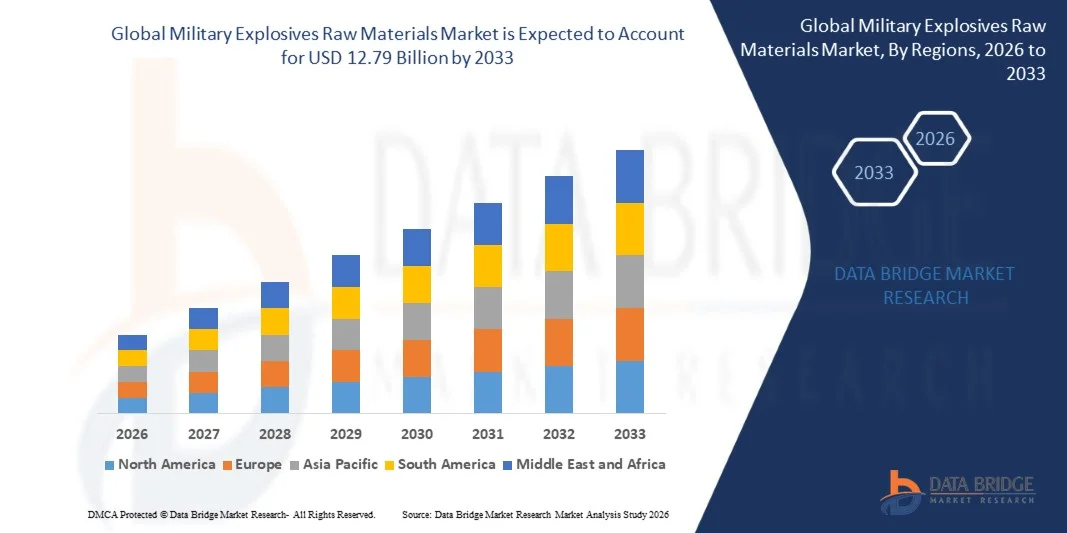
- As per Data Bridge Market Research analysis, the military explosives raw materials market was valued at USD 8.40 billion in 2025 and is projected to reach USD 12.79 billion by 2033, growing at a CAGR of 5.40% from 2026 to 2033.
- The market is experiencing consistent growth driven by increasing demand for next-generation military ammunition, development of advanced weapon systems, and rising focus on improving explosive performance, safety, and reliability. Growing investments in missile systems, artillery ammunition, and precision-guided munitions are increasing the requirement for specialized raw materials.
- The increasing geopolitical tensions globally, combined with rising military modernization initiatives and expanding defense manufacturing capabilities, are compelling governments and defense contractors to strengthen their supply chains for critical explosive raw materials. The growing adoption of advanced energetic materials and insensitive munitions technologies is supporting the development of safer, more stable, and high-performance explosive systems for military applications
Market Size & Forecast
- Global Market Value (2025): USD 8.40 Billion
- Expected Market Value (2033): USD 12.79 Billion
- Forecast CAGR (2026–2033): 5.40%
- Leading Region in 2025: North America
- Fastest Growing Region: Asia Pacific
What are the Major Takeaways of the Military Explosives Raw Materials Market?
- North America dominated the military explosives raw materials market with the largest revenue share of 35.4% in 2025, supported by high defense expenditure, advanced ammunition manufacturing infrastructure, and continuous investments in missile, artillery, and precision-guided weapon programs.
- Asia-Pacific is expected to be the fastest-growing region at a CAGR of 5.9% from 2026 to 2033, fueled by increasing military budgets, expansion of indigenous defense production capabilities, and rising demand for advanced ammunition systems in China, India, Japan, and South Korea.
- The nitramine energetic compounds segment led the market with a 35% share in 2025, driven by extensive utilization of RDX and HMX across military explosive and ammunition systems.
- Primary initiating compounds are the fastest-growing raw material type, projected to register a CAGR of 6.5%, reflecting the surge in demand for advanced detonators, electronic fuzes, and modern weapon initiation systems.
- The secondary detonation segment dominated the function category with a 38% revenue share in 2025, led by extensive demand for energetic materials used in warheads, artillery ammunition, bombs, and demolition systems.
- Crystals accounted for 32% of the market share in 2025, preferred by extensive use of crystalline energetic materials in high-performance military explosive formulations.
- The recovered or reprocessed grade segment is the fastest-growing material grade category, with a CAGR of 6.0%, driven by increasing focus on material recovery, resource efficiency, and ammunition lifecycle management.
Report Scope and Military Explosives Raw Materials Market Segmentation
|
Attributes |
Military Explosives Raw Materials Key Market Insights |
|
Segments Covered |
|
|
Countries Covered |
North America
Europe
Asia-Pacific
Middle East and Africa
South America
|
|
Key Market Players |
|
|
Market Opportunities |
|
|
Value Added Data Infosets |
In addition to the market insights such as market value, growth rate, market segments, geographical coverage, market players, and market scenario, the market report curated by the Data Bridge Market Research team includes in-depth expert analysis, import/export analysis, pricing analysis, production consumption analysis, and pestle analysis. |
What is the Key Trend in the Military Explosives Raw Materials Market?
- Defense manufacturers are increasingly strengthening domestic energetic-material supply chains to improve ammunition resilience, reduce import dependence, and support sustained production of modern military systems across major defense markets and regions internationally.
- For instance, in November 2025, the U.K. Ministry of Defence invited industry proposals for at least six new energetics and munitions factories, targeting sovereign production of critical energetic materials including explosives, propellants, and related materials for defense readiness globally today.
- Advanced energetic materials are increasingly being developed to improve performance, stability, safety, and reliability across military ammunition.
- Defense programs are increasingly prioritizing resilient supply chains for explosives, propellants, precursors, and other critical materials required for sustained ammunition production.
- For instance, in March 2024, the European Commission allocated EUR 500 million under ASAP to strengthen ammunition production, with projects covering explosives and powder manufacturing, including more than 4,300 tonnes of additional explosives capacity.
- As governments and defense manufacturers continue prioritizing ammunition readiness and supply-chain resilience, demand for specialized military explosives raw materials is expected to strengthen, supporting investment in domestic energetic-material production capabilities across major defense-producing regions and markets today.
What are the Key Drivers of the Military Explosives Raw Materials Market?
- The rising defense expenditure and ammunition replenishment programs are significantly increasing demand for explosives raw materials required to manufacture artillery ammunition, missiles, propellants, and other military systems globally across expanding defense programs and inventories.
- For instance, in March 2024, the European Commission selected 31 projects receiving EUR 513 million to increase European ammunition production capacity, including more than 4,300 tonnes of explosives capacity for defense supply chains. European Commission press release
- Defense ministries and manufacturers are expanding domestic production of critical chemicals and energetic precursors to reduce foreign supply dependencies, strengthen industrial resilience, and support long-term readiness.
- For instance, in February 2024, the U.S. Department of Defense awarded USD 192.5 million for domestic production covering 22 critical defense chemicals, including precursors and oxidizers used in energetic formulations across applications. U.S. Department of Defense release
- With governments increasingly strengthening defense industrial bases and ammunition supply chains, military explosives raw materials will remain essential for expanding production capacity and supporting modern weapon-system requirements across defense manufacturing.
What Factors are Challenging the Growth of the Military Explosives Raw Materials Market?
- Military explosives raw-material production requires substantial capital investment due to specialized processing equipment, stringent safety systems, environmental controls, and highly regulated manufacturing infrastructure.
- For instance, in November 2025, the U.K. Ministry of Defence stated that companies proposing new energetics facilities must account for the level of investment required, economic viability, regulatory requirements, skills, technology, and suitable sites, while government funding would not be expected to cover the majority of facility costs.
- These requirements can limit participation among smaller suppliers, particularly where hazardous-material regulations substantially increase production costs.
- For instance, in July 2026, the U.K. Ministry of Defence awarded 22 companies feasibility-study contracts of up to USD 0.40 million each for proposed energetics manufacturing sites, with subsequent Front End Engineering Design contracts potentially worth up to USD 6.63 million each, illustrating the substantial financial and planning requirements before new facilities can be constructed.
- High capital requirements and stringent regulatory obligations continue to constrain expansion, particularly for new entrants and smaller manufacturers, while lengthy qualification processes can delay commercialization, increase project costs, and limit broader supply-chain diversification despite growing defense demand and capacity expansion requirements globally.
How is the Military Explosives Raw Materials Market Segmented?
The military explosives raw materials market is segmented on the basis of raw material type, function, physical form, material grade, processing step, and application.
- By Raw Material Type
On the basis of raw material type, the military explosives raw materials market is segmented into nitroaromatic energetic compounds, nitramine energetic compounds, energetic cellulose materials, primary initiating compounds, inorganic oxidizers, metallic & metalloid fuels, non-metallic fuels & combustible ingredients, sensitizers, energetic plasticizers, and non-energetic plasticizers. The nitramine energetic compounds segment dominated the market with a 2025 share of 35%, owing to extensive utilization of RDX and HMX across military explosive and ammunition systems. These materials are widely incorporated into high-performance energetic formulations. Their established use across defense manufacturing provides a broad demand base. Established production capabilities and qualification requirements also support continued utilization. Increasing ammunition manufacturing and military modernization programs are strengthening demand for established energetic compounds.
The primary initiating compounds segment is projected to register the fastest growth at a CAGR of 6.5% from 2026 to 2033, driven by rising demand for advanced detonators, electronic fuzes, and modern weapon initiation systems. These materials support controlled and reliable initiation in military applications. Increasing adoption of precision-guided weapons is supporting demand for specialized initiation technologies. Defense organizations are also emphasizing improved reliability and safety across weapon systems. Growth in missile and aerospace defense programs is further supporting the requirement for advanced initiating materials. Continuous development of initiation technologies is creating additional demand for specialized raw materials.
- By Function
On the basis of function, the military explosives raw materials market is segmented into primary initiation, secondary detonation, propellant energy generation, oxidation, fuel contribution, binding, plasticization, stabilization, and other raw-material functions. The secondary detonation segment dominated the market with a 2025 share of 38%, supported by extensive demand for energetic materials used in warheads, artillery ammunition, bombs, and demolition systems. Secondary energetic materials represent an important component of numerous military explosive applications. Their established utilization provides a broad and recurring demand base. Defense ammunition production and replenishment programs continue to support consumption. Military modernization is also sustaining requirements for reliable energetic materials.
The propellant energy generation segment is projected to register the fastest growth at a CAGR of 6.7% from 2026 to 2033, driven by increasing investment in missile propulsion, rocket systems, and long-range strike capabilities. Propulsion-related energetic materials are essential to the performance of missile and rocket systems. Growing development of advanced missile platforms is increasing requirements for specialized energetic inputs. Defense modernization programs are supporting investments in propulsion technologies and manufacturing capacity. The expansion of long-range and precision-guided systems is further strengthening demand. Research into advanced propulsion technologies is also supporting development of higher-performance material systems.
- By Physical Form
On the basis of physical form, the military explosives raw materials market is segmented into crystals, powders, granules, flakes, spherical particles, gels, and other supplied physical forms. The crystals segment dominated the market with a 2025 share of 32%, owing to extensive use of crystalline energetic materials in high-performance military explosive formulations. Crystalline materials provide consistent physical characteristics required for established energetic applications. Their use is supported by established manufacturing and processing infrastructure. Defense manufacturers have extensive experience handling crystalline energetic materials across different formulations. Their availability across several raw-material categories supports procurement flexibility. Continued ammunition production provides a stable demand base for crystalline materials.
The spherical particles segment is projected to register the fastest growth at a CAGR of 6.2% from 2026 to 2033, driven by increasing adoption of advanced processing technologies and engineered material characteristics. Spherical particles can provide favorable flow and packing characteristics during material processing. Increasing emphasis on controlled particle morphology is supporting their use in advanced formulations. Improvements in manufacturing technologies are enabling greater consistency in particle production. Research into advanced energetic materials is further encouraging development of specialized particle structures. Defense manufacturers are increasingly focused on improving production consistency and material performance.
- By Material Grade
On the basis of material grade, the military explosives raw materials market is segmented into standard defense grade, high-purity grade, initiation grade, high-explosive grade, recovered or reprocessed grade, and other material grades. The high-explosive grade segment dominated the market with a 2025 share of 31%, owing to extensive utilization in missiles, artillery systems, aerial bombs, and other high-energy military applications. These materials are designed to satisfy demanding performance requirements across military systems. Their broad application across ammunition and weapon platforms provides a substantial consumption base. Established defense manufacturing infrastructure supports continued procurement. Increasing military readiness initiatives are sustaining demand for high-performance energetic materials. Modernization programs are also supporting continued utilization across advanced weapon systems.
The recovered or reprocessed grade segment is projected to register the fastest growth at a CAGR of 6.0% from 2026 to 2033, supported by increasing focus on material recovery, resource efficiency, and ammunition lifecycle management. Recovery and reprocessing can help manufacturers improve utilization of available energetic materials. Growing emphasis on sustainable manufacturing practices is encouraging greater attention to material recovery. Defense organizations are also examining methods to improve resource efficiency across ammunition lifecycle activities. Technological improvements are supporting more controlled recovery and reprocessing operations. Environmental and waste-management considerations are further supporting interest in these processes.
- By Processing Step
On the basis of processing step, the military explosives raw materials market is segmented into crystallization or recrystallization, precipitation, micronization or size reduction, granulation, spray drying, pressing or compaction, recovery or reprocessing, and other final commercial processing steps. The crystallization or recrystallization segment dominated the market with a 2025 share of 29%, owing to its importance in producing energetic materials with controlled physical characteristics. The process is widely used for material purification and controlled crystal formation. Consistent material characteristics are important for downstream energetic-material manufacturing. Established production facilities already incorporate crystallization-related capabilities into their manufacturing processes. Demand is supported by continued production of conventional and advanced energetic materials. Strict quality requirements further reinforce the importance of controlled processing.
The micronization or size reduction segment is projected to register the fastest growth at a CAGR of 6.4% from 2026 to 2033, driven by increasing demand for precision-engineered energetic materials. Controlled particle size is increasingly relevant to advanced material-processing applications. Improvements in size-reduction technologies are enabling manufacturers to achieve tighter particle specifications. Such processing can support consistency in downstream formulation and manufacturing operations. Growing development of advanced propulsion and energetic systems is supporting demand for specialized processed materials. Research and development programs are also encouraging greater control over material characteristics.
- By Application
On the basis of application, the military explosives raw materials market is segmented into ammunition energetics, artillery, tank & mortar propelling charges, missile propulsion, air-defense interceptor energetics, missile-defense interceptor energetics, mine & demolition energetics, initiation & fuzing energetics, and other applications. The ammunition energetics segment dominated the market with a 2025 share of 34%, driven by continuous requirements for ammunition production, replenishment, and modernization. Ammunition systems require energetic raw materials across multiple production stages and applications. The large installed base of military ammunition systems provides a substantial recurring demand base. Defense organizations continue to strengthen ammunition inventories and manufacturing capabilities. Modernization programs are also supporting procurement of advanced energetic materials. Established manufacturing infrastructure further supports the segment.
The missile propulsion segment is projected to register the fastest growth at a CAGR of 7.0% from 2026 to 2033, supported by increasing investment in advanced missile systems, long-range strike capabilities, and propulsion technologies. Missile propulsion requires specialized energetic materials with tightly controlled performance characteristics. Increasing development of sophisticated missile platforms is supporting demand throughout the propulsion supply chain. Defense modernization programs are strengthening investment in missile manufacturing capabilities. Growing emphasis on precision and extended-range systems is further supporting the application. Continued research into advanced propulsion technologies is creating additional requirements for specialized raw materials.
Which Region Holds the Largest Share of the Military Explosives Raw Materials Market?
- North America dominated the military explosives raw materials market with the largest revenue share of 35.4% in 2025, supported by high defense expenditure, advanced ammunition manufacturing infrastructure, and continuous investments in missile, artillery, and precision-guided weapon programs.
- The region also benefits from ongoing military modernization, strong domestic defense manufacturing capabilities, and established supply chains for energetic materials and ammunition production. Increasing investments in advanced missile systems, artillery platforms, and next-generation defense technologies continue to support demand for military explosives raw materials across North America.
U.S. Military Explosives Raw Materials Market Insight
The U.S. military explosives raw materials market is witnessing strong growth due to rising investments in defense modernization, ammunition production, and advanced missile and propulsion systems. The country’s mature defense manufacturing ecosystem, along with increasing adoption of advanced energetic materials and expansion of domestic production capabilities, is driving demand across ammunition, artillery, missile, and air-defense applications. In addition, growing emphasis on strengthening defense supply chains and increasing production capacity is accelerating demand for military explosives raw materials across the country.
Asia-Pacific Military Explosives Raw Materials Market Insight
The Asia-Pacific military explosives raw materials market is expected to witness rapid growth, driven by increasing defense spending, military modernization, and rising investments in domestic ammunition and missile manufacturing across countries such as China, India, and Japan. Growing focus on strengthening defense capabilities, rising adoption of advanced weapon systems, and increasing demand for indigenous production are supporting regional market expansion. In addition, the growing development of missile, artillery, and air-defense systems is accelerating demand for specialized energetic raw materials across the region.
Japan Military Explosives Raw Materials Market Insight
The Japan military explosives raw materials market is witnessing consistent growth due to rising investments in defense modernization, advanced missile capabilities, and ammunition production. Defense manufacturers and government-supported programs are increasingly focusing on advanced missiles, air-defense systems, and other military platforms, supporting demand for specialized energetic raw materials. Moreover, increasing emphasis on domestic defense production, supply-chain resilience, and advanced military technologies is further contributing to market growth.
China Military Explosives Raw Materials Market Insight
The China military explosives raw materials market is growing rapidly, driven by increasing defense modernization, expanding domestic ammunition production, and rising investments in missile and propulsion technologies. Growing development of advanced military platforms and increasing focus on indigenous defense manufacturing are significantly boosting demand for specialized energetic raw materials. In addition, rising investments in missile, artillery, air-defense, and precision-guided weapon systems are supporting China's expanding military explosives raw materials market.
U.K. Military Explosives Raw Materials Market Insight
The U.K. military explosives raw materials market is experiencing steady growth, supported by rising defense modernization, ammunition manufacturing, and investments in advanced missile and propulsion systems. Increasing demand for artillery, missile, and air-defense capabilities is contributing to greater requirements for specialized energetic raw materials. Furthermore, growing investments in domestic defense manufacturing capacity and increasing focus on resilient military supply chains are supporting market growth across the U.K.
Germany Military Explosives Raw Materials Market Insight
The Germany military explosives raw materials market is expanding steadily due to the country’s growing defense modernization programs, ammunition production, and increasing adoption of advanced military systems. Defense manufacturers are strengthening capabilities across artillery, missile, and ammunition platforms, supporting demand for specialized energetic raw materials. Continuous investments in defense manufacturing infrastructure, domestic production capabilities, and supply-chain resilience, along with increasing focus on advanced military technologies, are further driving market growth in Germany.
Which are the Top Companies in Military Explosives Raw Materials Market?
The military explosives raw materials industry is primarily led by well-established companies, including:
- BAE Systems plc (U.K.)
- Chemring Group PLC (U.K.)
- EURENCO (France)
- Rheinmetall AG (Germany)
- Nitrochemie Wimmis AG (Switzerland)
- Nammo AS (Norway)
- General Dynamics Corporation (U.S.)
- Northrop Grumman Corporation (U.S.)
- Lockheed Martin Corporation (U.S.)
- L3Harris Technologies, Inc. (U.S.)
- Hanwha Corporation (South Korea)
- Orica Limited (Australia)
- Dyno Nobel (Australia)
- Austin Powder Company (U.S.)
- EPC Groupe (France)
- MAXAM (Spain)
- FORCIT Group (Finland)
- Enaex S.A. (Chile)
- AEL Mining Services Limited (South Africa)
- NobelSport (France)
What are Latest Developments in Military Explosives Raw Materials Market?
- In April 2025, BAE Systems announced major breakthroughs in the production of energetics and propellants, introducing continuous-flow manufacturing approaches designed to produce next-generation explosives while reducing dependence on nitrocellulose and nitroglycerine. The company stated that these technologies are intended to strengthen supply-chain resilience and support increased munitions production, with applications spanning small-arms and large-calibre ammunition.
- In December 2024, the U.K. Ministry of Defence launched Task Force KINDRED to address constraints across the energetics supply chain, including raw ingredients such as ammonium and nitric acid. The initiative brought together industry participants from raw-material suppliers through final energetic-product manufacturers to identify supply-chain challenges and potential measures for securing and expanding energetic-material availability
- In July 2023, BAE Systems announced a partnership with Parsons Corporation to modernize the Holston Army Ammunition Plant in Tennessee, supporting the expansion of explosives and propellant manufacturing capabilities. The modernization program was intended to transform aging ammunition-production infrastructure into advanced chemical-processing facilities while improving safety, reliability, and the ability to introduce newer manufacturing technologies.
- In November 2022, Naval Surface Warfare Center Indian Head Division signed an agreement with Global Military Products for the production of triaminotrinitrobenzene (TATB), establishing a prototype-scale capability for insensitive high-explosive compositions. The project included facility upgrades and development of a pilot-scale production capability, supporting the supply of advanced energetic materials for strategic systems and strengthening domestic energetic-material manufacturing capabilities.
- In March 2021, the U.S. Navy and National Armaments Consortium established a partnership to accelerate technology development across the energetics sector, covering explosives, propellants, warheads, propulsion systems, and related technologies. The initiative was designed to support prototyping, engineering development, and low-rate production while addressing supply-chain challenges associated with critical energetic-material precursors and strengthening the U.S. energetics industrial base.

- Interactive Data Analysis Dashboard
- Company Analysis Dashboard for high growth potential opportunities
- Research Analyst Access for customization & queries
- Competitor Analysis with Interactive dashboard
- Latest News, Updates & Trend analysis
- Harness the Power of Benchmark Analysis for Comprehensive Competitor Tracking
Data collection and base year analysis are done using data collection modules with large sample sizes. The stage includes obtaining market information or related data through various sources and strategies. It includes examining and planning all the data acquired from the past in advance. It likewise envelops the examination of information inconsistencies seen across different information sources. The market data is analysed and estimated using market statistical and coherent models. Also, market share analysis and key trend analysis are the major success factors in the market report. To know more, please request an analyst call or drop down your inquiry.
The key research methodology used by DBMR research team is data triangulation which involves data mining, analysis of the impact of data variables on the market and primary (industry expert) validation. Data models include Vendor Positioning Grid, Market Time Line Analysis, Market Overview and Guide, Company Positioning Grid, Patent Analysis, Pricing Analysis, Company Market Share Analysis, Standards of Measurement, Global versus Regional and Vendor Share Analysis. To know more about the research methodology, drop in an inquiry to speak to our industry experts.
Data Bridge Market Research is a leader in advanced formative research. We take pride in servicing our existing and new customers with data and analysis that match and suits their goal. The report can be customized to include price trend analysis of target brands understanding the market for additional countries (ask for the list of countries), clinical trial results data, literature review, refurbished market and product base analysis. Market analysis of target competitors can be analyzed from technology-based analysis to market portfolio strategies. We can add as many competitors that you require data about in the format and data style you are looking for. Our team of analysts can also provide you data in crude raw excel files pivot tables (Fact book) or can assist you in creating presentations from the data sets available in the report.












