


What is the Mining Truck Market Size and Growth Rate?
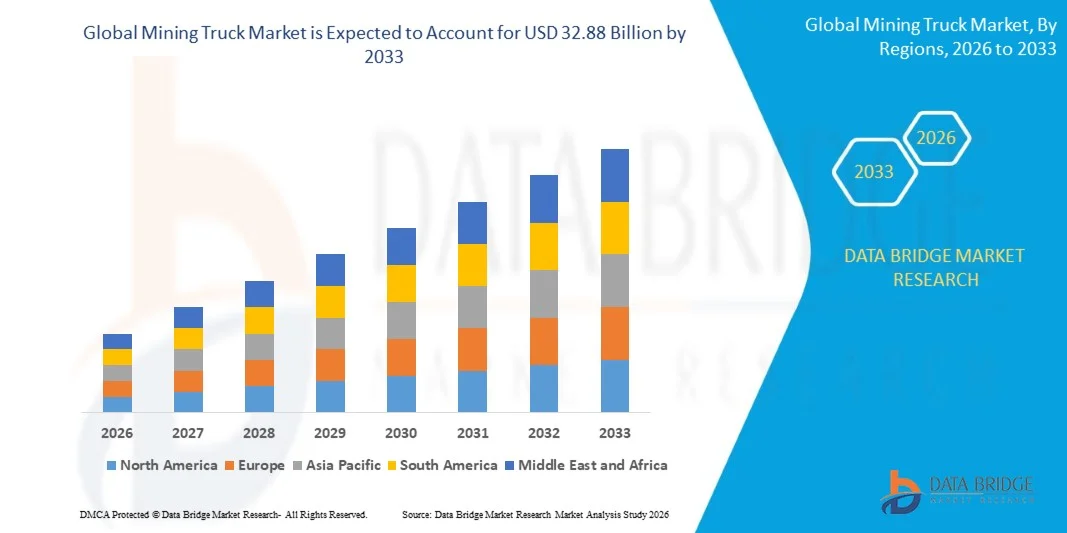
- As per Data Bridge Market Research analysis, the mining truck was valued at USD 21.10 billion in 2025 and is projected to reach USD 32.88 billion by 2033, growing at a CAGR of 5.70% from 2026 to 2033.
- The market is experiencing consistent growth driven by rising demand for high-capacity mining equipment, expansion of surface and underground mining activities, increasing mineral and metal production, and growing investments in advanced and automated mining trucks.
- The increasing focus on mining productivity, operational efficiency, and emissions reduction, combined with the growing adoption of Electric Vehicle, Hybrid Vehicles , and autonomous technologies, is encouraging mining companies and equipment manufacturers to develop and deploy next-generation mining trucks. These trucks offer higher payload capacity, improved fuel efficiency, enhanced operator safety, and greater automation, supporting their adoption across large-scale mining operations.
Market Size & Forecast
- Global Market Value (2025): USD 21.10 Billion
- Expected Market Value (2033): USD 32.88 Billion
- Forecast CAGR (2026–2033): 5.70%
- Leading Region in 2025: North America
- Fastest Growing Region: Asia Pacific
What are the Major Takeaways of the Mining Truck Market?
- North America dominated the global mining truck market with the largest revenue share of 32.0% in 2025, supported by established mining operations, fleet modernization, increasing demand for high-capacity haulage equipment, and investments in autonomous and advanced mining technologies.
- Asia-Pacific is expected to be the fastest-growing region at a CAGR of 7.4% from 2026 to 2033, fueled by expanding mining activities, rising demand for coal and metals, increasing fleet replacement, and growing adoption of automated and electric mining equipment across China, Australia, India, and Indonesia.
- The dump trucks segment led the market with a 50.7% share in 2025, driven by their extensive use for transporting large volumes of ore, overburden, and minerals across large-scale surface mining operations.
- The haul trucks segment is the fastest-growing truck type category, projected to register a CAGR of 8.1%, reflecting increasing demand for high-capacity material transportation, expansion of open-pit mining operations, and integration of automation and fleet-management technologies.
- The diesel-powered segment dominated the power-source category with an 86.0% revenue share in 2025, supported by high power output, established fuel infrastructure, long operating range, and reliability across demanding heavy-duty mining operations.
- The 200–400 tons payload capacity segment accounted for 38.2% of the market share in 2025, driven by the increasing preference for high-payload mining trucks capable of transporting larger quantities of ore and waste in fewer hauling cycles.
- The surface mining segment is the fastest-growing application category, with a CAGR of 6.3%, driven by expanding open-pit mining projects, increasing mineral production, and rising demand for high-capacity haulage equipment.
Report Scope and Mining Truck Market Segmentation
|
Attributes |
Mining Truck Market Key Market Insights |
|
Segments Covered |
|
|
Countries Covered |
North America
Europe
Asia-Pacific
Middle East and Africa
South America
|
|
Key Market Players |
|
|
Market Opportunities |
|
|
Value Added Data Infosets |
In addition to the market insights such as market value, growth rate, market segments, geographical coverage, market players, and market scenario, the market report curated by the Data Bridge Market Research team includes in-depth expert analysis, import/export analysis, pricing analysis, production consumption analysis, and pestle analysis. |
What is the Key Trend in the Mining Truck Market?
- Mining equipment manufacturers are increasingly developing advanced mining trucks equipped with autonomous driving, fleet-management, and remote-operation technologies to improve productivity, safety, and operational efficiency across large-scale mining sites.
- For instance, in January 2024, Caterpillar expanded the deployment of its autonomous haulage technology across mining operations, supporting the industry's transition toward automated truck fleets capable of operating with reduced operator intervention.
- The integration of real-time fleet monitoring, collision-avoidance systems, payload management, and autonomous navigation is enabling mining companies to optimize truck utilization, reduce idle time, and improve overall hauling efficiency.
- Mining companies are also increasingly adopting electric and hybrid mining trucks as manufacturers focus on reducing fuel consumption, operating costs, and greenhouse gas emissions associated with conventional diesel-powered equipment.
- For instance, in 2024, Komatsu continued advancing its battery-electric haul truck development and testing programs, supporting the industry's transition toward lower-emission mining equipment and electrified haulage operations.
- As mining operations increasingly prioritize automation, electrification, safety, and productivity, the development of autonomous, connected, and electric mining trucks is expected to accelerate, supporting the modernization of mining fleets worldwide.
What are the Key Drivers of the Mining Truck Market?
- The expansion of coal, metal, and mineral mining activities is increasing demand for high-capacity mining trucks capable of transporting large volumes of ore, overburden, and other materials across open-pit and underground mining operations.
- For instance, in September 2024, Caterpillar showcased its 372-tonne Cat 798 AC mining truck configured for autonomous haulage, alongside technologies designed to support electrification and energy management across mining operations.
- Mining companies are increasingly investing in fleet modernization and alternative propulsion technologies to improve operational efficiency, reduce fuel consumption, and support long-term emissions-reduction objectives.
- For instance, in January 2024, General Motors and Komatsu announced a collaboration to develop a hydrogen fuel-cell power module for the Komatsu 930E electric-drive mining truck, which has a nominal payload of 320 tons.
- The growing adoption of autonomous haulage, electrification, and digital fleet-management technologies is encouraging mining operators to replace or upgrade conventional trucks with advanced equipment capable of improving productivity, safety, energy efficiency, and overall fleet utilization.
Which Factors are Challenging the Growth of the Mining Truck Market?
- Mining trucks involve high acquisition and operating costs, while large-scale haulage equipment requires substantial investment in maintenance infrastructure, replacement parts, specialized technicians, and supporting mine-site facilities.
- For instance, in April 2025, Caterpillar introduced its next-generation Cat 775 off-highway truck with a 65-tonne payload and a design engineered to enable fully autonomous capabilities in the future, highlighting the increasing technological complexity incorporated into modern haulage equipment.
- Electric and alternative-power mining trucks also require additional charging, energy-storage, refueling, or power-distribution infrastructure, which can increase the investment required for mine-site modernization.
- For instance, in September 2024, Komatsu introduced its battery-electric WX04B underground LHD together with a 150 kW battery charger, demonstrating the need for dedicated charging infrastructure alongside the deployment of electric mining equipment.
- Harsh mining environments characterized by dust, vibration, extreme temperatures, heavy loads, and uneven terrain can increase component wear and maintenance requirements, while the transition toward autonomous and electrified fleets requires additional technical expertise and workforce training.
- These infrastructure, investment, maintenance, and technological requirements can create barriers to rapid fleet modernization, particularly for mining operators with limited capital availability, although continued advances in automation, electrification, and power-flexible truck technologies are supporting the gradual transition toward next-generation mining fleets.
How is the Mining Truck Market Segmented?
The mining truck market is segmented on the basis of type, propulsion type, payload capacity, power output, application, and end use.
- By Type
On the basis of type, the mining truck market is segmented into rigid dump trucks and articulated dump trucks. The rigid dump trucks segment dominated the market with an estimated 58.4% share in 2025, owing to their high payload capacity, durability, and suitability for large-scale open-pit mining operations. Rigid dump trucks are extensively deployed for transporting ore, overburden, and waste materials over established haul roads. Their robust construction and high power output support continuous operation under demanding mining conditions. Large-scale mining companies increasingly rely on rigid trucks to improve hauling productivity and reduce the number of transportation cycles. The growing deployment of automation and fleet-management technologies is further enhancing the operational efficiency of rigid dump trucks.
The articulated dump trucks segment is projected to register the fastest growth at an estimated CAGR of 6.4% from 2026 to 2033, driven by increasing demand for flexible haulage equipment capable of operating across uneven and challenging terrain. Articulated dump trucks provide improved maneuverability and traction compared with rigid configurations, supporting their use across variable mining conditions. Their articulated chassis enables improved movement on rough and inclined haul roads. Mining operators are increasingly evaluating these trucks for applications requiring greater flexibility and mobility. Advancements in telematics, operator-assistance systems, and fuel-efficient powertrains are also improving their operating performance.
- By Propulsion Type
On the basis of propulsion type, the mining truck market is segmented into diesel, hybrid, and electric. The diesel segment dominated the market with an estimated 86.0% share in 2025, supported by its high power output, established refueling infrastructure, long operating range, and proven reliability in heavy-duty mining operations. Diesel-powered trucks remain widely deployed across large mining sites because they can continuously transport high payloads under demanding operating conditions. Existing maintenance and fuel infrastructure further supports their widespread use. The continued requirement for reliable high-capacity haulage equipment, particularly across remote mining locations, is supporting the dominance of diesel propulsion.
The electric segment is projected to register the fastest growth at an estimated CAGR of 11.2% from 2026 to 2033, driven by increasing efforts to reduce fuel consumption, operating costs, and emissions from mining operations. Battery-electric and other electrically driven mining trucks are gaining attention as mining companies pursue decarbonization and energy-efficiency targets. Improvements in battery capacity, charging systems, regenerative braking, and electric-drive technologies are increasing the feasibility of electrified haulage. Manufacturers are also introducing high-capacity electric trucks designed for demanding mining environments. Growing investment in low-emission mining fleets is expected to accelerate adoption of electric propulsion.
- By Payload Capacity
On the basis of payload capacity, the mining truck market is segmented into less than 100 tons, 100–200 tons, and more than 200 tons. The more than 200 tons segment dominated the market with an estimated 38.2% share in 2025, supported by strong demand for high-capacity haulage equipment across large-scale mining operations. Mining companies use high-payload trucks to transport greater quantities of ore, overburden, and waste materials in fewer hauling cycles. These trucks are particularly suited to large open-pit operations where high-volume material movement is required. The focus on improving mining productivity and reducing hauling costs is encouraging operators to deploy higher-capacity trucks.
The 100–200 tons segment is projected to register the fastest growth at an estimated CAGR of 6.2% from 2026 to 2033, driven by its balance of payload capacity, operating flexibility, and suitability across different mining conditions. Trucks within this capacity range can support medium- and large-scale mining operations while providing greater deployment flexibility than ultra-high-capacity equipment. Increasing mine development and fleet replacement programs are supporting demand for trucks in this payload class. Manufacturers are also improving fuel efficiency, drivetrain performance, and automated operating capabilities in this category. These developments are expected to support wider adoption of 100–200-ton mining trucks.
- By Power Output
On the basis of power output, the mining truck market is segmented into up to 500 HP, 500–1,000 HP, and above 1,000 HP. The above 1,000 HP segment dominated the market with an estimated 49.6% share in 2025, supported by the increasing deployment of high-capacity mining trucks requiring substantial power to transport heavy payloads across demanding haul roads. High-power trucks provide the torque and performance required for carrying large loads over long distances and challenging gradients. They are particularly important in large-scale surface mining operations where productivity and cycle-time efficiency are major considerations. Manufacturers are increasingly improving engine efficiency, electric-drive systems, and power-management technologies to optimize the performance of high-power mining trucks.
The 500–1,000 HP segment is projected to register the fastest growth at an estimated CAGR of 6.1% from 2026 to 2033, supported by demand for mining trucks that provide a balance between power, payload capacity, and operating efficiency. These trucks can serve a broad range of mining applications without requiring the infrastructure associated with the largest mining equipment. Improvements in engine technologies, electronic controls, and drivetrain efficiency are enhancing performance in this power category. Fleet modernization programs are also creating demand for efficient mid- to high-power trucks. Increasing mining activity across developing and established mining regions is expected to support segment growth.
- By Application
On the basis of application, the mining truck market is segmented into coal mining, metal mining, mineral mining, and others. The metal mining segment dominated the market with an estimated 42.6% share in 2025, supported by increasing extraction of iron ore, copper, gold, nickel, and other metals required for industrial production, infrastructure development, and energy-transition technologies. Metal mining operations frequently require high-capacity material transportation across large mining sites. The expansion of copper, lithium, nickel, and other mineral extraction projects is increasing demand for efficient haulage equipment. Mining companies are also investing in fleet modernization to improve productivity and reduce operating costs.
The mineral mining segment is projected to register the fastest growth at an estimated CAGR of 6.6% from 2026 to 2033, driven by increasing demand for industrial and critical minerals used in construction, manufacturing, energy storage, and advanced technologies. Rising exploration and extraction activities are creating additional requirements for material-handling equipment. The increasing importance of minerals used in renewable energy systems and electric-vehicle supply chains is further supporting mining investment. Mining operators are adopting higher-capacity and technologically advanced trucks to improve material movement. These factors are expected to support demand for mining trucks across mineral mining operations.
- By End Use
On the basis of end use, the mining truck market is segmented into open-pit mining and underground mining. The open-pit mining segment dominated the market with an estimated 78.1% share in 2025, supported by the extensive use of high-capacity mining trucks for transporting ore, overburden, and waste across large surface mining operations. Open-pit mines typically require substantial material movement over established haul roads, creating strong demand for rigid and high-payload mining trucks. The expansion of large-scale metal, coal, and mineral mining projects is supporting continued equipment deployment. Automation and fleet-management technologies are also being increasingly integrated into open-pit truck operations to improve productivity and safety.
The underground mining segment is projected to register the fastest growth at an estimated CAGR of 5.9% from 2026 to 2033, driven by increasing underground extraction of metals and minerals as accessible surface deposits become more constrained. Underground operations require specialized haulage equipment capable of operating in confined spaces and challenging underground environments. Improvements in compact mining trucks, electric propulsion, and automated operation are increasing the suitability of advanced equipment for underground applications. The growing adoption of battery-electric underground equipment is also supporting fleet modernization. These developments are expected to create additional demand for mining trucks in underground mining operations.
Which Region Holds the Largest Share of the Mining Truck Market?
- North America dominated the global mining truck market with the largest revenue share of 32.0% in 2025, supported by established mining operations, fleet modernization, demand for high-capacity mining equipment, and increasing investments in autonomous and advanced mining technologies. The region's mature mining infrastructure and strong presence of major mining equipment manufacturers continue to support demand for rigid dump trucks, articulated dump trucks, and technologically advanced mining fleets.
- The region also benefits from increasing adoption of autonomous haulage systems, electric-drive mining trucks, fleet-management technologies, and equipment modernization programs. Growing emphasis on operational efficiency, mine-site safety, productivity, and emissions reduction is encouraging mining operators to upgrade existing fleets and deploy next-generation mining trucks across large-scale mining operations.
U.S. Mining Truck Market Insight
The U.S. mining truck market is witnessing strong growth due to rising investments in mining infrastructure, mineral extraction activities, and advanced haulage technologies. The country’s mature mining industry, along with increasing adoption of autonomous, electric, and connected mining trucks, is driving demand across coal, metals, minerals, and aggregates applications. In addition, growing emphasis on improving mine productivity, reducing operating costs, and enhancing worker safety is accelerating the deployment of technologically advanced mining trucks across large-scale mining operations.
Asia-Pacific Mining Truck Market Insight
The Asia-Pacific mining truck market is expected to witness rapid growth, driven by expanding mining activities, increasing mineral production, and rising investments in mining infrastructure across countries such as China, India, and Japan. Growing demand for coal, iron ore, copper, and other minerals, along with increasing adoption of automated and electric haulage solutions, is supporting regional market expansion. Additionally, the growing presence of large-scale mining projects and investments in mine modernization are accelerating the deployment of high-capacity mining trucks across surface mining operations.
Japan Mining Truck Market Insight
The Japan mining truck market is witnessing consistent growth due to rising investments in advanced mining technologies, automation, and efficient material-handling solutions. Mining companies and equipment operators are increasingly adopting automated, electric, and connected trucks to improve operational efficiency, reduce emissions, and enhance safety. Moreover, increasing integration of digital monitoring, autonomous driving, and battery-powered technologies, along with the country’s focus on sustainable industrial operations, is further contributing to market growth.
China Mining Truck Market Insight
The China mining truck market is growing rapidly, driven by expanding mining activities, increasing demand for minerals, and rising investments in large-scale mining infrastructure. Growing adoption of autonomous, electric, and intelligent mining truck technologies across coal, metal, and mineral mining operations is significantly boosting market demand. In addition, rising investments in mine automation, increasing focus on operational safety, and rapid advancements in connected and smart mining technologies are positioning China as one of the fastest-growing markets for mining trucks globally.
U.K. Mining Truck Market Insight
The U.K. mining truck market is experiencing steady growth, supported by rising adoption of advanced mining equipment, automation technologies, and sustainable material-handling solutions. Increasing investments in modern mining infrastructure and growing demand for efficient, low-emission haulage systems are contributing to market growth. Furthermore, integration of autonomous operation, telematics, and electric powertrain technologies is improving mining truck efficiency and operational safety, supporting the development of advanced mining equipment applications in the U.K.
Germany Mining Truck Market Insight
The Germany mining truck market is expanding steadily due to the country’s strong industrial equipment manufacturing base, advanced engineering capabilities, and increasing adoption of next-generation mining technologies. Mining operators and equipment manufacturers are increasingly utilizing automated, electric, and connected trucks for material transportation, operational optimization, and sustainable mining activities. Continuous advancements in battery-powered systems, autonomous operation, digital monitoring, and vehicle automation, along with strong emphasis on industrial efficiency and environmental sustainability, are further driving market growth in Germany.
Which are the Top Companies in Mining Truck Market?
The mining truck industry is primarily led by well-established companies, including:
- Elaphe LTD. (Slovenia)
- HYUNDAI MOBIS CO., LTD. (South Korea)
- Hitachi Astemo, Ltd. (Japan)
- NTN Corporation (Japan)
- NSK Ltd. (Japan)
- NIDEC CORPORATION (Japan)
- Schaeffler AG (Germany)
- ZF Friedrichshafen AG (Germany)
- Robert Bosch GmbH (Germany)
- DENSO CORPORATION (Japan)
- MITSUBISHI ELECTRIC CORPORATION (Japan)
- MAGNA INTERNATIONAL INC. (Canada)
- BorgWarner Inc. (U.S.)
- Indigo Technologies, Inc. (U.S.)
- DeepDrive GmbH (Germany)
- REE Automotive Ltd. (Israel)
- Donut Lab OÜ (Estonia)
- Equipmake Ltd. (U.K.)
- Dana Incorporated (U.S.)
- AVL List GmbH (Austria)
What are Latest Developments in Mining Truck Market?
- In September 2025, Komatsu announced a strategic technology collaboration with Applied Intuition to develop a unified software-defined vehicle and autonomy platform for its next-generation mining equipment. The collaboration is intended to integrate vehicle operating systems, autonomy technologies, and advanced software capabilities to improve productivity, reduce downtime, and enable greater operational precision across future mining equipment. The development highlights the increasing integration of autonomous operation, digitalization, and software-defined technologies in next-generation mining trucks.
- In September 2025, Komatsu Australia announced that the 500th automated haulage system (AHS) truck had commenced operation in Western Australia. The milestone reflected the continued expansion of autonomous mining truck deployment across major Australian mining operations, with autonomous haulage systems supporting improved safety, continuous operation, and productivity. The development further demonstrated the growing adoption of automated mining trucks in large-scale open-pit mining operations.
- In May 2025, Komatsu announced that it had successfully demonstrated autonomous operation of a battery-ready electric-drive mining truck while connected to a dynamic trolley line. The system combined Komatsu's FrontRunner Autonomous Haulage System with trolley-assist technology to transfer electric power to a moving autonomous truck, supporting lower emissions, improved energy efficiency, and faster uphill travel. The development represented an advancement in integrating autonomous haulage with electrification technologies for future mining truck fleets.
- In February 2025, Liebherr announced that it would present its autonomous, battery-electric T 264 mining truck at Bauma 2025, featuring both static and dynamic charging solutions. The truck incorporates a 3.2 MW battery developed by Fortescue Zero and combines battery-electric propulsion with autonomous operation. The development highlighted the industry's movement toward high-capacity electric mining trucks capable of supporting zero-emission operations and flexible charging requirements.
- In September 2024, Liebherr and Fortescue announced an expanded zero-emission equipment partnership involving approximately 360 autonomous battery-electric T 264 mining trucks, along with electric excavators and battery-powered dozers. The companies planned to develop and deploy an integrated autonomous battery-electric haulage solution for large-scale mining operations, strengthening the commercialization of high-capacity electric mining trucks and supporting the transition toward lower-emission mining fleets.
- In September 2024, Epiroc introduced the Minetruck MT66 S eDrive, its first large-capacity mine truck featuring the company's latest-generation electric drivetrain. The underground mining truck combines an upgraded diesel engine with an electric drivetrain and was designed to improve productivity, increase ramp speed, and reduce fuel consumption. Epiroc stated that the electric drivetrain could reduce fuel consumption by up to 7%, highlighting the growing adoption of hybrid-electric technologies in underground mining trucks.

- Interactive Data Analysis Dashboard
- Company Analysis Dashboard for high growth potential opportunities
- Research Analyst Access for customization & queries
- Competitor Analysis with Interactive dashboard
- Latest News, Updates & Trend analysis
- Harness the Power of Benchmark Analysis for Comprehensive Competitor Tracking
Data collection and base year analysis are done using data collection modules with large sample sizes. The stage includes obtaining market information or related data through various sources and strategies. It includes examining and planning all the data acquired from the past in advance. It likewise envelops the examination of information inconsistencies seen across different information sources. The market data is analysed and estimated using market statistical and coherent models. Also, market share analysis and key trend analysis are the major success factors in the market report. To know more, please request an analyst call or drop down your inquiry.
The key research methodology used by DBMR research team is data triangulation which involves data mining, analysis of the impact of data variables on the market and primary (industry expert) validation. Data models include Vendor Positioning Grid, Market Time Line Analysis, Market Overview and Guide, Company Positioning Grid, Patent Analysis, Pricing Analysis, Company Market Share Analysis, Standards of Measurement, Global versus Regional and Vendor Share Analysis. To know more about the research methodology, drop in an inquiry to speak to our industry experts.
Data Bridge Market Research is a leader in advanced formative research. We take pride in servicing our existing and new customers with data and analysis that match and suits their goal. The report can be customized to include price trend analysis of target brands understanding the market for additional countries (ask for the list of countries), clinical trial results data, literature review, refurbished market and product base analysis. Market analysis of target competitors can be analyzed from technology-based analysis to market portfolio strategies. We can add as many competitors that you require data about in the format and data style you are looking for. Our team of analysts can also provide you data in crude raw excel files pivot tables (Fact book) or can assist you in creating presentations from the data sets available in the report.













