


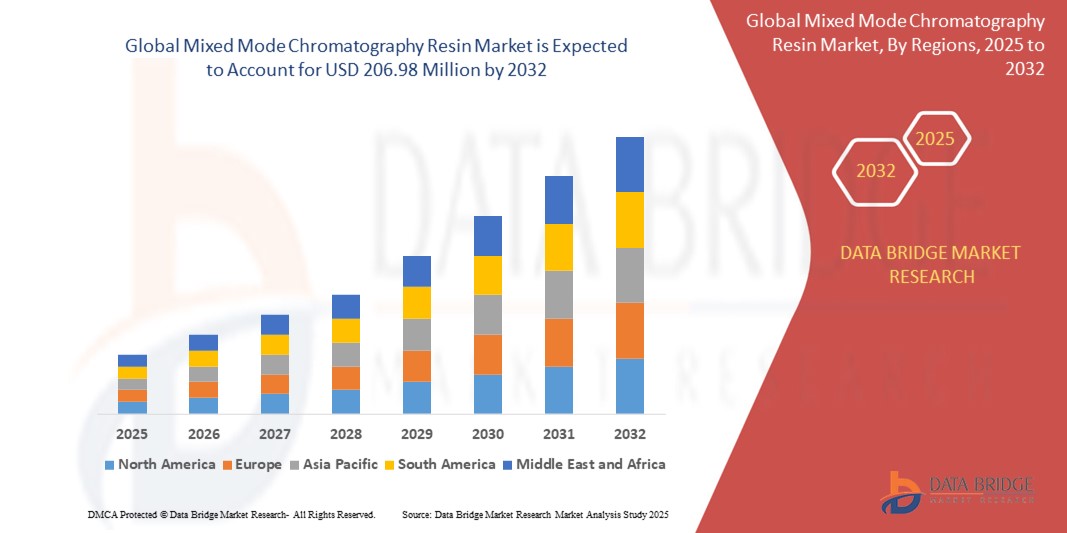
What is the Global Mixed Mode Chromatography Resin Market Size and Growth Rate?
- The global mixed mode chromatography resin market size was valued at USD 118.68 million in 2024 and is expected to reach USD 206.98 million by 2032, at a CAGR of 7.20% during the forecast period
- The mixed mode chromatography resin market is experiencing significant advancements, driven by the adoption of the latest methods and technologies. This growth is fueled by increased utilization across diverse industries such as biopharmaceuticals, food and beverages, and environmental analysis
- The versatility and efficiency of mixed mode chromatography resins are propelling market expansion, with a focus on enhancing purification processes and achieving higher yields
What are the Major Takeaways of Mixed Mode Chromatography Resin Market?
- The surging demand for biopharmaceuticals, including monoclonal antibodies, vaccines, and recombinant proteins, is propelling the mixed mode chromatography resin market. Biopharmaceutical companies are seeking efficient purification techniques to ensure high product purity and yield
- For instance, the increasing production of monoclonal antibodies for therapeutic purposes necessitates robust purification processes, where mixed mode chromatography resins excel in achieving the desired level of product purity and yield, thus driving their market growth
- North America dominated the mixed mode chromatography resin market with the largest revenue share of 32.65% in 2024, driven by the region’s strong pharmaceutical and biotechnology sectors and the increasing demand for efficient purification technologies in biologics manufacturing
- Asia-Pacific mixed mode chromatography resin market is poised to grow at the fastest CAGR of 9.4% during the forecast period of 2025 to 2032, driven by increasing biopharmaceutical production, expanding healthcare infrastructure, and rising investments in biotechnology across countries such as China, Japan, and India
- The Ion Exchange – Hydrophobic segment dominated the mixed mode chromatography resin market with the largest revenue share of 58.7% in 2024, driven by its versatility in capturing a wide range of biomolecules, including antibodies, proteins, and impurities, in a single purification step
Report Scope and Mixed Mode Chromatography Resin Market Segmentation
|
Attributes |
Mixed Mode Chromatography Resin Key Market Insights |
|
Segments Covered |
|
|
Countries Covered |
North America
Europe
Asia-Pacific
Middle East and Africa
South America
|
|
Key Market Players |
|
|
Market Opportunities |
|
|
Value Added Data Infosets |
In addition to the insights on market scenarios such as market value, growth rate, segmentation, geographical coverage, and major players, the market reports curated by the Data Bridge Market Research also include in-depth expert analysis, pricing analysis, brand share analysis, consumer survey, demography analysis, supply chain analysis, value chain analysis, raw material/consumables overview, vendor selection criteria, PESTLE Analysis, Porter Analysis, and regulatory framework. |
What is the Key Trend in the Mixed Mode Chromatography Resin Market?
“Growing Adoption of Mixed-Mode Resins for High Selectivity and Cost-Efficient Purification”
- A significant trend in the global mixed mode chromatography resin market is the rising demand for resins that combine multiple interaction mechanisms—such as ion exchange and hydrophobic interactions within a single chromatography step. This enables higher selectivity and simplifies purification processes, particularly in biopharmaceutical manufacturing
- Mixed Mode Chromatography Resins are increasingly favored in the purification of complex biologics like monoclonal antibodies (mAbs), vaccines, and plasma-derived products due to their ability to handle impurities that conventional resins struggle to remove
- For example, leading manufacturers are developing resins that offer enhanced binding capacity, salt tolerance, and operational flexibility, allowing for better process economics and more robust downstream workflows
- The growing pressure on pharmaceutical and biotechnology companies to improve production efficiency, reduce purification costs, and meet stringent regulatory standards is accelerating the integration of mixed mode chromatography resins in commercial bioprocessing operations
- This trend towards high-performance, multi-functional chromatography solutions is reshaping downstream processing, offering industries a viable path to address complex purification challenges with fewer process steps and lower resource consumption
What are the Key Drivers of Mixed Mode Chromatography Resin Market?
- The rising demand for biologics, including monoclonal antibodies, recombinant proteins, and vaccines, is a primary driver fueling the growth of the mixed mode chromatography resin market. As the pipeline for complex therapeutics expands, the need for advanced purification technologies that can efficiently separate target molecules from process impurities is increasing
- For instance, in March 2024, Bio-Rad Laboratories introduced a next-generation mixed mode chromatography resin designed to enhance process scalability and improve impurity clearance in antibody purification, driving adoption across pharmaceutical manufacturing facilities
- The advantages of mixed mode chromatography resins such as high binding capacities, reduced processing time, and the ability to handle challenging feedstocks are making them an attractive alternative to traditional single-mode resins
- Furthermore, the growing emphasis on cost-effective downstream processes, especially in emerging markets where price-sensitive drug production is critical, supports the demand for versatile chromatography solutions
- The increased focus on regulatory compliance, process robustness, and flexible purification strategies in the biopharmaceutical industry further accelerates the market growth for mixed mode chromatography resins globally
Which Factor is challenging the Growth of the Mixed Mode Chromatography Resin Market?
- The high cost of advanced mixed mode chromatography resins compared to conventional resins remains a significant challenge, particularly for small and mid-sized biopharmaceutical companies operating under tight budget constraints
- Additionally, the complexity of process optimization required for integrating mixed mode chromatography resins into existing downstream workflows can act as a barrier to adoption. Process development teams often need to invest additional time and resources to fine-tune operating conditions, which can delay large-scale implementation
- For example, companies new to the technology may face difficulties in achieving consistent performance due to variations in resin properties or the need for specialized technical expertise during scale-up
- Moreover, limited awareness in developing markets regarding the operational benefits of mixed mode chromatography resins can further restrain widespread market penetration
- Addressing these challenges through educational initiatives, cost-competitive product development, and enhanced technical support will be critical for manufacturers aiming to drive broader adoption and unlock the full potential of mixed mode chromatography resins in the global purification market
How is the Mixed Mode Chromatography Resin Market Segmented?
The market is segmented on the basis of technique, end-use, and application.
• By Technique
On the basis of technique, the mixed mode chromatography resin market is segmented into Ion Exchange – Hydrophobic and Hydroxyapatite. The Ion Exchange – Hydrophobic segment dominated the mixed mode chromatography resin market with the largest revenue share of 58.7% in 2024, driven by its versatility in capturing a wide range of biomolecules, including antibodies, proteins, and impurities, in a single purification step. The combination of ion exchange and hydrophobic interactions provides higher selectivity and improved purification performance, making it the preferred choice for complex bioprocessing applications.
The Hydroxyapatite segment is expected to witness the fastest growth rate of 22.4% from 2025 to 2032, fueled by its increasing use in polishing steps during biopharmaceutical production. Hydroxyapatite resins are gaining popularity for their unique ability to separate closely related biomolecules and deliver high-purity end products, especially in advanced therapeutic applications like vaccines and monoclonal antibodies.
• By End Use
On the basis of end-use, the mixed mode chromatography resin market is segmented into Pharmaceutical and Biotechnology. The Pharmaceutical segment held the largest market revenue share of 61.3% in 2024, driven by the rapid expansion of monoclonal antibody production, vaccine development, and therapeutic protein manufacturing. Pharmaceutical companies are increasingly adopting mixed mode chromatography resins to meet stringent regulatory requirements, improve purification efficiency, and reduce production costs.
The Biotechnology segment is anticipated to witness the fastest CAGR from 2025 to 2032, attributed to advancements in recombinant protein production and the rising demand for specialized purification processes within research and clinical development pipelines. Mixed Mode Chromatography Resins are becoming essential in biotechnology applications due to their ability to handle complex biological samples with enhanced precision and scalability.
• By Application
On the basis of application, the mixed mode chromatography resin market is segmented into Antibodies Production, Vaccine Production, Non-Antibody Proteins, Antibody-Drug Conjugate, and Separation of Low Molecular Weight Impurities. The Antibodies Production segment accounted for the largest market revenue share of 46.9% in 2024, driven by the growing global demand for monoclonal antibodies in therapeutic and diagnostic applications. The need for efficient, high-yield purification methods has made Mixed Mode Chromatography Resins a preferred solution in large-scale antibody production processes.
The Antibody-Drug Conjugate segment is expected to witness the fastest CAGR from 2025 to 2032, owing to the increasing pipeline of ADCs in oncology and targeted therapies. The ability of mixed mode chromatography resins to achieve high-purity separation of these complex molecules is accelerating their adoption within the biopharmaceutical industry, especially for downstream processing of highly potent therapeutics.
Which Region Holds the Largest Share of the Mixed Mode Chromatography Resin Market?
- North America dominated the mixed mode chromatography resin market with the largest revenue share of 32.65% in 2024, driven by the region’s strong pharmaceutical and biotechnology sectors and the increasing demand for efficient purification technologies in biologics manufacturing
- The growing investments in monoclonal antibodies, vaccines, and advanced therapeutics have significantly boosted the adoption of Mixed Mode Chromatography Resins across North America
- The region benefits from the presence of leading biopharmaceutical companies, advanced research infrastructure, and stringent regulatory requirements that encourage the use of high-performance purification methods, including mixed mode chromatography resins, particularly in critical downstream processing applications
U.S. Mixed Mode Chromatography Resin Market Insight
U.S. mixed mode chromatography resin market captured the largest revenue share in 2024 within North America, driven by the country’s leadership in biologics manufacturing, R&D investments, and strong demand for high-purity biopharmaceuticals. Growing government support for healthcare innovation, coupled with an expanding biologics pipeline, is propelling the demand for advanced resin technologies. The adoption of mixed mode chromatography resins is further accelerated by the need for efficient separation processes that improve yield and product quality across therapeutic protein, vaccine, and antibody production in the U.S.
Europe Mixed Mode Chromatography Resin Market Insight
Europe mixed mode chromatography resin market is projected to expand at a substantial CAGR throughout the forecast period, fueled by the region’s increasing focus on biosimilars production, vaccine development, and advanced purification techniques. Countries across Europe are investing heavily in biotechnology research, with a strong emphasis on achieving high process efficiency and product purity. The adoption of mixed mode chromatography resins is gaining traction across pharmaceutical and biotech industries, supported by the growing demand for cost-effective downstream processing solutions across both established and emerging markets within Europe.
U.K. Mixed Mode Chromatography Resin Market Insight
U.K. mixed mode chromatography resin market is anticipated to grow at a noteworthy CAGR during the forecast period, driven by the country’s significant pharmaceutical presence and growing investments in biologics and vaccine development. The U.K.’s emphasis on healthcare innovation, advanced biomanufacturing, and regulatory compliance is fostering demand for high-performance purification solutions, including mixed mode chromatography resins. Furthermore, the strong research ecosystem and focus on producing biosimilars are expected to support the market’s expansion in the U.K.
Germany Mixed Mode Chromatography Resin Market Insight
Germany mixed mode chromatography resin market is expected to expand at a considerable CAGR during the forecast period, supported by the country’s leadership in biopharmaceutical manufacturing, process engineering, and technological innovation. Germany's growing focus on advanced therapeutics and high-purity separation techniques is driving the adoption of mixed mode chromatography resins across pharmaceutical and biotechnology applications. The demand for efficient, scalable purification technologies aligns with the country's strong emphasis on quality, sustainability, and innovation within the life sciences sector.
Which Region is the Fastest Growing Region in the Mixed Mode Chromatography Resin Market?
Asia-Pacific mixed mode chromatography resin market is poised to grow at the fastest CAGR of 9.4% during the forecast period of 2025 to 2032, driven by increasing biopharmaceutical production, expanding healthcare infrastructure, and rising investments in biotechnology across countries such as China, Japan, and India. The region's growing focus on biosimilars, vaccine development, and therapeutic protein manufacturing is accelerating the adoption of Mixed Mode Chromatography Resins. Additionally, favorable government initiatives promoting domestic biopharma manufacturing, combined with the availability of skilled workforce and cost-effective production capabilities, are positioning Asia-Pacific as a key growth hub for the mixed mode chromatography resin market.
Japan Mixed Mode Chromatography Resin Market Insight
Japan mixed mode chromatography resin market is gaining momentum due to the country’s advanced life sciences sector, strong biopharma manufacturing base, and rising demand for innovative purification technologies. The increasing production of therapeutic proteins, vaccines, and monoclonal antibodies, combined with Japan’s focus on quality and regulatory standards, is driving adoption of mixed mode chromatography resins. Furthermore, technological advancements and collaboration with global biotech players are expected to strengthen Japan’s market position.
China Mixed Mode Chromatography Resin Market Insight
China mixed mode chromatography resin market accounted for the largest revenue share in Asia-Pacific in 2024, attributed to the country’s rapid growth in pharmaceutical manufacturing, bioprocessing capabilities, and increasing investments in domestic biologics production. China's commitment to enhancing healthcare infrastructure, along with government incentives supporting biosimilars and vaccine development, is driving robust demand for advanced purification technologies like mixed mode chromatography resins. The presence of leading local manufacturers and expanding R&D activities further strengthen China’s role as a major market for Mixed Mode Chromatography Resins in the region.
Which are the Top Companies in Mixed Mode Chromatography Resin Market?
The mixed mode chromatography resin industry is primarily led by well-established companies, including:
- Bio-Rad Laboratories, Inc. (U.S.)
- HOYA Corporation (Japan)
- Tosoh India Pvt. Ltd. (Japan)
- Merck KGaA (Germany)
- Danaher Corporation (U.S.)
- Purolite (U.S.)
- General Electric Company (U.S.)
- Sartorius AG (Germany)
- Thermo Fisher Scientific, Inc. (U.S.)
- Geno Technology Inc. (U.S.)
- Sepragen Corporation (U.S.)
- Bio-Works (Sweden)
- DuPont (U.S.)
- Cytiva (U.S.)
- Sunresin New Materials Co.Ltd. (China)
- Anatrace Products, LLC (U.S.)
- YMC Process Technologies (Japan)
What are the Recent Developments in Global Mixed Mode Chromatography Resin Market?
- In September 2022, Purolite unveiled a strategic alliance with PharmNXT Biotech, aiming to introduce its Praesto agarose-based Protein A and Ion Exchange chromatography resins to South Korea and Singapore. This partnership seeks to bolster the distribution and availability of the Praesto range, specifically targeting the South Korean market
- In September 2022, Tosoh Bioscience LLC launched the Octave BIO Multi-Column Chromatography (MCC) system, tailored for advancing pre-clinical processes. Distinguished by its versatile modular design, this system accommodates various resins, enhancing flexibility and efficiency in chromatographic applications for biotherapeutic development
- In June 2022, Bio-Rad Laboratories, Inc. launched EconoFit Chromatography Column Packs, tailored to support screening experiments with an array of resin options. These packs include prepacked columns featuring mixed-mode, cation, and anion resins, offering researchers the flexibility to select optimal chemistry for diverse target molecules in screening studies
- In June 2022, Tosoh Bioscience GmbH introduced SkillPak 50 and 200 pre-packed columns, designed for the development of a spectrum of biopharmaceuticals, including antibody fragments, viruses, antibody-drug conjugates (ADCs), monoclonal antibodies, and oligonucleotides. These columns streamline the chromatographic process, enhancing efficiency and reproducibility in bioprocess development

- Interactive Data Analysis Dashboard
- Company Analysis Dashboard for high growth potential opportunities
- Research Analyst Access for customization & queries
- Competitor Analysis with Interactive dashboard
- Latest News, Updates & Trend analysis
- Harness the Power of Benchmark Analysis for Comprehensive Competitor Tracking
Global Mixed Mode Chromatography Resin Market, Supply Chain Analysis and Ecosystem Framework
To support market growth and help clients navigate the impact of geopolitical shifts, DBMR has integrated in-depth supply chain analysis into its Global Mixed Mode Chromatography Resin Market research reports. This addition empowers clients to respond effectively to global changes affecting their industries. The supply chain analysis section includes detailed insights such as Global Mixed Mode Chromatography Resin Market consumption and production by country, price trend analysis, the impact of tariffs and geopolitical developments, and import and export trends by country and HSN code. It also highlights major suppliers with data on production capacity and company profiles, as well as key importers and exporters. In addition to research, DBMR offers specialized supply chain consulting services backed by over a decade of experience, providing solutions like supplier discovery, supplier risk assessment, price trend analysis, impact evaluation of inflation and trade route changes, and comprehensive market trend analysis.
Data collection and base year analysis are done using data collection modules with large sample sizes. The stage includes obtaining market information or related data through various sources and strategies. It includes examining and planning all the data acquired from the past in advance. It likewise envelops the examination of information inconsistencies seen across different information sources. The market data is analysed and estimated using market statistical and coherent models. Also, market share analysis and key trend analysis are the major success factors in the market report. To know more, please request an analyst call or drop down your inquiry.
The key research methodology used by DBMR research team is data triangulation which involves data mining, analysis of the impact of data variables on the market and primary (industry expert) validation. Data models include Vendor Positioning Grid, Market Time Line Analysis, Market Overview and Guide, Company Positioning Grid, Patent Analysis, Pricing Analysis, Company Market Share Analysis, Standards of Measurement, Global versus Regional and Vendor Share Analysis. To know more about the research methodology, drop in an inquiry to speak to our industry experts.
Data Bridge Market Research is a leader in advanced formative research. We take pride in servicing our existing and new customers with data and analysis that match and suits their goal. The report can be customized to include price trend analysis of target brands understanding the market for additional countries (ask for the list of countries), clinical trial results data, literature review, refurbished market and product base analysis. Market analysis of target competitors can be analyzed from technology-based analysis to market portfolio strategies. We can add as many competitors that you require data about in the format and data style you are looking for. Our team of analysts can also provide you data in crude raw excel files pivot tables (Fact book) or can assist you in creating presentations from the data sets available in the report.













