


Modified Atmosphere Packaging (MAP) Trays Market Size
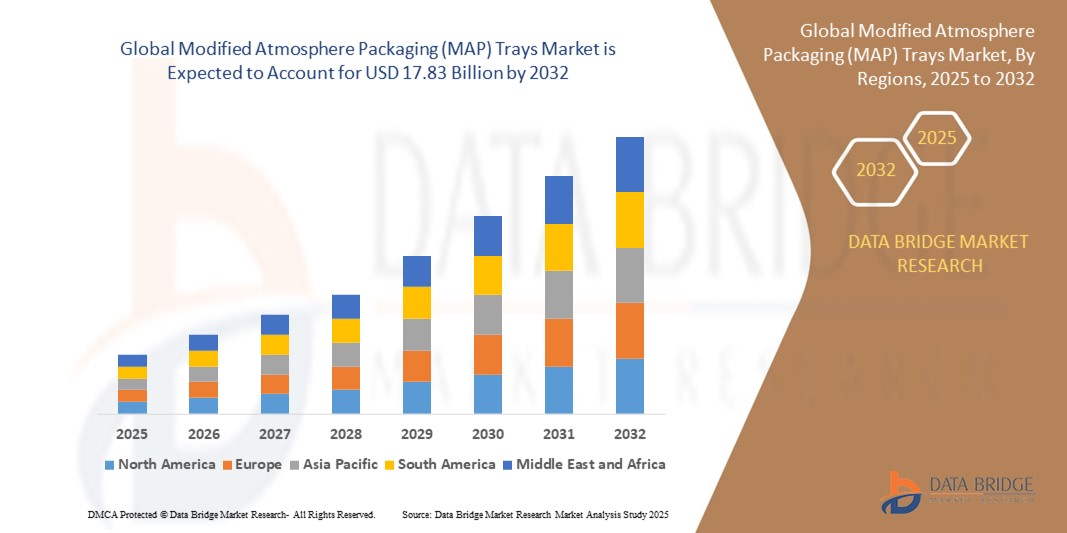
- The global modified atmosphere packaging (MAP) trays market size was valued at USD 11.61 billion in 2024 and is expected to reach USD 17.83 billion by 2032, at a CAGR of 5.5% during the forecast period
- The market growth is primarily driven by the increasing demand for extended shelf life of perishable food products, advancements in packaging technologies, and growing consumer preference for fresh and convenient food options
- The rise in e-commerce and retail food sectors, coupled with heightened awareness of food safety and sustainability, is further accelerating the adoption of MAP trays, establishing them as a preferred packaging solution in the food industry
Modified Atmosphere Packaging (MAP) Trays Market Analysis
- MAP trays, designed to extend the shelf life of fresh and perishable food products by controlling the atmosphere inside the packaging, are becoming essential in food preservation and supply chain efficiency for both retail and foodservice sectors
- The growing demand for MAP trays is fueled by the global expansion of the food and beverage industry, increasing consumer demand for fresh and minimally processed foods, and stringent regulations on food safety and waste reduction
- Asia-Pacific dominated the MAP trays market with the largest revenue share of 42.5% in 2024, driven by rapid urbanization, a booming food retail sector, and high demand for packaged food in countries such as China, Japan, and India
- North America is expected to be the fastest-growing region in the MAP trays market during the forecast period, propelled by technological innovations in packaging, increasing consumer demand for convenience foods, and the presence of major food processing companies
- The high barrier trays segment dominated the largest market revenue share of 38% in 2024, driven by their superior gas and moisture barrier properties, which are critical for extending the shelf life of perishable products such as meat, poultry, and seafood
Report Scope and Modified Atmosphere Packaging (MAP) Trays Market Segmentation
|
Attributes |
Modified Atmosphere Packaging (MAP) Trays Key Market Insights |
|
Segments Covered |
|
|
Countries Covered |
North America
Europe
Asia-Pacific
Middle East and Africa
South America
|
|
Key Market Players |
|
|
Market Opportunities |
|
|
Value Added Data Infosets |
In addition to the insights on market scenarios such as market value, growth rate, segmentation, geographical coverage, and major players, the market reports curated by the Data Bridge Market Research also include import export analysis, production capacity overview, production consumption analysis, price trend analysis, climate change scenario, supply chain analysis, value chain analysis, raw material/consumables overview, vendor selection criteria, PESTLE Analysis, Porter Analysis, and regulatory framework. |
Modified Atmosphere Packaging (MAP) Trays Market Trends
“Increasing Adoption of Smart Packaging Technologies”
- The Global Modified Atmosphere Packaging (MAP) Trays Market is experiencing a notable trend toward the integration of smart packaging technologies
- These technologies, including sensors and IoT-enabled trays, enable real-time monitoring of food quality, shelf life, and storage conditions
- Smart MAP trays can detect changes in gas composition or temperature, ensuring optimal preservation and reducing food waste
- For instance, companies are developing IoT-driven MAP solutions that provide data analytics for supply chain optimization and alert retailers to potential spoilage risks
- This trend enhances the efficiency and sustainability of MAP trays, making them increasingly appealing to food producers, retailers, and environmentally conscious consumers
- Advanced analytics from smart MAP systems can track factors such as humidity, oxygen levels, and microbial activity, enabling proactive quality control measures
Modified Atmosphere Packaging (MAP) Trays Market Dynamics
Driver
“Growing Demand for Extended Shelf Life and Sustainable Packaging”
- The rising consumer and retailer demand for food products with extended shelf life and reduced waste is a primary driver for the Global MAP Trays Market
- MAP trays maintain product freshness by controlling the atmosphere inside the packaging, significantly extending shelf life for perishable goods such as meat, seafood, and fresh produce
- Government initiatives promoting sustainable packaging, particularly in the Asia-Pacific region, which dominates the market, are accelerating the adoption of MAP trays
- The proliferation of e-commerce and advancements in material science, such as recyclable and biodegradable MAP trays, further support market growth by meeting eco-friendly consumer preferences
- Manufacturers are increasingly offering customized MAP tray solutions to cater to specific food types, enhancing product appeal and meeting retailer standards
Restraint/Challenge
“High Production Costs and Regulatory Compliance Issues”
- The high initial costs associated with the production, material selection, and integration of MAP tray systems can be a significant barrier, particularly for small-scale producers in emerging markets
- Developing specialized films and trays that maintain precise atmospheric conditions is complex and costly
- In addition, data privacy and regulatory compliance pose challenges, as smart MAP trays may collect and transmit data on storage conditions, raising concerns about data security and adherence to international standards
- The varied regulatory frameworks across regions, especially in Asia-Pacific (the dominating region) and North America (the fastest-growing region), regarding food safety and packaging materials, create operational complexities for global manufacturers.
- These factors can deter adoption and limit market growth in cost-sensitive regions or where regulatory compliance is stringent
Modified Atmosphere Packaging (MAP) Trays market Scope
The market is segmented on the basis of type, material, application, and end-use industry.
- By Type
On the basis of type, the MAP trays market is segmented into high barrier trays, low barrier trays, perforated trays, standard trays, and others. The high barrier trays segment dominated the largest market revenue share of 38% in 2024, driven by their superior gas and moisture barrier properties, which are critical for extending the shelf life of perishable products such as meat, poultry, and seafood. These trays are widely adopted due to their ability to maintain product freshness and quality during transportation and storage.
The perforated trays segment is expected to witness the fastest growth rate from 2025 to 2032, propelled by increasing demand for fresh produce packaging. Perforated trays allow controlled gas exchange, which is essential for maintaining the freshness of fruits and vegetables by regulating respiration rates, thus reducing spoilage and waste.
- By Material
On the basis of material, the MAP trays market is segmented into polypropylene (PP), polyethylene terephthalate (PET), polyvinyl chloride (PVC), polyethylene (PE), and others. The polyethylene terephthalate (PET) segment is expected to hold the largest market revenue share of 35.3% in 2024, driven by its excellent barrier properties, recyclability, and lightweight nature, which reduce transportation costs and align with sustainability trends. The use of recycled PET (rPET) further boosts its adoption due to regulatory and consumer pressures for eco-friendly packaging.
The polypropylene (PP) segment is anticipated to experience the fastest growth rate of 9.8% from 2025 to 2032. PP trays are favored for their durability, temperature resistance, and cost-effectiveness, making them ideal for a wide range of MAP applications, particularly in meat and ready-to-eat meal packaging. Advancements in PP-based high-barrier trays enhance their suitability for extended shelf-life products.
- By Application
On the basis of application, the MAP trays market is segmented into meat, poultry, seafood, fruits & vegetables, ready-to-eat meals, dairy products, bakery & confectionery, and others. The meat, poultry, and seafood segment is expected to hold the largest market revenue share of 40.2% in 2024, driven by the critical need for extended shelf life and freshness preservation in these perishable categories. MAP trays effectively reduce spoilage by controlling oxygen levels, ensuring product quality during long-distance transportation.
The ready-to-eat meals segment is anticipated to witness robust growth from 2025 to 2032. The increasing consumer demand for convenient, pre-packaged meals, coupled with the rise of e-commerce and online food delivery, drives the adoption of MAP trays to maintain product freshness and safety during transit.
- By End-Use Industry
On the basis of end-use industry, the MAP trays market is segmented into food & beverage, retail, foodservice, and others. The food & beverage segment dominated the market revenue share of 78.2% in 2024, fueled by the widespread adoption of MAP trays in meat, dairy, and produce sectors to extend shelf life without preservatives. This segment benefits from stringent food safety regulations and consumer demand for high-quality, fresh products.
The retail segment is expected to witness rapid growth of 8.5% from 2025 to 2032, driven by the increasing popularity of pre-packaged, fresh, and ready-to-eat products in supermarkets and hypermarkets. The expansion of online grocery shopping and home delivery services further accelerates the demand for MAP trays to ensure product integrity during distribution.
Modified Atmosphere Packaging (MAP) Trays Market Regional Analysis
- Asia-Pacific dominated the MAP trays market with the largest revenue share of 42.5% in 2024, driven by rapid urbanization, a booming food retail sector, and high demand for packaged food in countries such as China, Japan, and India
- Consumers prioritize MAP trays for extending shelf life, maintaining food freshness, and reducing waste, particularly in regions with complex supply chains and diverse dietary preferences
- Growth is supported by advancements in tray technology, including high-barrier and recyclable materials, alongside rising adoption in retail and foodservice sectors
U.S. Modified Atmosphere Packaging (MAP) Trays Market Insight
The U.S. modified atmosphere packaging (MAP) trays market is expected to witness significant growth, fueled by strong demand for convenience foods and growing consumer awareness of food safety and shelf-life extension benefits. The trend towards sustainable packaging and increasing regulations promoting recyclable materials further boost market expansion. Food manufacturers’ growing incorporation of MAP trays in retail and foodservice applications complements the market, creating a robust product ecosystem.
Europe Modified Atmosphere Packaging (MAP) Trays Market Insight
The Europe MAP trays market is expected to witness significant growth, supported by regulatory emphasis on food safety and waste reduction. Consumers seek trays that preserve food quality while offering sustainability. The growth is prominent in both retail and foodservice applications, with countries such as Germany and France showing significant uptake due to rising environmental concerns and urban food consumption trends.
U.K. Modified Atmosphere Packaging (MAP) Trays Market Insight
The U.K. market for MAP trays is expected to witness rapid growth, driven by demand for enhanced food preservation and waste reduction in urban and suburban settings. Increased interest in sustainable packaging and rising awareness of shelf-life extension benefits encourage adoption. In addition, evolving food safety regulations influence consumer choices, balancing tray functionality with compliance.
Germany Modified Atmosphere Packaging (MAP) Trays Market Insight
Germany is expected to witness rapid growth in the MAP trays market, attributed to its advanced food processing sector and high consumer focus on food quality and sustainability. German consumers prefer technologically advanced trays that maintain freshness and contribute to reduced food waste. The integration of these trays in premium food products and retail applications supports sustained market growth.
Asia-Pacific Modified Atmosphere Packaging (MAP) Trays Market Insight
The Asia-Pacific region dominates the MAP trays market, holding the largest share in 2024, driven by expanding food production and rising disposable incomes in countries such as China, India, and Japan. Increasing awareness of food safety, shelf-life extension, and sustainability is boosting demand. Government initiatives promoting eco-friendly packaging and food safety further encourage the use of advanced MAP trays.
Japan Modified Atmosphere Packaging (MAP) Trays Market Insight
Japan’s MAP trays market is expected to witness rapid growth due to strong consumer preference for high-quality, technologically advanced trays that enhance food freshness and safety. The presence of major food manufacturers and integration of MAP trays in retail and foodservice applications accelerate market penetration. Rising interest in sustainable packaging also contributes to growth.
China Modified Atmosphere Packaging (MAP) Trays Market Insight
China holds the largest share of the Asia-Pacific MAP trays market, propelled by rapid urbanization, rising food consumption, and increasing demand for fresh and processed food solutions. The country’s growing middle class and focus on sustainable packaging support the adoption of advanced MAP trays. Strong domestic manufacturing capabilities and competitive pricing enhance market accessibility.
Modified Atmosphere Packaging (MAP) Trays Market Share
The modified atmosphere packaging (MAP) trays industry is primarily led by well-established companies, including:
- Amcor plc (Australia)
- Berry Global Inc. (U.S.)
- Sealed Air Corporation (U.S.)
- Mondi Group (Austria)
- Coveris Holdings S.A. (Austria)
- Winpak Ltd. (Canada)
- Linpac Packaging (U.K.)
- Klöckner Pentaplast (Germany)
- Faerch A/S (Denmark)
- Huhtamaki Oyj (Finland)
- Pactiv LLC (U.S.)
- DS Smith Plc (U.K.)
- RPC Group (U.K.)
- Sonoco Products Company (U.S.)
- Constantia Flexibles (Austria)
What are the Recent Developments in Global Modified Atmosphere Packaging (MAP) Trays Market?
- In January 2025, Cirkla unveiled the world’s first molded fiber Modified Atmosphere Packaging (MAP) trays, marking a major advancement in sustainable food packaging. These innovative trays, crafted from renewable plant fibers such as sugarcane bagasse, reduce plastic content by approximately 85% compared to conventional plastic MAP trays. Engineered for high performance, they offer rigidity, seal strength, and barrier protection on par with plastic, while being recyclable in paper streams. Designed for seamless integration into existing packaging lines, Cirkla’s trays meet the food industry’s growing demand for eco-friendly, scalable solutions
- In November 2024, Amcor plc and Berry Global Group, Inc. announced a definitive all-stock merger agreement, uniting two major players in the Modified Atmosphere Packaging (MAP) space. The merger, valued at $8.4 billion, combines their complementary strengths in MAP trays, films, containers, and closures, creating a global leader in consumer and healthcare packaging solutions. With a shared focus on sustainability and innovation, the combined entity aims to accelerate the development of eco-friendly packaging technologies for the food and pharmaceutical industries, while delivering greater scale, supply chain flexibility, and enhanced R&D capabilities
- In July 2024, Amcor plc acquired Phoenix Flexibles, a flexible packaging company based in Gujarat, India, to expand its capabilities in Modified Atmosphere Packaging (MAP) film technologies. This acquisition enhances Amcor’s ability to produce a broader range of sustainable packaging solutions, including machine-direction oriented films, and supports local production for high-demand markets. With Phoenix Flexibles generating approximately $20 million in annual revenue, the move strengthens Amcor’s presence in the Asia-Pacific region, particularly in food, home care, and personal care segments, while reinforcing its commitment to innovation and sustainability in packaging
- In April 2024, ProAmpac teamed up with Sammi, a grab-and-go sandwich brand, to introduce the RAP Sandwich Wedge—a fiber-based Modified Atmosphere Packaging (MAP) solution designed for sandwiches and wraps. This innovative pack features a carton board structure paired with a thin transparent film liner, delivering both product visibility and hermetic sealing to extend shelf life and reduce food spoilage. The collaboration reflects a shared commitment to sustainability, offering an eco-friendly alternative to rigid plastic clamshells while maintaining high performance in the food-to-go market
- In March 2024, Moy Park partnered with Klöckner Pentaplast (KP) to launch the kp Elite® tray, a Modified Atmosphere Packaging (MAP) solution made entirely from recycled Polyethylene Terephthalate (rPET). This innovative tray is 100% recyclable, certified by RecyClass, and designed to maintain product freshness while significantly reducing food waste. The kp Elite tray also supports Moy Park’s transition to mono-material packaging, cutting plastic use by an estimated 50 tonnes annually. Combined with KP’s lidding film containing 30% post-consumer recycled plastic, the solution aligns with growing consumer and regulatory demands for sustainable, circular packaging

- Interactive Data Analysis Dashboard
- Company Analysis Dashboard for high growth potential opportunities
- Research Analyst Access for customization & queries
- Competitor Analysis with Interactive dashboard
- Latest News, Updates & Trend analysis
- Harness the Power of Benchmark Analysis for Comprehensive Competitor Tracking
Global Modified Atmosphere Packaging Map Trays Market, Supply Chain Analysis and Ecosystem Framework
To support market growth and help clients navigate the impact of geopolitical shifts, DBMR has integrated in-depth supply chain analysis into its Global Modified Atmosphere Packaging Map Trays Market research reports. This addition empowers clients to respond effectively to global changes affecting their industries. The supply chain analysis section includes detailed insights such as Global Modified Atmosphere Packaging Map Trays Market consumption and production by country, price trend analysis, the impact of tariffs and geopolitical developments, and import and export trends by country and HSN code. It also highlights major suppliers with data on production capacity and company profiles, as well as key importers and exporters. In addition to research, DBMR offers specialized supply chain consulting services backed by over a decade of experience, providing solutions like supplier discovery, supplier risk assessment, price trend analysis, impact evaluation of inflation and trade route changes, and comprehensive market trend analysis.
Data collection and base year analysis are done using data collection modules with large sample sizes. The stage includes obtaining market information or related data through various sources and strategies. It includes examining and planning all the data acquired from the past in advance. It likewise envelops the examination of information inconsistencies seen across different information sources. The market data is analysed and estimated using market statistical and coherent models. Also, market share analysis and key trend analysis are the major success factors in the market report. To know more, please request an analyst call or drop down your inquiry.
The key research methodology used by DBMR research team is data triangulation which involves data mining, analysis of the impact of data variables on the market and primary (industry expert) validation. Data models include Vendor Positioning Grid, Market Time Line Analysis, Market Overview and Guide, Company Positioning Grid, Patent Analysis, Pricing Analysis, Company Market Share Analysis, Standards of Measurement, Global versus Regional and Vendor Share Analysis. To know more about the research methodology, drop in an inquiry to speak to our industry experts.
Data Bridge Market Research is a leader in advanced formative research. We take pride in servicing our existing and new customers with data and analysis that match and suits their goal. The report can be customized to include price trend analysis of target brands understanding the market for additional countries (ask for the list of countries), clinical trial results data, literature review, refurbished market and product base analysis. Market analysis of target competitors can be analyzed from technology-based analysis to market portfolio strategies. We can add as many competitors that you require data about in the format and data style you are looking for. Our team of analysts can also provide you data in crude raw excel files pivot tables (Fact book) or can assist you in creating presentations from the data sets available in the report.













