What is the Mosfet Discrete Semiconductor Market Size and Growth Rate?
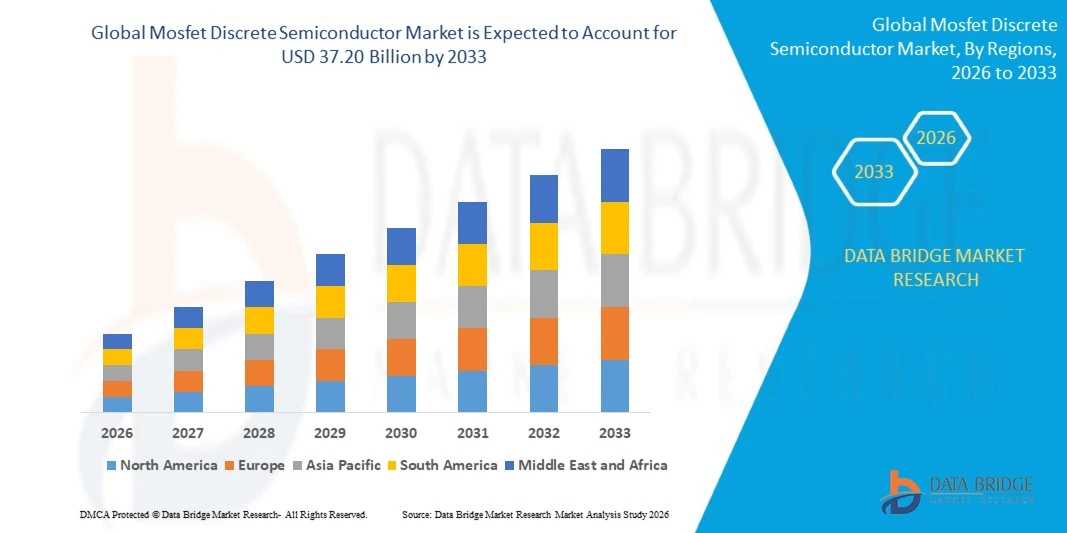
- As per Data Bridge Market Research analysis, the mosfet discrete semiconductor market was valued at USD 37.20 Billion in 2025 and is projected to reach USD 55.39 billion by 2033, growing at a CAGR of 5.10% from 2026 to 2033.
- The market is experiencing consistent growth driven by rising demand for energy-efficient power conversion, accelerating electrification of vehicles, and expanding deployment of power-hungry computing infrastructure across automotive, industrial, consumer electronics, telecommunications, and energy applications.
- The increasing shift toward electric mobility, renewable energy systems, and high-density server power architectures, combined with growing adoption of wide-bandgap devices alongside conventional silicon, is supporting market adoption. Discrete mosfets are being applied across power supplies, motor drives, battery management, silicon carbide power semiconductors, electric vehicle powertrains, and data center power stages, offering designers higher efficiency, lower conduction losses, and greater power density in compact footprints.
Market Size & Forecast
- Global Market Value (2025): USD 37.20 billion
- Expected Market Value (2033): USD 55.39 billion
- Forecast CAGR (2026–2033): 5.10%
- Leading Region in 2025: Asia-Pacific
- Fastest Growing Region: Asia-Pacific
What are the Major Takeaways of the Mosfet Discrete Semiconductor Market?
- Asia-Pacific dominated the mosfet discrete semiconductor market with the largest revenue share of 52.60% in 2025, supported by dense electronics manufacturing, large-scale automotive and consumer device production, and a deep base of domestic and international power semiconductor suppliers.
- Asia-Pacific is also expected to be the fastest-growing region at a CAGR of 5.90% from 2026 to 2033, fueled by electric vehicle production, expanding data center capacity, and continued localization of power semiconductor supply chains.
- The low voltage segment led the voltage category with a 45.20% share in 2025, driven by extensive use in power management, DC-DC conversion, motor control, and battery-powered devices.
- High voltage is the fastest-growing voltage class, projected to register a CAGR of 6.40%, reflecting rising demand from industrial drives, solar and energy storage inverters, and on-board charging equipment.
- The silicon segment dominated the material category with a 90.40% revenue share in 2025, supported by mature manufacturing capacity, broad voltage coverage, and cost competitiveness.
- Power supplies and converters accounted for 33.40% of the market share in 2025, preferred for the large installed base of adapters, server power units, and telecom rectifiers.
- Inverters and battery management is the fastest-growing application category, with a CAGR of 7.30%, driven by electrification of transportation and growth in stationary energy storage.
Report Scope and Mosfet Discrete Semiconductor Market Segmentation
|
Attributes |
Mosfet Discrete Semiconductor Key Market Insights |
|
Segments Covered |
|
|
Countries Covered |
North America
Europe
Asia-Pacific
Middle East and Africa
South America
|
|
Key Market Players |
|
|
Market Opportunities |
|
|
Value Added Data Infosets |
In addition to the insights on market scenarios such as market value, growth rate, segmentation, geographical coverage, and major players, the market reports curated by the Data Bridge Market Research also include in-depth expert analysis, geographically represented company-wise production and capacity, network layouts of distributors and partners, detailed and updated price trend analysis and deficit analysis of supply chain and demand. |
What is the Key Trend in the Mosfet Discrete Semiconductor Market?
- Discrete mosfet suppliers are broadening portfolios beyond conventional silicon, adding silicon carbide devices that combine higher breakdown voltage, lower switching losses, and better thermal behavior for electric vehicles, charging infrastructure, and renewable energy conversion.
- For instance, in June 2026, according to mouser electronics new-product listings, Vishay Intertechnology added its MaxSiC MXP075 750V N-channel silicon carbide mosfets to the distribution catalog, highlighting the push of established silicon suppliers into wide-bandgap power devices.
- Silicon carbide devices are increasingly offered in power-module and discrete formats so that designers can scale from single-switch topologies to high-current inverter stages while retaining a familiar gate-drive approach.
- For instance, in August 2026, according to mouser electronics new-product listings, onsemi added its NXH011F120M3F2 silicon carbide mosfet product to the catalog, reflecting continued expansion of silicon carbide options for industrial and energy applications.
- As electrification, higher switching frequencies, and compact power architectures continue to advance, the mosfet discrete semiconductor market is expected to see a growing share of revenue shift toward silicon carbide and application-optimized silicon devices.
What are the Key Drivers of the Mosfet Discrete Semiconductor Market?
- The rapid scale-up of AI computing and cloud infrastructure has significantly increased demand for efficient power conversion, since every watt saved in the 48 V intermediate bus stage reduces both energy use and cooling load in server racks.
- For instance, in March 2026, according to Mouser Electronics, Infineon Technologies launched its OptiMOS 7 25V power mosfets in 3.3 mm × 3.3 mm packages, offering hard-switching and soft-switching optimized variants aimed at data centers, 48 V intermediate bus converters, telecommunications infrastructure, and server power supply units.
- Automotive manufacturers, data center operators, telecom network builders, and industrial equipment makers are increasingly specifying low-loss mosfets to meet efficiency targets and shrink power supply size.
- For instance, in April 2026, according to Infineon Technologies AG, its OptiMOS 6 80V mosfets in a 5×6 mm² dual side cooling package were integrated into the intermediate bus converter stage of an AI server platform from a leading processor manufacturer, and the company estimated that scaling the efficiency gain across a hypothetical hyperscale data center with 2,000 racks would save more than 1.2 MWh of energy every hour.
- With electrification and AI workloads expanding together, discrete mosfets remain the most widely used switch for converting and controlling power, supporting steady replacement and new-design demand across end markets.
What Factors Are Challenging the Growth of the Mosfet Discrete Semiconductor Market?
- Mosfet manufacturing depends on silicon wafers, metals, packaging materials, and specialized fab capacity, which exposes suppliers and buyers to raw-material inflation, allocation, and price volatility.
- For instance, in March 2026, according to FTC Electronics, Vishay Intertechnology confirmed emergency price adjustments across its mosfet and integrated circuit portfolios between late February and early March 2026, citing sustained increases in raw-material costs.
- These cost pressures can lengthen purchasing cycles, push original equipment manufacturers to qualify second sources, and compress margins for downstream power supply and motor drive manufacturers.
- Competition from alternative power switches, including gallium nitride transistors and insulated gate bipolar transistors, also constrains growth in selected voltage and frequency ranges, particularly in fast-charging and high-power industrial designs.
- For instance, in July 2026, according to distributor notices circulated across the electronic components trade, Infineon Technologies implemented a price increase effective 1 July 2026, prompting buyers to secure buffer stock and validate alternative suppliers.
- The combination of input-cost inflation, supply allocation risk, and substitute technologies can restrain adoption among cost-sensitive buyers, particularly in consumer and low-margin industrial applications.
How is the Mosfet Discrete Semiconductor Market Segmented?
The mosfet discrete semiconductor market is segmented on the basis of voltage, material, application, and end user.
- By Voltage
On the basis of voltage, the mosfet discrete semiconductor market is segmented into low voltage, medium voltage, and high voltage. The low voltage segment dominated the market with 45.20% share in 2025, supported by extensive use in DC-DC converters, battery-powered devices, motor control, and automotive body electronics. Low-voltage mosfets benefit from continuous improvements in on-resistance and gate charge, which reduce conduction and switching losses. Their availability in compact surface-mount packages supports miniaturized designs. Large production volumes across consumer and automotive platforms also keep unit costs competitive. Design wins in server and telecom power stages are adding further momentum.
The high voltage segment is projected to register the fastest growth at a CAGR of 6.40% from 2026 to 2033, driven by rising demand from solar and energy storage inverters, industrial motor drives, electric vehicle chargers, and server power supplies. Superjunction and silicon carbide technologies are extending the efficiency of high-voltage switching. Higher power density requirements are encouraging adoption of top-side cooled and low-inductance packages. Growth in renewable energy installations and fast-charging networks is creating additional demand. Improved reliability and thermal performance are strengthening acceptance in demanding industrial environments.
- By Material
On the basis of material, the mosfet discrete semiconductor market is segmented into silicon, silicon carbide, and others. The silicon segment dominated the market with 90.40% share in 2025, supported by mature manufacturing capacity, broad voltage and current coverage, and cost competitiveness. Silicon mosfets continue to improve through new trench and charge-balance structures that reduce losses without changing the overall manufacturing flow. Their wide availability across multiple suppliers provides purchasing flexibility. Established design practices and qualification histories also make silicon the default choice for many applications.
The silicon carbide segment is projected to register the fastest growth at a CAGR of 14.20% from 2026 to 2033, driven by rising adoption in electric vehicle traction inverters, on-board chargers, solar inverters, and industrial power supplies. Silicon carbide offers higher breakdown strength, lower switching losses, and better high-temperature operation than silicon. Expansion of wafer capacity and the move to larger wafer diameters are expected to ease cost barriers. Suppliers are widening 650 V to 1,200 V portfolios to address a broader set of applications. Growing system-level efficiency requirements continue to favor wide-bandgap switches in high-power designs.
- By Application
On the basis of application, the mosfet discrete semiconductor market is segmented into power supplies and converters, motor drives, inverters and battery management, lighting, and others. The power supplies and converters segment dominated the application category with 33.40% share in 2025, supported by the large installed base of adapters, server power units, telecom rectifiers, and industrial power supplies. Efficiency regulations are pushing designers to adopt lower-loss devices. Higher switching frequencies reduce magnetic component size and improve power density. Replacement cycles and continuous design refreshes keep volumes steady.
The inverters and battery management segment is projected to register the fastest growth at a CAGR of 7.30% from 2026 to 2033, driven by electrification of vehicles, e-mobility, and stationary energy storage. Battery protection, load switching, and traction inverter stages use large numbers of mosfets per system. Higher voltage battery architectures are increasing demand for devices with greater ruggedness. Integration with gate drivers and sensing functions is improving system reliability. Growth in grid-connected storage and residential solar is creating further demand for efficient switching devices.
- By End User
On the basis of end user, the mosfet discrete semiconductor market is segmented into automotive, consumer electronics, industrial, telecommunications and data centers, energy and utilities, and others. The automotive segment dominated the end-user category with 31.20% share in 2025, supported by rising semiconductor content per vehicle across electric, hybrid, and conventional powertrains. Mosfets are used in motor control, electric power steering, battery systems, lighting, and body electronics. Automotive qualification requirements favor suppliers with strong quality records. Growth in advanced driver assistance and electrified accessories is increasing the number of power switches per vehicle.
The telecommunications and data centers segment is projected to register the fastest growth at a CAGR of 7.80% from 2026 to 2033, driven by expansion of AI computing clusters, cloud capacity, and network infrastructure. Server power architectures increasingly use 48 V distribution and multi-stage conversion, which raises the number and performance requirements of mosfets per rack. Power efficiency is a direct cost factor for operators because it influences both electricity and cooling expenses. Thermal performance, dual-side cooling packages, and low-loss switching are becoming key selection criteria. Continued investment in compute capacity is expected to sustain demand.
Which Region Holds the Largest Share of the Mosfet Discrete Semiconductor Market?
- Asia-Pacific dominated the mosfet discrete semiconductor market with the largest revenue share of 52.60% in 2025, supported by strong electronics manufacturing, automotive production, and consumer device assembly across China, Japan, South Korea, and Southeast Asia.
- The region also benefits from a dense supplier ecosystem, large domestic demand for power conversion equipment, and growing investment in electric vehicles, renewable energy, and data center capacity. Increasing localization of power semiconductor production continues to strengthen Asia-Pacific’s position in the global market.
U.S. Mosfet Discrete Semiconductor Market Insight
The U.S. mosfet discrete semiconductor market is witnessing steady growth due to rising demand from data centers, electric vehicles, aerospace and defense electronics, and industrial automation. The country’s strong base of power semiconductor designers and device makers, together with increasing investment in domestic manufacturing capacity, is supporting demand for advanced silicon and silicon carbide devices. In addition, growth in AI computing infrastructure, grid modernization, and electric vehicle charging networks is accelerating adoption of high-efficiency power switches across commercial and industrial applications.
Asia-Pacific Mosfet Discrete Semiconductor Market Insight
The Asia-Pacific mosfet discrete semiconductor market is expected to witness the largest and most diversified demand, driven by large-scale electronics manufacturing, expanding electric vehicle production, and rising investment in energy infrastructure across countries such as China, Japan, and India. Growing consumption of smartphones, appliances, and industrial equipment is supporting volume demand. In addition, the region’s extensive supply chain, from wafer fabrication to module assembly, and increasing government support for domestic semiconductor capability are accelerating adoption of mosfet devices across automotive, industrial, and consumer applications.
Japan Mosfet Discrete Semiconductor Market Insight
The Japan mosfet discrete semiconductor market is witnessing consistent growth due to strong demand for precision power components in automotive electronics, factory automation, robotics, and consumer appliances. Domestic suppliers and electronics manufacturers emphasize reliability, efficiency, and compact packaging, which supports adoption of advanced low-loss mosfets and silicon carbide devices. Moreover, investment in electrified mobility, energy-saving appliances, and industrial equipment upgrades is further contributing to market growth in Japan.
China Mosfet Discrete Semiconductor Market Insight
The China mosfet discrete semiconductor market is growing rapidly, driven by the country’s large electric vehicle industry, extensive consumer electronics production, and expanding solar and energy storage manufacturing. Rising domestic device production and policy support for semiconductor self-reliance are increasing the use of locally supplied mosfets across industrial and automotive applications. In addition, strong demand from server, telecom, and appliance manufacturers is positioning China as the largest single-country market for discrete power devices in Asia-Pacific.
U.K. Mosfet Discrete Semiconductor Market Insight
The U.K. mosfet discrete semiconductor market is experiencing steady growth, supported by demand from automotive electrification, aerospace, medical devices, and industrial control equipment. The country’s semiconductor capability, including the Newport wafer fab now operated by Vishay Intertechnology, supports domestic production of power devices and related engineering activity. Furthermore, growing investment in electric vehicle charging, offshore wind connections, and advanced manufacturing is supporting wider adoption of efficient power switching devices in the U.K.
Germany Mosfet Discrete Semiconductor Market Insight
The Germany mosfet discrete semiconductor market is expanding steadily due to the country’s strong automotive sector, industrial machinery base, and presence of leading power semiconductor manufacturers. Automakers and industrial equipment suppliers are increasingly adopting silicon carbide and low-loss silicon mosfets for traction inverters, chargers, drives, and renewable energy converters. Continuous advancements in power electronics, a strong focus on energy efficiency, and robust industrial demand are further driving market growth in the country.
Which are the Top Companies in Mosfet Discrete Semiconductor Market?
The mosfet discrete semiconductor industry is primarily led by well-established companies, including:
- Infineon Technologies AG (Germany)
- onsemi (U.S.)
- Vishay Intertechnology, Inc. (U.S.)
- STMicroelectronics (Switzerland)
- Nexperia B.V. (Netherlands)
- Toshiba Electronic Devices & Storage Corporation (Japan)
- Renesas Electronics Corporation (Japan)
- Alpha and Omega Semiconductor Limited (U.S.)
- ROHM Co., Ltd. (Japan)
- Diodes Incorporated (U.S.)
- Littelfuse, Inc. (U.S.)
- Microchip Technology Inc. (U.S.)
- Wolfspeed, Inc. (U.S.)
- Magnachip Semiconductor Corporation (South Korea)
- Texas Instruments Incorporated (U.S.)
- Mitsubishi Electric Corporation (Japan)
- Fuji Electric Co., Ltd. (Japan)
- Navitas Semiconductor (U.S.)
- China Resources Microelectronics Limited (China)
- Sanken Electric Co., Ltd. (Japan)
What are Latest Developments in Mosfet Discrete Semiconductor Market?
- In August 2026, onsemi added a new range of 80V single N-channel power mosfets to its portfolio, as listed by Mouser Electronics, extending its low and medium voltage options for power conversion, motor control, and battery applications.
- In August 2026, STMicroelectronics introduced the STH4N150-2AG N-channel power mosfet, as listed by Mouser Electronics, adding to its high-voltage power mosfet options for industrial and automotive designs.
- In April 2026, Vishay Intertechnology listed the VS-HOT200C080, a 200 A, 80 V power mosfet module, according to Mouser Electronics, expanding its module-level offering for high-current applications.
- In April 2026, iDEAL Semiconductor released its SuperQ IS20M8R0S1P 200V N-channel power mosfet, according to Mouser Electronics, targeting efficient power conversion with a new device structure.
- In March 2024, Vishay Intertechnology and Nexperia announced the final closing of the sale of Nexperia’s Newport wafer fabrication facility in South Wales, U.K., to Vishay, securing continued operation of the site and its workforce.
- Interactive Data Analysis Dashboard
- Company Analysis Dashboard for high growth potential opportunities
- Research Analyst Access for customization & queries
- Competitor Analysis with Interactive dashboard
- Latest News, Updates & Trend analysis
- Harness the Power of Benchmark Analysis for Comprehensive Competitor Tracking
Global Mosfet Discrete Semiconductor Market, Supply Chain Analysis and Ecosystem Framework
To support market growth and help clients navigate the impact of geopolitical shifts, DBMR has integrated in-depth supply chain analysis into its Global Mosfet Discrete Semiconductor Market research reports. This addition empowers clients to respond effectively to global changes affecting their industries. The supply chain analysis section includes detailed insights such as Global Mosfet Discrete Semiconductor Market consumption and production by country, price trend analysis, the impact of tariffs and geopolitical developments, and import and export trends by country and HSN code. It also highlights major suppliers with data on production capacity and company profiles, as well as key importers and exporters. In addition to research, DBMR offers specialized supply chain consulting services backed by over a decade of experience, providing solutions like supplier discovery, supplier risk assessment, price trend analysis, impact evaluation of inflation and trade route changes, and comprehensive market trend analysis.
Data collection and base year analysis are done using data collection modules with large sample sizes. The stage includes obtaining market information or related data through various sources and strategies. It includes examining and planning all the data acquired from the past in advance. It likewise envelops the examination of information inconsistencies seen across different information sources. The market data is analysed and estimated using market statistical and coherent models. Also, market share analysis and key trend analysis are the major success factors in the market report. To know more, please request an analyst call or drop down your inquiry.
The key research methodology used by DBMR research team is data triangulation which involves data mining, analysis of the impact of data variables on the market and primary (industry expert) validation. Data models include Vendor Positioning Grid, Market Time Line Analysis, Market Overview and Guide, Company Positioning Grid, Patent Analysis, Pricing Analysis, Company Market Share Analysis, Standards of Measurement, Global versus Regional and Vendor Share Analysis. To know more about the research methodology, drop in an inquiry to speak to our industry experts.
Data Bridge Market Research is a leader in advanced formative research. We take pride in servicing our existing and new customers with data and analysis that match and suits their goal. The report can be customized to include price trend analysis of target brands understanding the market for additional countries (ask for the list of countries), clinical trial results data, literature review, refurbished market and product base analysis. Market analysis of target competitors can be analyzed from technology-based analysis to market portfolio strategies. We can add as many competitors that you require data about in the format and data style you are looking for. Our team of analysts can also provide you data in crude raw excel files pivot tables (Fact book) or can assist you in creating presentations from the data sets available in the report.