


What is the Multi-Lane Free Flow Tolling Market Size and Growth Rate?
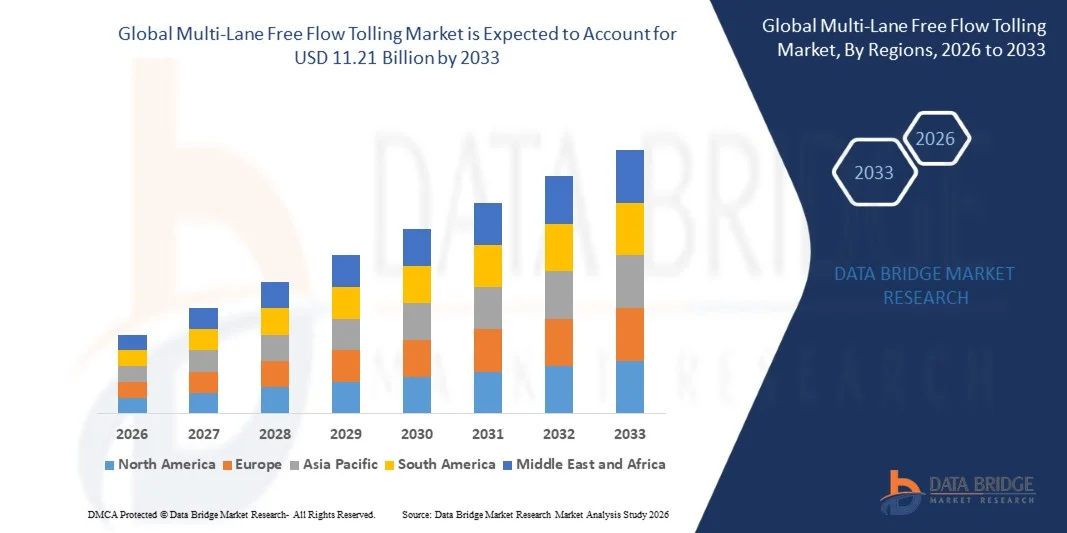
- As per Data Bridge Market Research analysis, the multi-lane free flow tolling market was valued at USD 6.10 billion in 2025 and is projected to reach USD 11.21 billion by 2033, growing at a CAGR of 7.90% from 2026 to 2033.
- The market is experiencing consistent growth driven by rising demand for congestion-free highway travel, increasing digitization of toll collection, and expanding use of camera-based, RFID, and satellite-based charging across highways, tunnels, bridges, and urban road networks.
- The increasing shift from manual and stop-and-go toll lanes to barrier-free collection, combined with growing integration of vehicle detection, classification, and enforcement analytics, is supporting market adoption. Multi-lane free flow technology is being applied across electronic toll collection networks, urban congestion charging schemes, and intelligent transportation systems, offering road users greater convenience and giving operators more efficient revenue collection through automatic number plate recognition.
Market Size & Forecast
- Global Market Value (2025): USD 6.10 Billion
- Expected Market Value (2033): USD 11.21 Billion
- Forecast CAGR (2026–2033): 7.90%
- Leading Region in 2025: Europe
- Fastest Growing Region: Asia-Pacific
What are the Major Takeaways of the Multi-Lane Free Flow Tolling Market?
- Europe dominated the multi-lane free flow tolling market with the largest revenue share of 35.82% in 2025, supported by early adoption of free-flow tolling, interoperable electronic toll services, and extensive distance-based charging for heavy vehicles.
- Asia-Pacific is expected to be the fastest-growing region at a CAGR of 10.45% from 2026 to 2033, fueled by national highway digitization programs, new tolled expressways, and rapid adoption of ANPR and RFID-based barrier-free tolling.
- The hardware segment led the component category with a 54.60% share in 2025, driven by large-scale installation of gantries, cameras, and roadside detection equipment.
- Services is the fastest-growing component, projected to register a CAGR of 9.40%, reflecting growth in long-term operations, back-office, and enforcement contracts.
- The automatic number plate recognition segment dominated the technology category with a 43.70% revenue share in 2025, led by its role in identifying vehicles without on-board equipment and enforcing payment.
- Highways and expressways accounted for 61.20% of the market share in 2025, preferred by road authorities seeking to remove plaza delays on high-volume intercity corridors.
- The urban congestion charging segment is the fastest-growing application category, with a CAGR of 9.60%, driven by city programs to manage traffic, emissions, and transport funding.
Report Scope and Multi-Lane Free Flow Tolling Market Segmentation
|
Attributes |
Multi-Lane Free Flow Tolling Key Market Insights |
|
Segments Covered |
|
|
Countries Covered |
North America
Europe
Asia-Pacific
Middle East and Africa
South America
|
|
Key Market Players |
|
|
Market Opportunities |
|
|
Value Added Data Infosets |
In addition to the market insights such as market value, growth rate, market segments, geographical coverage, market players, and market scenario, the market report curated by the Data Bridge Market Research team includes in-depth expert analysis, import/export analysis, pricing analysis, production consumption analysis, and pestle analysis. |
What is the Key Trend in the Multi-Lane Free Flow Tolling Market?
- Multi-lane free flow (MLFF) tolling is moving from isolated urban tunnels and bridges toward corridor-wide, barrier-free deployments on national highways, combining overhead gantries, automatic number plate recognition (ANPR) cameras, RFID tags, and increasingly satellite-based positioning to charge vehicles at highway speeds.
- For instance, in May 2026, according to All India Radio (News on AIR), the National Highways Authority of India launched the country's first MLFF barrier-less tolling system at the Chorayasi Toll Plaza on NH-48 in Gujarat, combining ANPR cameras with FASTag-based payments, and about 41,500 vehicles crossed the MLFF toll location on the first day
- Hybrid tolling models that combine conventional plazas with free-flow lanes are gaining traction, allowing operators to introduce barrier-free collection gradually while retaining payment options for occasional users and non-registered vehicles.
- Toll operators are also deploying AI-based vehicle detection, classification, and enforcement analytics, along with interoperable accounts and app-based payment options, to reduce revenue leakage and simplify the user experience.
- For instance, in January 2026, according to Kapsch TrafficCom, the company announced a contract extension, awarded in November 2025, to install 14 new gantries equipped with its VDX cameras on the Patras–Pyrgos Motorway in Greece, supporting a hybrid tolling model that combines plaza and free-flow tolling
- As camera accuracy, satellite positioning, and back-office automation continue to improve, MLFF tolling is expected to expand from premium corridors to wider road networks and evolve into an integrated platform for road charging, congestion management, and mobility data services.
What are the Key Drivers of the Multi-Lane Free Flow Tolling Market?
- Governments and road authorities are prioritizing congestion reduction, lower toll-collection costs, fuel savings, and emission reductions, which is encouraging a shift from manual and stop-and-go electronic toll lanes toward barrier-free collection.
- For instance, in December 2025, according to Indian Infrastructure, India's Ministry of Road Transport and Highways announced that MLFF would remove toll-plaza stops from national highways by the end of 2026, with vehicles passing at speeds of up to 80 kmph, and projected annual fuel savings of Rs 15 billion and an increase in toll revenue of Rs 60 billion.
- Rising vehicle volumes, growth in freight movement, and the expansion of tolled highways, tunnels, and urban corridors are increasing demand for tolling systems that can process high traffic volumes without physical barriers.
- For instance, in September 2026, according to Business Today, India's Union Minister for Road Transport and Highways Nitin Gadkari said barrier-free MLFF tolling is expected to be operational at toll plazas by February–March 2027, and estimated the economic value of time saved through faster tolling at about Rs 68,500 crore each year.
- Public–private concession models and long-term operations-and-maintenance contracts are further encouraging investment in advanced tolling infrastructure, as concessionaires seek higher collection efficiency and better data on traffic patterns.
What Factors Are Challenging the Growth of the Multi-Lane Free Flow Tolling Market?
- MLFF systems depend on accurate vehicle identification, reliable registration and account databases, and effective enforcement, because the absence of physical barriers makes it easier for non-compliant vehicles to avoid payment.
- For instance, in May 2026, according to the New Straits Times, experts warned that widespread toll evasion, weak enforcement, and poor motorist compliance could undermine Malaysia's plans to introduce MLFF, with revenue leakage affecting concessionaires' ability to maintain highways and fund future infrastructure upgrades.
- Installation of gantries, cameras, sensors, and back-office systems requires significant upfront capital, and integration with legacy toll plazas, vehicle registries, and multiple payment channels can be technically complex.
- Data-protection and privacy considerations related to ANPR and vehicle-tracking data can also slow approvals and require additional safeguards, audit processes, and supporting legal frameworks.
- For instance, in January 2021, according to the Legislative Council of Hong Kong, the government's free-flow tolling proposal relied on ANPR technology with audit checks that cross-reference toll tags, and required privacy impact assessments, consultation with the Office of the Privacy Commissioner for Personal Data, and legislation covering offences of toll evasion.
- The combination of enforcement dependence, upfront infrastructure cost, and data-protection requirements can constrain adoption in markets with limited legal frameworks or low registration data quality, particularly where conventional toll plazas still meet basic collection needs.
How is the Multi-Lane Free Flow Tolling Market Segmented?
The multi-lane free flow tolling market is segmented on the basis of component, technology, application, and end user.
- By Component
On the basis of component, the multi-lane free flow tolling market is segmented into hardware, software, and services. The hardware segment dominated the market with 54.60% share in 2025, supported by large-scale installation of gantries, roadside cameras, vehicle detection and classification sensors, RFID readers, and enforcement units on new and upgraded toll roads. Each barrier-free toll point requires multiple cameras, lighting, and sensing equipment designed for highway-speed accuracy in all weather conditions. Replacement cycles for ageing toll-lane equipment and expansion of tolled networks continue to generate hardware demand.
The services segment is projected to register the fastest growth at a CAGR of 9.40% from 2026 to 2033, driven by long-term operations and maintenance contracts, back-office processing, customer service, payment collection, and violation-enforcement activities. Barrier-free systems depend on continuous image review, account management, and recovery of unpaid tolls, which many authorities outsource to specialist operators. Delivery-and-operate contracts running ten years or more are becoming common, creating recurring service revenue. Growing use of cloud platforms and managed services is further supporting segment expansion.
- By Technology
On the basis of technology, the multi-lane free flow tolling market is segmented into automatic number plate recognition, RFID, GNSS, and others. The automatic number plate recognition segment dominated the market with 43.70% share in 2025, supported by its ability to identify vehicles without on-board equipment and to serve as the enforcement layer for tag-based and account-based tolling. Video tolling allows occasional and foreign users to pay after travel through pay-by-plate or pay-by-mail options. Improvements in camera resolution, image processing, and AI-based plate reading are increasing read accuracy at highway speeds.
The GNSS segment is projected to register the fastest growth at a CAGR of 10.80% from 2026 to 2033, driven by distance-based charging for heavy vehicles, virtual gantries, and tolling of road networks where physical structures are impractical. Satellite-based tolling can charge by distance and road category without dense roadside infrastructure, which lowers deployment cost for large networks. Advances in positioning accuracy, on-board units, and smartphone-based applications are expanding use cases. Governments exploring road-user charging and congestion pricing are also evaluating GNSS-based architectures.
- By Application
On the basis of application, the multi-lane free flow tolling market is segmented into highways and expressways, bridges and tunnels, urban congestion charging, and others. The highways and expressways segment dominated the application category with 61.20% share in 2025, supported by the extent of tolled intercity networks and the congestion and delay caused by stop-and-go toll plazas. Removing barriers allows vehicles to pass at normal speeds, improving throughput, fuel use, and travel time. Road authorities are also using barrier-free tolling to reduce plaza construction and operating costs on new corridors.
The urban congestion charging segment is projected to register the fastest growth at a CAGR of 9.60% from 2026 to 2033, driven by city programs that use free-flow cordons and low-emission zones to manage traffic and air quality. Camera-based enforcement and flexible charging rules allow cities to adjust prices by time, location, and vehicle emission class. Public concern over congestion, emissions, and funding for public transport is encouraging authorities to evaluate such schemes. Integration with mobility applications and account systems is improving user acceptance.
- By End User
On the basis of end user, the multi-lane free flow tolling market is segmented into government and public authorities, private concessionaires, and others. The government and public authorities segment dominated the end-user category with 52.30% share in 2025, supported by state-owned and publicly regulated road networks that are being converted to electronic and barrier-free collection. National highway agencies and transport departments are leading large procurement programs and setting technical standards for interoperability and enforcement. Policy priorities such as congestion reduction, transparency in collection, and lower operating costs are sustaining public-sector demand.
The private concessionaires segment is projected to register the fastest growth at a CAGR of 8.70% from 2026 to 2033, driven by the need to raise collection efficiency, reduce plaza staffing costs, and improve customer experience on concession roads. Concessionaires are investing in free-flow lanes, video tolling, and analytics-based enforcement to protect revenue over long contract periods. New public–private projects, including tunnels and managed lanes, are being designed as barrier-free from the outset. Partnerships with technology suppliers and payment providers are further supporting adoption.
Which Region Holds the Largest Share of the Multi-Lane Free Flow Tolling Market?
- Europe dominated the multi-lane free flow tolling market with the largest revenue share of 35.82% in 2025, supported by long-established free-flow and interoperable tolling networks, distance-based charging for heavy goods vehicles, and active tolling-technology suppliers.
- The region also benefits from supportive transport policy, widespread use of ANPR and tag-based systems, and ongoing upgrades of tolling infrastructure on motorways, tunnels, and urban zones. Increasing focus on interoperability, emission-based charging, and cross-border road-user services continues to strengthen Europe's position in the global market.
Germany Multi-Lane Free Flow Tolling Market Insight
The Germany multi-lane free flow tolling market is witnessing consistent growth due to the country's established satellite-based toll system for heavy vehicles, dense motorway network, and strong focus on road-user charging. Authorities and operators are upgrading enforcement, detection, and back-office capabilities to support evolving toll structures and emission-based pricing. Moreover, advanced engineering capabilities, strict data-protection standards, and emphasis on interoperable and efficient infrastructure are further contributing to market growth in the country.
Asia-Pacific Multi-Lane Free Flow Tolling Market Insight
The Asia-Pacific multi-lane free flow tolling market is expected to witness rapid growth, driven by expanding expressway networks, national digitization programs, and increasing investments in barrier-free tolling across countries such as India, Australia, and China. Growing vehicle ownership, urban congestion, and demand for faster freight movement are supporting regional expansion. In addition, strong participation of local concessionaires and technology suppliers and increasing adoption of ANPR and RFID-based systems are accelerating demand for MLFF solutions.
India Multi-Lane Free Flow Tolling Market Insight
The India multi-lane free flow tolling market is growing rapidly, driven by the national rollout of barrier-less tolling on highways and the integration of ANPR cameras with the FASTag electronic payment system. Authorities are launching MLFF at selected toll plazas and urban expressways, with plans to extend coverage across the national highway network. Furthermore, the push to reduce travel time, fuel use, and plaza operating costs, along with growing opportunities for payment providers and technology suppliers, is significantly boosting market demand.
Australia Multi-Lane Free Flow Tolling Market Insight
The Australia multi-lane free flow tolling market is experiencing steady growth, supported by long-standing use of free-flow tolling on urban motorways and tunnels in major cities. New projects are specified as barrier-free from the outset and are procured through long-term delivery-and-operate contracts. In addition, growing freight volumes, urban congestion, and investment in large road projects are encouraging continued adoption of advanced vehicle detection, classification, and number plate recognition systems.
U.K. Multi-Lane Free Flow Tolling Market Insight
The U.K. multi-lane free flow tolling market is experiencing steady growth, supported by the use of barrier-free charging at major river crossings, clean air zones, and road-user schemes. Pay-by-plate and online account options allow drivers to settle charges without stopping. Furthermore, growing emphasis on air-quality management, congestion control, and digital payment convenience is supporting wider adoption of camera-based free-flow systems and related enforcement analytics.
U.S. Multi-Lane Free Flow Tolling Market Insight
The U.S. multi-lane free flow tolling market is witnessing strong growth due to the widespread shift to all-electronic and open-road tolling on turnpikes, bridges, tunnels, and managed lanes. Toll agencies are investing in video tolling, interoperable transponders, and improved back-office systems to reduce labor costs and improve customer experience. In addition, rising traffic volumes, infrastructure funding needs, and growing use of express lanes are encouraging operators to adopt advanced free-flow and enforcement technologies.
Which are the Top Companies in Multi-Lane Free Flow Tolling Market?
The multi-lane free flow tolling industry is primarily led by well-established companies, including:
- Kapsch TrafficCom AG (Austria)
- Thales Group (France)
- TransCore, LP (U.S.)
- Conduent Incorporated (U.S.)
- Q-Free ASA (Norway)
- SICE (Spain)
- Indra Sistemas, S.A. (Spain)
- Siemens Mobility GmbH (Germany)
- Jenoptik AG (Germany)
- Egis (France)
- EMOVIS (France)
- Fujitsu Limited (Japan)
- Toshiba Infrastructure Systems & Solutions Corporation (Japan)
- Mitsubishi Heavy Industries Machinery Systems, Ltd. (Japan)
- Hangzhou Hikvision Digital Technology Co., Ltd. (China)
- Genetec Inc. (Canada)
- Cubic Corporation (U.S.)
- TagMaster AB (Sweden)
- VITRONIC GmbH (Germany)
- Neology, Inc. (U.S.)
What are Latest Developments in Multi-Lane Free Flow Tolling Market?
- In June 2026, the National Highways Authority of India launched MLFF-based tolling at the Daulatpura Toll Plaza on the Delhi–Jaipur section of NH-48 in Rajasthan, and announced plans to transition the Shahjahanpur and Manoharpur toll plazas to the MLFF system.
- In May 2026, India's Union Minister Nitin Gadkari rolled out a barrier-less toll plaza at Mundka–Bakkarwala on Urban Extension Road-II in the National Capital Region, using ANPR cameras and GNSS-based vehicle tracking; official projections cited a fall in toll-collection operating costs from about 15% to 3–4%, fuel savings of about 250 crore litres annually, and a reduction of about 81,000 tonnes of carbon emissions.
- In June 2026, Kapsch TrafficCom announced that it had been awarded three video-based tolling projects by NZ Transport Agency Waka Kotahi in New Zealand, with a combined contract value of more than NZD 8.5 million and delivery timelines from late 2026 through early 2028.
- In August 2025, Kapsch TrafficCom announced that it was selected by the State Tolling Corporation to deliver and operate the MLFF tolling infrastructure for the North East Link Tollway in Melbourne, with delivery through 2028 and a 10-year operations and maintenance phase through 2038.
- In February 2025, Vegfinans AS awarded Kapsch TrafficCom a four-year framework contract, estimated at USD 8.39 million, to deploy the Autopass MLFF tolling system on existing and newly tolled roads across six counties in Norway.

- Interactive Data Analysis Dashboard
- Company Analysis Dashboard for high growth potential opportunities
- Research Analyst Access for customization & queries
- Competitor Analysis with Interactive dashboard
- Latest News, Updates & Trend analysis
- Harness the Power of Benchmark Analysis for Comprehensive Competitor Tracking
Data collection and base year analysis are done using data collection modules with large sample sizes. The stage includes obtaining market information or related data through various sources and strategies. It includes examining and planning all the data acquired from the past in advance. It likewise envelops the examination of information inconsistencies seen across different information sources. The market data is analysed and estimated using market statistical and coherent models. Also, market share analysis and key trend analysis are the major success factors in the market report. To know more, please request an analyst call or drop down your inquiry.
The key research methodology used by DBMR research team is data triangulation which involves data mining, analysis of the impact of data variables on the market and primary (industry expert) validation. Data models include Vendor Positioning Grid, Market Time Line Analysis, Market Overview and Guide, Company Positioning Grid, Patent Analysis, Pricing Analysis, Company Market Share Analysis, Standards of Measurement, Global versus Regional and Vendor Share Analysis. To know more about the research methodology, drop in an inquiry to speak to our industry experts.
Data Bridge Market Research is a leader in advanced formative research. We take pride in servicing our existing and new customers with data and analysis that match and suits their goal. The report can be customized to include price trend analysis of target brands understanding the market for additional countries (ask for the list of countries), clinical trial results data, literature review, refurbished market and product base analysis. Market analysis of target competitors can be analyzed from technology-based analysis to market portfolio strategies. We can add as many competitors that you require data about in the format and data style you are looking for. Our team of analysts can also provide you data in crude raw excel files pivot tables (Fact book) or can assist you in creating presentations from the data sets available in the report.













