


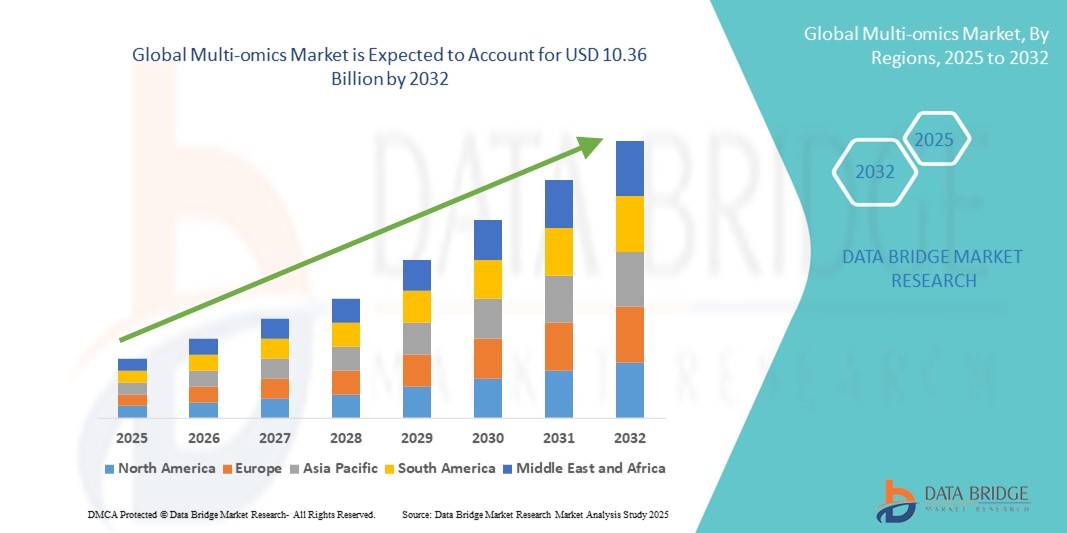
Multi-omics Market Size
- The global multi-omics market size was valued at USD 3.34 billion in 2024 and is expected to reach USD 10.36 billion by 2032, at a CAGR of 15.20% during the forecast period
- The market growth is largely fueled by the increasing integration of genomics, transcriptomics, proteomics, metabolomics, and epigenomics to derive deeper biological insights across drug discovery, personalized medicine, and disease diagnostics. The convergence of these disciplines enables comprehensive data-driven decision-making and is transforming traditional biomedical research methodologies
- Furthermore, rising demand for precision medicine, expanding applications in oncology and rare disease research, and the growing availability of high-throughput omics platforms are accelerating the uptake of multi-omics solutions. These converging factors—combined with AI-driven analytics, supportive government funding, and the proliferation of big data in healthcare—are significantly boosting the growth of the global multi-omics market
Multi-omics Market Analysis
- The Multi-omics market, which integrates genomics, proteomics, metabolomics, transcriptomics, and epigenomics, is becoming a cornerstone of precision medicine and systems biology due to its ability to provide comprehensive molecular profiling
- The rising demand for multi-omics platforms is driven by the increasing need for personalized treatment strategies, advancements in next-generation sequencing and mass spectrometry technologies, and growing investments in translational research
- North America dominated the multi-omics market with the largest revenue share of 38.6% in 2024, fueled by robust research infrastructure, strong biotech funding, and the presence of major players such as Thermo Fisher Scientific, Illumina, and Agilent Technologies. The U.S. leads with large-scale implementation of multi-omics in cancer genomics, rare disease research, and clinical trials
- Asia-Pacific is projected to be the fastest growing region in the multi-omics market, registering a CAGR of 19.3% from 2025 to 2032, supported by increasing government initiatives in omics research, growing biotech ecosystems in China, India, and South Korea, and rising healthcare expenditure
- The bulk segment dominated the multi-omics market with revenue share of 63.1% in 2024, due to its widespread use in population-level studies and lower cost compared to single-cell techniques. Bulk analysis continues to be the preferred method for large-scale omics studies involving tissues and mixed samples
Report Scope and Multi-omics Market Segmentation
|
Attributes |
Multi-omics Key Market Insights |
|
Segments Covered |
|
|
Countries Covered |
North America
Europe
Asia-Pacific
Middle East and Africa
South America
|
|
Key Market Players |
|
|
Market Opportunities |
|
|
Value Added Data Infosets |
In addition to the insights on market scenarios such as market value, growth rate, segmentation, geographical coverage, and major players, the market reports curated by the Data Bridge Market Research also include in-depth expert analysis, pricing analysis, brand share analysis, consumer survey, demography analysis, supply chain analysis, value chain analysis, raw material/consumables overview, vendor selection criteria, PESTLE Analysis, Porter Analysis, and regulatory framework. |
Multi-omics Market Trends
Rapid Technological Advancements Enhancing Multi-Omics Integration
- A significant and accelerating trend in the global multi-omics market is the convergence of high-throughput technologies such as next-generation sequencing (NGS), mass spectrometry, and single-cell analysis platforms, which enable a deeper understanding of complex biological systems
- For instance, companies like 10x Genomics and Illumina are integrating multi-omics workflows that combine transcriptomics with proteomics or epigenomics at the single-cell level, facilitating highly granular molecular profiling for disease research
- Multi-omics platforms now incorporate advanced bioinformatics tools capable of aligning and interpreting vast datasets across various omics layers, enabling researchers to uncover novel biomarkers and disease mechanisms with greater precision
- The integration of multi-omics into clinical workflows is streamlining patient stratification, therapeutic response prediction, and drug discovery processes, particularly in fields such as oncology, neurology, and immunology
- Furthermore, multi-omics solutions are being increasingly incorporated into national and global initiatives, such as the Human Cell Atlas and the Cancer Moonshot project, accelerating translational research
- This trend toward comprehensive, interconnected, and data-driven molecular profiling is reshaping how biomedical research and precision medicine are conducted, leading to an increase in demand from academic research institutions, CROs, and pharmaceutical companies worldwide
Multi-omics Market Dynamics
Driver
Growing Need Due to Rising Demand for Precision Medicine and Integrated Omics Approaches
- The increasing prevalence of complex diseases like cancer, neurological disorders, and metabolic syndromes is driving the demand for integrated multi-omics approaches, which provide comprehensive insights at the genomic, transcriptomic, proteomic, and metabolomic levels
- For instance, global initiatives such as the Human Tumor Atlas Network (HTAN) and All of Us Research Program are leveraging multi-omics platforms to accelerate personalized medicine development and deepen understanding of disease heterogeneity
- The pharmaceutical and biotechnology industries are adopting multi-omics to identify biomarkers, predict therapeutic responses, and reduce drug development timelines, supporting its rapid market expansion
- Furthermore, the growing integration of single-cell technologies and spatial omics tools is enabling more precise cellular and molecular profiling, which is increasingly valued in translational and clinical research
- The use of cloud-based bioinformatics platforms and advanced analytical tools is making it easier for researchers to process and interpret large-scale omics data, broadening accessibility across research institutes, CROs, and diagnostic labs
Restraint/Challenge
Data Integration Complexity and High Cost of Multi-Omics Platforms
- Despite growing adoption, the multi-omics market faces major challenges around data integration, as each omics layer generates large and diverse datasets that require advanced computational tools and domain-specific knowledge to interpret accurately
- For instance, harmonizing genomic data with proteomic or metabolomic profiles demands significant infrastructure, skilled personnel, and standardized workflows, which can be a barrier for smaller institutions or developing regions
- The high cost associated with multi-omics platforms—including instruments, reagents, and bioinformatics software—limits adoption, particularly for preclinical and academic research groups with limited budgets
- Moreover, privacy concerns around patient data and regulatory compliance (e.g., GDPR in Europe or HIPAA in the U.S.) complicate the large-scale use of multi-omics in clinical applications
- To overcome these challenges, the market needs improved interoperability standards, scalable data platforms, and greater investments in data security and cost-efficient multi-omics solutions. This would help democratize access and support sustainable market growth over the forecast period
Multi-omics Market Scope
The market is segmented on the basis of products & services, type, platform, application, and end use.
- By Products & Services
On the basis of products & services, the global multi-omics market is segmented into Products and services. The products segment dominated the largest market revenue share of 58.3% in 2024, driven by the rising adoption of high-throughput omics instruments and continuous advancements in sequencing and mass spectrometry platforms. Increasing demand for accurate, reproducible, and sensitive detection in genomics and proteomics workflows fuels the need for advanced instruments and consumables.
The services segment is anticipated to witness the fastest growth rate of 20.6% from 2025 to 2032, supported by the expanding trend of outsourcing omics data analysis to third-party bioinformatics service providers. This is further accelerated by the growing demand for integrated multi-omics data interpretation across academia and pharmaceutical research.
- By Type
On the basis of type, the market is segmented into single-cell and bulk. The bulk segment held the largest revenue share of 63.1% in 2024, due to its widespread use in population-level studies and lower cost compared to single-cell techniques. Bulk analysis continues to be the preferred method for large-scale omics studies involving tissues and mixed samples.
The single-cell segment is projected to register the fastest CAGR of 24.3% from 2025 to 2032, owing to its growing relevance in uncovering cellular heterogeneity, especially in oncology, neurology, and developmental biology.
- By Platform
On the basis of platform, the global multi-omics market is segmented into genomics, transcriptomics, proteomics, metabolomics, and integrated omics platforms. The genomics segment dominated the market with the largest revenue share of 31.4% in 2024, driven by the high volume of genomic data generated and its fundamental role across various biological investigations and clinical applications.
The metabolomics segment is expected to experience the fastest CAGR of 21.8% from 2025 to 2032, thanks to growing interest in metabolic profiling for disease biomarker discovery and personalized therapy monitoring.
- By Application
On the basis of application, the global multi-omics market is segmented into oncology, cell biology, neurology, immunology, and other applications. The cell biology segment held the highest revenue share of 26.7% in 2024, propelled by a surge in research targeting cellular responses, differentiation, and signaling pathways.
The oncology segment is anticipated to expand at the fastest CAGR of 23.5% during the forecast period, as multi-omics approaches become pivotal in cancer research, diagnostics, and targeted therapy development.
- By End Use
On the basis of end use, the market is segmented into academic & research organizations, pharmaceutical & biotechnology companies, hospital and diagnostic laboratories, and other end-users. The academic & research organizations segment captured the largest market share of 39.7% in 2024, driven by the rising volume of basic and translational research globally and increasing government funding for multi-omics-based studies.
The pharmaceutical & biotechnology companies segment is expected to witness the fastest CAGR of 22.4% from 2025 to 2032, as these players increasingly leverage multi-omics insights for drug discovery, biomarker development, and clinical trial optimization.
Multi-omics Market Regional Analysis
- North America dominated the multi-omics market with the largest revenue share of 38.6% in 2024, driven by a growing demand for advanced life sciences technologies, increasing adoption of precision medicine, and strong investments in multi-omics research platforms
- Consumers and researchers in the region benefit from robust biotechnology infrastructure, early adoption of cutting-edge analytical tools, and well-funded genomic research programs
- The presence of key players, academic institutions, and favorable regulatory frameworks further strengthens North America’s leadership in the global Multi-omics market
U.S. Multi-omics Market Insight
The U.S. multi-omics market captured the largest revenue share of 78% in 2024 within North America, supported by strong NIH funding, high-throughput omics research in cancer and rare diseases, and expanding initiatives in personalized medicine. Widespread integration of AI and bioinformatics into research workflows is significantly accelerating discovery and application. In addition, the U.S. biotechnology sector’s focus on merging genomic, proteomic, and metabolomic data to create precision diagnostics and therapeutics is fueling demand.
Europe Multi-omics Market Insight
The Europe multi-omics market is projected to expand at a substantial CAGR throughout the forecast period, driven by supportive regulatory policies for omics research, increasing collaborations between universities and pharma companies, and emphasis on population-wide health studies like the UK Biobank. The region also benefits from strong government funding in genomic and clinical research. Countries like Germany, the U.K., and France are at the forefront of implementing integrative omics in healthcare and drug discovery.
U.K. Multi-omics Market Insight
The U.K. multi-omics market is anticipated to grow at a noteworthy CAGR during the forecast period due to increasing applications of multi-omics in NHS-backed healthcare innovation and academic research programs. The Genomics England initiative and national personalized medicine strategies have positioned the U.K. as a leader in omics-based research. Collaboration with global biotech firms and AI integration into research models are further propelling market growth.
Germany Multi-omics Market Insight
The Germany multi-omics market is expected to grow significantly due to its strong pharmaceutical and diagnostics sectors. The government’s investment in translational medicine and precision health research is boosting multi-omics platform deployment across academic and clinical settings. The presence of major biotech hubs like Berlin and Heidelberg, along with a strong focus on proteogenomics and metabolomics, supports sustained market expansion.
Asia-Pacific Multi-omics Market Insight
The Asia-Pacific multi-omics market is poised to grow at the fastest CAGR of 19.3% from 2025 to 2032, driven by rapid technological adoption, increasing government initiatives to promote genomic research, and a surge in healthcare digitization. Countries such as China, Japan, and India are investing heavily in national genomic databases and bioinformatics infrastructure, creating fertile ground for multi-omics solutions across pharmaceutical, academic, and clinical domains.
Japan Multi-omics Market Insight
The Japan multi-omics market is gaining momentum due to its advanced R&D ecosystem, government-funded precision medicine programs, and a focus on aging-related disease research. Japanese universities and pharma firms are actively adopting transcriptomics, proteomics, and metabolomics to uncover new biomarkers and develop tailored therapies. High integration of AI in data interpretation is further driving adoption.
China Multi-omics Market Insight
The China multi-omics market accounted for the largest revenue share in Asia-Pacific in 2024, supported by robust government funding under initiatives like the China Precision Medicine Plan, growing biotech startups, and widespread deployment of next-generation sequencing technologies. China’s role as a global manufacturing hub and its aggressive push for omics integration into clinical workflows are key factors boosting its market dominance.
Multi-omics Market Share
The Multi-omics industry is primarily led by well-established companies, including:
- BD (U.S.)
- Thermo Fisher Scientific Inc. (U.S.)
- Illumina, Inc. (U.S.)
- Danaher Corporation (U.S.)
- PerkinElmer Inc. (U.S.)
- Shimadzu Corporation (Japan)
- Bruker (U.S.)
- QIAGEN (Germany)
- Agilent Technologies, Inc. (U.S.)
- BGI (China)
- 10x Genomics (U.S.)
- CYTENA GmbH (Germany)
Latest Developments in Global Multi-omics Market
- In September 2023, 10x Genomics, Inc. announced the commercial availability of a new kit to expand the capabilities of its chromium single cell gene expression flex assay to include high throughput multi-omic cellular profiling. The new kit enables streamlined, multi-omic characterization of cell populations so that researchers can expand their options at a larger scale and detect simultaneous gene and protein expression. This strategy helped the company to expand its product offerings
- In February 2023, Becton, Dickinson, and Company launched a high-throughput single-cell multiomics platform, Rhapsody HT Xpress System, to expand the scope of scientific discovery. This new system enables scientists to isolate, barcode, and analyze single cells at a high sample throughput - up to eight times more cells than prior versions of BD single-cell analysers. This strategy is anticipated to help the company widen its product applications and cater to a larger customer base
- In July 2025, Dante Omics AI unveiled its proprietary GPU-accelerated multi-omics platform designed to integrate genomics, transcriptomics, and metabolomics data. This innovation offers real-time molecular analysis and high-performance computing power, driving significant advancements in personalized medicine and complex disease modeling
- In May 2025, Pluto Biosciences announced it secured USD 3.6 million in funding to expand its AI-powered multi-omics data platform. The platform allows pharmaceutical companies to run bioinformatics pipelines and visualize data at scale without writing code, promoting broader adoption in clinical research
- In May 2025, MGI Tech debuted its DNBSEQ-T1+ sequencer and DNBelab C-YellowR 16 single-cell platform at the ESHG 2025 in Milan. These next-generation systems are designed for high-throughput multi-omics workflows, with features like automation, scalability, and cost-efficiency for large clinical studies
- In May 2025, University of Warwick inaugurated a cutting-edge multi-omics facility in the West Midlands, U.K. The center will support detailed organ-level omics mapping, including liver and brain samples, for translational research and drug discovery initiatives across Europe
- In February 2025, Illumina announced an expansion of its multi-omics research solutions with new technologies in single-cell analysis, methylation, spatial transcriptomics, and CRISPR screening. The initiative supports researchers in unlocking deeper biological insights and accelerating discoveries in disease biology

- Interactive Data Analysis Dashboard
- Company Analysis Dashboard for high growth potential opportunities
- Research Analyst Access for customization & queries
- Competitor Analysis with Interactive dashboard
- Latest News, Updates & Trend analysis
- Harness the Power of Benchmark Analysis for Comprehensive Competitor Tracking
Data collection and base year analysis are done using data collection modules with large sample sizes. The stage includes obtaining market information or related data through various sources and strategies. It includes examining and planning all the data acquired from the past in advance. It likewise envelops the examination of information inconsistencies seen across different information sources. The market data is analysed and estimated using market statistical and coherent models. Also, market share analysis and key trend analysis are the major success factors in the market report. To know more, please request an analyst call or drop down your inquiry.
The key research methodology used by DBMR research team is data triangulation which involves data mining, analysis of the impact of data variables on the market and primary (industry expert) validation. Data models include Vendor Positioning Grid, Market Time Line Analysis, Market Overview and Guide, Company Positioning Grid, Patent Analysis, Pricing Analysis, Company Market Share Analysis, Standards of Measurement, Global versus Regional and Vendor Share Analysis. To know more about the research methodology, drop in an inquiry to speak to our industry experts.
Data Bridge Market Research is a leader in advanced formative research. We take pride in servicing our existing and new customers with data and analysis that match and suits their goal. The report can be customized to include price trend analysis of target brands understanding the market for additional countries (ask for the list of countries), clinical trial results data, literature review, refurbished market and product base analysis. Market analysis of target competitors can be analyzed from technology-based analysis to market portfolio strategies. We can add as many competitors that you require data about in the format and data style you are looking for. Our team of analysts can also provide you data in crude raw excel files pivot tables (Fact book) or can assist you in creating presentations from the data sets available in the report.













