


Myomectomy Market Size
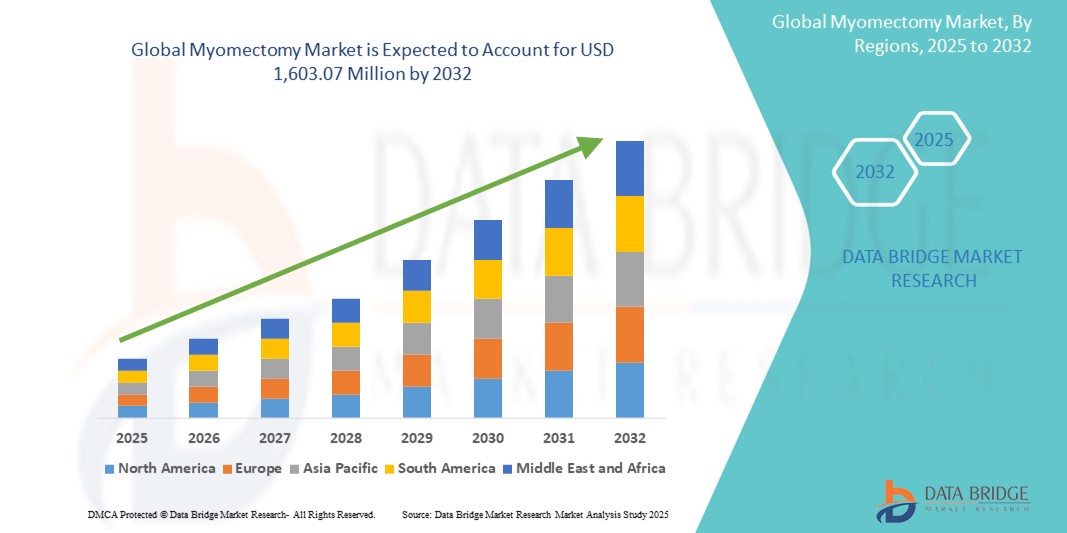
- The global myomectomy market size was valued at USD 824.28 million in 2024 and is expected to reach USD 1,603.07 million by 2032, at a CAGR of 8.67% during the forecast period
- The market growth is primarily driven by the rising prevalence of uterine fibroids among women of reproductive age and the increasing demand for uterus-preserving surgical options
- In addition, advancements in minimally invasive surgical techniques and robotic-assisted procedures are improving patient outcomes and recovery times, making myomectomy a preferred treatment choice. These clinical and technological advancements are fostering wider adoption of myomectomy procedures, thereby propelling the market's expansion
Myomectomy Market Analysis
- Myomectomy, a surgical procedure for removing uterine fibroids while preserving the uterus, is gaining traction as a preferred treatment among women seeking fertility preservation and minimally invasive options for managing fibroid-related symptoms in both hospital and ambulatory settings
- The rising demand for myomectomy procedures is largely driven by increasing awareness of reproductive health, higher incidence of uterine fibroids, and growing preference for uterus-sparing treatments among women of reproductive age
- North America dominated the myomectomy market with the largest revenue share of 39.5% in 2024, supported by advanced healthcare infrastructure, high diagnostic rates, and a strong presence of leading surgical device manufacturers, with the U.S. experiencing significant procedural volumes due to early adoption of robotic-assisted and laparoscopic surgeries
- Asia-Pacific is expected to be the fastest growing region in the myomectomy market during the forecast period due to improving access to healthcare, increasing medical tourism, and rising awareness of fibroid-related treatment options
- Laparoscopic myomectomy segment dominated the myomectomy market with a share of 46.1% in 2024, driven by patient preference for minimally invasive approaches offering reduced recovery time, lower complication rates, and shorter hospital stays
Report Scope and Myomectomy Market Segmentation
|
Attributes |
Myomectomy Key Market Insights |
|
Segments Covered |
|
|
Countries Covered |
North America
Europe
Asia-Pacific
Middle East and Africa
South America
|
|
Key Market Players |
|
|
Market Opportunities |
|
|
Value Added Data Infosets |
In addition to the insights on market scenarios such as market value, growth rate, segmentation, geographical coverage, and major players, the market reports curated by the Data Bridge Market Research also include in-depth expert analysis, pricing analysis, brand share analysis, consumer survey, demography analysis, supply chain analysis, value chain analysis, raw material/consumables overview, vendor selection criteria, PESTLE Analysis, Porter Analysis, and regulatory framework. |
Myomectomy Market Trends
“Technological Advancements in Minimally Invasive and Robotic Surgery”
- A significant and accelerating trend in the global myomectomy market is the growing adoption of minimally invasive and robotic-assisted surgical techniques. These technological advancements are improving surgical precision, reducing patient recovery times, and minimizing post-operative complications, thereby driving broader acceptance of myomectomy as a preferred fibroid treatment option
- For instance, the da Vinci Surgical System by Intuitive Surgical allows for robot-assisted laparoscopic myomectomy, enabling surgeons to perform complex procedures with enhanced dexterity and control. Hospitals worldwide are increasingly equipping operating rooms with such systems to offer patients less invasive options
- Robotic systems and advanced laparoscopic tools facilitate the removal of fibroids with smaller incisions, leading to shorter hospital stays and quicker return to normal activities, which is especially important for women prioritizing fertility preservation
- The integration of 3D imaging, high-definition visualization, and precision instruments in these procedures enhances surgical outcomes and patient safety. These improvements are expanding the appeal of myomectomy over more invasive alternatives such as hysterectomy, especially among younger women and those with fertility considerations
- Moreover, increasing clinical research and medical education around fibroid treatment options are encouraging early diagnosis and timely surgical intervention, further promoting market growth. Hospitals and gynecology centers are also offering personalized treatment plans supported by real-time imaging and AI-assisted diagnostics
- The demand for advanced, minimally invasive myomectomy procedures is growing steadily across both developed and emerging markets, driven by patient preference for uterus-sparing, faster-recovery treatments and the expanding availability of advanced surgical technologies
Myomectomy Market Dynamics
Driver
“Rising Uterine Fibroid Incidence and Fertility Preservation Awareness”
- The increasing prevalence of uterine fibroids among women globally and a growing awareness about fertility preservation are significant drivers of the myomectomy market’s growth
- For instance, according to the Office on Women's Health (U.S.), up to 80% of women develop fibroids by the age of 50, with many requiring surgical intervention. This high incidence has led to a greater demand for uterus-preserving surgeries such as myomectomy over definitive procedures such as hysterectomy
- Women seeking to retain fertility are increasingly opting for laparoscopic or robotic-assisted myomectomy, particularly in regions where awareness and access to gynecological care are expanding. Educational campaigns, improved diagnostic imaging, and targeted patient counseling are also contributing to timely surgical intervention
- The availability of less invasive, fertility-friendly options makes myomectomy more appealing, especially in the reproductive age group. As reproductive healthcare evolves to prioritize patient choice and quality of life, the demand for effective yet conservative surgical solutions such as myomectomy continues to rise
- Advancements in surgical tools and perioperative care further support the adoption of myomectomy, both in hospital and ambulatory care settings, enhancing patient outcomes and satisfaction
Restraint/Challenge
“Surgical Risks and Access Disparities in Developing Regions”
- Despite technological progress, the invasiveness of surgical procedures and limited access to skilled surgeons and advanced facilities in developing regions remain challenges to broader myomectomy adoption
- For instance, myomectomy still carries risks such as bleeding, adhesion formation, and the potential need for conversion to hysterectomy in complicated cases. In areas with limited access to laparoscopic or robotic systems, patients may face higher complication risks or longer recovery times with conventional open surgery
- Furthermore, disparities in healthcare infrastructure and specialist availability hinder timely diagnosis and access to minimally invasive treatment, particularly in low-income and rural areas. This can delay intervention and limit patients' options for uterus-sparing procedures
- In addition, the cost of advanced technologies such as robotic systems can be prohibitive for many hospitals, leading to uneven adoption and access to high-quality surgical care. The need for comprehensive insurance coverage, skilled training, and investment in surgical innovation remains a barrier in several countries
- Overcoming these limitations will require coordinated efforts to expand access to trained specialists, promote cost-effective surgical innovations, and improve healthcare infrastructure, particularly in underserved regions, to ensure broader and equitable adoption of myomectomy as a fibroid treatment solution
Myomectomy Market Scope
The market is segmented on the basis of type, product, and end user.
- By Type
On the basis of type, the global myomectomy market is segmented into robotic myomectomy, abdominal myomectomy, hysteroscopic myomectomy, and laparoscopic myomectomy. The laparoscopic myomectomy segment dominated the market with the largest market revenue share of 46.1% in 2024, driven by increasing patient preference for minimally invasive procedures that offer faster recovery, less postoperative pain, and minimal scarring. Healthcare providers favor laparoscopic techniques due to reduced hospital stays, improved surgical precision, and lower complication rates, especially for women seeking fertility preservation.
The robotic myomectomy segment is anticipated to witness the fastest growth rate from 2025 to 2032, fueled by advancements in robotic-assisted surgical systems and growing availability in high-end hospitals. Robotic platforms offer enhanced dexterity, visualization, and accuracy, making them suitable for complex cases involving multiple or deeply embedded fibroids. The increasing awareness and adoption of robotic procedures, particularly in developed countries, contribute to the segment's rapid expansion.
- By Product
On the basis of product, the myomectomy market is segmented into laparoscopic power morcellators, harmonic scalpel, laparoscopic sealer, and others. The laparoscopic power morcellators segment held the largest market share in 2024 due to their extensive use in minimally invasive fibroid removal procedures. These devices enable the fragmentation and extraction of large fibroids through small incisions, reducing surgical trauma and enhancing patient recovery. Despite past regulatory scrutiny, advancements in containment systems and surgical techniques are restoring confidence in morcellator usage.
The harmonic scalpel segment is expected to register the fastest growth over the forecast period, attributed to its ability to simultaneously cut and coagulate tissue with ultrasonic energy, reducing intraoperative bleeding and improving surgical efficiency. Growing demand for precision instruments that minimize thermal damage and surgical time supports the rising adoption of harmonic scalpels in advanced myomectomy procedures.
- By End User
On the basis of end user, the myomectomy market is segmented into hospitals, ambulatory surgical centers, clinics, and medical device companies. The hospitals segment accounted for the largest revenue share in 2024, owing to the high volume of gynecological surgeries performed in these settings, availability of specialized surgical teams, and access to advanced infrastructure and robotic systems. Hospitals remain the primary site for complex and multi-fibroid myomectomy procedures, especially in urban and tertiary care facilities.
The ambulatory surgical centers (ASCs) segment is projected to grow at the fastest rate during the forecast period, driven by the increasing shift toward outpatient, minimally invasive procedures and the cost-effectiveness of ASCs. Rising patient preference for shorter hospital stays, rapid recovery, and lower treatment costs are encouraging the adoption of myomectomy procedures in ASC settings.
Myomectomy Market Regional Analysis
- North America dominated the myomectomy market with the largest revenue share of 39.5% in 2024, supported by advanced healthcare infrastructure, high diagnostic rates, and a strong presence of leading surgical device manufacturers
- Patients in the region benefit from access to advanced surgical technologies, including robotic-assisted and minimally invasive procedures, along with widespread insurance coverage for gynecological treatments
- This strong market position is further reinforced by well-established healthcare infrastructure, a high concentration of skilled surgeons, and increasing awareness about fibroid management and fertility preservation, positioning myomectomy as the preferred treatment choice in hospital and outpatient settings across the region
U.S. Myomectomy Market Insight
The U.S. myomectomy market captured the largest revenue share of 79% in 2024 within North America, driven by the high prevalence of uterine fibroids and strong patient demand for fertility-preserving surgical treatments. Advanced healthcare infrastructure, widespread access to robotic-assisted surgery, and comprehensive insurance coverage are key factors supporting market dominance. The growing preference for minimally invasive myomectomy procedures, along with increased awareness of women’s reproductive health, continues to propel the market forward.
Europe Myomectomy Market Insight
The Europe myomectomy market is projected to grow at a substantial CAGR throughout the forecast period, largely influenced by rising awareness of uterine health, favorable reimbursement policies, and the expansion of advanced surgical facilities. Increasing patient preference for uterus-sparing treatments and the adoption of laparoscopic and robotic techniques in countries such as Germany, France, and Italy are contributing to market growth. The rising incidence of symptomatic fibroids and emphasis on outpatient procedures are also driving demand.
U.K. Myomectomy Market Insight
The U.K. myomectomy market is anticipated to grow at a noteworthy CAGR during the forecast period, supported by a strong focus on women’s health, advancements in gynecological surgery, and a shift toward minimally invasive procedures. With increasing emphasis on fertility preservation and patient-centric care, hospitals and specialty clinics are offering more laparoscopic and robotic-assisted myomectomy options. Public awareness campaigns and access to NHS and private healthcare services are further fueling market expansion.
Germany Myomectomy Market Insight
The Germany myomectomy market is expected to expand at a considerable CAGR during the forecast period, driven by the country’s advanced healthcare system and emphasis on surgical innovation. The demand for minimally invasive and robotic procedures continues to grow, especially in urban centers, where patients seek high-precision, fertility-preserving treatments. Germany’s focus on patient outcomes and surgical excellence is fostering the adoption of modern myomectomy techniques across both public and private healthcare institutions.
Asia-Pacific Myomectomy Market Insight
The Asia-Pacific myomectomy market is poised to grow at the fastest CAGR of 23.6% during the forecast period of 2025 to 2032, driven by increasing healthcare awareness, a rising female population of reproductive age, and improvements in surgical infrastructure in countries such as China, India, and Japan. Government efforts to expand gynecological services and the growing acceptance of minimally invasive procedures are encouraging market adoption. The affordability of treatments and rising medical tourism also contribute to regional growth.
Japan Myomectomy Market Insight
The Japan myomectomy market is gaining momentum due to the country’s advanced medical technology landscape and growing focus on women’s reproductive health. High awareness, widespread access to diagnostic imaging, and demand for precise, minimally invasive treatments are driving market expansion. Hospitals in Japan are increasingly equipped with robotic-assisted surgical systems, and aging population demographics are contributing to a preference for uterus-conserving procedures with quicker recovery times.
India Myomectomy Market Insight
The India myomectomy market accounted for the largest revenue share in Asia-Pacific in 2024, fueled by rising fibroid incidence, expanding urban healthcare infrastructure, and growing demand for affordable, uterus-preserving surgeries. The market benefits from increased awareness of gynecological conditions and access to cost-effective laparoscopic procedures. Government initiatives aimed at improving women’s health services and the growing presence of private healthcare providers are also accelerating the adoption of myomectomy across the country.
Myomectomy Market Share
The Myomectomy industry is primarily led by well-established companies, including:
- Medtronic (Ireland)
- Johnson & Johnson Services, Inc. (U.S.)
- Olympus Corporation (Japan)
- Stryker (U.S.)
- Hologic, Inc. (U.S.)
- Intuitive Surgical, Inc. (U.S.)
- Karl Storz SE & Co. KG (Germany)
- B. Braun SE (Germany)
- Richard Wolf GmbH (Germany)
- CONMED Corporation (U.S.)
- Cook Medical LLC (U.S.)
- Minerva Surgical, Inc. (U.S.)
- CooperSurgical, Inc. (U.S.)
- Lumenis Ltd. (Israel)
- BD (U.S.)
- Rudolf Medical GmbH + Co. KG (Germany)
What are the Recent Developments in Global Myomectomy Market?
- In May 2024, Intuitive Surgical, Inc. announced expanded capabilities for its da Vinci Xi surgical system, optimizing it further for complex gynecologic procedures, including myomectomy. This upgrade aims to improve precision and flexibility during minimally invasive fibroid removal, reinforcing Intuitive Surgical’s leadership in robotic-assisted surgery and its role in advancing women's health solutions globally
- In March 2024, Olympus Corporation introduced its next-generation laparoscopic instruments tailored for gynecological surgeries, including myomectomy. These tools feature enhanced ergonomics and visualization support, offering surgeons better control and reducing operative time. The development aligns with Olympus’s strategy to drive innovation in minimally invasive gynecologic procedures
- In February 2024, Hologic, Inc. launched a global awareness campaign to educate women on uterine fibroid management and highlight myomectomy as a uterus-preserving treatment option. This initiative, supported by healthcare partners, aims to empower women to seek timely and informed care, promoting early diagnosis and increased adoption of surgical interventions
- In January 2024, Stryker Corporation announced the integration of artificial intelligence (AI)-powered analytics into its laparoscopic systems, enabling enhanced intraoperative decision-making during procedures such as myomectomy. The move reflects a growing trend of integrating digital tools to improve surgical outcomes and reduce complication rates in gynecological surgeries
- In December 2023, Medtronic plc expanded its gynecologic surgical device portfolio with the launch of a new bipolar energy device specifically designed for myomectomy. This innovation enhances tissue sealing and reduces blood loss during fibroid removal. Medtronic’s focus on developing precision tools for complex gynecological procedures supports the growing demand for minimally invasive uterine-sparing treatments worldwide

- Interactive Data Analysis Dashboard
- Company Analysis Dashboard for high growth potential opportunities
- Research Analyst Access for customization & queries
- Competitor Analysis with Interactive dashboard
- Latest News, Updates & Trend analysis
- Harness the Power of Benchmark Analysis for Comprehensive Competitor Tracking
Data collection and base year analysis are done using data collection modules with large sample sizes. The stage includes obtaining market information or related data through various sources and strategies. It includes examining and planning all the data acquired from the past in advance. It likewise envelops the examination of information inconsistencies seen across different information sources. The market data is analysed and estimated using market statistical and coherent models. Also, market share analysis and key trend analysis are the major success factors in the market report. To know more, please request an analyst call or drop down your inquiry.
The key research methodology used by DBMR research team is data triangulation which involves data mining, analysis of the impact of data variables on the market and primary (industry expert) validation. Data models include Vendor Positioning Grid, Market Time Line Analysis, Market Overview and Guide, Company Positioning Grid, Patent Analysis, Pricing Analysis, Company Market Share Analysis, Standards of Measurement, Global versus Regional and Vendor Share Analysis. To know more about the research methodology, drop in an inquiry to speak to our industry experts.
Data Bridge Market Research is a leader in advanced formative research. We take pride in servicing our existing and new customers with data and analysis that match and suits their goal. The report can be customized to include price trend analysis of target brands understanding the market for additional countries (ask for the list of countries), clinical trial results data, literature review, refurbished market and product base analysis. Market analysis of target competitors can be analyzed from technology-based analysis to market portfolio strategies. We can add as many competitors that you require data about in the format and data style you are looking for. Our team of analysts can also provide you data in crude raw excel files pivot tables (Fact book) or can assist you in creating presentations from the data sets available in the report.













