


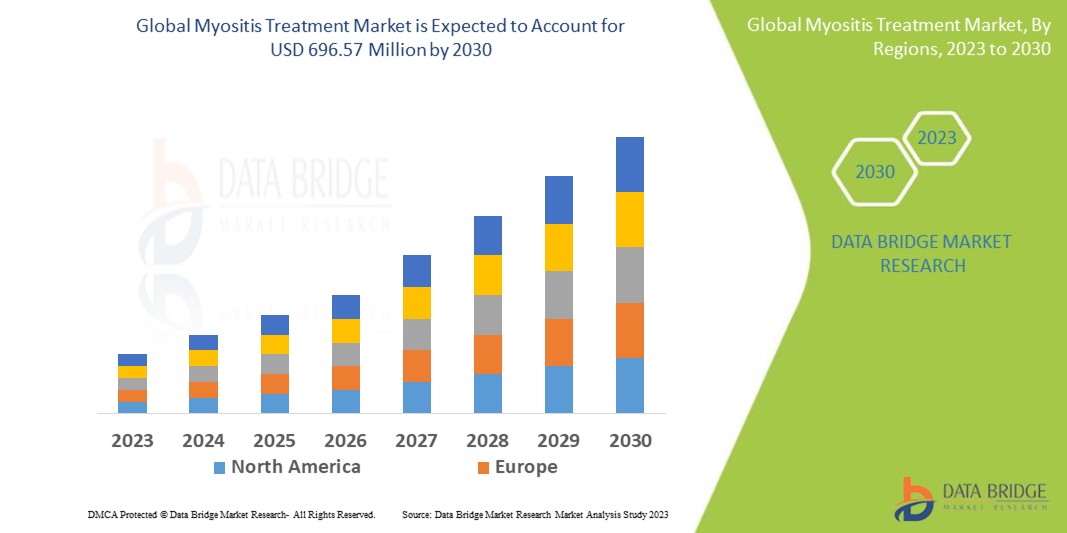
Myositis Treatment Market Analysis and Size
Myositis is a condition characterized by inflammation in muscles, which can be caused by infection, injury, or autoimmune disease. Two specific kinds of myositis are polymyositis and dermatomyositis. Muscle weakness, swelling, and pain are common symptoms of myositis. The major causes of myositis are inflammations, viral infections, and medications such as statins, cocaine, and alcohol.
Data Bridge Market Research analyses that the myositis treatment market, which was USD 493.15 million in 2022, would rocket up to USD 696.57 million by 2030 and is expected to undergo a CAGR of 4.4% during the forecast period of 2023 to 2030. “Inclusion body myositis” dominates the type segment of the myositis treatment market owing to the increasing prevalence of muscle inflammation. In addition to the insights on market scenarios such as market value, growth rate, segmentation, geographical coverage, and major players, the market reports curated by the Data Bridge Market Research also include depth expert analysis, patient epidemiology, pipeline analysis, pricing analysis, and regulatory framework.
Myositis Treatment Market Scope and Segmentation
|
Report Metric |
Details |
|
Forecast Period |
2023 to 2030 |
|
Base Year |
2022 |
|
Historic Years |
2021 (Customizable to 2015-202o) |
|
Quantitative Units |
Revenue in USD Million, Volumes in Units, Pricing in USD |
|
Segments Covered |
By Type (Inclusion-Body Myositis, Polymyositis, Dermatomyositis, Others), Diagnosis (Muscle Biopsy, Electromyography, Myositis Specific Antibody Panel Blood Test, Genetic Testing, Others), Therapy Type (Exercise and Physiotherapy, Steroid Medication, Intravenous Immunoglobulin Therapy, Others), Route of Administration (Oral, Injectable and Others), End Users (Hospitals, Homecare, Specialty Clinics, Others), Distribution Channel (Hospital Pharmacy, Online Pharmacy, Retail Pharmacy, Others) |
|
Countries Covered |
U.S., Canada, Mexico, Germany, France, U.K., Netherlands, Switzerland, Belgium, Russia, Italy, Spain, Turkey, Rest of Europe, China, Japan, India, South Korea, Singapore, Malaysia, Australia, Thailand, Indonesia, Philippines, Rest of Asia-Pacific, Saudi Arabia, U.A.E, South Africa, Egypt, Israel, Rest of Middle East and Africa, Brazil, Argentina, and Rest of South America. |
|
Market Players Covered |
|
|
Market Opportunities |
|
Market Definition
Myositis is a term used to describe the inflammation of the muscles, which can cause pain, fatigue, and muscular wasting. It is a particular kind of autoimmune disease when the body's immune system unintentionally targets its own muscle tissues. Myositis is often treated with a multidisciplinary strategy that combines medication, physical therapy and dietary changes. Treatment objectives are reducing inflammation, controlling symptoms, enhancing muscle function and strength, and avoiding long-term consequences.
Myositis Treatment Market Dynamics
Drivers
- Increasing prevalence of myositis
According to reports, increased awareness among healthcare professionals and better diagnostic skills have led to a rise in the prevalence of myositis. The market for myositis treatments can rise due to the growing patient population.
- Rising research activities
The treatment market is expanding due to ongoing research projects aimed at unraveling the underlying mechanisms of myositis and creating cutting-edge therapeutic strategies. clinical trials and increased investment in R&D can help identify novel cures and broaden the range of available treatments.
- Increasing advancement in therapeutic options
Targeted therapies and biologic medicines are two myositis treatments that are currently being developed that have the potential to increase market growth greatly. These developments are meant to offer more targeted and effective medications than traditional ones, possibly with fewer adverse effects.
Opportunities
- Increasing integration of telemedicine
For patients in rural locations or with limited mobility, the introduction of telemedicine and remote monitoring technology can improve access to specialized care. These technological developments open up possibilities for remote disease monitoring, virtual consultations, and improved disease management.
- Increasing collaborations and partnerships
Partnerships between pharmaceutical corporations, academic institutions, and research organizations can speed up the discovery and development of cutting-edge treatments for myositis. Collaborations that encourage knowledge sharing, resource pooling, and combined clinical trials can open up new market prospects.
- Increasing advancements in personalized medicine
Personalizing medical care for each patient based on their unique features is an idea that is gaining ground. Myositis treatment tactics may be optimised using biomarkers, genetic testing, and precision medicine techniques to improve patient results.
Restrains/ Challenges
- Lack of standard rules
There are no widely accepted treatment guidelines because of the diversity of myositis subtypes and the scarcity of large-scale clinical trials. Inconsistent care and uncertainty for patients and healthcare professionals can result from treatment methodologies and practices variations.
- Adverse effects
Many myositis treatments, especially corticosteroids, and immunosuppressant, have possible adverse effects. It can be difficult to weigh the advantages of a course of treatment against its possible drawbacks, particularly when it involves prolonged or high-dose treatment.
- Limited treatment options
Despite improvements in myositis therapy, a sizable unmet demand exists for more efficient and focused treatments. The development of tailored therapies that address the many myositis symptoms is difficult due to the intricacy of the disease and the underlying autoimmune mechanisms.
- High treatment cost
The cost of myositis treatment can be a major access barrier, especially with newer medicines and biologic drugs. Access to novel treatments may be hampered by insurance, cost, and payment policies, especially in areas with limited resources.
This myositis treatment market report provides details of new recent developments, trade regulations, import-export analysis, production analysis, value chain optimization, market share, impact of domestic and localized market players, analyses opportunities in terms of emerging revenue pockets, changes in market regulations, strategic market growth analysis, market size, category market growths, application niches and dominance, product approvals, product launches, geographic expansions, technological innovations in the market. To gain more info on the myositis treatment market contact Data Bridge Market Research for an Analyst Brief, our team will help you take an informed market decision to achieve market growth.
Global Myositis Treatment Market Scope
The myositis treatment market is segmented on the basis of type, diagnosis, therapy type, route of administration, end-user and distribution channel. The growth amongst these segments will help you analyse meagre growth segments in the industries and provide the users with valuable market overview and market insights to help them in making strategic decisions for identification of core market applications.
Type
- Inclusion- body myositis
- Polymyositis
- Dermatomyositis
- Others
Diagnosis
- Muscle biopsy
- Electromyography
- Myositis specific antibody panel blood test
- Genetic testing
- Others
Therapy type
- Exercise and physiotherapy
- Steroid medication
- Intravenous immunoglobulin therapy
- Others
Route of administration
- Oral
- Injectable
- Others
End-User
- Hospitals
- Homecare
- Specialty clinics
- Others
Distribution channel
- Hospital pharmacy
- Retail pharmacy
- Online pharmacy
- Others
Myositis Treatment Market Regional Analysis/Insights
The myositis treatment market is analyzed and market size insights and trends are provided by type, diagnosis, therapy type, route of administration, end-user and distribution channel as referenced above.
The countries covered in the myositis treatment market report are the U.S., Canada, Mexico, Germany, France, U.K., Netherlands, Switzerland, Belgium, Russia, Italy, Spain, Turkey, Rest of Europe, China, Japan, India, South Korea, Singapore, Malaysia, Australia, Thailand, Indonesia, Philippines, Rest of Asia-Pacific, Saudi Arabia, U.A.E, South Africa, Egypt, Israel, Rest of Middle East and Africa, Brazil, Argentina, and Rest of South America.
North America dominates the myositis treatment market because of the well-developed healthcare infrastructure and available treatments and therapies within the region.
Asia-Pacific is the fastest growing in the myositis treatment market because of the steady development of healthcare infrastructure and rising geriatric population.
The country section of the myositis treatment market report also provides individual market impacting factors and changes in regulation in the market domestically that impacts the current and future trends of the market. Data points such as consumption volumes, production sites and volumes, import export analysis, price trend analysis, cost of raw materials, down-stream and upstream value chain analysis are some of the major pointers used to forecast the market scenario for individual countries. Also, presence and availability of global brands and their challenges faced due to large or scarce competition from local and domestic brands, impact of domestic tariffs and trade routes are considered while providing forecast analysis of the country data.
Healthcare Infrastructure growth Installed base and New Technology Penetration
The myositis treatment market also provides you with detailed market analysis for every country growth in healthcare expenditure for capital equipment, installed base of different kind of products for myositis treatment market, impact of technology using life line curves and changes in healthcare regulatory scenarios and their impact on myositis treatment market. The data is available for historic period 2015-202o.
Competitive Landscape and Myositis Treatment Market Share Analysis
The myositis treatment market competitive landscape provides details by competitor. Details included are company overview, company financials, revenue generated, market potential, investment in research and development, new market initiatives, global presence, production sites and facilities, production capacities, company strengths and weaknesses, product launch, product width and breadth, application dominance. The above data points provided are only related to the companies’ focus related to the market.
Some of the major players operating in the myositis treatment market are:
- Corbus Pharmaceuticals Holdings, Inc (U.S.)
- CytRx Corporation (U.S.)
- Pfizer Inc. (U.S.)
- Novartis AG (Switzerland)
- IDERA, Inc. (U.S.)
- Genentech, Inc (U.S.)
- Merck & Co., Inc. (U.S.)
- AbbVie Inc. (U.S.)
- GlaxoSmithKline plc. (India)
- Mallinckrodt (U.K.)
- Bausch Health Companies Inc. (Canada)
- Akorn Operating Company LLC (U.S.)
- Sanofi (France)
- Promega Corporation (U.S.)
- AstraZeneca (U.K.)
- Amgen Inc. (U.S.)

- Interactive Data Analysis Dashboard
- Company Analysis Dashboard for high growth potential opportunities
- Research Analyst Access for customization & queries
- Competitor Analysis with Interactive dashboard
- Latest News, Updates & Trend analysis
- Harness the Power of Benchmark Analysis for Comprehensive Competitor Tracking
Table of Content
1 INTRODUCTION
1.1 OBJECTIVES OF THE STUDY
1.2 MARKET DEFINITION
1.3 OVERVIEW OF GLOBAL MYOSITIS TREATMENT MARKET
1.4 CURRENCY AND PRICING
1.5 LIMITATION
1.6 MARKETS COVERED
2 MARKET SEGMENTATION
2.1 KEY TAKEAWAYS
2.2 ARRIVING AT THE GLOBAL XX SIZE
2.2.1 VENDOR POSITIONING GRID
2.2.2 TECHNOLOGY LIFE LINE CURVE
2.2.3 TRIPOD DATA VALIDATION MODEL
2.2.4 MARKET GUIDE
2.2.5 MULTIVARIATE MODELLING
2.2.6 TOP TO BOTTOM ANALYSIS
2.2.7 CHALLENGE MATRIX
2.2.8 APPLICATION COVERAGE GRID
2.2.9 STANDARDS OF MEASUREMENT
2.2.10 VENDOR SHARE ANALYSIS
2.2.11 DATA POINTS FROM KEY PRIMARY INTERVIEWS
2.2.12 DATA POINTS FROM KEY SECONDARY DATABASES
2.3 GLOBAL MYOSITIS TREATMENT MARKET: RESEARCH SNAPSHOT
2.4 ASSUMPTIONS
3 EXECUTIVE SUMMARY
4 PREMIUM INSIGHTS
4.1 PESTEL ANALYSIS
4.2 PORTER’S FIVE FORCES MODEL
5 INDUSTRY INSIGHTS
5.1 PATENT ANALYSIS
5.1.1 PATENT LANDSCAPE
5.1.2 USPTO NUMBER
5.1.3 PATENT EXPIRY
5.1.4 EPIO NUMBER
5.1.5 PATENT STRENGTH AND QUALITY
5.1.6 PATENT CLAIMS
5.1.7 PATENT CITATIONS
5.1.8 PATENT LITIGATION AND LICENSING
5.1.9 FILE OF PATENT
5.1.10 PATENT RECEIVED CONTRIES
5.1.11 TECHNOLOGY BACKGROUND
5.2 DRUG TREATMENT RATE BY MATURED MARKETS
5.3 DEMOGRAPHIC TRENDS: IMPACTS ON ALL INCIDENCE RATES
5.4 PATIENT FLOW DIAGRAM
5.5 KEY PRICING STRATEGIES
5.6 KEY PATIENT ENROLLMENT STRATEGIES
5.7 INTERVIEWS WITH SPECIALIST
5.8 OTHER KOL SNAPSHOTS
6 EPIDEMIOLOGY
6.1 INCIDENCE OF ALL BY GENDER
6.2 TREATMENT RATE
6.3 MORTALITY RATE
6.4 DRUG ADHERENCE AND THERAPY SWITCH MODEL
6.5 PATIENT TREATMENT SUCCESS RATES
7 MERGERS AND ACQUISITION
7.1 LICENSING
7.2 COMMERCIALIZATION AGREEMENTS
8 REGULATORY FRAMEWORK
8.1 REGULATORY APPROVAL PROCESS
8.2 GEOGRAPHIES’ EASE OF REGULATORY APPROVAL
8.3 REGULATORY APPROVAL PATHWAYS
8.4 LICENSING AND REGISTRATION
8.5 POST-MARKETING SURVEILLANCE
8.6 GOOD MANUFACTURING PRACTICES (GMPS) GUIDELINES
9 PIPELINE ANALYSIS
9.1 CLINICAL TRIALS AND PHASE ANALYSIS
9.2 DRUG THERAPY PIPELINE
9.3 PHASE III CANDIDATES
9.4 PHASE II CANDIDATES
9.5 PHASE I CANDIDATES
9.6 OTHERS (PRE-CLINICAL AND RESEARCH)
TABLE 1 GLOBAL CLINICAL TRIAL MARKET FOR XX
Company Name Therapeutic Area
XX XX
XX XX
XX XX
XX XX
XX XX
XX XX
Sources: Press Releases, Annual Reports, SEC Filings, Investor Presentations, Other Government Sources, Analysis Based on Inputs from Secondary, Expert Interviews
TABLE 2 DISTRIBUTION OF PRODUCTS AND PROJECTS BY PHASE
Phase Number of Projects
Preclinical/Research Projects XX
Clinical Development XX
Phase I XX
Phase II XX
Phase III XX
U.S. Filed/Approved But Not Yest Marketed XX
Total XX
Sources: Press Releases, Annual Reports, SEC Filings, Investor Presentations, Other Government Sources, Analysis Based on Inputs from Secondary, Expert Interviews
TABLE 3 DISTRIBUTION OF PROJECTS BY THERAPEUTIC AREA AND PHASE
Therapeutic Area Preclinical/ Research Project
XX XX
XX XX
XX XX
XX XX
XX XX
Total Projects XX
Sources: Press Releases, Annual Reports, SEC Filings, Investor Presentations, Other Government Sources, Analysis Based on Inputs from Secondary, Expert Interviews
TABLE 4 DISTRIBUTION OF PROJECTS BY SCIENTIFIC APPROACH AND PHASE
Technology Preclinical/ Research Project
XX XX
XX XX
XX XX
XX XX
XX XX
Total Projects XX
Sources: Press Releases, Annual Reports, SEC Filings, Investor Presentations, Other Government Sources, Analysis Based on Inputs from Secondary, Expert Interviews
FIGURE 1 TOP ENTITIES BASED ON R&D GLANCE FOR XX
Sources: Press Releases, Annual Reports, SEC Filings, Investor Presentations, Other Government Sources, Analysis Based on Inputs from Secondary, Expert Interviews
10 MARKETED DRUG ANALYSIS
10.1 DRUG
10.1.1 BRAND NAME
10.1.2 GENERICS NAME
10.2 THERAPEUTIC INDIACTION
10.3 PHARACOLOGICAL CLASS OD THE DRUG
10.4 DRUG PRIMARY INDICATION
10.5 MARKET STATUS
10.6 MEDICATION TYPE
10.7 DRUG DOSAGES FORM
10.8 DOSAGES AVAILABILITY
10.9 PACKAGING TYPE
10.1 DRUG ROUTE OF ADMINISTRATION
10.11 DOSING FREQUENCY
10.12 DRUG INSIGHT
10.13 AN OVERVIEW OF THE DRUG DEVELOPMENT ACTIVITIES SUCH AS REGULATORY MILSTONE, SAFETY DATA AND EFFICACY DATA, MARKET EXCLUSIVITY DATA.
10.13.1 FORECAST MARKET OUTLOOK
10.13.2 CROSS COMPETITION
10.13.3 THERAPEUTIC PORTFOLIO
10.13.4 CURRENT DEVELOPMENT SCENARIO
11 MARKET ACCESS
11.1 10-YEAR MARKET FORECAST
11.2 CLINICAL TRIAL RECENT UPDATES
11.3 ANNUAL NEW FDA APPROVED DRUGS
11.4 DRUGS MANUFACTURER AND DEALS
11.5 MAJOR DRUG UPTAKE
11.6 CURRENT TREATMENT PRACTICES
11.7 IMPACT OF UPCOMING THERAPY
12 R & D ANALYSIS
12.1 COMPARATIVE ANALYSIS
12.2 DRUG DEVELOPMENTAL LANDSCAPE
12.3 IN-DEPTH INSIGHTS ON REGULATORY MILESTONES
12.4 THERAPEUTIC ASSESSMENT
12.5 ASSET-BASED COLLABORATIONS AND PARTNERSHIPS
13 MARKET OVERVIEW
13.1 DRIVERS
13.2 RESTRAINTS
13.3 OPPORTUNITIES
13.4 CHALLENGES
14 GLOBAL MYOSITIS TREATMENT MARKET, BY TYPE
14.1 OVERVIEW
14.2 INCLUSION BODY MYOSITIS (IBM)
14.2.1 SPORADIC INCLUSION BODY MYOSITIS (S-IBM)
14.2.2 HEREDITARY INCLUSION BODY MYOPATHY (H-IBM)
14.3 DERMATOMYOSITIS
14.3.1 DERMATOMYOSITIS SINE MYOSITIS
14.3.2 ADULTY DERMATOMYOSITIS
14.3.3 JUVENILE DERMATOMYOSITIS
14.4 POLYMYOSITIS
14.5 NECROTIZING MYOPATHY
14.6 JUVENILE MYOSITIS
14.7 OTHERS
15 GLOBAL MYOSITIS TREATMENT MARKET, BY TREATMENT
15.1 OVERVIEW
15.2 MEDICATION
15.2.1 CORTICOSTEROIDS
15.2.1.1. PREDNISONE
15.2.1.2. METHYLPREDNISOLONE
15.2.1.3. PREDNISOLONE
15.2.1.4. ACTHAR (ADRENOCORTICOTROPIC HORMONE, ACTH)
15.2.1.5. OTHERS
15.2.2 IMMUNOSUPPRESSANTS
15.2.2.1. AZATHIOPRINE
15.2.2.2. METHOTREXATE
15.2.2.3. CYCLOSPORINE
15.2.2.4. CYCLOPHOSPHAMIDE
15.2.2.5. MYCOPHENOLATE MOFETIL
15.2.2.6. TACROLIMUS
15.2.2.7. HYDROXYCHLOROQUINE
15.2.2.8. OTHERS
15.2.3 IMMUNOGLOBULINS
15.2.3.1. IMMUNE GLOBULINS INTRAVENOUS
15.2.3.2. IMMUNE GLOBULINS SUBCUTANEOUS
15.2.3.3. OTHERS
15.2.4 MONOCLONAL ANTIBODIES
15.2.5 ALKYLATING AGENTS
15.2.6 OTHERS
15.3 SUPPLEMENTS
15.3.1 CREATINE MONOHYDRATE
15.3.2 MITOCHONDRIAL COCKTAIL
15.3.3 OTHERS
15.4 THERAPY
15.4.1 PHYSICAL THERAPY
15.4.2 OCCUPATIONAL THERAPY
15.4.3 SPEECH THERAPY
15.4.4 SELF-CARE THERAPY
15.4.5 OTHERS
16 GLOBAL MYOSITIS TREATMENT MARKET, BY DIAGNOSIS
16.1 OVERVIEW
16.2 MUSCLE BIOPSY
16.3 ELECTROCARDIOGRAM
16.4 ELECTROMYOGRAPHY
16.5 CHEST X-RAY AND CT SCAN OF THE CHEST
16.6 LUNG FUNCTION TESTS
16.7 SWALLOWING STUDY
16.8 MYOSITIS SPECIFIC ANTIBODY PANEL BLOOD TEST
16.9 GENETIC TESTING
16.1 OTHERS
17 GLOBAL MYOSITIS TREATMENT MARKET, BY DRUG TYPE
17.1 OVERVIEW
17.2 BRANDED
17.2.1 WYSOLONE
17.2.2 AZATHIOPRINE
17.2.3 METHOTREXATE
17.2.4 DELTASONE
17.2.5 ACTEMRA
17.2.6 METICORTEN
17.2.7 SANDIMMUNE
17.2.8 NEORAL
17.2.9 PROGRAF
17.2.10 ADVAGRAF
17.2.11 OTHERS
17.3 GENERIC
18 GLOBAL MYOSITIS TREATMENT MARKET, BY AGE
18.1 OVERVIEW
18.2 ADULT
18.3 GERIATRICS
19 GLOBAL MYOSITIS TREATMENT MARKET, BY ROUTE OF ADMINISTRATION
19.1 OVERVIEW
19.2 ORAL
19.3 INJECTABLE
19.4 OTHERS
20 GLOBAL MYOSITIS TREATMENT MARKET, BY END USER
20.1 OVERVIEW
20.2 HOSPITALS
20.3 SPECIALTY CLINICS
20.4 HOME HEALTHCARE
20.5 THERAPY CENTERS
20.6 OTHERS
21 GLOBAL MYOSITIS TREATMENT MARKET, BY DISTRIBUTION CHANNEL
21.1 OVERVIEW
21.2 HOSPITAL PHARMACIES
21.3 ONLINE PHARMACIES
21.4 RETAIL PHARMACIES
21.5 OTHERS
22 GLOBAL MYOSITIS TREATMENT MARKET , BY REGION
22.1 GLOBAL MYOSITIS TREATMENT MARKET , (ALL SEGMENTATION PROVIDED ABOVE IS REPRESENTED IN THIS CHAPTER BY COUNTRY)
22.2 NORTH AMERICA
22.2.1 U.S.
22.2.2 CANADA
22.2.3 MEXICO
22.3 EUROPE
22.3.1 GERMANY
22.3.2 U.K.
22.3.3 ITALY
22.3.4 FRANCE
22.3.5 SPAIN
22.3.6 RUSSIA
22.3.7 SWITZERLAND
22.3.8 TURKEY
22.3.9 BELGIUM
22.3.10 NETHERLANDS
22.3.11 DENMARK
22.3.12 SWEDEN
22.3.13 POLAND
22.3.14 NORWAY
22.3.15 FINLAND
22.3.16 REST OF EUROPE
22.4 ASIA-PACIFIC
22.4.1 JAPAN
22.4.2 CHINA
22.4.3 SOUTH KOREA
22.4.4 INDIA
22.4.5 SINGAPORE
22.4.6 THAILAND
22.4.7 INDONESIA
22.4.8 MALAYSIA
22.4.9 PHILIPPINES
22.4.10 AUSTRALIA
22.4.11 NEW ZEALAND
22.4.12 VIETNAM
22.4.13 TAIWAN
22.4.14 REST OF ASIA-PACIFIC
22.5 SOUTH AMERICA
22.5.1 BRAZIL
22.5.2 ARGENTINA
22.5.3 REST OF SOUTH AMERICA
22.6 MIDDLE EAST AND AFRICA
22.6.1 SOUTH AFRICA
22.6.2 EGYPT
22.6.3 BAHRAIN
22.6.4 UNITED ARAB EMIRATES
22.6.5 KUWAIT
22.6.6 OMAN
22.6.7 QATAR
22.6.8 SAUDI ARABIA
22.6.9 REST OF MEA
22.7 KEY PRIMARY INSIGHTS: BY MAJOR COUNTRIES
23 GLOBAL MYOSITIS TREATMENT MARKET , SWOT AND DBMR ANALYSIS
24 GLOBAL MYOSITIS TREATMENT MARKET , COMPANY LANDSCAPE
24.1 COMPANY SHARE ANALYSIS: GLOBAL
24.2 COMPANY SHARE ANALYSIS: NORTH AMERICA
24.3 COMPANY SHARE ANALYSIS: EUROPE
24.4 COMPANY SHARE ANALYSIS: ASIA-PACIFIC
24.5 MERGERS & ACQUISITIONS
24.6 NEW PRODUCT DEVELOPMENT & APPROVALS
24.7 EXPANSIONS
24.8 REGULATORY CHANGES
24.9 PARTNERSHIP AND OTHER STRATEGIC DEVELOPMENTS
25 GLOBAL MYOSITIS TREATMENT MARKET , COMPANY PROFILE
25.1 CSL
25.1.1 COMPANY OVERVIEW
25.1.2 REVENUE ANALYSIS
25.1.3 GEOGRAPHIC PRESENCE
25.1.4 PRODUCT PORTFOLIO
25.1.5 RECENT DEVELOPMENTS
25.2 MERCK & CO.
25.2.1 COMPANY OVERVIEW
25.2.2 REVENUE ANALYSIS
25.2.3 GEOGRAPHIC PRESENCE
25.2.4 PRODUCT PORTFOLIO
25.2.5 RECENT DEVELOPMENTS
25.3 PFIZER INC
25.3.1 COMPANY OVERVIEW
25.3.2 REVENUE ANALYSIS
25.3.3 GEOGRAPHIC PRESENCE
25.3.4 PRODUCT PORTFOLIO
25.3.5 RECENT DEVELOPMENTS
25.4 CORBUS PHARMACEUTICALS HOLDINGS, INC.
25.4.1 COMPANY OVERVIEW
25.4.2 REVENUE ANALYSIS
25.4.3 GEOGRAPHIC PRESENCE
25.4.4 PRODUCT PORTFOLIO
25.4.5 RECENT DEVELOPMENTS
25.5 NOVARTIS
25.5.1 COMPANY OVERVIEW
25.5.2 REVENUE ANALYSIS
25.5.3 GEOGRAPHIC PRESENCE
25.5.4 PRODUCT PORTFOLIO
25.5.5 RECENT DEVELOPMENTS
25.6 ADMA BIOLOGICS, INC.
25.6.1 COMPANY OVERVIEW
25.6.2 REVENUE ANALYSIS
25.6.3 GEOGRAPHIC PRESENCE
25.6.4 PRODUCT PORTFOLIO
25.6.5 RECENT DEVELOPMENTS
25.7 GSK PLC.
25.7.1 COMPANY OVERVIEW
25.7.2 REVENUE ANALYSIS
25.7.3 GEOGRAPHIC PRESENCE
25.7.4 PRODUCT PORTFOLIO
25.7.5 RECENT DEVELOPMENTS
25.8 ACCORD HEALTHCARE
25.8.1 COMPANY OVERVIEW
25.8.2 REVENUE ANALYSIS
25.8.3 GEOGRAPHIC PRESENCE
25.8.4 PRODUCT PORTFOLIO
25.8.5 RECENT DEVELOPMENTS
25.9 APOTEX INC
25.9.1 COMPANY OVERVIEW
25.9.2 REVENUE ANALYSIS
25.9.3 GEOGRAPHIC PRESENCE
25.9.4 PRODUCT PORTFOLIO
25.9.5 RECENT DEVELOPMENTS
25.1 SANDOZ INTERNATIONAL GMBH
25.10.1 COMPANY OVERVIEW
25.10.2 REVENUE ANALYSIS
25.10.3 GEOGRAPHIC PRESENCE
25.10.4 PRODUCT PORTFOLIO
25.10.5 RECENT DEVELOPMENTS
25.11 DR. REDDY’S LABORATORIES LTD.
25.11.1 COMPANY OVERVIEW
25.11.2 REVENUE ANALYSIS
25.11.3 GEOGRAPHIC PRESENCE
25.11.4 PRODUCT PORTFOLIO
25.11.5 RECENT DEVELOPMENTS
25.12 TEVA PHARMACEUTICALS USA, INC.
25.12.1 COMPANY OVERVIEW
25.12.2 REVENUE ANALYSIS
25.12.3 GEOGRAPHIC PRESENCE
25.12.4 PRODUCT PORTFOLIO
25.12.5 RECENT DEVELOPMENTS
25.13 SUN PHARMACEUTICAL INDUSTRIES LTD.
25.13.1 COMPANY OVERVIEW
25.13.2 REVENUE ANALYSIS
25.13.3 GEOGRAPHIC PRESENCE
25.13.4 PRODUCT PORTFOLIO
25.13.5 RECENT DEVELOPMENTS
25.14 HIKMA PHARMACEUTICALS PLC
25.14.1 COMPANY OVERVIEW
25.14.2 REVENUE ANALYSIS
25.14.3 GEOGRAPHIC PRESENCE
25.14.4 PRODUCT PORTFOLIO
25.14.5 RECENT DEVELOPMENTS
25.15 ANANT PHARMACEUTICALS
25.15.1 COMPANY OVERVIEW
25.15.2 REVENUE ANALYSIS
25.15.3 GEOGRAPHIC PRESENCE
25.15.4 PRODUCT PORTFOLIO
25.15.5 RECENT DEVELOPMENTS
25.16 AUROBINDO PHARMA USA
25.16.1 COMPANY OVERVIEW
25.16.2 REVENUE ANALYSIS
25.16.3 GEOGRAPHIC PRESENCE
25.16.4 PRODUCT PORTFOLIO
25.16.5 RECENT DEVELOPMENTS
25.17 LUPIN PHARMACEUTICALS, INC
25.17.1 COMPANY OVERVIEW
25.17.2 REVENUE ANALYSIS
25.17.3 GEOGRAPHIC PRESENCE
25.17.4 PRODUCT PORTFOLIO
25.17.5 RECENT DEVELOPMENTS
25.18 ABBVIE INC
25.18.1 COMPANY OVERVIEW
25.18.2 REVENUE ANALYSIS
25.18.3 GEOGRAPHIC PRESENCE
25.18.4 PRODUCT PORTFOLIO
25.18.5 RECENT DEVELOPMENTS
25.19 ZENTIVA
25.19.1 COMPANY OVERVIEW
25.19.2 REVENUE ANALYSIS
25.19.3 GEOGRAPHIC PRESENCE
25.19.4 PRODUCT PORTFOLIO
25.19.5 RECENT DEVELOPMENTS
25.2 ASTELLAS PHARMA INC.
25.20.1 COMPANY OVERVIEW
25.20.2 REVENUE ANALYSIS
25.20.3 GEOGRAPHIC PRESENCE
25.20.4 PRODUCT PORTFOLIO
25.20.5 RECENT DEVELOPMENTS
NOTE: THE COMPANIES PROFILED IS NOT EXHAUSTIVE LIST AND IS AS PER OUR PREVIOUS CLIENT REQUIREMENT. WE PROFILE MORE THAN 100 COMPANIES IN OUR STUDY AND HENCE THE LIST OF COMPANIES CAN BE MODIFIED OR REPLACED ON REQUEST
26 RELATED REPORTS
27 CONCLUSION
28 QUESTIONNAIRE
29 ABOUT DATA BRIDGE MARKET RESEARCH

Data collection and base year analysis are done using data collection modules with large sample sizes. The stage includes obtaining market information or related data through various sources and strategies. It includes examining and planning all the data acquired from the past in advance. It likewise envelops the examination of information inconsistencies seen across different information sources. The market data is analysed and estimated using market statistical and coherent models. Also, market share analysis and key trend analysis are the major success factors in the market report. To know more, please request an analyst call or drop down your inquiry.
The key research methodology used by DBMR research team is data triangulation which involves data mining, analysis of the impact of data variables on the market and primary (industry expert) validation. Data models include Vendor Positioning Grid, Market Time Line Analysis, Market Overview and Guide, Company Positioning Grid, Patent Analysis, Pricing Analysis, Company Market Share Analysis, Standards of Measurement, Global versus Regional and Vendor Share Analysis. To know more about the research methodology, drop in an inquiry to speak to our industry experts.
Data Bridge Market Research is a leader in advanced formative research. We take pride in servicing our existing and new customers with data and analysis that match and suits their goal. The report can be customized to include price trend analysis of target brands understanding the market for additional countries (ask for the list of countries), clinical trial results data, literature review, refurbished market and product base analysis. Market analysis of target competitors can be analyzed from technology-based analysis to market portfolio strategies. We can add as many competitors that you require data about in the format and data style you are looking for. Our team of analysts can also provide you data in crude raw excel files pivot tables (Fact book) or can assist you in creating presentations from the data sets available in the report.












