


Nanofiber-Based Wound Dressings Market Size
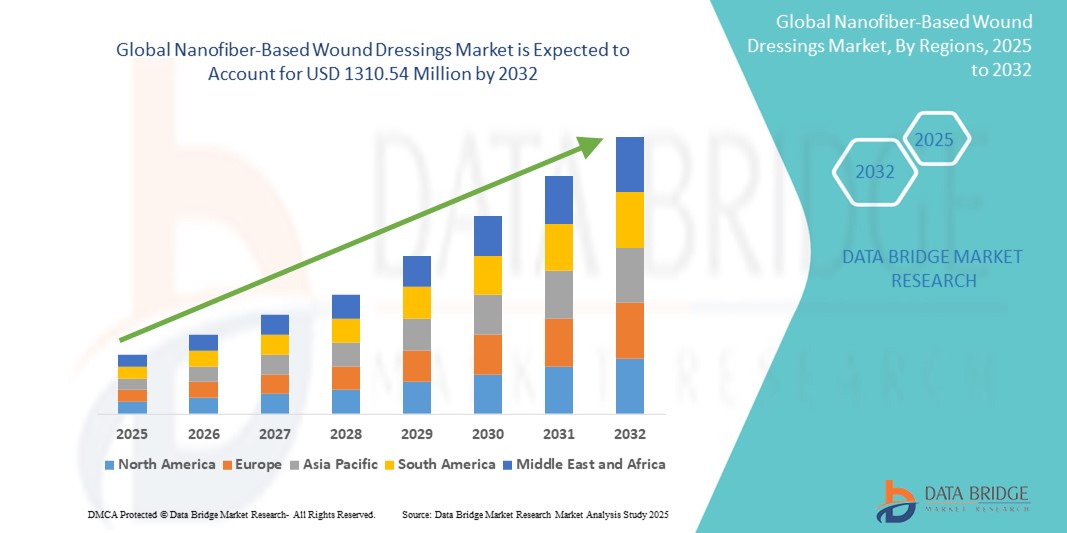
- The global nanofiber-based wound dressings market size was valued at USD 666.47 Million in 2024 and is expected to reach USD 1,310.54 Million by 2032, at a CAGR of 8.82% during the forecast period
- The market growth is largely fueled by the increasing demand for advanced wound care technologies and continuous innovations in nanofiber fabrication techniques, leading to enhanced healing outcomes and reduced recovery times across acute and chronic wound cases
- Furthermore, rising healthcare expenditure, the growing prevalence of diabetic ulcers, pressure sores, and surgical wounds, and the need for biocompatible, antimicrobial, and breathable dressings are establishing nanofiber-based wound dressings as the preferred solution in both hospital and home care settings. These converging factors are accelerating the adoption of Nanofiber-Based Wound Dressings, thereby significantly boosting the industry's growth
Nanofiber-Based Wound Dressings Market Analysis
- Nanofiber-based wound dressings, offering advanced wound healing through superior moisture control, breathability, and antimicrobial properties, are increasingly vital components of modern wound care in both clinical and home settings due to their enhanced healing efficacy, biocompatibility, and ability to mimic natural extracellular matrices
- The escalating demand for nanofiber-based wound dressings is primarily fueled by the rising prevalence of chronic wounds, diabetic ulcers, and post-surgical infections, along with growing awareness of advanced wound care products and the shift towards personalized and regenerative medicine
- North America dominated the nanofiber-based wound dressings market with the largest revenue share of 40.51% in 2024, driven by high healthcare expenditure, technological advancements, and a strong presence of key industry players. The U.S. is experiencing substantial growth in the use of nanofiber-based dressings, particularly in chronic wound management and post-operative care, supported by clinical research and FDA approvals
- Asia-Pacific is expected to be the fastest-growing region in the nanofiber-based wound dressings market, projected to register a CAGR of 9.8% from 2025 to 2032, owing to increasing urbanization, rising incidence of diabetes, government initiatives in healthcare infrastructure, and growing adoption of advanced medical technologies in countries such as China, India, and Japan
- The polymeric nanofibers segment dominated the nanofiber-based wound dressings market, with a market share of 47.1% in 2024, driven by widespread adoption due to their biocompatibility, scalability, and cost-effectiveness
Report Scope and Nanofiber-Based Wound Dressings Market Segmentation
|
Attributes |
Nanofiber-Based Wound Dressings Key Market Insights |
|
Segments Covered |
|
|
Countries Covered |
North America
Europe
Asia-Pacific
Middle East and Africa
South America
|
|
Key Market Players |
|
|
Market Opportunities |
|
|
Value Added Data Infosets |
In addition to the insights on market scenarios such as market value, growth rate, segmentation, geographical coverage, and major players, the market reports curated by the Data Bridge Market Research also include in-depth expert analysis, pricing analysis, brand share analysis, consumer survey, demography analysis, supply chain analysis, value chain analysis, raw material/consumables overview, vendor selection criteria, PESTLE Analysis, Porter Analysis, and regulatory framework. |
Nanofiber-Based Wound Dressings Market Trends
“Enhanced Performance Through Bioactive Innovations and Nanotechnology”
- A significant and accelerating trend in the global nanofiber-based wound dressings market is the deepening integration of bioactive materials and advanced nanotechnology to enhance wound healing efficacy. This synergy of innovations is significantly improving moisture balance, exudate management, and antimicrobial performance in clinical applications
- For instance, electrospun nanofiber dressings are being developed with embedded therapeutic agents such as silver nanoparticles, antibiotics, and growth factors, enabling controlled drug release and targeted therapy. Similarly, composite nanofiber dressings are engineered to mimic the extracellular matrix, offering improved cell adhesion and tissue regeneration
- Innovative developments also enable dressings to provide real-time feedback on wound conditions such as pH or infection levels through integrated biosensors. This allows for more precise and timely clinical decision-making. For instance, some smart nanofiber materials can change color in response to bacterial activity or wound moisture levels, alerting caregivers to take action
- The seamless application of nanofiber-based dressings in both acute and chronic wounds has expanded their usage across surgical, burn, and trauma care. Through versatile material compositions, these dressings support faster re-epithelialization, reduced scarring, and minimized infection risks—creating a unified approach to modern wound care
- This trend towards more intelligent, biofunctional, and regenerative wound solutions is fundamentally reshaping clinical expectations for wound management. Consequently, companies are investing in biocompatible, multi-layered nanofiber systems designed to optimize healing environments while being cost-effective and easy to apply
- The demand for nanofiber wound dressings that offer enhanced healing capabilities and personalized care is growing rapidly across hospitals, specialty clinics, and home care settings, as healthcare providers increasingly prioritize patient outcomes, infection prevention, and reduced treatment durations
Nanofiber-Based Wound Dressings Market Dynamics
Driver
“Growing Need Due to Rising Chronic Wounds and Advanced Wound Care Adoption”
- The increasing prevalence of chronic wounds such as diabetic ulcers, pressure sores, and venous leg ulcers, coupled with the rising aging population globally, is a significant driver for the heightened demand for nanofiber-based wound dressings
- For instance, in April 2024, a collaboration between top research institutions and medical device companies led to the launch of a composite nanofiber dressing that offers antimicrobial properties and enhanced wound healing for diabetic foot ulcers. Such developments are expected to drive the Nanofiber-Based Wound Dressings industry growth in the forecast period
- As healthcare providers seek more efficient, patient-centric solutions, nanofiber-based dressings offer advanced features such as controlled drug delivery, superior exudate absorption, and infection prevention, making them a compelling upgrade over traditional gauze or hydrocolloid dressings
- Furthermore, the growing adoption of minimally invasive and home-based wound care treatments is making nanofiber-based dressings an integral component of modern wound management systems, offering compatibility with advanced therapeutic regimens
- The convenience of customizable dressing formats, improved biocompatibility, and ease of application are key factors propelling the adoption of nanofiber-based wound dressings in both hospital and homecare settings. The trend towards bioengineered wound care and the increasing availability of affordable nanofiber-based solutions further contribute to market growth
Restraint/Challenge
“Concerns Regarding Regulatory Approval and High Production Costs”
- Concerns surrounding the complex regulatory pathways for novel wound care materials, including nanofiber-based dressings, pose a significant challenge to broader market penetration. Regulatory bodies often require extensive clinical validation to ensure safety and efficacy, leading to delayed product launches and higher costs
- For instance, companies developing new bioactive nanofiber dressings must meet stringent FDA or EMA requirements related to materials, sterility, biocompatibility, and therapeutic claims, which can slow down commercialization efforts
- Addressing these regulatory challenges through streamlined clinical testing, collaborations with regulatory consultants, and phased market introductions is crucial for building trust with healthcare providers and payers. In addition, the relatively high production cost of electrospinning and other nanofiber fabrication techniques can be a barrier to affordability, especially in price-sensitive healthcare systems or developing regions
- While technological advancements are gradually reducing manufacturing costs, the perceived price premium for nanofiber dressings may still hinder widespread adoption, particularly in outpatient or homecare markets
- Overcoming these challenges through scalable manufacturing, increased R&D investments, and strategic public-private partnerships will be vital for sustained market growth and accessibility of nanofiber-based wound care globally
Nanofiber-Based Wound Dressings Market Scope
The market is segmented on the basis of product type, material, wound type, application, and distribution channel.
• By Product Type
On the basis of product type, the nanofiber-based wound dressings market is segmented into electrospun nanofiber dressings, self-assembled nanofiber dressings, composite nanofiber dressings, and others. The electrospun nanofiber dressings segment dominated the largest market revenue share of 42.8% in 2024, attributed to their high surface area and porosity which accelerate healing and drug delivery efficiency.
The composite nanofiber dressings segment is anticipated to witness the fastest growth rate of CAGR 10.3% from 2025 to 2032, due to increasing demand for multifunctional and antimicrobial wound care solutions.
• By Material
On the basis of material, the nanofiber-based wound dressings market is segmented into polymeric nanofibers, carbon-based nanofibers, ceramic nanofibers, and others. The polymeric nanofibers segment held the largest market revenue share of 47.1% in 2024, driven by widespread adoption due to their biocompatibility, scalability, and cost-effectiveness.
The Carbon-Based Nanofibers segment is expected to witness the fastest CAGR of 9.8% from 2025 to 2032, fueled by their unique mechanical strength and antimicrobial activity.
• By Wound Type
On the basis of wound type, the nanofiber-based wound dressings market is segmented into acute wounds, chronic wounds, surgical wounds, and burns. The chronic wounds segment accounted for the largest market share of 39.3% in 2024, owing to the high prevalence of diabetes, pressure ulcers, and venous leg ulcers.
The burns segment is projected to grow at the fastest CAGR of 11.1% from 2025 to 2032, due to the need for advanced dressings that promote rapid tissue regeneration and prevent infections.
• By Application
On the basis of application, the nanofiber-based wound dressings market is segmented into hospitals, clinics, home healthcare, and others. The hospitals segment dominated with a revenue share of 44.7% in 2024, driven by high admission rates and access to advanced wound care technologies.
The home healthcare segment is expected to witness the highest CAGR of 10.6% from 2025 to 2032, fueled by rising geriatric population, increasing chronic wounds, and shift toward outpatient care.
• By Distribution Channel
On the basis of distribution channel, the nanofiber-based wound dressings market is segmented into direct tenders, retail pharmacies, and online sales. The retail pharmacies segment captured the largest revenue share of 49.2% in 2024, supported by the convenience of OTC availability and broad distribution networks.
The online sales segment is forecasted to expand at the fastest CAGR of 12.4% from 2025 to 2032, driven by the rise of e-commerce, home care demand, and consumer preference for digital health product purchases.
Nanofiber-Based Wound Dressings Market Regional Analysis
- North America dominated the nanofiber-based wound dressings market with the largest revenue share of 40.51% in 2024, driven by the rising incidence of chronic wounds, advanced healthcare infrastructure, and high awareness regarding novel wound care technologies
- The presence of key players, favorable reimbursement policies, and strong investments in R&D also support market dominance
- The region’s growing geriatric population and increasing cases of diabetes and pressure ulcers have further accelerated the demand for nanofiber-based wound dressings, particularly in clinical and home care settings
U.S. Nanofiber-Based Wound Dressings Market Insight
The U.S. nanofiber-based wound dressings market captured the largest revenue share of 71% in 2024 within North America, fueled by rising chronic wounds among aging populations and strong demand for cost-effective, advanced wound care solutions. Hospitals and home healthcare settings are increasingly adopting electrospun and polymeric nanofiber dressings due to their superior healing capabilities. Moreover, government support for wound care research and a growing emphasis on outpatient treatment have significantly driven the U.S. market forward.
Europe Nanofiber-Based Wound Dressings Market Insight
The Europe nanofiber-based wound dressings market is projected to expand at a CAGR of 8.9% from 2025 to 2032, driven by an aging population, rising surgical procedures, and advancements in wound care technologies. Stringent healthcare standards, favorable regulatory support for nanotechnology, and strong public health initiatives related to diabetic foot ulcers and venous leg ulcers are expected to drive market growth across key European countries.
U.K. Nanofiber-Based Wound Dressings Market Insight
The U.K. nanofiber-based Wound Dressings market is anticipated to grow at a CAGR of 9.2% during the forecast period, supported by NHS investments in chronic wound management and increasing awareness of advanced dressing products. The shift towards cost-effective outpatient care and growing e-commerce accessibility of wound dressings are also boosting sales, especially for home use and elderly patient care.
Germany Nanofiber-Based Wound Dressings Market Insight
The Germany nanofiber-based wound dressings market is expected to expand at a CAGR of 8.7% from 2025 to 2032, propelled by the country’s focus on healthcare innovation and sustainability. Germany’s advanced hospital infrastructure and early adoption of nanotechnology in healthcare have fostered strong demand for biocompatible, eco-friendly nanofiber dressings. Customized solutions for surgical and burn wounds further enhance growth prospects.
Asia-Pacific Nanofiber-Based Wound Dressings Market Insight
The Asia-Pacific nanofiber-based wound dressings market is poised to grow at the fastest CAGR of 9.8% from 2025 to 2032, driven by increasing diabetic populations, expanding healthcare access, and growing demand for affordable wound care solutions. Government support for healthcare modernization and increasing domestic manufacturing of nanotechnology-based products are expected to further catalyze market expansion, especially in China, India, and Japan.
Japan Nanofiber-Based Wound Dressings Market Insight
The Japan nanofiber-based wound dressings market is gaining momentum due to its rapidly aging population and advanced biomedical research capabilities. The market is expected to grow at a CAGR of 10.4%, as hospitals adopt next-gen dressings for complex wounds. In addition, Japan’s focus on regenerative medicine and innovations in tissue engineering contribute significantly to the adoption of nanofiber-based solutions in both public and private healthcare sectors.
China Nanofiber-Based Wound Dressings Market Insight
The China nanofiber-based wound dressings market accounted for the largest revenue share in Asia-Pacific at 46.5% in 2024, driven by robust healthcare reforms, expanding medical tourism, and a growing middle-class population with increased healthcare spending. China’s local manufacturers are playing a key role by offering affordable nanofiber-based dressings, while government initiatives supporting the development of domestic biotech and medtech capabilities continue to bolster market growth.
Nanofiber-Based Wound Dressings Market Share
The nanofiber-based wound dressings industry is primarily led by well-established companies, including:
- Smith+Nephew (U.K.)
- 3M (U.S.)
- Mölnlycke Health Care AB (Sweden)
- ConvaTec Group PLC (U.K.)
- Coloplast A/S (Denmark)
- Medline Industries LP (U.S.)
- Johnson & Johnson Services, Inc. (U.S.)
- Cardinal Health, Inc. (U.S.)
- Derma Sciences, Inc. (U.S.)
- B. Braun SE (Germany)
- Hollister Incorporated (U.S.)
- Advanced Medical Solutions Group plc (U.K.)
- Kinetic Concepts (U.S.)
- PolyNovo Limited (Australia)
- Axio Biosolutions Pvt Ltd (India)
- Medtronic (Ireland)
- Nanosono Ltd. (Israel)
Latest Developments in Global Nanofiber-Based Wound Dressings Market
- In April 2023, Nanofiber Solutions Inc., a leading innovator in advanced wound care technologies, announced the launch of a next-generation nanofiber-based wound dressing designed to accelerate healing in chronic wounds. The product, featuring enhanced porosity and drug delivery capabilities, demonstrates significant improvement in tissue regeneration and antimicrobial performance, supporting its potential adoption in both hospital and outpatient settings
- In March 2023, Acteev Medical, a subsidiary of Ascend Performance Materials, introduced a nanofiber wound dressing infused with zinc ion technology. This product launch highlights the company’s focus on antimicrobial resistance, providing a solution that effectively reduces bacterial load while maintaining a conducive healing environment—ideal for diabetic ulcers, burns, and pressure injuries
- In March 2023, Nanosanitas Biotech announced a collaboration with a European healthcare consortium to develop multifunctional nanofiber-based wound dressings with real-time biosensing capabilities. The partnership aims to deliver intelligent wound care solutions that can monitor pH and moisture levels, enabling proactive wound management and timely interventions
- In February 2023, Carmatix Healthcare expanded its distribution of biodegradable nanofiber wound dressings across Southeast Asia. The strategic move aims to improve accessibility to advanced wound care in emerging markets, where the prevalence of chronic wounds is rising due to aging populations and increasing incidence of diabetes
- In January 2023, Electrospun Nanotech, a U.S.-based medical device company, received FDA clearance for its proprietary nanofiber wound dressing indicated for use in post-surgical wounds. The product leverages electrospinning technology to create a scaffold that mimics the extracellular matrix, promoting faster and more efficient healing

- Interactive Data Analysis Dashboard
- Company Analysis Dashboard for high growth potential opportunities
- Research Analyst Access for customization & queries
- Competitor Analysis with Interactive dashboard
- Latest News, Updates & Trend analysis
- Harness the Power of Benchmark Analysis for Comprehensive Competitor Tracking
Data collection and base year analysis are done using data collection modules with large sample sizes. The stage includes obtaining market information or related data through various sources and strategies. It includes examining and planning all the data acquired from the past in advance. It likewise envelops the examination of information inconsistencies seen across different information sources. The market data is analysed and estimated using market statistical and coherent models. Also, market share analysis and key trend analysis are the major success factors in the market report. To know more, please request an analyst call or drop down your inquiry.
The key research methodology used by DBMR research team is data triangulation which involves data mining, analysis of the impact of data variables on the market and primary (industry expert) validation. Data models include Vendor Positioning Grid, Market Time Line Analysis, Market Overview and Guide, Company Positioning Grid, Patent Analysis, Pricing Analysis, Company Market Share Analysis, Standards of Measurement, Global versus Regional and Vendor Share Analysis. To know more about the research methodology, drop in an inquiry to speak to our industry experts.
Data Bridge Market Research is a leader in advanced formative research. We take pride in servicing our existing and new customers with data and analysis that match and suits their goal. The report can be customized to include price trend analysis of target brands understanding the market for additional countries (ask for the list of countries), clinical trial results data, literature review, refurbished market and product base analysis. Market analysis of target competitors can be analyzed from technology-based analysis to market portfolio strategies. We can add as many competitors that you require data about in the format and data style you are looking for. Our team of analysts can also provide you data in crude raw excel files pivot tables (Fact book) or can assist you in creating presentations from the data sets available in the report.













