Natural Ingredient Insect Repellent Market Overview
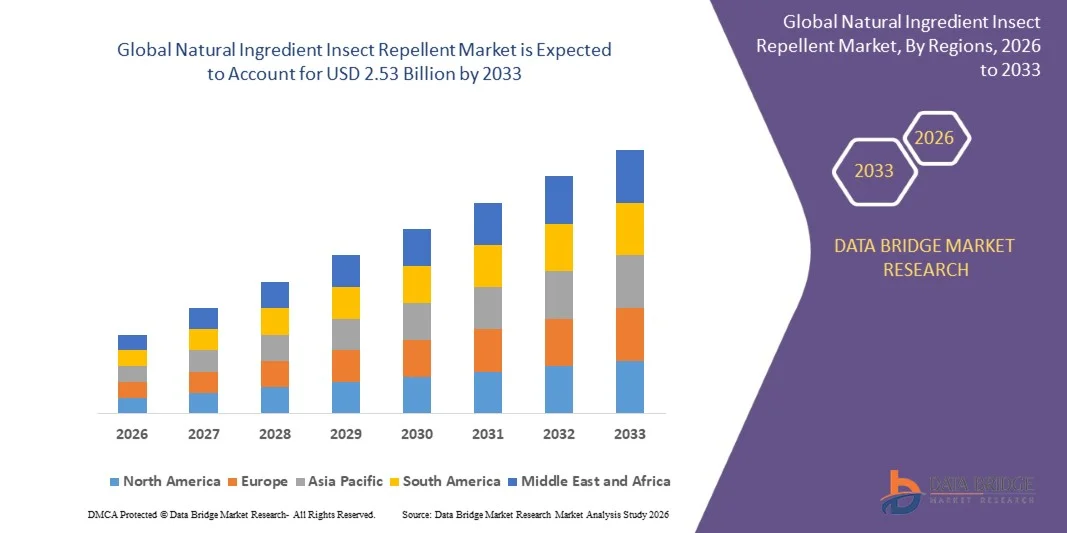
The Natural Ingredient Insect Repellent Market was valued at USD 1.52 billion in 2025 and is projected to reach USD 2.53 billion by 2033, growing at a CAGR of 6.60% from 2026 to 2033. The market is experiencing consistent growth driven by rising consumer preference for safe and eco-friendly insect protection solutions, increasing awareness regarding the harmful effects of synthetic chemical repellents, and growing demand for plant-based and natural personal care products.
The increasing prevalence of mosquito-borne diseases globally, combined with rising health consciousness and environmental concerns, is encouraging households, outdoor consumers, and personal care brands to adopt natural ingredient insect repellent solutions. Plant-based formulations containing ingredients such as citronella, neem, eucalyptus oil, and other essential oils are gaining popularity as alternatives to conventional chemical-based repellents. In addition, expanding applications across household protection, outdoor activities, travel, and child-safe personal care products, along with growing innovation in organic and sustainable formulations, are further supporting the adoption of natural ingredient insect repellent products worldwide.
Key Market Trends & Insights
- North America dominated the Natural Ingredient Insect Repellent Market with the largest revenue share of 34.6% in 2025, supported by increasing consumer preference for plant-based personal care products, growing awareness regarding chemical-free insect protection solutions, and strong demand for eco-friendly repellents. Rising health consciousness, regulatory support for safer ingredients, and expanding availability through retail and e-commerce channels are further strengthening market growth across the region.
- The mosquitoes segment dominated the market with a 52.74% share in 2025, owing to the rising global prevalence of mosquito-borne diseases such as dengue, malaria, and chikungunya.
- Asia-Pacific is expected to be the fastest-growing region at a CAGR of 7.4% from 2026 to 2033, fueled by increasing awareness of natural pest control solutions, rising urbanization, expanding middle-class consumer base, and growing demand for safer insect repellent products in countries such as China, India, and Japan. The growth of online retail platforms is also improving product accessibility across emerging markets.
- The oil of lemon eucalyptus segment dominated the ingredient category with a 39.5% revenue share in 2025, supported by its recognized effectiveness as a plant-based mosquito repellent ingredient, increasing consumer preference for botanical formulations, and rising adoption in natural personal care and outdoor protection products.
Market Size & Forecast
- Global Market Value (2025): USD 1.52 Billion
- Expected Market Value (2033): USD 2.53 Billion
- Forecast CAGR (2026–2033): 6.60%
- Leading Region in 2025: North America
- Fastest Growing Region: Asia-Pacific
Report Scope and Natural Ingredient Insect Repellent Market Segmentation
|
Attributes |
Natural Ingredient Insect Repellent Key Market Insights |
|
Segments Covered |
|
|
Countries Covered |
North America · U.S. · Canada · Mexico Europe · Germany · France · U.K. · Netherlands · Switzerland · Belgium · Russia · Italy · Spain · Turkey · Rest of Europe Asia-Pacific · China · Japan · India · South Korea · Singapore · Malaysia · Australia · Thailand · Indonesia · Philippines · Rest of Asia-Pacific Middle East and Africa · Saudi Arabia · U.A.E. · South Africa · Egypt · Israel · Rest of Middle East and Africa South America · Brazil · Argentina · Rest of South America |
|
Key Market Players |
• S. C. Johnson & Son, Inc. (U.S.) |
|
Market Opportunities |
· Rising Demand for Plant-Based and Eco-Friendly Repellent Solutions · Growing Adoption in Outdoor Recreation and Travel Applications · Expansion of Natural Repellents in Emerging Markets |
|
Value Added Data Infosets |
In addition to the insights on market scenarios such as market value, growth rate, segmentation, geographical coverage, and major players, the market reports curated by the Data Bridge Market Research also include in-depth expert analysis, geographically represented company-wise production and capacity, network layouts of distributors and partners, detailed and updated price trend analysis and deficit analysis of supply chain and demand. |
Natural Ingredient Insect Repellent Market Trends
Trend: Rising Demand for Plant-Based and Eco-Friendly Insect Repellent Solutions
The Natural Ingredient Insect Repellent Market is witnessing a significant shift toward botanical and sustainable formulations as consumers increasingly prefer safer alternatives to synthetic chemical-based repellents. Ingredients such as oil of lemon eucalyptus, citronella oil, catnip oil, and soybean oil are gaining popularity due to their plant-derived properties and growing acceptance in personal care and outdoor protection products. The rising focus on clean-label products, environmental sustainability, and reduced exposure to synthetic chemicals is encouraging manufacturers to expand natural insect repellent portfolios. In recent years, companies have increased investments in developing innovative formulations combining natural active ingredients with improved effectiveness, longer protection duration, and consumer-friendly application formats such as sprays, creams, and essential oil-based products.
Natural Ingredient Insect Repellent Market Dynamics
Key Market Driver: Increasing Awareness of Mosquito-Borne Diseases and Demand for Preventive Protection
Growing concerns regarding mosquito-borne diseases such as dengue, malaria, and chikungunya are driving demand for effective insect protection solutions worldwide. Governments, healthcare organizations, and public health campaigns are promoting preventive measures, increasing consumer awareness regarding personal protection against insect bites. The expansion of outdoor recreation activities, travel, and urban living environments is further supporting demand for natural insect repellents across residential and commercial applications. Regions including Asia-Pacific, North America, and Latin America are witnessing increased adoption of botanical repellents as consumers seek products that provide protection while aligning with health and sustainability preferences.
Key Restraint/Challenge: Limited Long-Term Effectiveness Compared with Synthetic Repellents
A major challenge for the Natural Ingredient Insect Repellent Market is the difficulty of achieving comparable protection duration and performance levels offered by synthetic-based alternatives. Natural ingredients may require higher concentrations or frequent reapplication, which can impact consumer preference and product positioning. In addition, variations in ingredient quality, seasonal availability of botanical raw materials, and higher formulation costs create challenges for manufacturers. Maintaining product stability, regulatory compliance, and consistent effectiveness while keeping prices competitive remains a key barrier for wider adoption in price-sensitive markets.
Key Market Opportunity: Expansion of E-Commerce and Innovation in Natural Repellent Formulations
The increasing penetration of online retail platforms presents significant growth opportunities for natural insect repellent manufacturers by enabling wider consumer access and direct-to-consumer distribution. Rising demand for organic, cruelty-free, and sustainable personal care products is encouraging companies to introduce innovative formats such as essential oil blends, wearable repellents, skin-friendly creams, and long-lasting natural sprays. In addition, advancements in extraction technologies and ingredient research are supporting the development of improved botanical formulations. The growing adoption of natural products in emerging markets, particularly across Asia-Pacific, along with increasing consumer preference for environmentally responsible solutions, is expected to further accelerate market expansion through 2033.
Natural Ingredient Insect Repellent Market Scope
The Natural Ingredient Insect Repellent Market is segmented on the basis of product type, ingredient, pest targeted, and distribution channel.
- By Product Type
On the basis of product type, the Natural Ingredient Insect Repellent Market is segmented into sprays/aerosols, cream, essential oil, liquid vaporizers, and others. The Sprays/Aerosols segment dominated the market with a 39.85% share in 2025, owing to their convenience, easy application, portability, and widespread consumer adoption for household and outdoor insect protection. These products provide quick coverage, effective pest protection, and are widely preferred across residential, travel, and outdoor recreation applications. Increasing awareness regarding mosquito-borne diseases and rising demand for convenient insect protection solutions are supporting segment growth. In addition, manufacturers are introducing plant-based spray formulations with improved safety profiles, longer protection duration, and reduced chemical content, further strengthening the dominance of sprays/aerosols in the market.
The essential oil segment is projected to register the fastest growth at a CAGR of 8.1% from 2026 to 2033, driven by increasing consumer preference for natural, organic, and chemical-free insect repellent alternatives. Essential oil-based repellents containing ingredients such as citronella, eucalyptus, neem, and other botanical extracts are gaining popularity among health-conscious consumers. Growing demand for sustainable personal care products, child-safe formulations, and environmentally friendly solutions is accelerating segment expansion. Furthermore, rising adoption of aromatherapy-based products and premium natural wellness products is creating new opportunities for essential oil insect repellent manufacturers.
- By Ingredient
On the basis of ingredient, the Natural Ingredient Insect Repellent Market is segmented into Oil of lemon eucalyptus, citronella oil, catnip oil, soybean oil, and others. The oil of lemon eucalyptus segment dominated the market with a 34.62% share in 2025, due to its proven effectiveness as a plant-based insect repellent ingredient and increasing regulatory acceptance in multiple regions. Oil of lemon eucalyptus is widely used in natural mosquito repellent formulations due to its long-lasting protection properties and consumer preference for botanical ingredients. Growing demand for DEET-free alternatives and increasing awareness about natural protection methods are supporting segment growth. In addition, product innovations focused on improving formulation stability, fragrance, and user experience are further reinforcing the leading position of this ingredient segment.
The catnip oil segment is expected to witness the fastest CAGR of 8.7% from 2026 to 2033, driven by increasing research interest in plant-derived insect repellent compounds and growing demand for innovative natural formulations. Catnip oil is gaining attention due to its potential effectiveness against mosquitoes and other insects, creating opportunities for use in advanced repellent products. Increasing investment in botanical ingredient research, rising consumer preference for sustainable solutions, and expansion of natural personal care markets are supporting segment growth. Moreover, manufacturers are exploring new formulations combining multiple essential oils to enhance effectiveness and consumer acceptance.
- By Pest Targeted
On the basis of pest targeted, the Natural Ingredient Insect Repellent Market is segmented into mosquitoes, flies, ticks, and others. The mosquitoes segment dominated the market with a 52.74% share in 2025, owing to the rising global prevalence of mosquito-borne diseases such as dengue, malaria, and chikungunya. Growing public health concerns and increased awareness regarding mosquito prevention are driving strong demand for natural mosquito repellent products. Households, healthcare organizations, and outdoor consumers are increasingly adopting botanical-based repellents as safer alternatives to synthetic chemical solutions. In addition, government initiatives promoting vector control and increasing adoption of personal protection products are further strengthening the dominance of mosquito-targeted repellents.
The ticks segment is anticipated to witness the fastest CAGR of 7.9% from 2026 to 2033, driven by increasing awareness regarding tick-borne diseases and rising participation in outdoor activities such as hiking, camping, and adventure tourism. Consumers are increasingly seeking natural tick protection solutions due to concerns regarding chemical exposure and environmental impact. Growing demand for pet-safe and family-friendly insect repellent products is also supporting segment growth. Furthermore, expansion of outdoor lifestyle markets and increasing product availability through online channels are expected to accelerate adoption of natural tick repellents.
- By Distribution Channel
On the basis of distribution channel, the Natural Ingredient Insect Repellent Market is segmented into online and offline. The offline segment dominated the market with a 61.35% share in 2025, supported by strong presence of supermarkets, pharmacies, convenience stores, and specialty retail outlets. Consumers continue to prefer offline channels due to product availability, immediate purchase convenience, and the ability to compare different formulations before buying. Established retail networks of major personal care and consumer goods companies are contributing to strong product penetration. In addition, increasing availability of natural insect repellent products across pharmacies and wellness stores is reinforcing the dominance of offline distribution channels.
The online segment is expected to witness the fastest CAGR of 9.2% from 2026 to 2033, driven by increasing e-commerce adoption, digital purchasing trends, and growing consumer access to a wider range of natural insect repellent products. Online platforms enable manufacturers to reach broader customer bases while offering product information, reviews, and subscription-based purchasing options. Rising preference for convenient home delivery, increasing penetration of smartphones, and expansion of digital marketplaces are accelerating online sales growth. Furthermore, direct-to-consumer brands focusing on organic and sustainable insect repellent solutions are increasingly leveraging online channels to strengthen market presence.
Natural Ingredient Insect Repellent Market Regional Analysis
North America dominated the Natural Ingredient Insect Repellent Market and accounted for the largest revenue share of 34.6% in 2025, supported by increasing consumer preference for plant-based personal care products, growing awareness regarding chemical-free insect protection solutions, and strong demand for eco-friendly repellents. The region benefits from rising health consciousness, regulatory support for safer ingredient-based products, and expanding availability through supermarkets, pharmacies, and e-commerce platforms. Increasing adoption of natural formulations containing ingredients such as oil of lemon eucalyptus and citronella oil is further strengthening market growth across the U.S. and Canada.
U.S. Natural Ingredient Insect Repellent Market Insight
The U.S. natural ingredient insect repellent market is witnessing strong growth due to rising consumer demand for sustainable personal care products, increasing awareness regarding mosquito-borne diseases, and growing preference for botanical-based protection solutions. The country’s strong retail ecosystem, expansion of online shopping platforms, and increasing availability of organic and plant-derived insect repellents are driving market adoption. In addition, rising outdoor recreational activities, including camping, hiking, and travel, are contributing to higher demand for sprays, creams, and essential oil-based repellents.
Europe Natural Ingredient Insect Repellent Market Insight
The Europe natural ingredient insect repellent market remains a significant contributor to global revenue, driven by increasing demand for sustainable consumer products, strict regulations supporting safer formulations, and growing awareness regarding environmentally friendly pest protection solutions. Consumers across European countries are increasingly shifting toward natural alternatives due to concerns regarding synthetic chemicals and environmental impact. The expansion of organic personal care trends and availability of natural insect repellent products through retail and digital channels are supporting market growth across the region.
U.K. Natural Ingredient Insect Repellent Market Insight
The U.K. natural ingredient insect repellent market is experiencing steady growth, supported by increasing consumer interest in clean-label personal care products and rising demand for environmentally responsible insect protection solutions. Growing awareness of plant-based ingredients, expanding e-commerce penetration, and increasing outdoor leisure activities are contributing to market expansion. Furthermore, manufacturers are focusing on innovative natural formulations, including essential oil-based sprays and skin-friendly creams, to meet changing consumer preferences.
Germany Natural Ingredient Insect Repellent Market Insight
The Germany natural ingredient insect repellent market is expanding steadily due to strong consumer preference for sustainable products, high environmental awareness, and growing demand for natural personal care solutions. The country’s focus on eco-friendly lifestyles and strict quality standards is encouraging adoption of botanical insect repellents. Increasing availability of natural formulations through pharmacies, specialty stores, and online platforms is further supporting market growth, while manufacturers continue to develop innovative products with improved effectiveness and safety profiles.
Asia-Pacific Natural Ingredient Insect Repellent Market Insight
The Asia-Pacific natural ingredient insect repellent market is expected to witness rapid growth at a CAGR of 7.4% from 2026 to 2033, driven by increasing awareness of natural pest control solutions, rising urbanization, expanding middle-class consumer base, and growing demand for safer insect repellent products across countries such as China, India, and Japan. The region’s increasing concerns regarding mosquito-borne diseases, improving consumer spending power, and rapid expansion of online retail platforms are enhancing product accessibility. Growing adoption of natural formulations in residential, outdoor, and personal care applications is further accelerating regional market growth.
Japan Natural Ingredient Insect Repellent Market Insight
The Japan natural ingredient insect repellent market is witnessing consistent growth due to increasing consumer preference for high-quality, safe, and environmentally friendly personal care products. Growing awareness regarding chemical-free insect protection and strong demand for premium botanical formulations are supporting market expansion. The country’s advanced retail infrastructure and growing popularity of outdoor activities are further driving demand for convenient formats such as sprays, creams, and essential oil-based repellents.
China Natural Ingredient Insect Repellent Market Insight
The China natural ingredient insect repellent market is growing rapidly, driven by rising urbanization, increasing awareness of health and hygiene, and growing consumer preference for natural and sustainable products. Expanding middle-class purchasing power, increasing e-commerce adoption, and rising demand for safer household and personal protection products are significantly contributing to market growth. In addition, growing concerns regarding mosquito-related health risks and increasing availability of botanical insect repellents through digital and retail channels are positioning China as one of the fastest-growing markets globally.
Natural Ingredient Insect Repellent Market Share
The Natural Ingredient Insect Repellent industry is primarily led by well-established companies, including:
- S. C. Johnson & Son, Inc. (U.S.)
- Reckitt Benckiser Group plc (United Kingdom)
- Spectrum Brands Holdings, Inc. (U.S.)
- Godrej Consumer Products Limited (India)
- Henkel AG & Co. KGaA (Germany)
- The Clorox Company (U.S.)
- Dabur India Limited (India)
- Himalaya Wellness Company (India)
- Quantum Health (U.S.)
- PelGar International Ltd (United Kingdom)
- Jyothy Labs Limited (India)
- Enesis Group (Indonesia)
- PIC Corporation (U.S.)
- Coghlan's Ltd. (Canada)
- 3M Company (U.S.)
- Natracare (United Kingdom)
- Badger Company, Inc. (U.S.)
- All Terrain Natural Products (U.S.)
- Murphy's Naturals (U.S.)
- Repel (U.S.)
- Coleman Company (U.S.)
- Cutter Insect Repellents (U.S.)
- Thermacell Repellents, Inc. (U.S.)
- ExOfficio (U.S.)
- Ecosmart Technologies (U.S.)
- Nature's Way Products, LLC (U.S.)
- Artnaturals (U.S.)
- Wondercide (U.S.)
- Babyganics (U.S.)
- Kinfield (U.S.)
- Sawyer Products (U.S.)
- EarthKind (U.S.)
- Green Goo (U.S.)
- Dr. Mercola (U.S.)
Latest Developments in Natural Ingredient Insect Repellent Market
- In September 2021, MOXĒ launched its Essential Oils-Based All-Natural Mosquito & Insect Repellent Spray, expanding its portfolio of plant-based household and personal care products. The product was developed using essential oil-based ingredients as an alternative to conventional chemical repellents and targeted consumers seeking natural mosquito and insect protection solutions. The launch reflected the growing market shift toward clean-label, DEET-free, and environmentally conscious insect repellent formulations
- In April 2022, EcoBuggy launched its natural mosquito and tick repellent product line featuring a 100% plant-based formulation. The product incorporated Hydrogel-Time-Release™ technology designed to gradually release active botanical ingredients and provide extended protection. The launch highlighted increasing innovation in natural repellent technologies aimed at improving effectiveness while avoiding synthetic active ingredients such as DEET and Picaridin
- In June 2022, Murphy’s Naturals introduced its Lemon Eucalyptus Oil Mosquito & Tick Repellent Mist, expanding its plant-based insect protection portfolio. The new continuous mist format was designed to improve application convenience while utilizing oil of lemon eucalyptus as the primary naturally derived active ingredient. The launch demonstrated rising consumer demand for natural repellents combining effective protection with easy-to-use delivery formats
- In November 2022, SC Johnson expanded its insect protection initiatives by supporting mosquito-borne disease prevention efforts through its OFF!® insect repellent brand. The company donated more than 26,000 units of insect repellents to vulnerable communities in Brazil through partnerships with local organizations, highlighting the increasing role of insect repellent manufacturers in addressing mosquito-related health risks and improving access to protection solutions
- In May 2024, incognito launched its sustainable natural insect repellent bracelet, designed with botanical insect-repelling oils including java citronella, lemon eucalyptus, and peppermint oil. The reusable wearable product targeted outdoor consumers seeking convenient and eco-friendly insect protection alternatives. The launch reflected the growing trend toward innovative natural repellent formats beyond traditional sprays and creams

- Interactive Data Analysis Dashboard
- Company Analysis Dashboard for high growth potential opportunities
- Research Analyst Access for customization & queries
- Competitor Analysis with Interactive dashboard
- Latest News, Updates & Trend analysis
- Harness the Power of Benchmark Analysis for Comprehensive Competitor Tracking
Data collection and base year analysis are done using data collection modules with large sample sizes. The stage includes obtaining market information or related data through various sources and strategies. It includes examining and planning all the data acquired from the past in advance. It likewise envelops the examination of information inconsistencies seen across different information sources. The market data is analysed and estimated using market statistical and coherent models. Also, market share analysis and key trend analysis are the major success factors in the market report. To know more, please request an analyst call or drop down your inquiry.
The key research methodology used by DBMR research team is data triangulation which involves data mining, analysis of the impact of data variables on the market and primary (industry expert) validation. Data models include Vendor Positioning Grid, Market Time Line Analysis, Market Overview and Guide, Company Positioning Grid, Patent Analysis, Pricing Analysis, Company Market Share Analysis, Standards of Measurement, Global versus Regional and Vendor Share Analysis. To know more about the research methodology, drop in an inquiry to speak to our industry experts.
Data Bridge Market Research is a leader in advanced formative research. We take pride in servicing our existing and new customers with data and analysis that match and suits their goal. The report can be customized to include price trend analysis of target brands understanding the market for additional countries (ask for the list of countries), clinical trial results data, literature review, refurbished market and product base analysis. Market analysis of target competitors can be analyzed from technology-based analysis to market portfolio strategies. We can add as many competitors that you require data about in the format and data style you are looking for. Our team of analysts can also provide you data in crude raw excel files pivot tables (Fact book) or can assist you in creating presentations from the data sets available in the report.