


Neonatal Jaundice Phototherapy Market Size
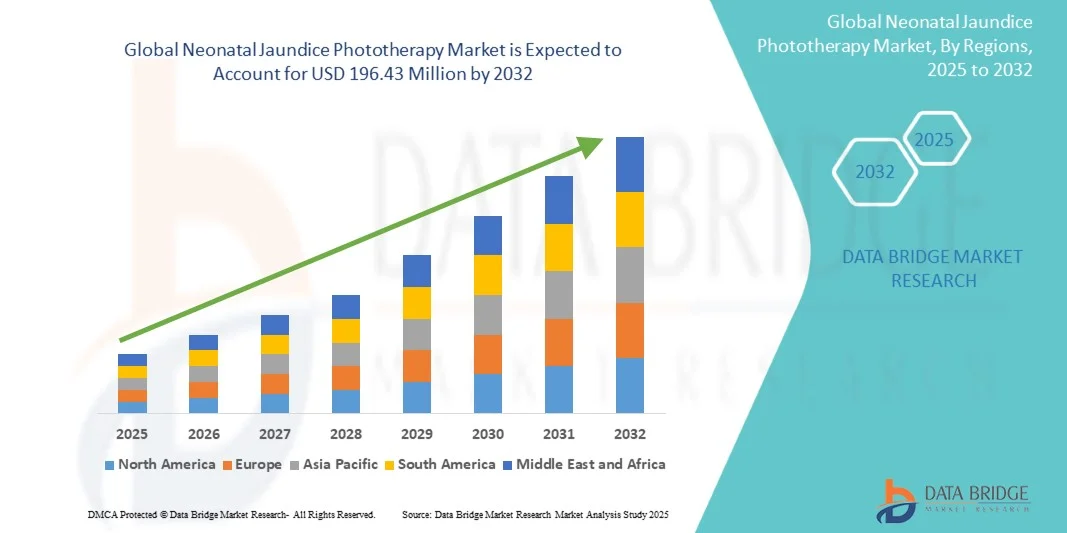
- The global neonatal jaundice phototherapy market size was valued at USD 115.50 million in 2024 and is expected to reach USD 196.43 million by 2032, at a CAGR of 6.86% during the forecast period
- The market growth is largely fueled by the rising prevalence of neonatal jaundice worldwide, coupled with increasing demand for advanced phototherapy devices in neonatal intensive care units and maternity hospitals
- Furthermore, technological advancements such as LED-based and portable phototherapy systems, along with growing healthcare investments and improved access to neonatal care in emerging economies, are driving adoption. These converging factors are accelerating the uptake of phototherapy solutions, thereby significantly boosting the industry's growth
Neonatal Jaundice Phototherapy Market Analysis
- Neonatal jaundice phototherapy devices, which use specific light wavelengths to reduce elevated bilirubin levels in newborns, are increasingly vital components of neonatal intensive care and maternity units due to their effectiveness, safety, and ability to prevent severe complications such as kernicterus
- The escalating demand for phototherapy solutions is primarily fueled by the high global incidence of neonatal jaundice, rising awareness among healthcare providers, and continuous technological advancements such as LED-based systems and portable fiber-optic units
- North America dominated the neonatal jaundice phototherapy market with the largest revenue share of 42.6% in 2024, supported by advanced healthcare infrastructure, high adoption of innovative neonatal care technologies, and strong presence of key device manufacturers in the U.S.
- Asia-Pacific is expected to be the fastest growing region in the neonatal jaundice phototherapy market during the forecast period due to high birth rates, growing healthcare investments, and improved access to neonatal care in countries such as India and China
- The LED phototherapy segment dominated the neonatal jaundice phototherapy market in 2024 with a share of 45.8%, driven by its superior irradiance, longer lifespan, energy efficiency, and growing preference among hospitals and clinics
Report Scope and Neonatal Jaundice Phototherapy Market Segmentation
|
Attributes |
Neonatal Jaundice Phototherapy Key Market Insights |
|
Segments Covered |
|
|
Countries Covered |
North America
Europe
Asia-Pacific
Middle East and Africa
South America
|
|
Key Market Players |
|
|
Market Opportunities |
|
|
Value Added Data Infosets |
In addition to the insights on market scenarios such as market value, growth rate, segmentation, geographical coverage, and major players, the market reports curated by the Data Bridge Market Research also include in-depth expert analysis, pricing analysis, brand share analysis, consumer survey, demography analysis, supply chain analysis, value chain analysis, raw material/consumables overview, vendor selection criteria, PESTLE Analysis, Porter Analysis, and regulatory framework. |
Neonatal Jaundice Phototherapy Market Trends
“Advancements in LED and Portable Phototherapy Devices”
- A significant and accelerating trend in the global neonatal jaundice phototherapy market is the growing adoption of LED-based and portable phototherapy devices, offering higher irradiance, longer lifespan, and energy efficiency compared to conventional fluorescent systems
- For Instance, The BiliLux LED phototherapy system integrates high-intensity LEDs with portable design, allowing flexible use in NICUs and post-discharge homecare treatment
- LED phototherapy devices enable features such as adjustable irradiance, built-in timers, and temperature monitoring, ensuring precise and safer bilirubin reduction for newborns
- The portability of newer phototherapy systems allows simultaneous treatment of multiple infants and facilitates homecare management, increasing accessibility and comfort for newborns and caregivers
- This trend towards efficient, flexible, and user-friendly phototherapy devices is fundamentally transforming neonatal care, with companies such as Dräger and Natus introducing compact LED units with integrated monitoring and alarms
- The demand for advanced LED and portable phototherapy solutions is growing rapidly across hospitals and homecare settings as healthcare providers increasingly prioritize treatment efficacy, safety, and operational ease
Neonatal Jaundice Phototherapy Market Dynamics
Driver
“Rising Incidence of Neonatal Jaundice and Awareness of Early Intervention”
- The increasing prevalence of neonatal jaundice globally, coupled with heightened awareness of its potential complications, is a significant driver for the adoption of phototherapy devices
- For Instance, In March 2024, Natus Medical deployed high-intensity LED phototherapy units in multiple Indian hospitals to improve early jaundice management
- As healthcare providers recognize the importance of early bilirubin reduction in preventing severe complications such as kernicterus, hospitals are investing in advanced phototherapy devices
- Furthermore, government healthcare initiatives and hospital programs aimed at reducing neonatal morbidity and mortality are accelerating adoption of modern phototherapy solutions
- Increased demand is also driven by the need for safe and efficient treatment options for both preterm and term infants, with portable and wearable devices expanding access in smaller facilities
- The combination of clinical necessity, government support, and technological advancement is propelling rapid growth in neonatal jaundice phototherapy adoption in developed and emerging economies
Restraint/Challenge
“High Cost and Regulatory Compliance Hurdles”
- The relatively high cost of advanced LED phototherapy devices compared to conventional fluorescent units poses a significant challenge for adoption, especially in budget-constrained hospitals and clinics
- For Instance, Smaller maternity clinics in Africa and South Asia have reported delayed adoption of LED-based devices due to high procurement and maintenance costs
- Compliance with strict healthcare device regulations and certifications (FDA, CE) can slow product launches and add complexity for manufacturers targeting multiple regions
- Lack of trained personnel to operate advanced phototherapy systems can limit adoption, particularly in rural or underdeveloped healthcare settings
- While prices for LED devices are gradually decreasing, perceived premium costs remain a barrier for smaller hospitals and homecare providers, delaying broader market penetration
- Overcoming these challenges through cost-effective designs, localized manufacturing, and training programs will be vital to ensure wider adoption and sustained market growth globally
Neonatal Jaundice Phototherapy Market Scope
The market is segmented on the basis of technology, product, end user, and distribution channel.
- By Technology
On the basis of technology, the neonatal jaundice phototherapy market is segmented into LED phototherapy, fluorescent phototherapy, halogen phototherapy, and fiber-optic phototherapy. LED phototherapy segment dominated the market with the largest revenue share of 45.8% in 2024 due to its superior irradiance, longer lifespan, and energy efficiency compared to traditional fluorescent and halogen lamps. Hospitals and NICUs increasingly prefer LED devices for their consistent performance and reduced heat generation, which improves safety for preterm and term infants. LED phototherapy devices often come with advanced features such as adjustable intensity, timers, and built-in alarms, enhancing treatment precision. The segment also benefits from strong adoption in both developed and emerging markets, supported by increasing awareness of neonatal jaundice management. Manufacturers such as Dräger, Natus, and BiliLux have expanded their LED device portfolios, further consolidating market dominance. High upfront costs are offset by lower operating and maintenance expenses, making LEDs a preferred long-term investment.
Fiber-optic phototherapy segment is anticipated to witness the fastest CAGR from 2025 to 2032, driven by its portability and suitability for homecare and ward-based applications. Fiber-optic pads allow localized treatment, enabling ambulatory care and post-discharge therapy, which is gaining popularity among hospitals and parents asuch as. The technology is especially suitable for preterm or critically ill infants who require minimal handling. Advancements in wearable fiber-optic phototherapy devices with LED integration and low heat output are further fueling adoption. Rising demand for neonatal homecare solutions and smaller medical facilities contributes to rapid growth. The segment’s flexibility, low noise, and ease of use position it as a high-growth area within the phototherapy market.
- By Product
On the basis of product, the neonatal jaundice phototherapy market is segmented into overhead units, portable systems, and fiber-optic patch systems. Overhead units dominated the market in 2024, representing the largest share of revenue due to their widespread use in hospital NICUs. These units provide uniform light distribution over the infant’s body, allowing effective treatment for multiple patients simultaneously. Overhead devices are preferred for their durability, high irradiance, and integration with monitoring systems. Hospitals favor these units for in-hospital treatment of both term and preterm infants, as they reduce treatment time and complications. Overhead phototherapy systems also benefit from established vendor support and service networks, making them a reliable choice for large medical facilities. Their proven clinical efficacy and familiarity among healthcare providers ensure continued dominance in the market.
Portable systems are expected to witness the fastest growth rate from 2025 to 2032 due to rising demand for flexible, bedside, and homecare applications. These systems allow treatment in smaller clinics or during patient transfer between wards, enhancing care accessibility. Portable phototherapy devices often incorporate LED technology, lightweight design, and adjustable irradiance, meeting modern neonatal care requirements. The growth is supported by increasing awareness among parents and healthcare providers of the benefits of early jaundice management. Rising adoption in emerging regions with limited NICU capacity also fuels market expansion. The portability and affordability of these devices make them a preferred solution in decentralized healthcare setups.
- By End User
On the basis of end user, the neonatal jaundice phototherapy market is segmented into hospitals, maternity hospitals & birthing centers, pediatric clinics, and homecare. Hospitals dominated the market in 2024, accounting for the largest share of revenue, as they have the necessary infrastructure, trained personnel, and resources to support advanced phototherapy devices. Hospitals provide centralized treatment for severe and moderate jaundice cases, particularly in NICUs. The dominance is also reinforced by government-funded hospital programs in developed and emerging economies. Hospitals increasingly invest in LED overhead units and fiber-optic systems to ensure effective bilirubin management. Access to skilled neonatologists and standardized treatment protocols further drives hospital adoption. Hospitals’ ability to handle high patient volumes makes them the largest end-user segment.
Homecare is expected to witness the fastest growth from 2025 to 2032, driven by the rising adoption of portable and wearable phototherapy devices for post-discharge care. Parents and caregivers are increasingly opting for home-based treatment to reduce hospital stays while ensuring continuous therapy. Telehealth integration and remote monitoring systems support homecare adoption, enabling medical supervision outside hospital settings. The segment is fueled by increasing awareness of early jaundice intervention and convenience for working parents. Homecare devices are compact, safe, and user-friendly, aligning with trends toward decentralized healthcare. Market growth is supported by rising income levels, urbanization, and healthcare digitization.
- By Distribution Channel
On the basis of distribution channel, the neonatal jaundice phototherapy market is segmented into direct sales, distributors, and e-commerce. Direct Sales dominated the market in 2024, accounting for the largest revenue share due to long-term contracts between manufacturers and large hospitals or government healthcare facilities. Direct sales ensure reliable product delivery, installation, and maintenance services. Hospitals and maternity centers prefer direct purchase agreements for premium LED overhead units and fiber-optic systems. Manufacturers maintain close relationships with healthcare providers to offer training, service support, and regulatory compliance assistance. Direct sales channels also facilitate bulk orders and customized solutions for larger facilities. This channel is particularly dominant in developed regions with established healthcare infrastructure.
E-commerce is expected to witness the fastest growth from 2025 to 2032, driven by rising demand for portable and homecare phototherapy devices. Online platforms provide convenient access to devices for parents, small clinics, and emerging market hospitals. E-commerce also enables rapid adoption of new wearable and fiber-optic phototherapy solutions. The growth is supported by increasing digital literacy, online payment penetration, and awareness campaigns promoting home-based jaundice care. Manufacturers are leveraging e-commerce to reduce distribution costs and expand market reach. Online sales channels also facilitate easy comparison, reviews, and after-sales support for end-users, accelerating adoption.
Neonatal Jaundice Phototherapy Market Regional Analysis
- North America dominated the neonatal jaundice phototherapy market with the largest revenue share of 42.6% in 2024, supported by advanced healthcare infrastructure, high adoption of innovative neonatal care technologies, and strong presence of key device manufacturers in the U.S.
- Hospitals and maternity centers in the region prioritize high-efficacy LED phototherapy devices, overhead units, and fiber-optic systems to ensure safe and effective treatment for both preterm and term infants
- This widespread adoption is further supported by well-established NICUs, trained neonatal specialists, and government initiatives promoting infant health, establishing phototherapy devices as a critical component of neonatal care in both public and private healthcare facilities
U.S. Neonatal Jaundice Phototherapy Market Insight
The U.S. neonatal jaundice phototherapy market captured the largest revenue share of ~78% in 2024 within North America, fueled by widespread adoption of advanced NICU equipment and modern neonatal care practices. Hospitals and maternity centers increasingly prioritize LED-based and fiber-optic phototherapy devices for efficient, safe, and early treatment of newborns. The growing awareness of neonatal jaundice complications and government initiatives promoting infant health further propel market growth. In addition, the trend of post-discharge homecare and portable phototherapy solutions is increasing adoption among parents and outpatient facilities. Integration with monitoring systems and smart healthcare management platforms is also contributing to the expansion of the U.S. market.
Europe Neonatal Jaundice Phototherapy Market Insight
The Europe neonatal jaundice phototherapy market is projected to expand at a substantial CAGR throughout the forecast period, primarily driven by stringent healthcare standards and early neonatal intervention programs. High adoption rates in NICUs and maternity hospitals, along with increasing awareness among healthcare providers, are fostering phototherapy usage. European healthcare providers favor energy-efficient, LED-based phototherapy systems due to their long-term cost-effectiveness and clinical efficacy. The market is experiencing significant growth across both public and private hospitals, as well as birthing centers, with devices being incorporated into new facilities and modernization projects. Government programs promoting neonatal health are also supporting demand in key countries.
U.K. Neonatal Jaundice Phototherapy Market Insight
The U.K. neonatal jaundice phototherapy market is anticipated to grow at a noteworthy CAGR during the forecast period, driven by rising awareness of jaundice-related complications and the increasing number of births in urban areas. Hospitals and maternity centers are adopting advanced overhead and portable phototherapy units to ensure timely treatment. Moreover, concerns regarding neonatal health and early bilirubin management are encouraging healthcare providers to invest in modern phototherapy technologies. The U.K.’s robust healthcare infrastructure and strong neonatal care programs continue to stimulate market growth. Homecare adoption of portable LED devices is also gradually increasing in the country.
Germany Neonatal Jaundice Phototherapy Market Insight
The Germany neonatal jaundice phototherapy market is expected to expand at a considerable CAGR during the forecast period, fueled by increasing awareness of early neonatal care and demand for energy-efficient medical devices. Hospitals, maternity centers, and pediatric clinics are investing in technologically advanced LED phototherapy systems to enhance treatment outcomes. Germany’s well-developed healthcare infrastructure, coupled with a focus on innovation and sustainability, promotes the adoption of efficient phototherapy devices. Integration of devices with hospital monitoring systems and neonatal care protocols is becoming increasingly common. The demand for portable and wearable phototherapy systems is also gaining traction for both in-hospital and homecare applications.
Asia-Pacific Neonatal Jaundice Phototherapy Market Insight
The Asia-Pacific neonatal jaundice phototherapy market is poised to grow at the fastest CAGR during the forecast period of 2025 to 2032, driven by high birth rates, urbanization, and growing awareness of neonatal jaundice management in countries such as China, India, and Japan. The region’s expanding healthcare infrastructure, rising disposable incomes, and government programs promoting infant health are driving adoption. Increasing access to portable and LED phototherapy devices is enabling treatment in smaller hospitals, clinics, and homecare settings. Moreover, domestic and international manufacturers are enhancing availability and affordability of phototherapy solutions.
Japan Neonatal Jaundice Phototherapy Market Insight
The Japan neonatal jaundice phototherapy market is gaining momentum due to the country’s high healthcare standards, technological adoption, and increasing demand for convenient neonatal care solutions. Hospitals and birthing centers are investing in LED-based and portable phototherapy systems for safer, faster bilirubin reduction. Integration with patient monitoring systems and hospital IT platforms supports enhanced neonatal care. Japan’s focus on early neonatal intervention and a growing preference for homecare phototherapy solutions for discharged infants are further fueling market growth. Advanced wearable phototherapy devices are also contributing to adoption in both hospital and home settings.
India Neonatal Jaundice Phototherapy Market Insight
The India neonatal jaundice phototherapy market accounted for the largest revenue share in Asia-Pacific in 2024, attributed to the country’s high birth rates, rising awareness of neonatal jaundice, and expanding healthcare infrastructure. Hospitals, maternity centers, and pediatric clinics are increasingly adopting LED and portable phototherapy devices. Government programs promoting neonatal health, coupled with affordable device options from domestic and international manufacturers, are key factors driving growth. The trend toward post-discharge homecare solutions and portable phototherapy systems is also contributing to market expansion. Rapid urbanization, rising disposable incomes, and increasing investments in neonatal care facilities further support the market’s growth in India.
Neonatal Jaundice Phototherapy Market Share
The Neonatal Jaundice Phototherapy industry is primarily led by well-established companies, including:
- Natus Medical Incorporated (U.S.)
- Herbert Waldmann GmbH & Co. KG (Germany)
- Neotech Medical Systems Pvt. Ltd. (India)
- NeoLight LLC (U.S.)
- Nareena Lifesciences Private Limited (India)
- Cascade Health Care (U.S.)
- Tiny Hearts. (Nigeria)
- General Electric Company (U.S.)
- Atom Medical Corporation (Japan)
- GINEVRI (Italy)
- Heal Force (China)
- Fanem (Brazil)
- BISTOS Co., Ltd. (South Korea)
- Istanbul Medikal LTD. ŞTİ. (Turkey)
- NOVOS (Turkey)
- Löwenstein Medical SE & Co. KG (Germany)
What are the Recent Developments in Neonatal Jaundice Phototherapy Market?
- In August 2025, Airlangga University (UNAIR) launched AirBiliNest, a portable smart phototherapy device aimed at treating newborn jaundice. This innovative product addresses the persistently high rate of jaundice in newborns and offers a range of features to enhance treatment effectiveness
- In June 2025, Drägerwerk AG introduced a next-generation phototherapy device utilizing LED technology, designed to improve treatment outcomes for neonatal jaundice. This technological advancement is pivotal, as LED devices have been shown to deliver effective therapy while minimizing thermal stress and energy consumption
- In January 2025, a study published in Pediatrics Technology introduced the "BiliCocoon," a wearable phototherapy device for neonatal hyperbilirubinemia. While slightly less effective than traditional methods, it allows neonates more time with their parents, promoting bonding during treatment
- In November 2024, Ivinson Hospital unveiled Bili-Hut, a breakthrough phototherapy device designed to revolutionize newborn jaundice treatment. This device offers faster recovery and improved comfort for both babies and parents, marking a significant advancement in neonatal care
- In July 2024, CHOC received national recognition for treating newborns with jaundice after participating in an 18-month effort by the American Academy of Pediatrics (AAP) to improve quality of care for babies born with elevated levels of bilirubin

- Interactive Data Analysis Dashboard
- Company Analysis Dashboard for high growth potential opportunities
- Research Analyst Access for customization & queries
- Competitor Analysis with Interactive dashboard
- Latest News, Updates & Trend analysis
- Harness the Power of Benchmark Analysis for Comprehensive Competitor Tracking
Data collection and base year analysis are done using data collection modules with large sample sizes. The stage includes obtaining market information or related data through various sources and strategies. It includes examining and planning all the data acquired from the past in advance. It likewise envelops the examination of information inconsistencies seen across different information sources. The market data is analysed and estimated using market statistical and coherent models. Also, market share analysis and key trend analysis are the major success factors in the market report. To know more, please request an analyst call or drop down your inquiry.
The key research methodology used by DBMR research team is data triangulation which involves data mining, analysis of the impact of data variables on the market and primary (industry expert) validation. Data models include Vendor Positioning Grid, Market Time Line Analysis, Market Overview and Guide, Company Positioning Grid, Patent Analysis, Pricing Analysis, Company Market Share Analysis, Standards of Measurement, Global versus Regional and Vendor Share Analysis. To know more about the research methodology, drop in an inquiry to speak to our industry experts.
Data Bridge Market Research is a leader in advanced formative research. We take pride in servicing our existing and new customers with data and analysis that match and suits their goal. The report can be customized to include price trend analysis of target brands understanding the market for additional countries (ask for the list of countries), clinical trial results data, literature review, refurbished market and product base analysis. Market analysis of target competitors can be analyzed from technology-based analysis to market portfolio strategies. We can add as many competitors that you require data about in the format and data style you are looking for. Our team of analysts can also provide you data in crude raw excel files pivot tables (Fact book) or can assist you in creating presentations from the data sets available in the report.












