


What is the Neuro-Stimulators Market Size and Growth Rate?
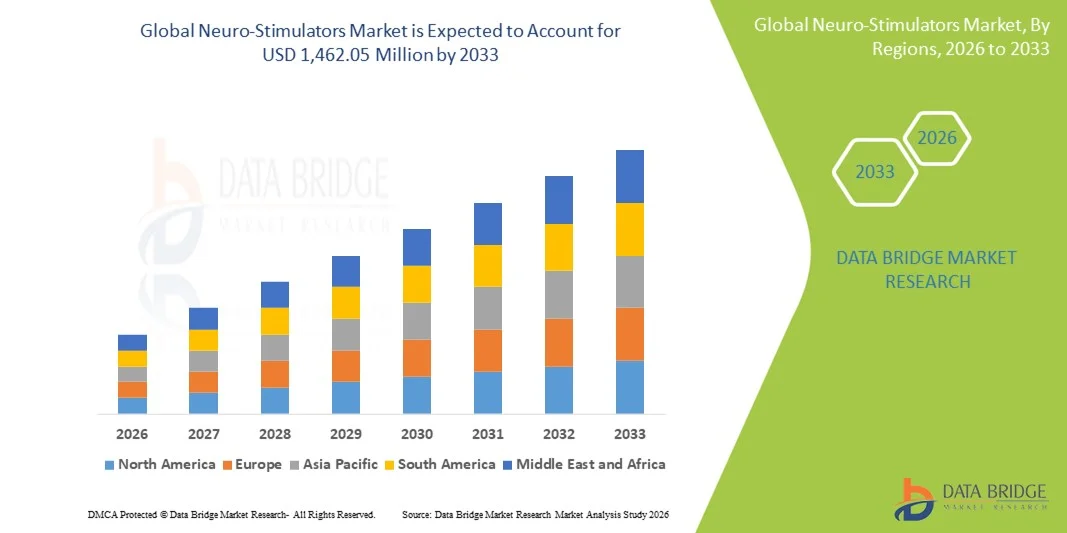
- As per Data Bridge Market Research Analysis the global neuro-stimulators market size was valued at USD 672.22 million in 2025 and is expected to reach USD 1,462.05 million by 2033, at a CAGR of 10.2% during the forecast period
- The market growth is largely driven by the increasing prevalence of neurological disorders, advancements in neurostimulation technologies, and rising awareness of non-invasive and minimally invasive treatment options
- Furthermore, growing patient preference for pain management and functional improvement therapies, along with supportive reimbursement policies and healthcare infrastructure development, is positioning neuro-stimulators as a preferred solution for neurological care. These combined factors are propelling the adoption of neuro-stimulator devices, thereby significantly enhancing the market’s expansion
Market Size & Forecast
- Global Market Value (2025): USD 672.22 million
- Expected Market Value (2033): USD 1,462.05 million
- Forecast CAGR (2026–2033): 10.2%
What are the Major Takeaways of Neuro-Stimulators Market?
- Neuro-stimulators, providing electrical stimulation to targeted areas of the nervous system, are becoming essential tools in managing chronic pain, neurological disorders, and movement-related conditions in both hospital and home-care settings due to their therapeutic efficacy, programmability, and minimally invasive design
- The rising adoption of neuro-stimulation therapies is primarily driven by increasing prevalence of neurological disorders such as Parkinson’s disease, epilepsy, and chronic pain conditions, along with growing awareness of non-pharmacological treatment options and patient preference for minimally invasive solutions
- North America dominated the neuro-stimulators market with the largest revenue share of 39.2% in 2025, attributed to advanced healthcare infrastructure, high R&D investments, and the presence of key market players, with the U.S. witnessing significant adoption of implantable and wearable neuro-stimulation devices, supported by technological innovations in wireless connectivity, AI-driven therapy customization, and integrated monitoring systems
- Asia-Pacific is expected to be the fastest growing region in the neuro-stimulators market during the forecast period, driven by rising healthcare expenditure, improving reimbursement policies, and increasing awareness about neurological care solutions
- Spinal Cord stimulator dominated the neuro-stimulators market with a market share of 42% in 2025, fueled by their proven efficacy in managing chronic pain, expanding clinical applications, and growing adoption in both inpatient and outpatient care settings
Report Scope and Neuro-Stimulators Market Segmentation
|
Attributes |
Neuro-Stimulators Key Market Insights |
|
Segments Covered |
|
|
Countries Covered |
North America
Europe
Asia-Pacific
Middle East and Africa
South America
|
|
Key Market Players |
|
|
Market Opportunities |
|
|
Value Added Data Infosets |
In addition to the insights on market scenarios such as market value, growth rate, segmentation, geographical coverage, and major players, the market reports curated by the Data Bridge Market Research also include in-depth expert analysis, patient epidemiology, pipeline analysis, pricing analysis, and regulatory framework |
What is the Key Trend in the Neuro-Stimulators Market?
Advancements in AI-Driven and Wearable Neuro-Stimulation
- A significant and accelerating trend in the global neuro-stimulators market is the integration of artificial intelligence (AI) with wearable and implantable devices, enabling more precise, personalized, and adaptive therapy for neurological disorders
- For instance, Boston Scientific’s latest SCS devices leverage AI algorithms to automatically adjust stimulation patterns based on patient activity and feedback, improving therapy outcomes and comfort
- AI-enabled neuro-stimulators can analyze patient response data in real time, optimize stimulation parameters, and provide predictive alerts for potential therapy adjustments, enhancing clinical efficacy
- The combination of wearable neuro-stimulators with mobile applications allows patients and clinicians to remotely monitor therapy, track progress, and make adjustments through a single interface, increasing convenience and adherence
- This trend toward intelligent, connected, and patient-centric neuro-stimulation solutions is redefining expectations for neurological care, with companies such as Abbott developing closed-loop systems that continuously adapt stimulation based on patient feedback
- The demand for AI-driven, wearable, and minimally invasive neuro-stimulators is growing rapidly across both hospital and home-care settings, as patients and clinicians increasingly prioritize precision, personalization, and ease of use
- Increasing integration of neuro-stimulators with telemedicine platforms is enabling remote consultations, therapy adjustments, and continuous patient monitoring, enhancing accessibility in underserved regions
- Growing collaborations between device manufacturers and software developers are driving the development of multi-functional neuro-stimulation systems that combine pain management, mobility support, and cognitive therapy in a single device
Neuro-Stimulators Market Dynamics
Driver
Rising Prevalence of Neurological Disorders and Growing Therapy Awareness
- The increasing incidence of chronic pain, movement disorders, and other neurological conditions, combined with growing awareness of neuro-stimulation therapies, is a significant driver for market growth
- For instance, in March 2025, Medtronic announced the expansion of its spinal cord stimulation portfolio, highlighting patient education programs and hospital partnerships to increase therapy adoption
- As more patients seek non-pharmacological solutions for pain management and neurological care, neuro-stimulators offer advanced programmable therapy, adjustable stimulation, and reduced side effects compared to traditional treatments
- Furthermore, the growing penetration of wearable, minimally invasive, and home-use neuro-stimulation devices is making these therapies more accessible and appealing to a broader patient base
- Increasing support from healthcare providers, reimbursement policies, and hospital adoption programs further reinforces the uptake of neuro-stimulation therapies in both inpatient and outpatient settings
- The convenience of personalized therapy, remote monitoring, and improved clinical outcomes is driving strong adoption across global neuro-stimulator markets, particularly in regions with advanced healthcare infrastructure
- Rising awareness campaigns and patient advocacy initiatives are promoting early intervention using neuro-stimulation therapies, boosting adoption among newly diagnosed patients
- Technological advancements in battery life and device miniaturization are enabling longer use, improved portability, and patient comfort, further accelerating market growth
Restraint/Challenge
High Device Costs and Regulatory Compliance Hurdles
- The high cost of advanced neuro-stimulators, coupled with stringent regulatory approval processes, poses a significant challenge to broader market adoption
- For instance, lengthy FDA or CE approval timelines for implantable devices can delay market entry and limit patient access to innovative therapies
- Concerns regarding device safety, post-implantation complications, and cybersecurity risks for connected neuro-stimulators may make patients and clinicians hesitant to adopt these solutions
- Addressing these challenges requires robust clinical trials, strict compliance with international standards, and transparent communication about device safety and efficacy, as emphasized by Abbott and Boston Scientific
- In addition, affordability remains a barrier in developing regions, where high costs may prevent widespread adoption despite increasing neurological disorder prevalence
- Overcoming these hurdles through cost optimization, patient assistance programs, and regulatory support is critical for sustained growth in the global neuro-stimulators market
- Limited awareness among healthcare providers about the full potential of neuro-stimulation therapies can delay referrals and reduce adoption rates, particularly in emerging markets
- Challenges in integrating neuro-stimulators with existing hospital IT systems and electronic health records may slow adoption in technologically diverse healthcare settings
How is the Neuro-Stimulators Market Segmented?
The market is segmented on the basis of product, type, application, and end user.
- By Product
On the basis of product, the neuro-stimulators market is segmented into spinal cord stimulator (SCS), deep brain stimulator (DBS), sacral nerve stimulator, vagus nerve stimulator (VNS), responsive neurostimulation (RNS), transcranial magnetic stimulation (TMS), peripheral nerve stimulation (PNS), and gastric electric stimulator. The spinal cord stimulator segment dominated the market with the largest revenue share of 42% in 2025, driven by its proven efficacy in chronic pain management and increasing adoption in both hospital and home-care settings. SCS devices are highly preferred for their programmability, minimally invasive implantation, and ability to significantly improve patient quality of life. The segment’s dominance is also supported by continuous technological advancements such as rechargeable batteries, wireless connectivity, and AI-enabled therapy optimization. Strong clinical evidence and widespread physician adoption further reinforce SCS as the leading neuro-stimulation therapy. Continuous R&D investments and supportive reimbursement policies are also helping sustain the market leadership of this segment.
The peripheral nerve stimulation segment is anticipated to witness the fastest growth rate of 22.3% from 2026 to 2033, fueled by rising awareness of non-invasive and targeted therapies for pain management, post-surgical recovery, and rehabilitation. PNS devices offer advantages such as minimally invasive procedures, outpatient suitability, and customizable stimulation patterns, which are driving adoption in emerging markets. Expanding applications in sports medicine, rehabilitation, and home-use therapeutic devices are further contributing to rapid growth. Technological innovations, user-friendly designs, and integration with wearable applications enhance the attractiveness of this segment.
- By Type
On the basis of type, the neuro-stimulators market is segmented into invasive neuro-stimulators and non-invasive neuro-stimulators. The invasive neuro-stimulators segment dominated the market with a revenue share of 58.7% in 2025, driven by their proven clinical efficacy, ability to deliver precise stimulation, and wide adoption for conditions such as chronic pain, Parkinson’s disease, and epilepsy. Implantable devices provide continuous therapy and programmable customization, making them the preferred choice among hospitals and specialty clinics. The dominance is reinforced by high patient adherence, strong physician trust, and regulatory approvals for multiple indications. Technological advancements, long-term patient outcomes, and integration with AI-enabled monitoring systems further strengthen this segment.
The non-invasive neuro-stimulators segment is expected to witness the fastest growth at a CAGR of 23.1% from 2026 to 2033, owing to growing patient preference for at-home treatments, minimal risk procedures, and expanding applications in depression, dystonia, and rehabilitation therapy. Non-invasive devices such as transcranial magnetic stimulators and wearable PNS systems are gaining traction due to ease of use, lower cost, and regulatory support in several regions. Increasing focus on homecare therapy, patient convenience, and rising awareness in emerging markets are key growth drivers.
- By Application
On the basis of application, the neuro-stimulators market is segmented into pain management, epilepsy, essential tremor, hearing loss, urinary and fecal incontinence, depression, dystonia, gastroparesis, Parkinson’s disease, and others. The pain management segment dominated the market with the largest revenue share of 39.8% in 2025, due to the high prevalence of chronic pain conditions globally and strong clinical validation of neuro-stimulation therapy for alleviating pain. Growing patient awareness, favorable reimbursement policies, and increasing adoption of SCS and PNS devices further support this dominance. Hospitals and specialty clinics heavily rely on pain management devices for patient treatment plans. Clinical evidence supporting long-term efficacy, safety, and quality of life improvement reinforces the segment’s leadership.
The depression segment is expected to witness the fastest growth rate of 24.0% from 2026 to 2033, driven by the rising adoption of non-invasive neuro-stimulation therapies such as TMS and VNS, increasing mental health awareness, and supportive government initiatives for mental health treatment. Expanding applications in outpatient care and home-use devices are also contributing to rapid market growth. Technological innovations, improved patient compliance, and integration with digital health platforms further accelerate adoption.
- By End User
On the basis of end user, the neuro-stimulators market is segmented into hospitals, specialty clinics / pain management centers, home healthcare settings, rehabilitation centers, and others. Hospitals dominated the neuro-stimulators market with the largest revenue share of 46.5% in 2025, driven by the widespread adoption of implantable neuro-stimulation devices for chronic pain, movement disorders, and neurological conditions. Hospitals offer specialized infrastructure, skilled neurosurgeons, and advanced imaging facilities that are critical for surgical implantation of devices like spinal cord stimulators, deep brain stimulators, and vagus nerve stimulators. The dominance is further supported by strong clinical adoption, availability of advanced therapies, and comprehensive patient monitoring systems. Hospitals also benefit from favorable reimbursement policies and insurance coverage, making them the primary point of neuro-stimulator utilization.
Specialty Clinics / Pain Management Centers are expected to witness the fastest growth at a CAGR of 22.8% from 2026 to 2033, fueled by the rising demand for minimally invasive neuro-stimulation therapies and targeted pain management solutions. These centers focus on chronic pain and neurological disorder management and are increasingly adopting non-invasive and wearable devices that allow patients to undergo therapy in outpatient settings. Technological advancements, patient awareness, and growing accessibility of personalized neuro-stimulation therapies contribute to the rapid expansion of this segment.
Which Region Holds the Largest Share of the Neuro-Stimulators Market?
- North America dominated the neuro-stimulators market with the largest revenue share of 39.2% in 2025, attributed to advanced healthcare infrastructure, high R&D investments, and the presence of key market players
- Patients and healthcare providers in the region highly value the precision, programmability, and minimally invasive nature of neuro-stimulators, along with the integration of AI-driven therapy optimization and remote monitoring capabilities
- This widespread adoption is further supported by strong R&D investments, favorable reimbursement policies, and the presence of key market players, establishing neuro-stimulators as a preferred therapeutic solution for pain management, movement disorders, and other neurological conditions
U.S. Neuro-Stimulators Market Insight
The U.S. neuro-stimulators market captured the largest revenue share of 79% in 2025 within North America, fueled by the rising prevalence of neurological disorders and strong adoption of advanced neurostimulation therapies. Patients increasingly prioritize minimally invasive and programmable solutions for chronic pain, Parkinson’s disease, epilepsy, and other neurological conditions. The growing availability of AI-enabled and wearable neuro-stimulators, combined with robust hospital infrastructure and specialist centers, further propels market growth. Moreover, favorable reimbursement policies and increasing awareness among healthcare providers and patients are significantly contributing to the market's expansion.
Europe Neuro-Stimulators Market Insight
The Europe neuro-stimulators market is projected to expand at a substantial CAGR throughout the forecast period, primarily driven by a high prevalence of neurological disorders and increasing adoption of advanced therapies. Growing awareness of non-pharmacological treatment options, coupled with supportive reimbursement frameworks, is fostering the uptake of neuro-stimulation devices. European patients and clinicians are drawn to the precision, programmability, and minimally invasive nature of neuro-stimulators. The region is experiencing significant growth across hospitals, neurology centers, and outpatient clinics, with neuro-stimulators increasingly incorporated into standard treatment protocols.
U.K. Neuro-Stimulators Market Insight
The U.K. neuro-stimulators market is anticipated to grow at a noteworthy CAGR during the forecast period, driven by rising incidence of chronic pain, movement disorders, and neurological conditions. In addition, concerns regarding effective management of neurological diseases are encouraging healthcare providers to adopt implantable and non-invasive neuro-stimulation solutions. The U.K.’s strong healthcare infrastructure, coupled with increasing awareness among neurologists and patients, is expected to continue to stimulate market growth. Government initiatives supporting mental health and pain management therapies further accelerate adoption.
Germany Neuro-Stimulators Market Insight
The Germany neuro-stimulators market is expected to expand at a considerable CAGR during the forecast period, fueled by increasing awareness of advanced neurological therapies and the prevalence of chronic neurological disorders. Germany’s well-established healthcare system, emphasis on innovation, and access to cutting-edge technologies promote the adoption of both invasive and non-invasive neuro-stimulation devices. Hospitals and specialty clinics are incorporating neuro-stimulators into treatment protocols, particularly for chronic pain, Parkinson’s disease, and epilepsy. Integration with telemedicine and remote monitoring solutions is also becoming increasingly common, enhancing patient adherence and outcomes.
Asia-Pacific Neuro-Stimulators Market Insight
The Asia-Pacific neuro-stimulators market is poised to grow at the fastest CAGR of 23.5% during the forecast period of 2026 to 2033, driven by increasing healthcare expenditure, rising prevalence of neurological disorders, and improving medical infrastructure in countries such as China, Japan, and India. The region's growing awareness of non-pharmacological and minimally invasive therapies is driving adoption. Furthermore, as APAC emerges as a manufacturing and innovation hub for neuro-stimulation devices, affordability and accessibility are expanding to a wider patient population. Government initiatives promoting digital health and neurological care are also contributing to growth.
Japan Neuro-Stimulators Market Insight
The Japan neuro-stimulators market is gaining momentum due to the country’s aging population, high incidence of neurological disorders, and advanced healthcare infrastructure. Japanese patients and healthcare providers increasingly prioritize minimally invasive, programmable, and AI-enabled neuro-stimulation solutions. Integration with telemedicine and wearable monitoring devices is fueling market growth. Moreover, Japan’s focus on elderly care and home-based therapy is such asly to spur demand for easy-to-use and reliable neuro-stimulation devices across both residential and clinical settings.
India Neuro-Stimulators Market Insight
The India neuro-stimulators market accounted for the largest market revenue share in Asia-Pacific in 2025, attributed to rapid urbanization, increasing prevalence of neurological disorders, and rising healthcare awareness. India is witnessing growing adoption of both invasive and non-invasive neuro-stimulation devices across hospitals, clinics, and home-care settings. Expansion of health insurance coverage, availability of cost-effective solutions, and rising investments in neurological healthcare infrastructure are key factors propelling the market. In addition, increasing collaborations between domestic manufacturers and global players are driving technology accessibility and market growth.
Which are the Top Companies in Neuro-Stimulators Market?
The Neuro-Stimulators industry is primarily led by well-established companies, including:
- Medtronic (Ireland)
- Boston Scientific Corporation (U.S.)
- Abbott (U.S.)
- Nevro Corporation (U.S.)
- LivaNova plc (U.K.)
- NeuroPace, Inc. (U.S.)
- Biotronik (Germany)
- Neuronetics (U.S.)
- ElectroCore LLC (U.S.)
- Synapse Biomedical (U.S.)
- Cochlear Ltd (Australia)
- Advanced Bionics (U.S.)
- B. Braun SE (Germany)
- MED EL Medical Electronics (Austria)
- CONMED Corporation (U.S.)
- Laborie Medical Technologies (U.S.)
- Zimmer Biomet (U.S.)
- Aleva Neurotherapeutics (Switzerland)
- NeuroSigma, Inc. (U.S.)
What are Latest Developments in Neuro-Stimulators Market?
- In December 2025, the U.S. FDA approved Flow Neuroscience’s FL‑100, the first at‑home non‑invasive brain stimulation device for treating moderate to severe depression, allowing patients to receive mild electrical stimulation therapy under remote supervision
- In February 2025, Medtronic announced that its Percept™ DBS neurostimulator with exclusive BrainSense™ Adaptive technology received FDA approval marking the world’s first adaptive DBS system that dynamically adjusts therapy based on real‑time brain signals to better manage Parkinson’s disease symptoms and personalize treatment
- In November 2024, Nevro Corp. announced that its HFX iQ™ spinal cord stimulation (SCS) system integrating high‑frequency therapy and cloud‑based personalized insights — received CE Mark certification in Europe, enabling expanded commercialization of this AI‑enabled personalized pain relief solution
- In January 2024, Abbott received U.S. FDA approval and announced the launch of its Liberta RC™ rechargeable deep brain stimulation (DBS) system, touted as the world’s smallest rechargeable DBS with remote programming capabilities to treat movement disorders such as Parkinson’s disease and essential tremor. The system also integrates with Abbott’s NeuroSphere™ Virtual Clinic for remote clinician support
- In June 2021, Medtronic received FDA approval for its Vanta™ implantable neurostimulator, a next‑generation recharge‑free spinal cord stimulation platform offering up to 11 years of battery life and adaptive stimulation via proprietary AdaptiveStim™ technology for chronic pain relief

- Interactive Data Analysis Dashboard
- Company Analysis Dashboard for high growth potential opportunities
- Research Analyst Access for customization & queries
- Competitor Analysis with Interactive dashboard
- Latest News, Updates & Trend analysis
- Harness the Power of Benchmark Analysis for Comprehensive Competitor Tracking
Data collection and base year analysis are done using data collection modules with large sample sizes. The stage includes obtaining market information or related data through various sources and strategies. It includes examining and planning all the data acquired from the past in advance. It likewise envelops the examination of information inconsistencies seen across different information sources. The market data is analysed and estimated using market statistical and coherent models. Also, market share analysis and key trend analysis are the major success factors in the market report. To know more, please request an analyst call or drop down your inquiry.
The key research methodology used by DBMR research team is data triangulation which involves data mining, analysis of the impact of data variables on the market and primary (industry expert) validation. Data models include Vendor Positioning Grid, Market Time Line Analysis, Market Overview and Guide, Company Positioning Grid, Patent Analysis, Pricing Analysis, Company Market Share Analysis, Standards of Measurement, Global versus Regional and Vendor Share Analysis. To know more about the research methodology, drop in an inquiry to speak to our industry experts.
Data Bridge Market Research is a leader in advanced formative research. We take pride in servicing our existing and new customers with data and analysis that match and suits their goal. The report can be customized to include price trend analysis of target brands understanding the market for additional countries (ask for the list of countries), clinical trial results data, literature review, refurbished market and product base analysis. Market analysis of target competitors can be analyzed from technology-based analysis to market portfolio strategies. We can add as many competitors that you require data about in the format and data style you are looking for. Our team of analysts can also provide you data in crude raw excel files pivot tables (Fact book) or can assist you in creating presentations from the data sets available in the report.













