


Newcastle Disease Treatment Market Size
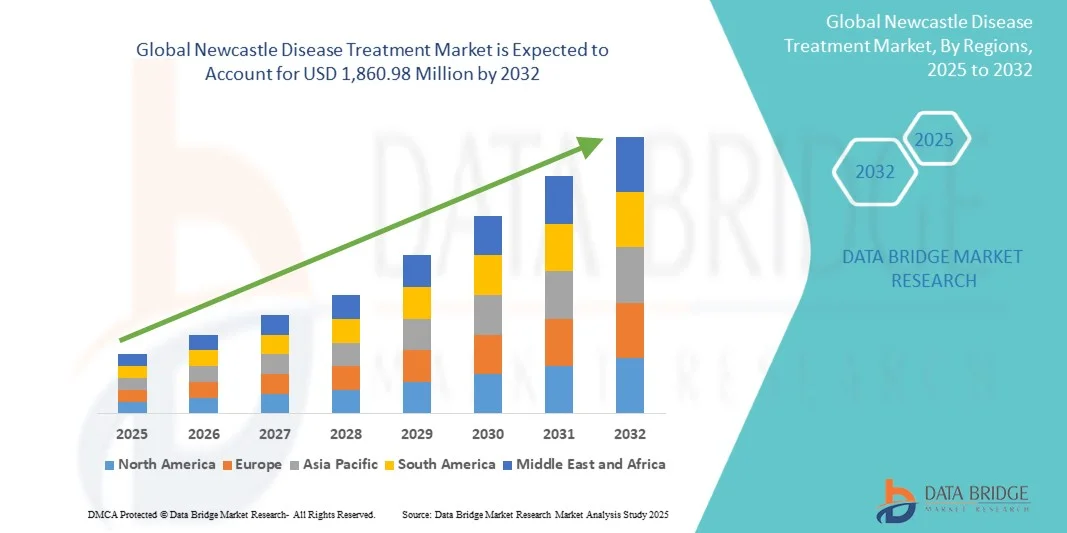
- The global Newcastle Disease treatment market size was valued at USD 955.49 million in 2024 and is expected to reach USD 1,860.98 million by 2032, at a CAGR of 8.69% during the forecast period
- The market growth is largely driven by the increasing prevalence of Newcastle Disease among poultry, along with rising awareness regarding disease management and preventive vaccination programs across commercial and backyard farms
- Furthermore, growing demand for poultry products, coupled with advancements in veterinary vaccines and antiviral therapies, is encouraging the adoption of effective Newcastle Disease treatment solutions, thereby significantly accelerating the market’s expansion
Newcastle Disease Treatment Market Analysis
- Newcastle Disease treatments, including vaccines and antiviral therapeutics, are increasingly critical for maintaining poultry health and preventing economic losses in both commercial and backyard farming due to their effectiveness in disease control, ease of administration, and compatibility with existing poultry management practices
- The rising demand for Newcastle Disease treatments is primarily fueled by the increasing prevalence of the disease, growing awareness of biosecurity measures among poultry farmers, and the need for improved flock productivity and mortality reduction
- North America dominated the Newcastle Disease treatment market with the largest revenue share of 40.3% in 2024, characterized by advanced poultry farming practices, high adoption of modern veterinary interventions, and a strong presence of key industry players, with the U.S. experiencing substantial uptake of innovative vaccines and treatment protocols supported by regulatory initiatives and biosecurity programs
- Asia-Pacific is expected to be the fastest-growing region in the Newcastle Disease treatment market during the forecast period due to increasing poultry production, rising awareness about poultry health management, and expanding government initiatives supporting disease prevention
- Live attenuated vaccine segment dominated the Newcastle Disease treatment market with a market share of 47.2% in 2024, driven by its proven efficacy, ease of mass administration in flocks, and cost-effectiveness for large-scale poultry operations
Report Scope and Newcastle Disease Treatment Market Segmentation
|
Attributes |
Newcastle Disease Treatment Key Market Insights |
|
Segments Covered |
|
|
Countries Covered |
North America
Europe
Asia-Pacific
Middle East and Africa
South America
|
|
Key Market Players |
|
|
Market Opportunities |
|
|
Value Added Data Infosets |
In addition to the insights on market scenarios such as market value, growth rate, segmentation, geographical coverage, and major players, the market reports curated by the Data Bridge Market Research also include in-depth expert analysis, pricing analysis, brand share analysis, consumer survey, demography analysis, supply chain analysis, value chain analysis, raw material/consumables overview, vendor selection criteria, PESTLE Analysis, Porter Analysis, and regulatory framework. |
Newcastle Disease Treatment Market Trends
“Advancements in Vaccine Technology and Delivery Methods”
- A significant and accelerating trend in the global Newcastle Disease treatment market is the development of next-generation vaccines, including recombinant, vector-based, and thermostable formulations, which enhance efficacy and ease of administration for poultry farmers
- For instance, the LaSota-based live attenuated vaccines have been modified for improved heat tolerance, allowing safer transport and storage in tropical regions without refrigeration
- Novel delivery methods, such as in-ovo vaccination and mass aerosol administration, enable large-scale immunization of flocks while minimizing stress to birds and labor requirements for farmers
- Integration of these vaccines with poultry management software platforms allows better tracking of vaccination schedules, immune responses, and disease outbreak patterns for optimized flock health management
- This trend towards more effective, user-friendly, and technologically advanced vaccination solutions is reshaping expectations for poultry disease prevention, with companies such as Ceva Santé Animale developing recombinant vaccines with enhanced protection and ease of use
- The adoption of advanced vaccines and streamlined delivery methods is growing rapidly across commercial poultry farms, driven by the need for higher productivity and reduced mortality rates
Newcastle Disease Treatment Market Dynamics
Driver
“Increasing Poultry Production and Growing Disease Awareness”
- The rising demand for poultry products globally, coupled with increasing awareness of Newcastle Disease among farmers, is a key driver for market growth
- For instance, in March 2024, Merck Animal Health launched an outreach initiative to educate farmers in the U.S. and Europe on best practices for Newcastle Disease vaccination and biosecurity measures
- As poultry farmers seek to protect flocks from outbreaks that can cause severe economic losses, the adoption of vaccines and antiviral treatments is increasing significantly
- Furthermore, the expansion of commercial poultry operations and the modernization of farms are boosting the demand for integrated disease prevention solutions, including vaccines, diagnostics, and monitoring systems
- The growing preference for scientifically validated treatments and regulatory-supported vaccination programs is further propelling market adoption across both developed and developing regions
- Improved flock health, reduced mortality rates, and enhanced production efficiency are key factors driving widespread use of Newcastle Disease treatments in poultry farms globally
Restraint/Challenge
“Vaccine Storage, Administration Challenges, and Regulatory Compliance”
- Concerns regarding the proper storage, handling, and administration of Newcastle Disease vaccines pose significant challenges to market growth, especially in regions with limited cold chain infrastructure
- For instance, vaccines requiring strict refrigeration can lose efficacy if exposed to high temperatures during transport or storage, creating risks of ineffective disease control
- Ensuring trained personnel for correct vaccine administration, particularly in small-scale and backyard poultry operations, remains a barrier to consistent immunization coverage
- Compliance with regulatory standards and approval processes for new vaccines or antiviral products can delay product launches and limit market availability in certain regions
- The relatively high cost of advanced vaccines or combination treatments compared to conventional options may also hinder adoption among price-sensitive farmers
- Overcoming these challenges through improved cold chain logistics, farmer training programs, and streamlined regulatory pathways is critical for sustained growth in the Newcastle Disease treatment market
Newcastle Disease Treatment Market Scope
The market is segmented on the basis of type, vaccine strains, application, route of administration, end-users, and distribution channel.
- By Type
On the basis of type, the Newcastle Disease treatment market is segmented into live attenuated vaccine, inactivated vaccine, and conjugated vaccine. The live attenuated vaccine segment dominated the market with the largest market revenue share of 47.2% in 2024, driven by its proven efficacy, ease of mass administration in flocks, and cost-effectiveness for large-scale poultry operations. Farmers prefer live attenuated vaccines for their ability to provide strong and long-lasting immunity while being compatible with multiple administration methods such as intraocular, intranasal, and aerosol spray. These vaccines also support rapid immunization schedules, improving flock productivity and reducing disease-related losses. Furthermore, the segment benefits from extensive availability in veterinary pharmacies and research institutes. Established trust and historical use in commercial farms reinforce their dominance.
The inactivated vaccine segment is anticipated to witness the fastest growth rate of 18.9% from 2025 to 2032, fueled by its safety profile and suitability for immunocompromised birds. Inactivated vaccines offer minimal risk of reversion to virulence and are increasingly adopted in regions with strict biosecurity regulations. Their combination with other poultry vaccines in multivalent formulations provides comprehensive protection. Farmers also value controlled immunization and predictable immune response. Expanding awareness among veterinary practitioners and commercial poultry operations is driving adoption. Ongoing R&D and regulatory approvals support faster market penetration.
- By Vaccine Strains
On the basis of vaccine strains, the Newcastle Disease treatment market is segmented into avirulent, lentogenic, mesogenic, and velogenic strains. The lentogenic strain segment dominated the market with the largest revenue share in 2024 due to its widespread use in commercial vaccination programs, providing effective immunity while minimizing adverse effects in young chicks. Lentogenic strains are preferred for primary vaccination and are compatible with multiple delivery routes, including in-ovo, intraocular, and aerosol spray. Their long-standing successful use in both developed and developing regions reinforces dominance. Farmers benefit from low cost, easy administration, and strong protection against common Newcastle Disease outbreaks. Continuous availability and trust among veterinary clinics and pharmacies further support growth.
The mesogenic strain segment is expected to witness the fastest CAGR from 2025 to 2032, driven by its ability to induce stronger immunity in older birds and provide protection against more virulent strains. These vaccines are increasingly deployed in areas with higher disease prevalence and stringent biosecurity standards. Rising demand for poultry meat and eggs accelerates adoption of mesogenic vaccines across commercial farms. Advances in vaccine formulation and regulatory approvals are fueling growth. Farmers and veterinarians increasingly prefer these vaccines for outbreak prevention and improved flock survival rates. Enhanced awareness campaigns also contribute to faster market uptake.
- By Application
On the basis of application, the Newcastle Disease treatment market is segmented into chickens, turkeys, pigeons, and others. The chickens segment dominated the market with the largest revenue share of 58.3% in 2024, owing to high global demand for chicken meat and eggs, which makes controlling Newcastle Disease a top priority. Widespread rearing of chickens in both commercial and backyard farms ensures consistent vaccine demand. Farmers rely on vaccines that allow mass immunization and rapid administration. Integration with modern poultry health management systems enhances monitoring and efficacy. Continuous government support and institutional vaccination programs further reinforce dominance.
The turkeys segment is anticipated to witness the fastest growth rate of 20.5% from 2025 to 2032, driven by the expanding turkey farming industry in North America and Europe. Increasing consumer preference for turkey meat and proactive disease management practices is boosting vaccine adoption. Specialized vaccination programs targeting turkeys enhance immunity and reduce mortality. Aerosol and intranasal administration methods further support rapid coverage of large flocks. Rising awareness among farmers and integration with commercial farm operations accelerate growth. Technological innovation in vaccine delivery also contributes to adoption.
- By Route of Administration
On the basis of route of administration, the Newcastle Disease treatment market is segmented into intraocular, intranasal, aerosol spray, and others. The aerosol spray segment dominated the market with the largest revenue share of 42.6% in 2024 due to its efficiency in mass vaccination, reducing labor costs and minimizing stress to birds. Aerosol delivery ensures uniform vaccine coverage across large flocks, making it ideal for commercial farms. Compatibility with live attenuated and recombinant vaccines enhances flexibility. Farmers benefit from faster vaccination schedules and reduced operational complexity. Widespread adoption in poultry farms and support from veterinary clinics reinforce dominance. Integration with automated vaccination equipment further drives growth.
The in-ovo administration segment is expected to witness the fastest CAGR from 2025 to 2032, driven by its ability to vaccinate embryos before hatching, providing early immunity and reducing susceptibility to Newcastle Disease. In-ovo delivery improves operational efficiency in automated hatcheries. Early vaccination ensures stronger flock protection and reduces disease outbreaks. Adoption is increasing in large commercial operations with advanced management systems. Government programs promoting biosecurity further support growth. Research and technological advancements in automated in-ovo systems are fueling faster adoption rates.
- By End-Users
On the basis of end-users, the Newcastle Disease treatment market is segmented into veterinary hospitals, veterinary clinics, veterinary research institutes, and others. The veterinary clinics segment dominated the market with the largest revenue share of 44.9% in 2024, due to accessibility for small-scale and commercial poultry farmers seeking expert guidance. Clinics provide vaccination services, follow-up care, and disease management advice, ensuring high adoption of treatments. Established trust, easy availability, and proximity to farmers strengthen dominance. Clinics also support awareness programs on Newcastle Disease prevention. Partnerships with pharmaceutical companies further facilitate consistent supply.
The veterinary research institutes segment is expected to witness the fastest growth rate of 19.3% from 2025 to 2032, driven by increased research on innovative vaccines, strain characterization, and antiviral therapies. Institutes play a critical role in testing new formulations and improving vaccine efficacy. Collaboration with pharmaceutical companies and government bodies accelerates product development. Rising investments in R&D support faster introduction of advanced treatments. Focus on regulatory compliance and safety testing enhances market trust. Technological innovation and ongoing research further fuel growth in this segment.
- By Distribution Channel
On the basis of distribution channel, the Newcastle Disease treatment market is segmented into direct tender, veterinary pharmacies, retail pharmacies, online pharmacies, and others. The direct tender segment dominated the market with the largest revenue share of 47.1% in 2024, owing to bulk procurement by commercial poultry farms, government vaccination programs, and institutional buyers. Direct tenders ensure reliable supply, cost-effectiveness, and quality assurance. Large-scale farms benefit from scheduled deliveries and regulatory compliance. Government-backed programs further strengthen this segment. Established partnerships between suppliers and institutional buyers reinforce dominance.
The online pharmacies segment is expected to witness the fastest CAGR from 2025 to 2032, driven by increasing internet penetration and awareness among small-scale poultry farmers. Online platforms provide convenient access to vaccines, antiviral treatments, and advisory services. Farmers in remote areas can procure products efficiently, reducing logistical challenges. Integration of digital payments and user-friendly interfaces supports adoption. Rising trust in e-commerce channels and home delivery accelerates growth. Online pharmacies also offer access to advanced vaccine options and combination products, contributing to faster adoption.
Newcastle Disease Treatment Market Regional Analysis
- North America dominated the Newcastle Disease treatment market with the largest revenue share of 40.3% in 2024, characterized by advanced poultry farming practices, high adoption of modern veterinary interventions, and a strong presence of key industry players
- Poultry farmers in the region prioritize effective vaccination and treatment solutions to protect flocks from Newcastle Disease outbreaks, ensuring productivity and minimizing economic losses
- This widespread adoption is further supported by well-established cold chain infrastructure, access to advanced vaccines, and a technologically adept veterinary workforce, enabling timely and efficient immunization across commercial and backyard farms
U.S. Newcastle Disease Treatment Market Insight
The U.S. Newcastle Disease treatment market captured the largest revenue share of 82% in 2024 within North America, driven by advanced commercial poultry operations and strong adoption of modern vaccination programs. Farmers prioritize effective disease prevention strategies, including live attenuated and recombinant vaccines, to protect flocks and reduce economic losses. The widespread use of veterinary clinics and institutional vaccination programs further supports market growth. Increasing awareness of biosecurity measures, coupled with government-backed initiatives, is enhancing adoption across both small-scale and industrial farms. Integration of digital flock management tools allows precise monitoring of vaccination schedules and disease outbreaks. Overall, the U.S. market is characterized by high adoption of advanced, scientifically validated Newcastle Disease treatments.
Europe Newcastle Disease Treatment Market Insight
The Europe Newcastle Disease treatment market is projected to expand at a significant CAGR throughout the forecast period, primarily driven by stringent veterinary regulations and the rising demand for poultry health management solutions. Growing urbanization and the increasing scale of commercial poultry farms are fostering the adoption of vaccines and antiviral therapies. European farmers are focusing on preventive healthcare to minimize mortality and maximize production efficiency. The region sees substantial uptake across chickens, turkeys, and other poultry species in both commercial and backyard farms. Research initiatives and collaborations with pharmaceutical companies enhance the availability of advanced vaccines. The trend toward integrated flock health management systems is further supporting market growth.
U.K. Newcastle Disease Treatment Market Insight
The U.K. Newcastle Disease treatment market is anticipated to grow at a noteworthy CAGR during the forecast period, driven by the modernization of poultry farms and the rising awareness of disease prevention. Farmers are increasingly adopting vaccines, especially live attenuated and inactivated formulations, to protect flocks against outbreaks. Concerns regarding economic losses due to disease are encouraging both small-scale and commercial farmers to implement robust vaccination programs. The country’s strong veterinary infrastructure, research support, and regulatory frameworks facilitate access to advanced treatments. Awareness campaigns and training for proper vaccine administration are accelerating adoption. The U.K. market continues to prioritize safe, effective, and scientifically validated Newcastle Disease treatments.
Germany Newcastle Disease Treatment Market Insight
The Germany Newcastle Disease treatment market is expected to expand at a considerable CAGR during the forecast period, fueled by high awareness of poultry biosecurity and advanced farm management practices. Farmers are adopting technologically advanced vaccines, including recombinant and thermostable formulations, to minimize mortality and enhance flock immunity. Germany’s well-developed veterinary infrastructure supports regular vaccination schedules and effective disease monitoring. Research institutes and pharmaceutical collaborations facilitate the availability of innovative treatments. Increasing focus on sustainable and safe poultry production promotes adoption across commercial operations. The integration of modern vaccination programs with automated flock management systems is driving growth in Germany.
Asia-Pacific Newcastle Disease Treatment Market Insight
The Asia-Pacific Newcastle Disease treatment market is poised to grow at the fastest CAGR during the forecast period of 2025 to 2032, driven by increasing poultry production, rising disposable incomes, and technological advancements in countries such as China, India, and Japan. Rapid urbanization and expansion of commercial farms are driving the adoption of vaccines and antiviral therapies. Government-backed vaccination initiatives and biosecurity programs are promoting disease prevention across small and large-scale operations. The region is also emerging as a hub for vaccine manufacturing, improving affordability and accessibility. Integration of digital tools for vaccination tracking enhances operational efficiency. Growing awareness among farmers about flock health management is accelerating treatment adoption.
Japan Newcastle Disease Treatment Market Insight
The Japan Newcastle Disease treatment market is gaining momentum due to the country’s high-tech poultry farming infrastructure and strong focus on biosecurity. Farmers are adopting advanced vaccination programs, including live attenuated and recombinant vaccines, to ensure flock health and productivity. Integration of digital monitoring and automated vaccination systems improves efficiency and disease control. Increasing consumer demand for safe poultry products reinforces the focus on disease prevention. Aging farmers and workforce automation encourage the use of easy-to-administer and effective vaccines. The trend of modernizing poultry operations is driving consistent growth in Japan’s market.
India Newcastle Disease Treatment Market Insight
The India Newcastle Disease treatment market accounted for the largest market revenue share in Asia-Pacific in 2024, attributed to the country’s expanding poultry industry, rapid urbanization, and increasing awareness of flock health management. Both commercial and backyard poultry farms are actively adopting live attenuated, inactivated, and recombinant vaccines to prevent outbreaks. Government programs promoting vaccination and biosecurity measures further support market growth. The availability of affordable vaccines and growing veterinary infrastructure enhance adoption. Technological adoption, such as mobile-based vaccination tracking and advisory services, is improving efficiency. Strong domestic pharmaceutical manufacturing and rising demand for poultry products are key factors propelling market expansion in India.
Newcastle Disease Treatment Market Share
The Newcastle Disease Treatment industry is primarily led by well-established companies, including:
- Merck & Co., Inc. (U.S.)
- Ceva (France)
- QYH Biotech Co., Ltd (China)
- Ringpu Biology (China)
- YEBIO BIOENGINEERING CO., LTD (China)
- Harbin Veterinary Research Institute (China)
- DHN (China)
- Zoetis Services LLC (U.S.)
- ChengDu Tecbond (China)
- Elanco (U.S.)
- FATRO (Italy)
- CAVAC (France)
- Vaksindo (Indonesia)
- Boehringer Ingelheim International GmbH (Germany)
- AdvaCare Pharma (U.S.)
- Vaccure Pharma (India)
- Parkers Pharma Limited (India)
- Hester Biosciences (India)
- Hilleman Laboratories (Singapore)
What are the Recent Developments in Newcastle Disease Treatment Market?
- In June 2025, scientists at The Pirbright Institute successfully created gene-edited chicken cells that produce significantly higher yields of both influenza A virus and Newcastle Disease Virus (NDV). This breakthrough has the potential to improve the efficiency and scalability of vaccine production, addressing the global demand for effective poultry vaccines. The development marks a significant advancement in the field of vaccine research and production
- In May 2025, Merck Animal Health showcased its innovative poultry health solutions at the World Veterinary Poultry Association Congress (WBC 2024). The company presented novel research evaluating vaccination programs for Infectious Bursal Disease and Newcastle Disease, highlighting its commitment to advancing poultry health through research and development. The symposium provided a platform for sharing scientific advancements and fostering collaboration in the field of veterinary medicine
- In January 2025, Sweden was officially declared free of Newcastle Disease after a comprehensive eradication campaign. This achievement marks a significant milestone in the country's efforts to control and eliminate this highly contagious viral disease that primarily affects poultry. The successful eradication underscores the effectiveness of stringent biosecurity measures, timely vaccination programs, and coordinated efforts between veterinary authorities and poultry producers
- In August 2024, Zoetis introduced the HVT-ND vector vaccine, designed to protect against Genotype VII Newcastle Disease Virus (NDV) strains. This vaccine addresses the challenge posed by evolving velogenic NDV strains, which are highly pathogenic and have caused significant outbreaks in poultry populations. The development of this vaccine represents a significant step in enhancing the efficacy of Newcastle disease prevention strategies, particularly in regions affected by these virulent strains
- In April 2024, Merck Animal Health announced that its INNOVAX-ND-H5 vaccine received a positive opinion from the European Medicines Agency's Committee for Medicinal Products for Veterinary Use (CVMP). This vaccine is a single-dose product administered in ovo or subcutaneously at one day of age to reduce mortality, clinical signs, and virus excretion due to infection with highly pathogenic Avian Influenza (HPAI) virus of the H5 type

- Interactive Data Analysis Dashboard
- Company Analysis Dashboard for high growth potential opportunities
- Research Analyst Access for customization & queries
- Competitor Analysis with Interactive dashboard
- Latest News, Updates & Trend analysis
- Harness the Power of Benchmark Analysis for Comprehensive Competitor Tracking
Data collection and base year analysis are done using data collection modules with large sample sizes. The stage includes obtaining market information or related data through various sources and strategies. It includes examining and planning all the data acquired from the past in advance. It likewise envelops the examination of information inconsistencies seen across different information sources. The market data is analysed and estimated using market statistical and coherent models. Also, market share analysis and key trend analysis are the major success factors in the market report. To know more, please request an analyst call or drop down your inquiry.
The key research methodology used by DBMR research team is data triangulation which involves data mining, analysis of the impact of data variables on the market and primary (industry expert) validation. Data models include Vendor Positioning Grid, Market Time Line Analysis, Market Overview and Guide, Company Positioning Grid, Patent Analysis, Pricing Analysis, Company Market Share Analysis, Standards of Measurement, Global versus Regional and Vendor Share Analysis. To know more about the research methodology, drop in an inquiry to speak to our industry experts.
Data Bridge Market Research is a leader in advanced formative research. We take pride in servicing our existing and new customers with data and analysis that match and suits their goal. The report can be customized to include price trend analysis of target brands understanding the market for additional countries (ask for the list of countries), clinical trial results data, literature review, refurbished market and product base analysis. Market analysis of target competitors can be analyzed from technology-based analysis to market portfolio strategies. We can add as many competitors that you require data about in the format and data style you are looking for. Our team of analysts can also provide you data in crude raw excel files pivot tables (Fact book) or can assist you in creating presentations from the data sets available in the report.












