


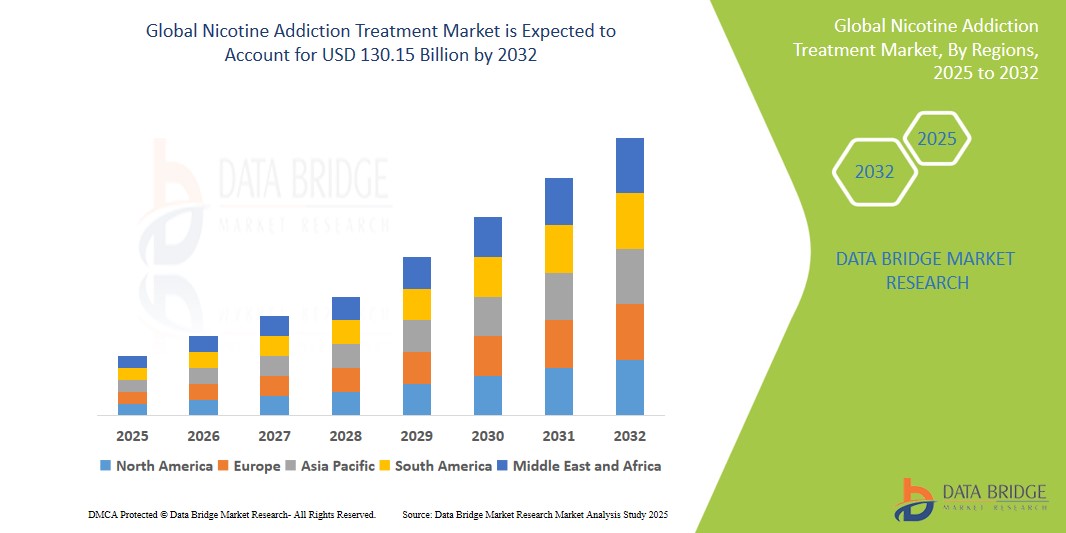
Global Nicotine Addiction Treatment Market Size
- The global nicotine addiction treatment market was valued at USD 65.93 billion in 2024 and is projected to reach USD 130.15 billion by 2032, growing at a CAGR of 10.2% during the forecast period
- The market growth is primarily driven by increasing awareness of the harmful effects of smoking, rising government initiatives and anti-smoking campaigns, and advancements in nicotine replacement therapies and behavioral treatments
Global Nicotine Addiction Treatment Market Analysis
- Nicotine addiction treatment includes a range of pharmacological and non-pharmacological therapies aimed at helping individuals reduce or eliminate their dependency on nicotine. These include nicotine replacement therapies (NRTs) like patches, gums, and sprays, as well as prescription drugs such as varenicline and bupropion, and psychological interventions.
- The demand for effective nicotine addiction treatments is increasing due to the global health burden of tobacco use, rising prevalence of smoking-related illnesses, and growing adoption of harm reduction strategies.
- North America currently leads the market, driven by supportive regulatory policies, high smoking cessation awareness, and widespread availability of treatment products.
- Asia-Pacific is expected to witness the fastest growth during the forecast period, owing to the high tobacco consumption rate, increasing government support for cessation programs, and growing awareness about health risks associated with nicotine.
- The nicotine replacement therapy (NRT) segment dominates the market with a market share of 68.5%, attributed to its accessibility, over-the-counter availability, and growing consumer preference for gradual cessation approaches.
Report Scope and Global Nicotine Addiction Treatment Market Segmentation
|
Attributes |
Global Nicotine Addiction Treatment Market Key Insights |
|
Segments Covered |
|
|
Countries Covered |
North America
Europe
Asia-Pacific
Middle East and Africa
South America
|
|
Key Market Players |
|
|
Market Opportunities |
|
|
Value Added Data Infosets |
In addition to the insights on market scenarios such as market value, growth rate, segmentation, geographical coverage, and major players, the market reports curated by the Data Bridge Market Research also include import export analysis, production capacity overview, production consumption analysis, price trend analysis, climate change scenario, supply chain analysis, value chain analysis, raw material/consumables overview, vendor selection criteria, PESTLE Analysis, Porter Analysis, and regulatory framework. |
Global Nicotine Addiction Treatment Market Trends
“Advancements in Nicotine Replacement Therapy (NRT) and Digital Health Integration”
- A key trend in the nicotine addiction treatment market is the increasing integration of digital health platforms alongside traditional nicotine replacement therapies (NRT)
- Digital tools, including mobile apps, telemedicine services, and online support platforms, are enhancing the treatment experience by providing continuous support, personalized smoking cessation plans, and behavioral tracking
- For instance, mobile applications can monitor progress, set goals, and send motivational reminders, while telehealth platforms allow patients to consult with healthcare providers remotely, making treatment more accessible
- These advancements are helping individuals to manage withdrawal symptoms and cravings more effectively, leading to improved success rates in smoking cessation and driving the demand for innovative treatment solutions.
Global Nicotine Addiction Treatment Market Dynamics
Driver
“Increasing Awareness and Government Initiatives for Smoking Cessation”
- The rising awareness about the dangers of smoking and the increased government and public health initiatives are major drivers for the nicotine addiction treatment market
- Governments worldwide are focusing on smoking cessation campaigns, such as anti-smoking advertisements, tax increases on tobacco products, and smoking bans in public places. These efforts are significantly increasing the demand for smoking cessation treatments and nicotine replacement products
- For instance, In March 2023, the U.S. Food and Drug Administration (FDA) launched a national campaign to reduce smoking, aiming to lower smoking rates by encouraging smokers to seek treatment options such as nicotine patches, gums, and prescription medications
- As more smokers seek to quit, the demand for nicotine addiction treatments continues to rise, contributing to improved healthcare outcomes and a healthier population
Opportunity
“Personalized Smoking Cessation Programs Powered by Artificial Intelligence (AI)”
- AI-powered personalized smoking cessation programs present a significant opportunity for growth. These programs can analyze a user's smoking behavior and provide tailored treatment plans based on their nicotine dependency level and behavioral patterns
- By integrating machine learning algorithms, these solutions can recommend the best treatment options, monitor progress, and adjust treatment regimens in real-time
- For instance, AI-driven platforms could help in predicting when a smoker is most likely to experience cravings and suggest strategies to overcome them, such as behavioral therapy or an increase in nicotine dosage for better management
- The integration of AI into treatment solutions can enhance patient engagement, improve long-term success rates, and revolutionize smoking cessation programs by providing more efficient, individualized care.
Restraint/Challenge
“High Equipment Costs Hindering Market Penetration”
- A major challenge facing the nicotine addiction treatment market is the high cost of certain smoking cessation therapies, which can limit their accessibility, particularly in low-income regions and among individuals without sufficient insurance coverage
- Prescription medications such as varenicline and bupropion can be costly, and while nicotine replacement therapies (NRT) are more affordable, they still pose a financial barrier for some individuals, especially in developing countries
- For instance, A study published in December 2024 highlighted that the high cost of prescription medications and nicotine replacement products significantly hampers access to treatment in lower-income areas, making it difficult for many smokers to receive the support they need to quit
- This challenge results in disparities in access to effective smoking cessation treatments and could hinder overall market growth, particularly in emerging markets where affordability and healthcare accessibility are ongoing issues.
Global Nicotine Addiction Treatment Market Scope
The market is segmented on the basis application, product type, technology, magnification type, end user, and distribution channel.
|
Segmentation |
Sub-Segmentation |
|
By Type |
|
|
By Treatment Type |
|
|
By Drugs |
|
|
By Product Type |
|
|
By Route of Administration |
|
|
By Drug Delivery System |
|
|
By End Users |
|
In 2025, Nicotine Replacement Therapy (NRT) is projected to dominate the market with the largest share in the treatment segment
The nicotine replacement therapy (NRT) segment is expected to dominate the Global Nicotine Addiction Treatment Market with the largest share of 68.5% in 2025 due to its wide acceptance, over-the-counter availability, and effectiveness in managing withdrawal symptoms and cravings. As the most common treatment approach, NRT allows smokers to gradually reduce nicotine dependence, making it a popular choice for smoking cessation. Increasing awareness about the dangers of smoking, government smoking cessation initiatives, and the growing number of smokers seeking treatment are driving the demand for NRT products. Advancements in NRT products, such as patches, gums, and lozenges, continue to improve the user experience and enhance treatment outcomes.
The Oral Route of Administration is expected to account for the largest share during the forecast period in the route of administration segment
In 2025, the oral route of administration is expected to dominate the market with the largest market share of 57.4% due to the convenience, accessibility, and ease of use associated with oral nicotine replacement products such as gums, lozenges, and pills.
Global Nicotine Addiction Treatment Market Regional Analysis
“North America Holds the Largest Share in the Global Nicotine Addiction Treatment Market”
- North America dominates the Global Nicotine Addiction Treatment Market, driven by the high prevalence of smoking-related diseases, increased government efforts to curb smoking, and widespread adoption of smoking cessation treatments
- The U.S. holds a significant share of the market, primarily due to the high number of smokers and increasing public awareness about the adverse health effects of smoking. Moreover, smoking cessation programs and the availability of various nicotine replacement therapies (NRT) play a crucial role in driving demand
- Additionally, the implementation of stricter regulations on tobacco products and the growing support for smoking cessation from both healthcare providers and government organizations contribute to market growth. The high adoption of over-the-counter nicotine replacement products and prescription-based smoking cessation medications further strengthens the market in North America
“Asia-Pacific is Projected to Register the Highest CAGR in the Global Nicotine Addiction Treatment Market”
- The Asia-Pacific region is expected to witness the highest growth rate in the Global Nicotine Addiction Treatment Market, driven by the increasing prevalence of smoking, rapid urbanization, and rising awareness about the health risks of smoking
- Countries such as China, India, and Japan are emerging as key markets, owing to their large smoker populations and growing awareness of the importance of smoking cessation. Governments across these countries are implementing anti-smoking campaigns and promoting smoking cessation programs
- China and India, with their vast populations and high smoking rates, are seeing significant investments in smoking cessation initiatives and nicotine addiction treatments. The adoption of nicotine replacement therapies and other pharmacological treatments is expanding as healthcare infrastructure improves and more smokers seek treatment
- Japan is also becoming a key market due to its advanced healthcare system, with increasing numbers of smokers seeking professional help and using advanced smoking cessation products. Growing adoption of digital platforms for smoking cessation and government-driven programs further support market growth in these regions
Global Nicotine Addiction Treatment Market Share
The market competitive landscape provides details by competitor. Details included are company overview, company financials, revenue generated, market potential, investment in research and development, new market initiatives, global presence, production sites and facilities, production capacities, company strengths and weaknesses, product launch, product width and breadth, application dominance. The above data points provided are only related to the companies' focus related to market.
The Major Market Leaders Operating in the Market Are:
- Takeda Pharmaceutical Company Limited (Japan)
- Johnson & Johnson Services, Inc. (U.S.)
- GlaxoSmithKline plc (U.K.)
- Pfizer Inc. (U.S.)
- Novartis AG (Switzerland)
- Sanofi (France)
- Dr. Reddy’s Laboratories Ltd (India)
- Teva Pharmaceutical Industries Ltd (Israel)
- Mylan N.V. (U.S.)
- Axsome Therapeutics, Inc. (U.S.)
- Hager Biosciences, LLC (U.S.)
- ADDEX THERAPEUTICS (Switzerland)
- Omeros Corporation (U.S.)
- Sosei Group Corporation (Japan)
- CV Sciences, Inc. (U.S.)
- Cerecor, Inc. (U.S.)
- Astraea Therapeutics LLC (U.S.)
- Nicotex (India)
- Alkermes (Ireland)
- Mallinckrodt (U.S.)
Latest Developments in Global Nicotine Addiction Treatment Market
- In June 2023, Imperial Brand Plc, a tobacco and nicotine company announced the acquisition of nicotine pouches from TJP Labs in order to enter the U.S. market.
- In June 2023, Altria Group, Inc announced the acquisition of NJOY LLC. NJOY e-vapor products are to be marked by NJOY, a wholly owned subsidiary of Altria.
- In January 2025, Pfizer Inc. launched an updated version of its Chantix smoking cessation medication, offering new dosing options and a refined treatment plan.
- In September 2024, GlaxoSmithKline launched a new Nicorette product line with a faster acting formula to assist users in quitting smoking more effectively.

- Interactive Data Analysis Dashboard
- Company Analysis Dashboard for high growth potential opportunities
- Research Analyst Access for customization & queries
- Competitor Analysis with Interactive dashboard
- Latest News, Updates & Trend analysis
- Harness the Power of Benchmark Analysis for Comprehensive Competitor Tracking
Data collection and base year analysis are done using data collection modules with large sample sizes. The stage includes obtaining market information or related data through various sources and strategies. It includes examining and planning all the data acquired from the past in advance. It likewise envelops the examination of information inconsistencies seen across different information sources. The market data is analysed and estimated using market statistical and coherent models. Also, market share analysis and key trend analysis are the major success factors in the market report. To know more, please request an analyst call or drop down your inquiry.
The key research methodology used by DBMR research team is data triangulation which involves data mining, analysis of the impact of data variables on the market and primary (industry expert) validation. Data models include Vendor Positioning Grid, Market Time Line Analysis, Market Overview and Guide, Company Positioning Grid, Patent Analysis, Pricing Analysis, Company Market Share Analysis, Standards of Measurement, Global versus Regional and Vendor Share Analysis. To know more about the research methodology, drop in an inquiry to speak to our industry experts.
Data Bridge Market Research is a leader in advanced formative research. We take pride in servicing our existing and new customers with data and analysis that match and suits their goal. The report can be customized to include price trend analysis of target brands understanding the market for additional countries (ask for the list of countries), clinical trial results data, literature review, refurbished market and product base analysis. Market analysis of target competitors can be analyzed from technology-based analysis to market portfolio strategies. We can add as many competitors that you require data about in the format and data style you are looking for. Our team of analysts can also provide you data in crude raw excel files pivot tables (Fact book) or can assist you in creating presentations from the data sets available in the report.












