


What is the Non-GMO Food Market Size and Growth Rate?
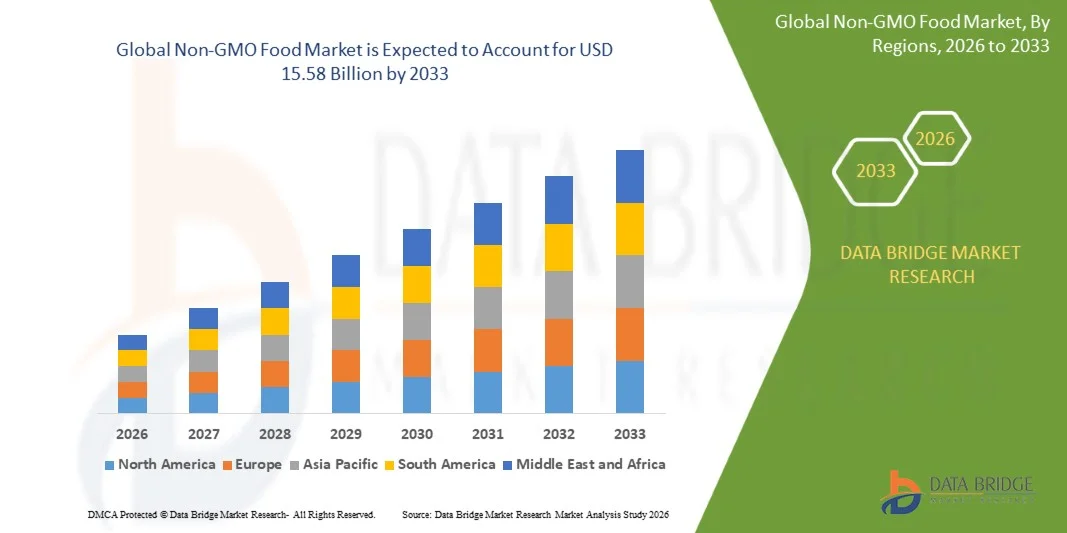
- As per Data Bridge Market Research analysis, the Non-GMO food market was valued at USD 4.92 billion in 2025 and is projected to reach USD 15.58 billion by 2033, growing at a CAGR of 15.50% from 2026 to 2033.
- The market is experiencing consistent growth driven by rising consumer demand for natural and clean-label food products, increasing health consciousness, growing preference for transparent ingredient sourcing, and the expanding availability of non-GMO products across retail and food-service channels.
- The increasing consumer awareness regarding genetically modified ingredients, combined with growing promotion of sustainable agricultural practices and demand for food products produced using non-GMO seeds, is compelling food manufacturers and retailers to expand their certified non-GMO product offerings. Supermarkets, specialty stores, and online retail platforms are further improving product accessibility and supporting market expansion.
Market Size & Forecast
- Global Market Value (2025): USD 4.92 Billion
- Expected Market Value (2033): USD 15.58 Billion
- Forecast CAGR (2026–2033): 15.50%
- Leading Region in 2025: North America
- Fastest Growing Region: Asia Pacific
What are the Major Takeaways of the Non-GMO Food Market?
- North America dominated the Non-GMO food market with the largest revenue share of 39.62% in 2025, supported by strong consumer awareness, established certification systems, mature retail networks, and widespread availability of non-GMO products.
- Asia-Pacific is expected to be the fastest-growing region at a CAGR of 6.05% from 2026 to 2033, fueled by rising middle-class populations, increasing food-safety awareness, expanding modern retail infrastructure, and growing adoption of non-GMO products across emerging markets.
- The cereals and grains segment led the market with a 42.5% share in 2025, driven by the widespread consumption of grains as staple foods and their extensive use in breakfast cereals, baked products, snacks, and other food applications.
- Bakery are the fastest-growing simulation type, projected to register a CAGR of 10%, reflecting the surge in demand for clean-label baked goods and greater incorporation of non-GMO flour, grains, seeds, and other ingredients.
- The conventional segment dominated the category with a 69.35% revenue share in 2025, led by its broader availability, established production systems, and relatively greater affordability compared with organic non-GMO products
- Beverage accounted for 36.0% of the market share in 2025, preferred by increasing demand for clean-label, natural, functional, and non-GMO beverage formulations.
- The dairy alternatives segment is the fastest-growing application category, with a CAGR of 12.7%, driven by increasing consumption of plant-based milk and other dairy substitute products
Report Scope and Non-GMO Food Market Segmentation
|
Attributes |
Non-GMO Food Key Market Insights |
|
Segments Covered |
|
|
Countries Covered |
North America
Europe
Asia-Pacific
Middle East and Africa
South America
|
|
Key Market Players |
|
|
Market Opportunities |
|
|
Value Added Data Infosets |
In addition to the insights on market scenarios such as market value, growth rate, segmentation, geographical coverage, and major players, the market reports curated by the Data Bridge Market Research also include in-depth expert analysis, pricing analysis, brand share analysis, consumer survey, demography analysis, supply chain analysis, value chain analysis, raw material/consumables overview, vendor selection criteria, PESTLE Analysis, Porter Analysis, and regulatory framework. |
What is the Key Trend in the Non-GMO Food Market?
- Food manufacturers are increasingly positioning non-GMO products alongside clean-label, natural, organic, and minimally processed attributes to meet consumers’ growing demand for transparency and recognizable ingredients.
- For instance, in January 2025, the Non-GMO Project launched its Non-UPF Verified program, extending its food-integrity approach beyond GMO avoidance toward minimally processed foods; the organization stated that its Butterfly mark was already found on more than 63,000 products from over 5,000 brands.
- Growing consumer interest in ingredient transparency is encouraging brands to obtain third-party verification and communicate sourcing practices directly through recognizable certification labels.
- Plant-based food manufacturers are increasingly incorporating non-GMO ingredients and certification into product positioning to differentiate products within the expanding health-focused food category.
- For instance, in May 2025, Dojo Fresh received support from the Non-GMO Project to renew verification for its three plant-protein mixes, reinforcing the use of clean, minimally processed, non-GMO ingredients in plant-based foods.
- As consumers increasingly connect non-GMO claims with transparency, clean-label attributes, and responsible sourcing, manufacturers are expected to expand verified product portfolios, particularly across plant-based foods, beverages, snacks, and other packaged food categories.
What are the Key Drivers of the Non-GMO Food Market?
- The rising consumer health consciousness and demand for transparent food labeling are significantly increasing demand for non-GMO products as shoppers seek recognizable ingredients and greater visibility into food production and sourcing.
- For instance, in May 2025, an EcoFocus survey of 4,000 U.S. consumers found that 54% of grocery shoppers were extremely or very concerned about the safety of genetically modified foods, while 60% of shoppers aware of the Non-GMO Project label considered it extremely or very influential in purchasing decisions.
- Food manufacturers, retailers, and brands are expanding non-GMO product ranges to respond to demand for clean-label foods, sustainable sourcing, and credible third-party certification across multiple food and beverage categories.
- For instance, in September 2025, PwC reported that 84% of Indian consumers considered food safety a vital purchasing driver, highlighting the growing importance of transparency, credible certifications, and clear communication of product attributes.
- With consumers increasingly prioritizing food safety, ingredient transparency, and sustainable production practices, non-GMO positioning will remain an important differentiating attribute for manufacturers developing health-focused and premium food products.
Which Factors are Challenging the Growth of the Non-GMO Food Market?
- Maintaining non-GMO integrity across agricultural and food-processing supply chains requires additional segregation, identity preservation, testing, traceability, and certification, increasing production and handling costs.
- For instance, in November 2024, researchers at Iowa State University published a cost-estimation model for non-GM corn and soybean segregation at country grain elevators. The study evaluated 24 scenarios across different GMO tolerance levels and specifically quantified the additional costs required to maintain non-GM integrity during grain handling and segregation.
- These additional requirements can limit adoption among smaller manufacturers and suppliers, particularly when products contain high-risk ingredients such as corn and soy that require greater scrutiny during verification.
- The complexity of maintaining non-GMO status throughout sourcing, processing, and distribution can also increase certification expenses, documentation requirements, and supply-chain management burdens for food manufacturers.
- For instance, in February 2024, a study on traceability strategies for preventing unauthorized GMOs reported that certification costs were considered minimal compared with the costs associated with segregation, highlighting that maintaining separate non-GMO supply chains can represent a significant financial burden.
- The additional segregation, testing, certification, and traceability requirements continue to increase the cost of producing non-GMO foods, potentially resulting in higher retail prices and restricting penetration among price-sensitive consumers and smaller food companies.
How is the Non-GMO Food Market Segmented?
The Non-GMO food market is segmented on the basis of type, category, application, and distribution channel.
- By Type
On the basis of type, the non-GMO food market is segmented into cereals and grains, liquor, meat and poultry, edible oil, and bakery. The cereals and grains segment dominated the market with 42.5% share in 2025, owing to the widespread consumption of grains as staple foods and their extensive use in breakfast cereals, baked products, snacks, and other food applications. Non-GMO cereals and grains benefit from their essential role in daily diets across developed and emerging markets. Growing consumer preference for naturally sourced and traceable ingredients is further supporting demand for non-GMO grains. Corn, wheat, rice, oats, and other grains are increasingly incorporated into products positioned around clean-label and health-conscious attributes. The segment also benefits from established agricultural and processing supply chains that support large-scale production and distribution. Increasing availability of certified non-GMO grain products through mainstream and specialty retailers is further improving consumer accessibility.
The bakery segment is expected to witness the fastest growth at 10% CAGR during the forecast period, supported by increasing consumer demand for clean-label baked goods and greater incorporation of non-GMO flour, grains, seeds, and other ingredients. Growing awareness of ingredient sourcing is encouraging bakeries and packaged-food manufacturers to communicate non-GMO attributes more prominently. Bread, cookies, crackers, pastries, and other baked products are increasingly incorporating non-GMO ingredients to differentiate themselves in competitive markets. The expansion of organic and natural food retail is also increasing the availability of non-GMO bakery products. Manufacturers are responding to changing consumer preferences by reformulating products with simpler ingredient profiles and recognizable raw materials. The growing overlap between non-GMO, organic, and clean-label positioning is creating additional opportunities for premium bakery products.
- By Category
On the basis of category, the non-GMO food market is segmented into conventional and organic. The conventional segment dominated the market with a 69.35% share in 2025, supported by its broader availability, established production systems, and relatively greater affordability compared with organic non-GMO products. Conventional non-GMO foods appeal to consumers who want to avoid genetically modified ingredients without necessarily purchasing fully organic products. Manufacturers can maintain non-GMO positioning while retaining greater flexibility in sourcing and production compared with organic requirements. The segment is widely available across mainstream supermarkets, hypermarkets, convenience stores, and other mass-market retail channels. Its comparatively accessible pricing enables non-GMO products to reach a broader consumer base beyond premium and health-focused shoppers. Food manufacturers increasingly use non-GMO certification as an additional product attribute alongside conventional formulations
The organic segment is projected to register the fastest growth at a CAGR of 7.38% during the forecast period, driven by consumers increasingly associating organic and non-GMO attributes with higher quality, sustainability, and environmental responsibility. Organic products strengthen the appeal of non-GMO positioning because consumers seeking organic foods often prioritize restrictions on genetically modified ingredients. Growing demand for clean-label, minimally processed, and sustainably produced foods is encouraging manufacturers to expand organic non-GMO portfolios. Premium categories such as children's snacks, beverages, cereals, and specialty foods are providing attractive opportunities for organic non-GMO products. Retailers are also creating dedicated shelf spaces for organic and non-GMO products, improving their visibility and consumer accessibility. Higher margins associated with premium organic products are encouraging manufacturers to diversify their portfolios toward combined organic and non-GMO offerings.
- By Application
On the basis of application, the non-GMO food market is segmented into beverages, meat products, fruits and vegetables, dairy alternatives, animal feed, and others. The beverages segment dominated the market with 36.0% share in 2025, supported by increasing demand for clean-label, natural, functional, and non-GMO beverage formulations. Non-GMO ingredients are increasingly incorporated into plant-based beverages, functional drinks, juices, and other health-oriented beverage products. Growing consumer awareness of ingredient sourcing is encouraging beverage manufacturers to provide greater transparency regarding raw materials and production practices. Plant-based beverages are particularly relevant because ingredients such as soy and other crops are frequently evaluated for GMO status by consumers seeking non-GMO alternatives. The expansion of organic and natural beverage portfolios is further creating opportunities for products carrying both organic and non-GMO positioning. Online and specialty retail channels are also improving access to premium non-GMO beverage products.
The dairy alternatives segment is expected to witness the fastest growth at 12.7% CAGR during the forecast period, driven by increasing consumption of plant-based milk and other dairy substitute products. Soy, almond, oat, coconut, and other plant-derived ingredients are increasingly used in dairy alternatives, creating opportunities for non-GMO formulations. Consumers purchasing plant-based products often place greater emphasis on ingredient transparency, sustainability, and perceived health benefits. Manufacturers are therefore expanding non-GMO and organic variants to differentiate their dairy-alternative portfolios. The growing availability of plant-based beverages, yogurts, creamers, and other dairy substitutes across mainstream retailers is increasing market accessibility. Premium positioning around natural, organic, and non-GMO ingredients is also supporting higher-value product development.
- By Distribution Channel
On the basis of distribution channel, the non-GMO food market is segmented into hypermarkets and supermarkets, food specialist retailers, convenience stores, and online. The hypermarkets and supermarkets segment dominated the market with a 56.02% share in 2025, supported by extensive product assortments, established retail infrastructure, and convenient access to certified non-GMO products. Large retailers provide dedicated natural, organic, and non-GMO sections that improve product visibility and consumer awareness. In-store certification labels and packaging information also help consumers identify and compare non-GMO products during purchasing decisions. Supermarkets and hypermarkets can offer products across multiple categories, including cereals, bakery, beverages, meat, and edible oils. Their established supplier networks enable more consistent product availability and support wider distribution of certified products. Retailers are also increasingly using private-label and premium product ranges to respond to demand for clean-label and non-GMO foods.
The online segment is projected to be the fastest-growing distribution channel at a CAGR of 6.85% during the forecast period, driven by increasing digital grocery adoption, convenience, wider product discovery, and access to specialized non-GMO brands. Online platforms enable consumers to access detailed ingredient information, certification claims, sourcing information, and product reviews before purchasing. The channel is particularly attractive for niche and premium non-GMO products that may have limited availability in conventional physical stores. Subscription purchasing and direct-to-consumer models are also supporting repeat purchases of specialty food products. Younger consumers are increasingly using digital channels to discover clean-label, organic, plant-based, and non-GMO products. The expansion of online grocery infrastructure is further improving delivery convenience and product accessibility.
Which Region Holds the Largest Share of the Non-GMO Food Market?
- North America dominated the Non-GMO food market with the largest revenue share of 39.62% in 2025, supported by strong consumer awareness, established certification systems, mature retail networks, and widespread availability of non-GMO products.
- The region also benefits from growing demand for clean-label and sustainably sourced foods, widespread availability of certified products, and increasing adoption across supermarkets, specialty stores, and online retail channels. Rising consumer resistance toward genetically modified foods and stronger emphasis on ingredient transparency continue to strengthen North America’s leadership position in the global market.
U.S. Non-GMO Food Market Insight
The U.S. non-GMO food market is witnessing strong growth due to rising consumer awareness of food safety, clean-label products, and ingredient transparency. The country’s mature food retail ecosystem, along with widespread availability of non-GMO and organic products, is driving demand across cereals, bakery products, beverages, meat, and other food categories. In addition, growing consumer preference for natural and minimally processed foods and increasing trust in third-party certification are accelerating non-GMO product adoption across the U.S. food market.
Asia-Pacific Non-GMO Food Market Insight
The Asia-Pacific non-GMO food market is expected to witness rapid growth, driven by increasing urbanization, rising disposable incomes, and growing consumer concerns regarding food safety and ingredient transparency across countries such as China, India, and Japan. Expanding modern retail and e-commerce networks, along with increasing availability of certified and premium food products, are supporting regional market expansion. In addition, changing consumption patterns and rising demand for healthier and more transparent food choices are accelerating non-GMO product adoption across the region.
Japan Non-GMO Food Market Insight
The Japan non-GMO food market is witnessing consistent growth due to strong consumer emphasis on food quality, safety, and reliable product labeling. Food manufacturers and retailers are increasingly offering non-GMO products to address growing preferences for healthier and more transparent food choices. Moreover, the country’s established food standards, sophisticated retail infrastructure, and consumer preference for high-quality products are further contributing to non-GMO food market growth in Japan.
China Non-GMO Food Market Insight
The China non-GMO food market is growing rapidly, driven by rising consumer concerns regarding food safety, product quality, and ingredient transparency. Increasing urbanization, expanding modern retail channels, and growing demand for premium packaged foods are significantly supporting market development. In addition, increasing consumer awareness of healthier food choices, improvements in food traceability, and the expansion of certified food products are positioning China as one of the key growth markets for non-GMO foods in Asia-Pacific.
U.K. Non-GMO Food Market Insight
The U.K. non-GMO food market is experiencing steady growth, supported by increasing consumer interest in food transparency, sustainable sourcing, and clean-label products. Growing availability of non-GMO and organic products across supermarkets, specialty retailers, and online channels is contributing to market expansion. Furthermore, increasing consumer focus on health, environmental sustainability, and responsible food production is strengthening demand for non-GMO food products in the U.K.
Germany Non-GMO Food Market Insight
The Germany non-GMO food market is expanding steadily due to strong consumer demand for food quality, transparency, and products produced without genetic engineering. Manufacturers and retailers are increasingly offering non-GMO food products across dairy, meat, bakery, and other categories to meet consumer preferences. Continuous growth in certified non-GMO products, established labeling practices, and strong consumer awareness are further supporting market development in Germany.
Which are the Top Companies in Non-GMO Food Market?
The Non-GMO food industry is primarily led by well-established companies, including:
- Nature's Path Foods, Inc. (Canada)
- Bob’s Red Mill Natural Foods (U.S.)
- The Hain Celestial Group, Inc. (U.S.)
- General Mills Inc. (U.S.)
- PepsiCo, Inc. (U.S.)
- Danone (France)
- Kraft Heinz, Inc. (U.S.)
- Califia Farms, LLC (U.S.)
- Organic Valley (U.S.)
- LesserEvil Snacks (U.S.)
- Alter Eco Foods & WorldPantry.com® LLC (U.S.)
- Riverside Natural Foods Ltd. (Canada)
- King Arthur Baking Company, Inc. (U.S.)
- Conagra Brands, Inc. (U.S.)
- The Campbell's Company (U.S.)
- B&G Foods, Inc. (U.S.)
- Hormel Foods Corporation (U.S.)
- Tyson Foods, Inc. (U.S.)
- McCain Foods Limited (Canada)
- Nestlé (Switzerland)
What are Latest Developments in Non-GMO Food Market?
- In January 2025, the Non-GMO Project announced the launch of its new Non-UPF Verified program, designed to help consumers identify foods that are both non-GMO and minimally processed. The initiative expands the organization’s verification activities beyond GMO avoidance and reflects growing demand for greater transparency around food ingredients and processing practices. The program was developed to support consumer access to foods aligned with clean-label and less-processed food preferences.
- In April 2025, Natural Grocers expanded its private-label food range with the launch of three non-GMO Peruvian-sourced snack products, including Sea Salt Sweet Potato Chips, Sea Salt Kettle Potato Chips, and Sea Salt Cassava Chips. The products were positioned around simple ingredients and non-GMO certification, while also emphasizing plant-based and dairy-free attributes. The launch highlights the continued expansion of non-GMO offerings into premium and better-for-you snack categories.
- In February 2022, Bel Brands USA announced the introduction of Babybel Plant-Based cheese wheels in the U.S. following their earlier U.K. launch. The new product was developed as a dairy-free alternative to traditional Babybel and was certified vegan and Non-GMO Project Verified. The launch demonstrated the increasing integration of non-GMO positioning with plant-based and dairy-alternative food products.
- In October 2021, Natural Grocers launched its first Non-GMO Month, creating a dedicated promotional and educational initiative around non-GMO foods. The program included promotions on non-GMO and organic products, nutrition education, and consumer information explaining GMOs and the importance of non-GMO choices. The initiative strengthened consumer engagement with non-GMO products while increasing their visibility across the retailer’s food assortment.
- In May 2021, Atlantic Natural Foods announced the launch of its online store featuring its portfolio of plant-based brands, including Loma Linda, TUNO, neat, and Kaffree Roma. The products included non-GMO plant-based meals, meal starters, seafood alternatives, and egg-replacement products, expanding consumer access to non-GMO foods through direct online retail. The development also highlighted the growing overlap between non-GMO, plant-based, and convenient food offerings.

- Interactive Data Analysis Dashboard
- Company Analysis Dashboard for high growth potential opportunities
- Research Analyst Access for customization & queries
- Competitor Analysis with Interactive dashboard
- Latest News, Updates & Trend analysis
- Harness the Power of Benchmark Analysis for Comprehensive Competitor Tracking
Global Non Gmo Food Market, Supply Chain Analysis and Ecosystem Framework
To support market growth and help clients navigate the impact of geopolitical shifts, DBMR has integrated in-depth supply chain analysis into its Global Non Gmo Food Market research reports. This addition empowers clients to respond effectively to global changes affecting their industries. The supply chain analysis section includes detailed insights such as Global Non Gmo Food Market consumption and production by country, price trend analysis, the impact of tariffs and geopolitical developments, and import and export trends by country and HSN code. It also highlights major suppliers with data on production capacity and company profiles, as well as key importers and exporters. In addition to research, DBMR offers specialized supply chain consulting services backed by over a decade of experience, providing solutions like supplier discovery, supplier risk assessment, price trend analysis, impact evaluation of inflation and trade route changes, and comprehensive market trend analysis.
Data collection and base year analysis are done using data collection modules with large sample sizes. The stage includes obtaining market information or related data through various sources and strategies. It includes examining and planning all the data acquired from the past in advance. It likewise envelops the examination of information inconsistencies seen across different information sources. The market data is analysed and estimated using market statistical and coherent models. Also, market share analysis and key trend analysis are the major success factors in the market report. To know more, please request an analyst call or drop down your inquiry.
The key research methodology used by DBMR research team is data triangulation which involves data mining, analysis of the impact of data variables on the market and primary (industry expert) validation. Data models include Vendor Positioning Grid, Market Time Line Analysis, Market Overview and Guide, Company Positioning Grid, Patent Analysis, Pricing Analysis, Company Market Share Analysis, Standards of Measurement, Global versus Regional and Vendor Share Analysis. To know more about the research methodology, drop in an inquiry to speak to our industry experts.
Data Bridge Market Research is a leader in advanced formative research. We take pride in servicing our existing and new customers with data and analysis that match and suits their goal. The report can be customized to include price trend analysis of target brands understanding the market for additional countries (ask for the list of countries), clinical trial results data, literature review, refurbished market and product base analysis. Market analysis of target competitors can be analyzed from technology-based analysis to market portfolio strategies. We can add as many competitors that you require data about in the format and data style you are looking for. Our team of analysts can also provide you data in crude raw excel files pivot tables (Fact book) or can assist you in creating presentations from the data sets available in the report.













