


What is the Non-Thermal Processing Market Size and Growth Rate?
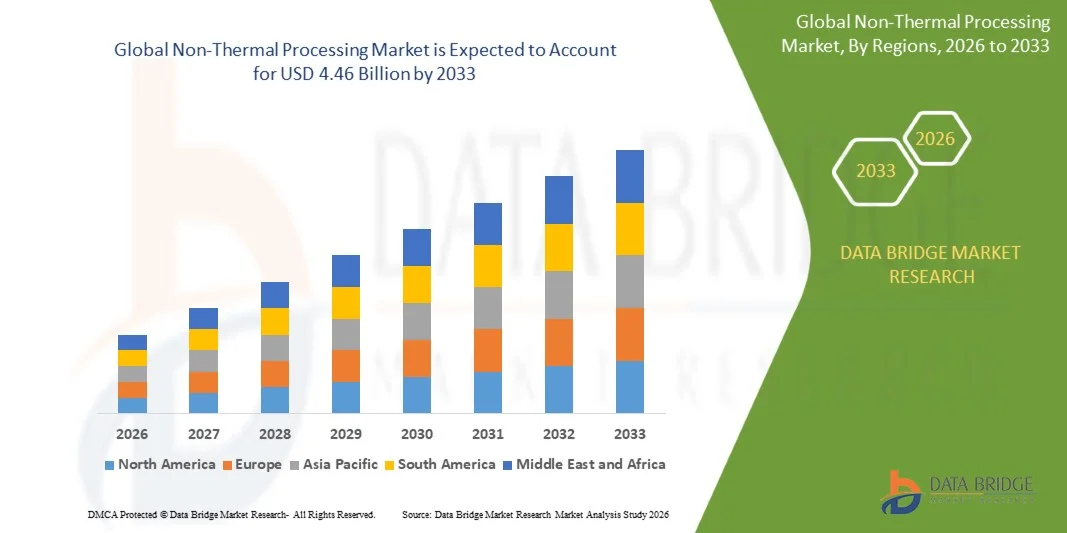
- As per Data Bridge Market Research Analysis the global non-thermal processing market size was valued at USD 2.55 billion in 2025 and is expected to reach USD 4.46 billion by 2033, at a CAGR of 7.25% during the forecast period
- The market growth is largely fueled by the increasing demand for minimally processed and clean-label food products, as consumers prioritize natural taste, nutritional value, and extended shelf life without the use of heat or chemical preservatives
- Furthermore, rising concerns regarding food safety, microbial contamination, and the need for energy-efficient processing solutions are establishing non-thermal technologies as a preferred alternative to conventional thermal methods. These converging factors are accelerating the adoption of advanced processing techniques, thereby significantly boosting the industry's growth
Market Size & Forecast
- Global Market Value (2025): USD 2.55 billion
- Expected Market Value (2033): USD 4.46 billion
- Forecast CAGR (2026–2033): 7.25%
What are the Major Takeaways of Non-Thermal Processing Market?
- Non-thermal processing refers to advanced food preservation technologies that inactivate microorganisms and enzymes without the application of heat, using methods such as high pressure processing, pulsed electric fields, ultrasonic, irradiation, and cold plasma. These technologies help maintain the sensory attributes, nutritional quality, and freshness of food products while ensuring safety and extended shelf life
- The escalating demand for non-thermal processing is primarily fueled by the growing preference for fresh and high-quality food, increasing regulatory focus on food safety standards, and rising adoption of innovative processing technologies across beverages, meat, and ready-to-eat food segments
- North America dominated the non-thermal processing market with a share of 41.28% in 2025, due to the strong presence of advanced food processing infrastructure and increasing demand for clean-label and minimally processed food products
- Asia-Pacific is expected to be the fastest growing region in the non-thermal processing market during the forecast period due to rapid urbanization, rising disposable incomes, and increasing demand for processed and packaged foods
- HPP segment dominated the market with a market share of 49.52% in 2025, due to its proven efficiency in extending shelf life while preserving nutritional and sensory attributes of food products. High pressure processing is widely used across beverages, meat, and ready-to-eat products due to its ability to inactivate pathogens without heat. Its scalability and growing industrial adoption across developed and emerging markets have strengthened its dominance
Report Scope and Non-Thermal Processing Market Segmentation
|
Attributes |
Non-Thermal Processing Key Market Insights |
|
Segments Covered |
|
|
Countries Covered |
North America
Europe
Asia-Pacific
Middle East and Africa
South America
|
|
Key Market Players |
|
|
Market Opportunities |
|
|
Value Added Data Infosets |
In addition to the insights on market scenarios such as market value, growth rate, segmentation, geographical coverage, and major players, the market reports curated by the Data Bridge Market Research also include in-depth expert analysis, pricing analysis, brand share analysis, consumer survey, demography analysis, supply chain analysis, value chain analysis, raw material/consumables overview, vendor selection criteria, PESTLE Analysis, Porter Analysis, and regulatory framework. |
What is the Key Trend in the Non-Thermal Processing Market?
“Growing Adoption of Clean-Label and Minimally Processed Food Products”
- A significant trend in the non-thermal processing market is the increasing adoption of clean-label and minimally processed food products, driven by rising consumer awareness regarding food safety, nutritional retention, and reduced chemical additives. This shift is encouraging food manufacturers to explore technologies that maintain freshness, taste, and nutrient profiles while complying with health-conscious consumption patterns
- For instance, companies such as HPP Europe and Avure Technologies provide high-pressure processing solutions that enable the production of minimally processed juices, ready-to-eat meals, and dairy products without compromising quality. These solutions are helping brands meet consumer demand for cleaner labels while extending shelf life and ensuring food safety
- The market is witnessing growth in the use of non-thermal methods such as pulsed electric fields and cold plasma for preserving delicate food matrices that are sensitive to heat treatment. These techniques are reinforcing the position of non-thermal processing as a key enabler of innovative, high-quality food products
- Rising integration of ultraviolet (UV) and ozone-based processing is expanding applications in beverages and liquid foods, where microbial inactivation is required without thermal degradation. This trend is driving food producers to adopt technologies that maintain flavor, color, and bioactive compounds
- Foodservice and retail industries are increasingly demanding non-thermal processed foods to cater to health-conscious and convenience-seeking consumers. This rising preference is shaping production strategies and fostering investment in scalable non-thermal processing technologies
- The trend toward sustainability and reduced energy consumption is further encouraging adoption of non-thermal techniques, which generally consume less energy compared with traditional thermal processing. This is positioning non-thermal solutions as environmentally favorable alternatives while supporting extended product shelf life
What are the Key Drivers of Non-Thermal Processing Market?
Driver
“Rising Demand for Enhanced Food Safety and Shelf-Life Extension”
- The increasing need for safer, longer-lasting food products is driving adoption of non-thermal processing technologies across multiple food categories. These methods help reduce microbial load without relying on chemical preservatives or high-temperature treatments, ensuring consistent quality and safety
- For instance, Hiperbaric supplies high-pressure processing (HPP) systems that extend the shelf life of juices, ready-to-eat meals, and dairy products while preserving nutritional and sensory attributes. These systems are enabling manufacturers to maintain compliance with stringent food safety standards while offering clean-label products
- The growing consumer focus on health, nutrition, and freshness is encouraging food producers to implement non-thermal methods to minimize nutrient loss. These technologies help maintain vitamins, antioxidants, and natural flavors in processed food products
- Regulatory pressures and industry standards for microbial safety are reinforcing the demand for non-thermal solutions that reliably inactivate pathogens without compromising quality. Compliance with these standards is increasingly critical for global food exporters
- Non-thermal processing adoption is also supported by increasing collaborations between technology providers and food manufacturers to develop tailored solutions. This collaborative innovation is accelerating the integration of advanced processing technologies in commercial food production
Restraint/Challenge
“High Initial Investment and Equipment Costs”
- The non-thermal processing market faces challenges due to the substantial capital investment required for advanced equipment and associated infrastructure. High procurement costs, combined with the need for skilled operators, make entry and scaling expensive for small and mid-sized food processors
- For instance, Avure Technologies’ HPP systems require significant upfront investment in pressure vessels, control systems, and facility modifications. These costs can be prohibitive for smaller manufacturers and may slow widespread adoption despite proven benefits
- Maintenance and operational expenses, including energy consumption and specialized labor, further contribute to overall cost burdens. These factors impact ROI timelines and influence purchasing decisions across the food industry
- Limited availability of cost-effective equipment in emerging regions also restricts access to non-thermal technologies. This uneven adoption hampers market penetration in countries with smaller processing sectors
- Market growth is constrained by the need to balance production efficiency with economic feasibility, requiring careful planning for high-throughput systems. These challenges are prompting manufacturers to evaluate cost-benefit ratios and prioritize investment in segments with the highest potential returns
How is the Non-Thermal Processing Market Segmented?
The market is segmented on the basis of food product, technology, and function.
• By Food Product
On the basis of food product, the non-thermal processing market is segmented into meat and seafood, fruits and vegetables, beverages, and others. The beverages segment dominated the largest market revenue share in 2025, driven by the increasing demand for minimally processed drinks that retain natural taste, color, and nutritional value. Non-thermal technologies are widely adopted in juices, dairy-based beverages, and functional drinks to extend shelf life without compromising quality. Rising consumer preference for preservative-free and clean-label beverages further strengthens the adoption of non-thermal processing in this segment. The ability to maintain freshness while ensuring safety has made beverages a key application area for advanced processing technologies.
The meat and seafood segment is anticipated to witness the fastest growth rate from 2026 to 2033, fueled by the rising need for effective microbial control without altering texture and flavor. Non-thermal methods help in maintaining the structural integrity and nutritional content of protein-rich foods while ensuring food safety standards. Increasing consumption of processed and ready-to-cook meat products is accelerating the demand for advanced preservation techniques. Growing concerns regarding foodborne pathogens and stringent regulatory requirements are further encouraging the adoption of non-thermal processing in this segment.
• By Technology
On the basis of technology, the non-thermal processing market is segmented into HPP, PEF, ultrasonic, irradiation, cold plasma, and others. The HPP segment held the largest market revenue share of 49.52% in 2025 driven by its proven efficiency in extending shelf life while preserving nutritional and sensory attributes of food products. High pressure processing is widely used across beverages, meat, and ready-to-eat products due to its ability to inactivate pathogens without heat. Its scalability and growing industrial adoption across developed and emerging markets have strengthened its dominance. Continuous advancements in equipment design and processing capacity further support the widespread implementation of HPP technology.
The cold plasma segment is expected to witness the fastest CAGR from 2026 to 2033, driven by its emerging potential for surface decontamination and microbial inactivation with minimal impact on food quality. This technology is gaining traction due to its energy efficiency and ability to operate at ambient temperatures. Increasing research activities and pilot-scale applications are accelerating its commercialization across multiple food categories. The rising demand for innovative and sustainable food processing solutions is further boosting the adoption of cold plasma technology.
• By Function
On the basis of function, the non-thermal processing market is segmented into quality assurance, microbial inactivation, cutting, emulsification and homogenization, cleaning, and others. The microbial inactivation segment dominated the largest market revenue share in 2025, driven by the critical need to ensure food safety and extend product shelf life. Non-thermal technologies effectively eliminate pathogens while preserving the nutritional and sensory properties of food products. Growing regulatory emphasis on food safety standards and increasing incidences of food contamination have accelerated the demand for efficient microbial control solutions. The segment continues to expand as food manufacturers prioritize safety without compromising product quality.
The quality assurance segment is anticipated to witness the fastest growth rate from 2026 to 2033, fueled by rising consumer demand for high-quality, fresh, and minimally processed food products. Non-thermal processing enables manufacturers to maintain product consistency, texture, and nutritional integrity throughout the supply chain. Increasing adoption of advanced technologies for real-time quality monitoring and control is driving segment growth. The growing focus on brand differentiation and premium product offerings is further encouraging the use of non-thermal processing for quality assurance purposes.
Which Region Holds the Largest Share of the Non-Thermal Processing Market?
- North America dominated the non-thermal processing market with the largest revenue share of 41.28% in 2025, driven by the strong presence of advanced food processing infrastructure and increasing demand for clean-label and minimally processed food products
- Food manufacturers in the region emphasize maintaining nutritional quality and extending shelf life without the use of heat, which supports the widespread adoption of technologies such as high pressure processing and pulsed electric fields
- This growth is further supported by stringent food safety regulations, high consumer awareness regarding food quality, and continuous technological advancements, establishing non-thermal processing as a preferred solution across beverage, meat, and ready-to-eat food segments
U.S. Non-Thermal Processing Market Insight
The U.S. non-thermal processing market captured the largest revenue share in 2025 within North America, fueled by the increasing demand for safe, preservative-free, and high-quality food products. Food manufacturers are increasingly investing in advanced processing technologies to meet regulatory standards and consumer expectations for freshness and nutrition. The strong presence of leading food processing companies and continuous innovation in food preservation techniques further supports market expansion. In addition, the rising popularity of functional beverages and ready-to-eat meals is accelerating the adoption of non-thermal processing solutions across the country.
Europe Non-Thermal Processing Market Insight
The Europe non-thermal processing market is projected to expand at a substantial CAGR throughout the forecast period, primarily driven by stringent food safety regulations and increasing demand for sustainable food processing solutions. The growing focus on reducing food waste while maintaining product quality is fostering the adoption of non-thermal technologies. European consumers show a strong preference for organic and minimally processed foods, which supports market growth. The region is witnessing increasing integration of advanced processing technologies across dairy, beverage, and meat industries.
U.K. Non-Thermal Processing Market Insight
The U.K. non-thermal processing market is anticipated to grow at a noteworthy CAGR during the forecast period, driven by the rising demand for clean-label food products and enhanced food safety standards. Consumers are increasingly prioritizing freshness, nutritional value, and longer shelf life without chemical preservatives. The expansion of retail chains and ready-to-eat food segments is encouraging food manufacturers to adopt innovative processing techniques. The growing inclination toward sustainable and energy-efficient processing solutions further supports market development.
Germany Non-Thermal Processing Market Insight
The Germany non-thermal processing market is expected to expand at a considerable CAGR during the forecast period, fueled by strong industrial capabilities and a focus on high-quality food production. The country’s emphasis on technological innovation and sustainability encourages the adoption of advanced food processing methods. Increasing demand for premium food products with preserved taste and nutrition is driving market growth. The integration of non-thermal technologies in meat processing and beverage industries is becoming increasingly prominent in Germany.
Asia-Pacific Non-Thermal Processing Market Insight
The Asia-Pacific non-thermal processing market is poised to grow at the fastest CAGR during the forecast period of 2026 to 2033, driven by rapid urbanization, rising disposable incomes, and increasing demand for processed and packaged foods. The region is experiencing growing awareness regarding food safety and quality, which is boosting the adoption of advanced processing technologies. Expanding food and beverage industries and supportive government initiatives promoting food safety standards are further accelerating market growth. In addition, increasing investments in food processing infrastructure are enhancing the adoption of non-thermal solutions.
Japan Non-Thermal Processing Market Insight
The Japan non-thermal processing market is gaining momentum due to the country’s advanced technology landscape and strong demand for high-quality and safe food products. Consumers prioritize freshness, taste, and nutritional value, which supports the adoption of non-thermal processing methods. The increasing demand for convenience foods and ready-to-eat meals is further driving market growth. The integration of innovative processing technologies in beverage and seafood industries is contributing to the expansion of the market.
China Non-Thermal Processing Market Insight
The China non-thermal processing market accounted for the largest market revenue share in Asia Pacific in 2025, attributed to rapid industrialization, expanding food processing sector, and growing middle-class population. Increasing demand for packaged and safe food products is driving the adoption of advanced processing technologies. The country’s strong manufacturing base and rising investments in food safety infrastructure are key factors supporting market growth. The expansion of domestic food brands and growing export activities are further accelerating the adoption of non-thermal processing solutions in China.
Which are the Top Companies in Non-Thermal Processing Market ?
The non-thermal processing industry is primarily led by well-established companies, including:
- GRAY STAR, Inc. (U.S.)
- Nordion (Canada) Inc. (Canada)
- Pulsemaster (Netherlands)
- CHIC Group (China)
- JBT Corporation (U.S.)
- Hiperbaric (Spain)
- Bühler AG (Switzerland)
- Robert Bosch GmbH (Germany)
- Emerson Electric Co. (U.S.)
- Schneider Electric (France)
- Elea Technology (Germany)
- Dukane Corp. (U.S.)
- Symbios Technologies (U.S.)
- BV TECH S.p.A. (Italy)
- FresherTech (Denmark)
What are Latest Developments in Non-Thermal Processing Market?
- In February 2025, Universal Pure completed the acquisition of High Pressure Processing assets from Dora's Naturals in the U.S., significantly strengthening its processing capacity and regional service network. This development reflects the increasing consolidation trend within the non-thermal processing market as companies aim to expand their operational footprint and meet growing demand for food safety and shelf-life extension solutions. The move enhances Universal Pure’s position as a key service provider while supporting manufacturers seeking scalable and reliable HPP services
- In November 2024, Lyras entered into a strategic collaboration with Signal Hill Products to deploy its raslysation UV-based non-thermal technology in cider production, marking a notable shift from conventional thermal pasteurization methods. This advancement demonstrates the expanding application scope of non-thermal technologies beyond dairy into alcoholic beverages while significantly reducing energy consumption. The partnership highlights rising industry focus on sustainability, efficiency, and product quality preservation, accelerating adoption of innovative processing solutions
- In October 2024, Quintus Technologies introduced the QIF 600L High Pressure Processing system designed to enhance food safety and operational efficiency through increased capacity and optimized load handling. This launch reflects ongoing technological advancements aimed at improving throughput and cost-effectiveness in large-scale food processing operations. The development strengthens the competitive landscape by enabling manufacturers to scale production while maintaining high safety and quality standards
- In June 2024, Hiperbaric expanded its presence by opening a new office in Shanghai’s Free-Trade Zone to capitalize on the rapidly growing demand for HPP solutions in China. This strategic expansion underscores the importance of the Asia-Pacific region as a high-growth market and highlights intensifying competition among key players to capture market share. The company’s objective to significantly increase its regional share reflects strong confidence in the future demand for non-thermal processing technologies
- In May 2024, OctoFrost partnered with Mekong Delta Gourmet to enhance IQF processing capabilities for tropical fruits in Vietnam, supporting technology transfer and regional market development. This collaboration highlights the growing adoption of advanced non-thermal and freezing technologies in emerging markets to improve product quality and export potential. The initiative strengthens the role of Asia-Pacific as a key growth hub while promoting innovation in fruit processing applications

- Interactive Data Analysis Dashboard
- Company Analysis Dashboard for high growth potential opportunities
- Research Analyst Access for customization & queries
- Competitor Analysis with Interactive dashboard
- Latest News, Updates & Trend analysis
- Harness the Power of Benchmark Analysis for Comprehensive Competitor Tracking
Global Non Thermal Processing Market, Supply Chain Analysis and Ecosystem Framework
To support market growth and help clients navigate the impact of geopolitical shifts, DBMR has integrated in-depth supply chain analysis into its Global Non Thermal Processing Market research reports. This addition empowers clients to respond effectively to global changes affecting their industries. The supply chain analysis section includes detailed insights such as Global Non Thermal Processing Market consumption and production by country, price trend analysis, the impact of tariffs and geopolitical developments, and import and export trends by country and HSN code. It also highlights major suppliers with data on production capacity and company profiles, as well as key importers and exporters. In addition to research, DBMR offers specialized supply chain consulting services backed by over a decade of experience, providing solutions like supplier discovery, supplier risk assessment, price trend analysis, impact evaluation of inflation and trade route changes, and comprehensive market trend analysis.
Data collection and base year analysis are done using data collection modules with large sample sizes. The stage includes obtaining market information or related data through various sources and strategies. It includes examining and planning all the data acquired from the past in advance. It likewise envelops the examination of information inconsistencies seen across different information sources. The market data is analysed and estimated using market statistical and coherent models. Also, market share analysis and key trend analysis are the major success factors in the market report. To know more, please request an analyst call or drop down your inquiry.
The key research methodology used by DBMR research team is data triangulation which involves data mining, analysis of the impact of data variables on the market and primary (industry expert) validation. Data models include Vendor Positioning Grid, Market Time Line Analysis, Market Overview and Guide, Company Positioning Grid, Patent Analysis, Pricing Analysis, Company Market Share Analysis, Standards of Measurement, Global versus Regional and Vendor Share Analysis. To know more about the research methodology, drop in an inquiry to speak to our industry experts.
Data Bridge Market Research is a leader in advanced formative research. We take pride in servicing our existing and new customers with data and analysis that match and suits their goal. The report can be customized to include price trend analysis of target brands understanding the market for additional countries (ask for the list of countries), clinical trial results data, literature review, refurbished market and product base analysis. Market analysis of target competitors can be analyzed from technology-based analysis to market portfolio strategies. We can add as many competitors that you require data about in the format and data style you are looking for. Our team of analysts can also provide you data in crude raw excel files pivot tables (Fact book) or can assist you in creating presentations from the data sets available in the report.













