What is the Nuts Allergen Testing Market Size and Growth Rate?
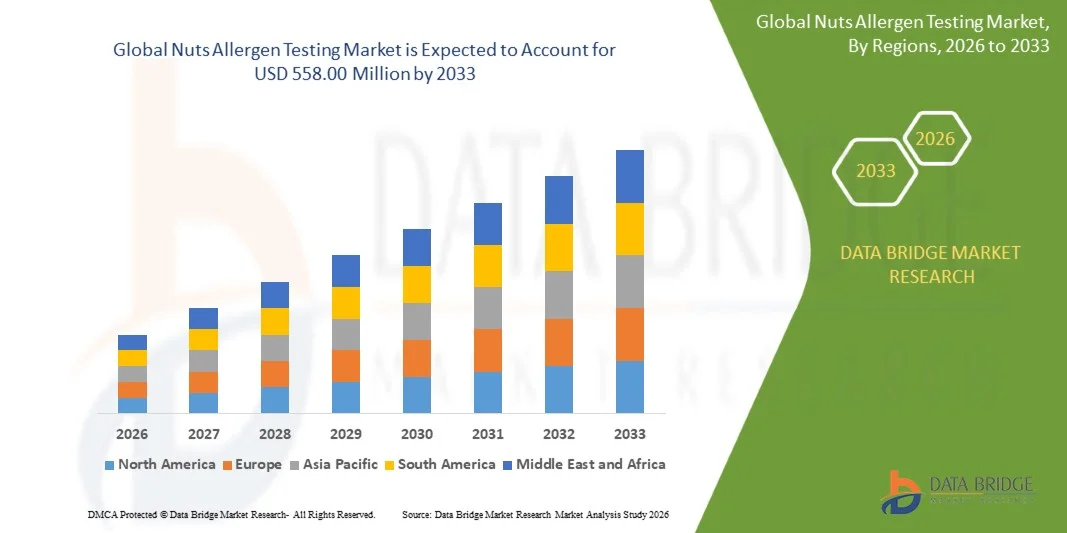
- As per Data Bridge Market Research analysis, the nuts allergen testing market was valued at USD 332.13 million in 2025 and is projected to reach USD 558.00 million by 2033, growing at a CAGR of 6.70% from 2026 to 2033.
- The market is experiencing steady growth driven by rising global prevalence of tree nut and peanut allergies, increasingly stringent food-labeling and allergen-disclosure regulations, and growing food manufacturer investment in cross-contamination prevention and verification testing across production facilities.
- The growing complexity of global food supply chains, combined with increasing consumer reliance on accurate allergen labeling for life-threatening allergy management, is compelling food manufacturers to integrate routine allergen testing into standard quality-control protocols at multiple production stages. Rising regulatory enforcement of precautionary allergen labeling requirements across North America, Europe, and Asia-Pacific is further reinforcing demand for reliable, validated nuts allergen testing methods.
Market Size & Forecast
- Global Market Value (2025): USD 332.13 Million
- Expected Market Value (2033): USD 558.00 Million
- Forecast CAGR (2026–2033): 6.70%
- Leading Region in 2025: North America
- Fastest Growing Region: Asia-Pacific
What are the Major Takeaways of the Nuts Allergen Testing Market?
- North America dominated the global nuts allergen testing market with the largest revenue share of 36.72% in 2025, supported by stringent food-labeling regulations and high consumer awareness of nut-allergy risks.
- Asia-Pacific is expected to be the fastest-growing region at a CAGR of 8.4% from 2026 to 2033, fueled by expanding processed-food manufacturing, rising regulatory enforcement of allergen labeling, and growing food-export testing requirements across China and India.
- The ELISA technology segment led the market with a 44.63% share in 2025, driven by its established sensitivity, cost-effectiveness, and widespread laboratory adoption for allergen protein detection.
- The PCR technology segment is the fastest-growing technology category, projected to register a CAGR of 8.7%, reflecting rising demand for highly sensitive DNA-based detection methods capable of identifying trace allergen contamination.
- The peanut nut type segment dominated the nut type category with a 38.94% revenue share in 2025, led by peanut's status as one of the most common and severe food-allergy triggers globally.
- The food & beverage manufacturers end user segment accounted for 48.72% of the market share in 2025, preferred for in-house quality-control testing integrated directly into production and supply-chain verification processes.
- The on-site/rapid testing deployment segment is the fastest-growing deployment category, with a CAGR of 8.9%, driven by rising demand for immediate, production-line allergen verification reducing dependency on external laboratory turnaround times.
Report Scope and Nuts Allergen Testing Market Segmentation
|
Attributes |
Nuts Allergen Testing Key Market Insights |
|
Segments Covered |
|
|
Countries Covered |
North America
Europe
Asia-Pacific
Middle East and Africa
South America
|
|
Key Market Players |
|
|
Market Opportunities |
|
|
Value Added Data Infosets |
In addition to the insights on market scenarios such as market value, growth rate, segmentation, geographical coverage, and major players, the market reports curated by the Data Bridge Market Research also include in-depth expert analysis, pricing analysis, brand share analysis, consumer survey, demography analysis, supply chain analysis, value chain analysis, raw material/consumables overview, vendor selection criteria, PESTLE Analysis, Porter Analysis, and regulatory framework. |
What is the Key Trend in the Nuts Allergen Testing Market?
- Food manufacturers are increasingly adopting rapid lateral flow testing devices for on-site, real-time allergen verification directly on production lines, reducing dependency on external laboratory confirmation for routine screening.
- For instance, in April 2025, Neogen expanded its Reveal rapid allergen testing product line to include additional tree nut-specific test strips, offering food manufacturers faster on-site verification capabilities for cross-contamination control.
- Rising adoption of PCR-based DNA testing methods is enabling laboratories and manufacturers to achieve higher sensitivity and specificity in detecting trace allergen contamination compared to conventional protein-based ELISA methods.
- Testing laboratories and technology providers are increasingly expanding multiplexed testing panels capable of simultaneously screening for multiple tree nut and peanut allergens within a single test, improving testing efficiency for food manufacturers managing diverse product lines.
- For instance, in January 2025, R-Biopharm introduced an expanded multiplex ELISA panel capable of simultaneously detecting peanut, almond, cashew, and hazelnut allergens, improving testing efficiency for manufacturers processing multiple nut-containing products.
- As food manufacturers and regulatory bodies continue to prioritize allergen-labeling accuracy and cross-contamination prevention, the adoption of advanced nuts allergen testing technologies is expected to accelerate, reinforcing their role as an essential food-safety quality-control measure across the global food supply chain.
What are the Key Drivers of the Nuts Allergen Testing Market?
- Rising global prevalence of tree nut and peanut allergies, combined with increasingly stringent food-labeling and allergen-disclosure regulations, has significantly increased demand for reliable, validated allergen testing methods across the food manufacturing industry.
- For instance, in March 2025, Romer Labs expanded its allergen testing kit production capacity in Europe to meet rising demand from food manufacturers complying with updated regional allergen-labeling requirements.
- Food manufacturers and testing laboratories are increasingly incorporating routine allergen testing into standard quality-control protocols to reduce recall risk, ensure regulatory compliance, and protect consumer safety across increasingly complex global supply chains.
- For instance, in October 2024, Thermo Fisher Scientific announced an investment in additional allergen testing instrument manufacturing capacity to support rising orders from food safety laboratories and manufacturers.
- For instance, in June 2024, Eurofins Scientific expanded its food allergen testing laboratory network to include additional facilities dedicated to nut allergen analysis, supporting growing demand from food manufacturers and retailers.
- With food manufacturers and regulatory bodies increasingly relying on rigorous testing protocols to prevent allergen cross-contamination and ensure accurate labeling, nuts allergen testing will remain indispensable across food safety, regulatory compliance, and product-recall prevention applications worldwide.
Which Factors are Challenging the Growth of the Nuts Allergen Testing Market?
- Nuts allergen testing methods can face technical challenges when allergens are present in highly processed or heat-treated food matrices. Thermal processing can alter protein structure and immunoreactivity, potentially affecting allergen recovery and detection accuracy.
- These matrix-interference and processing-related effects can make consistent allergen detection more difficult across bakery products, chocolates, and other complex food matrices, increasing the need for validated analytical methods and appropriate sample-preparation procedures.
- For instance, in 2024, Neogen continued offering its food-allergen testing portfolio for tree nuts, including quantitative ELISA and rapid lateral-flow methods for allergens such as walnut, hazelnut, almond, cashew, pecan, and pistachio. Its testing solutions cover processed food products, ingredients, clean-in-place rinses, and environmental samples, illustrating the need for different analytical approaches across diverse food matrices. Neogen allergen testing portfolio
- The technical complexity of achieving reliable allergen detection across diverse and highly processed food matrices continues to create validation and consistency challenges. These challenges can increase testing requirements for food manufacturers and slow the broader standardization and adoption of advanced nuts allergen-testing technologies.
How is the Nuts Allergen Testing Market Segmented?
The nuts allergen testing market is segmented on the basis of technology, nut type, offering, sample type, application, end user, format, deployment, testing mode and distribution channel.
- By Technology
On the basis of technology, the global nuts allergen testing market is segmented into ELISA, PCR, mass spectrometry, lateral flow/immunoassay, and others. The ELISA segment dominated the market with a 44.63% share in 2025, owing to its established sensitivity, cost-effectiveness, and widespread laboratory adoption for allergen protein detection. This technology delivers reliable, validated detection performance, making it the foundational testing method across current-generation allergen testing laboratories.
The PCR segment is projected to register the fastest growth at a CAGR of 8.7% from 2026 to 2033, driven by rising demand for highly sensitive DNA-based detection methods capable of identifying trace allergen contamination even in complex or highly processed food matrices. Advances in DNA-extraction and amplification technology, combined with growing laboratory adoption, are accelerating segment expansion. Real-time quantitative PCR variants are also gaining traction for their ability to correlate detected DNA signal with approximate allergen protein concentration, supporting more precise risk-assessment decisions.
- By Nut Type
On the basis of nut type, the global nuts allergen testing market is segmented into peanut and tree nuts (almond, cashew, walnut, hazelnut, pistachio, others). The peanut segment led the market with a 38.94% share in 2025, supported by peanut's status as one of the most common and severe food-allergy triggers globally, requiring extensive testing across diverse food product categories.
The tree nuts segment is expected to experience the fastest growth at a CAGR of 7.4% from 2026 to 2033, driven by increasing recognition of the diverse range of tree nut allergies and growing regulatory requirements for individual tree nut species disclosure on food labels.
- By Offering
On the basis of offering, the global nuts allergen testing market is segmented into test kits, instruments, reagents & consumables, and services. The test kits segment dominated the market with a share of 36.82% in 2025 due to its widespread adoption across both laboratory and on-site testing applications requiring accessible, standardized allergen detection formats. The widespread integration of test kits into routine quality-control workflows is driving strong demand for this offering category.
The services segment is anticipated to witness the fastest CAGR of 8.3% from 2026 to 2033, driven by the increasing outsourcing of allergen testing to specialized third-party laboratories among smaller food manufacturers lacking in-house testing capabilities. Testing laboratories are expanding contract-testing capacity to conduct cost-effective, scalable, and regulatory-compliant allergen analysis. Additionally, the integration of comprehensive testing-service packages with regulatory-consulting support is enhancing value for food manufacturers, further driving segment growth.
- By Sample Type
On the basis of sample type, the global nuts allergen testing market is segmented into raw ingredients, processed food products, environmental/surface swabs, and water. The processed food products segment led the market with a 42.36% share in 2025, supported by extensive testing requirements across finished food products prior to market release to ensure labeling accuracy and regulatory compliance.
The environmental/surface swabs segment is expected to witness the fastest CAGR of 8.6% from 2026 to 2033, driven by increasing food manufacturer emphasis on cross-contamination prevention through routine equipment and facility surface testing between production runs.
- By Application
On the basis of application, the global nuts allergen testing market is segmented into food safety & quality control, regulatory compliance, label verification, and research & development. The food safety & quality control segment dominated the market with a share of 47.28% in 2025 due to its critical role in preventing allergen cross-contamination and ensuring product safety throughout the manufacturing process. High adoption is driven by the increasing need for systematic testing protocols, integration with hazard analysis and critical control point programs, and enhanced consumer-safety assurance. Additionally, growing investment by food manufacturers to strengthen quality-control testing infrastructure is reinforcing the leading position of this segment in the market.
The regulatory compliance segment is expected to witness the fastest CAGR of 8.1% from 2026 to 2033, driven by increasingly stringent global allergen-labeling regulations requiring manufacturers to validate label accuracy through systematic testing. Growing regulatory enforcement across major food markets is further accelerating market expansion in this segment.
- By End User
On the basis of end user, the global nuts allergen testing market is segmented into food & beverage manufacturers, third-party testing laboratories, regulatory agencies & government bodies, and retailers. The food & beverage manufacturers segment dominated the market with a share of 48.72% in 2025 due to its widespread integration of in-house allergen testing into standard production quality-control processes. Additionally, established testing-infrastructure investment, broad supplier relationships, and extensive product-portfolio testing requirements are facilitating continued adoption of allergen testing among food manufacturers, while strong technical support networks are improving accessibility, reliability, and trust, further reinforcing this segment's leading market position.
The third-party testing laboratories segment is expected to witness the fastest CAGR of 8.2% from 2026 to 2033, driven by the increasing outsourcing of allergen testing among smaller food manufacturers and the growing need for independent, accredited verification testing to support regulatory compliance and consumer trust. These laboratories offer specialized testing expertise and accreditation credibility, enhancing overall testing reliability and supporting broader market confidence in allergen-testing outcomes.
- By Format
On the basis of format, the global nuts allergen testing market is segmented into qualitative testing and quantitative testing. The qualitative testing segment dominated the market with a share of 58.64% in 2025 due to its widespread use for rapid presence/absence screening across routine quality-control and cross-contamination verification applications. Additionally, established test-kit manufacturing infrastructure, broad supplier familiarity, and extensive production-cost optimization are facilitating continued adoption of qualitative testing across high-volume screening applications.
The quantitative testing segment is expected to witness the fastest CAGR of 7.9% from 2026 to 2033, driven by the increasing regulatory and consumer demand for precise allergen concentration measurement to support precautionary labeling thresholds and risk-assessment protocols. Manufacturers and laboratories are leveraging quantitative testing methods to enhance labeling precision, enable risk-based allergen management, and support evolving regulatory threshold requirements.
- By Deployment
On the basis of deployment, the global nuts allergen testing market is segmented into on-site/rapid testing and laboratory-based testing. The laboratory-based testing segment dominated the market with a share of 61.73% in 2025 due to its critical role in providing high-sensitivity, validated testing results required for regulatory compliance and formal product certification. Additionally, established laboratory-accreditation infrastructure, broad analytical-method validation, and extensive quality-assurance protocols are facilitating continued adoption of laboratory-based testing among food manufacturers and regulatory bodies.
The on-site/rapid testing segment is expected to witness the fastest CAGR of 8.9% from 2026 to 2033, driven by the increasing demand for immediate, production-line allergen verification that reduces dependency on external laboratory turnaround times. Manufacturers are leveraging rapid lateral flow and portable testing technologies to enhance production efficiency, enable real-time cross-contamination detection, and support faster corrective-action response, thereby accelerating adoption across manufacturing-floor quality-control applications.
- By Testing Mode
On the basis of testing mode, the global nuts allergen testing market is segmented into in-house testing and outsourced/contract testing. The in-house testing segment dominated the market with a share of 56.37% in 2025 due to its preference among large-scale food manufacturers with sufficient production volume and technical capacity to maintain dedicated testing infrastructure and personnel. Additionally, established internal quality-control integration, broad production-line testing access, and extensive testing-protocol customization are facilitating continued adoption of in-house testing among large manufacturers, while strong internal technical expertise is improving testing consistency, further reinforcing this segment's leading market position.
The outsourced/contract testing segment is expected to witness the fastest CAGR of 8.4% from 2026 to 2033, driven by the increasing reliance of smaller food manufacturers on specialized third-party laboratories offering accredited, cost-effective allergen testing without requiring significant in-house infrastructure investment. Testing laboratories are expanding service capacity to enhance accessibility, enable regulatory-compliant verification, and support smaller manufacturers' quality-assurance needs.
Which Region Holds the Largest Share of the Nuts Allergen Testing Market?
- North America dominated the nuts allergen testing market and accounted for the largest revenue share of 36.72% in 2025, supported by stringent food-labeling regulations, high consumer awareness of nut-allergy risks, and the presence of established testing technology providers and laboratory networks.
- The region also benefits from advanced regulatory enforcement infrastructure, high adoption of both laboratory-based and rapid on-site testing technologies, and growing use of allergen testing across food manufacturing, retail, and regulatory-compliance applications. Increasing focus on cross-contamination prevention and labeling accuracy continues to strengthen North America's leadership position in the global market.
United States Nuts Allergen Testing Market Insight
The United States nuts allergen testing market is growing steadily, driven by stringent federal food-labeling regulations, high consumer awareness of nut-allergy risks, and rising food manufacturer investment in cross-contamination prevention testing. Growing adoption of rapid on-site testing technologies across food production facilities is significantly boosting market demand. In addition, rising investments in testing-technology research and development, increasing collaboration between testing providers and food manufacturers, and rapid product innovation are positioning the United States as the leading global market for nuts allergen testing.
Canada Nuts Allergen Testing Market Insight
Canada’s nuts allergen testing market is expanding as food manufacturers, retailers, and regulators emphasize consumer safety and accurate allergen labeling. Demand is driven by rising awareness of food allergies, stricter compliance requirements, and the growing consumption of processed, packaged, and plant-based foods. Testing laboratories increasingly offer rapid PCR, ELISA, and chromatography-based solutions for detecting trace nut allergens. Market growth is supported by technological advancements, regulatory oversight, and manufacturers’ efforts to minimize cross-contamination risks across production and supply chains.
Asia-Pacific Nuts Allergen Testing Market Insight
The Asia-Pacific nuts allergen testing market is witnessing steady growth, driven by increasing food allergy awareness, expanding processed-food consumption, and strengthening food safety regulations. Growing demand for packaged foods, bakery products, confectionery, and plant-based alternatives is increasing the need for reliable allergen detection and labeling. Manufacturers are adopting ELISA, PCR, and rapid testing technologies to identify trace nut allergens and prevent cross-contamination. Japan, China, Australia, South Korea, and India represent important markets, supported by expanding food-processing industries and evolving regulatory standards.
China Nuts Allergen Testing Market Insight
The China nuts allergen testing market is expanding rapidly, supported by growing processed-food manufacturing capacity, rising regulatory enforcement of allergen labeling, and increasing food-export testing requirements to meet international market standards. Manufacturers and testing laboratories are increasingly investing in advanced allergen detection technologies for both domestic and export-oriented food production. Continuous expansion of domestic testing infrastructure and rising government support for food-safety modernization are further driving market growth in China.
India Nuts Allergen Testing Market Insight
The India nuts allergen testing market is expanding steadily, supported by growing organized food manufacturing, rising regulatory focus on food-safety standards, and increasing awareness of allergen-related health risks among consumers. Food manufacturers and testing laboratories are increasingly integrating allergen testing into standard quality-assurance protocols. Continuous advancements in cost-optimized testing technologies, along with strong government focus on food-safety regulation, are further driving market growth in India.
Which are the Top Companies in Nuts Allergen Testing Market?
The nuts allergen testing industry is primarily led by well-established companies, including:
- Thermo Fisher Scientific Inc. (U.S.)
- Merck KGaA (Germany)
- Neogen Corporation (U.S.)
- Romer Labs Division Holding GmbH (Austria)
- Bio-Rad Laboratories, Inc. (U.S.)
- Eurofins Scientific SE (Luxembourg)
- SGS SA (Switzerland)
- Intertek Group plc (U.K.)
- Bureau Veritas SA (France)
- ALS Limited (Australia)
- R-Biopharm AG (Germany)
- Charm Sciences, Inc. (U.S.)
- Hygiena, LLC (U.S.)
- Microbiologics, Inc. (U.S.)
- Agilent Technologies, Inc. (U.S.)
- Revvity, Inc. (U.S.)
- Merieux NutriSciences Corporation (U.S.)
- TÜV SÜD AG (Germany)
- Biotecon Diagnostics GmbH (Germany)
- Morinaga Institute of Biological Science, Inc. (Japan)
- EnviroLogix Inc. (U.S.)
- ELISA Technologies, Inc. (U.S.)
- Generon (Europe) Ltd (U.K.)
- Bio-Check (U.K.) Limited (U.K.)
- Congen Biotechnologie GmbH (Germany)
- FoodChek Systems Inc. (Canada)
What are Latest Developments in Nuts Allergen Testing Market?
- In September 2025, Thermo Fisher Scientific launched an expanded PCR-based allergen detection platform for food safety laboratories, strengthening its position in the high-sensitivity nut allergen testing market.
- In February 2025, Romer Labs expanded its allergen test kit manufacturing capacity in Austria to support growing demand from food manufacturers across Europe and Asia-Pacific.
- In November 2025, Neogen introduced an upgraded multiplex lateral flow testing device capable of simultaneously screening for multiple tree nut allergens on production lines, improving testing efficiency and reducing turnaround time for food manufacturers. This development strengthens Neogen's position in the rapid testing market by offering manufacturers streamlined, multi-allergen screening in a single test.
- In October 2024, Eurofins Scientific expanded its allergen testing laboratory network in North America to include additional accredited facilities dedicated to nut and tree nut allergen analysis.
- In June 2023, R-Biopharm partnered with a food safety research institute to co-develop next-generation multiplex ELISA testing panels for simultaneous tree nut allergen detection, combining its testing-technology expertise with the institute's food-safety research capabilities to support improved testing accuracy and efficiency.
- In March 2023, Charm Sciences received accreditation approval for an expanded rapid allergen testing validation program, enabling food manufacturers to qualify newly developed on-site test formats for use in regulatory-compliant quality-control workflows.

- Interactive Data Analysis Dashboard
- Company Analysis Dashboard for high growth potential opportunities
- Research Analyst Access for customization & queries
- Competitor Analysis with Interactive dashboard
- Latest News, Updates & Trend analysis
- Harness the Power of Benchmark Analysis for Comprehensive Competitor Tracking
Global Nuts Allergen Testing Market, Supply Chain Analysis and Ecosystem Framework
To support market growth and help clients navigate the impact of geopolitical shifts, DBMR has integrated in-depth supply chain analysis into its Global Nuts Allergen Testing Market research reports. This addition empowers clients to respond effectively to global changes affecting their industries. The supply chain analysis section includes detailed insights such as Global Nuts Allergen Testing Market consumption and production by country, price trend analysis, the impact of tariffs and geopolitical developments, and import and export trends by country and HSN code. It also highlights major suppliers with data on production capacity and company profiles, as well as key importers and exporters. In addition to research, DBMR offers specialized supply chain consulting services backed by over a decade of experience, providing solutions like supplier discovery, supplier risk assessment, price trend analysis, impact evaluation of inflation and trade route changes, and comprehensive market trend analysis.
Data collection and base year analysis are done using data collection modules with large sample sizes. The stage includes obtaining market information or related data through various sources and strategies. It includes examining and planning all the data acquired from the past in advance. It likewise envelops the examination of information inconsistencies seen across different information sources. The market data is analysed and estimated using market statistical and coherent models. Also, market share analysis and key trend analysis are the major success factors in the market report. To know more, please request an analyst call or drop down your inquiry.
The key research methodology used by DBMR research team is data triangulation which involves data mining, analysis of the impact of data variables on the market and primary (industry expert) validation. Data models include Vendor Positioning Grid, Market Time Line Analysis, Market Overview and Guide, Company Positioning Grid, Patent Analysis, Pricing Analysis, Company Market Share Analysis, Standards of Measurement, Global versus Regional and Vendor Share Analysis. To know more about the research methodology, drop in an inquiry to speak to our industry experts.
Data Bridge Market Research is a leader in advanced formative research. We take pride in servicing our existing and new customers with data and analysis that match and suits their goal. The report can be customized to include price trend analysis of target brands understanding the market for additional countries (ask for the list of countries), clinical trial results data, literature review, refurbished market and product base analysis. Market analysis of target competitors can be analyzed from technology-based analysis to market portfolio strategies. We can add as many competitors that you require data about in the format and data style you are looking for. Our team of analysts can also provide you data in crude raw excel files pivot tables (Fact book) or can assist you in creating presentations from the data sets available in the report.