


What is the Operator Training Simulator market Size and Growth Rate?
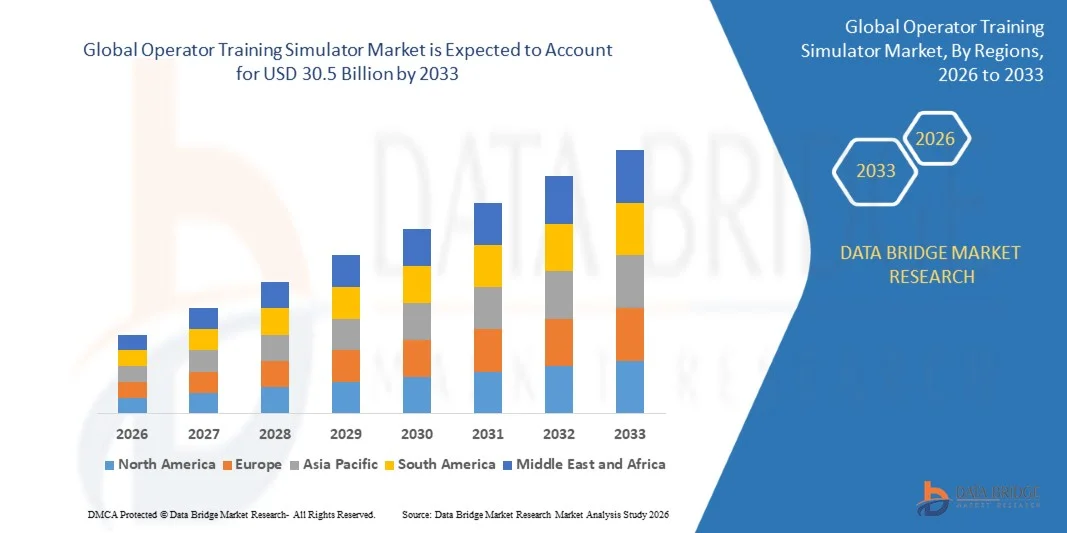
- As per market analysis, the global operator training simulator market was valued at approximately USD 12.6 billion in 2025 and is projected to reach USD 30.5 billion by 2033, growing at a CAGR of 11.9% from 2026 to 2033.
- The market is witnessing growth driven by increasing demand for skilled and competent operators, growing emphasis on workplace safety, stringent safety regulations, and the need to reduce human errors and operational risks across complex industrial environments. Operator training simulators provide controlled environments where personnel can practice routine operations, emergency situations, and critical decision-making without exposing workers or equipment to real-world risks.
- Increasing adoption of artificial intelligence, immersive 3D simulation, virtual reality, and advanced process simulation technologies is creating further growth opportunities. Industries such as oil and gas, energy and power, aerospace and defense, automotive, and healthcare are increasingly adopting simulation-based training to improve workforce preparedness, operational efficiency, and safety performance.
Market Size & Forecast
- Market Value (2025): USD 12.6 billion
- Expected Market Value (2033): USD 30.5 Million
- Forecast CAGR (2026–2033): 11.9%
- Leading Region in 2025: North America
- Fastest Growing Region: Asia-Pacific
What are the Major Takeaways of the Operator Training Simulator Market?
- North America dominated the global operator training simulator market with a market share of 32.9% in 2025, supported by advanced industrial infrastructure, stringent workplace safety requirements, and strong adoption of simulation-based workforce training across oil and gas, energy and power, manufacturing, aerospace and defense, and other industries. The presence of established automation and simulation technology providers and increasing investments in digitalization are further supporting regional market development.
- Asia-Pacific is expected to witness strong growth in the global operator training simulator market during the forecast period, supported by rapid industrialization, expansion of manufacturing and energy infrastructure, increasing focus on workforce safety, and growing adoption of digital simulation technologies. Rising investments in automation and operator training across China, India, Japan, South Korea, and other Asian economies are further contributing to regional expansion.
- Hardware represented the leading component segment of the global operator training simulator market with a market share of 47.7% in 2025, supported by the critical role of processors, graphics systems, input/output devices, and specialized peripherals in creating realistic and immersive training environments. Increasing demand for high-fidelity simulation systems and advanced visualization technologies is further supporting hardware adoption.
- Console Operator represented the largest operator segment of the global operator training simulator market in 2025, supported by the need to train personnel responsible for monitoring and controlling complex industrial processes from centralized control rooms. Increasing emphasis on emergency-response preparedness, operational safety, and decision-making under critical conditions is further supporting demand for console operator simulation.
- Oil & Gas represented the leading end-use segment of the global operator training simulator market in 2025, driven by the complex, high-risk operating conditions associated with exploration, production, processing, refining, and related activities. The need to improve operator preparedness, reduce human error, strengthen process safety, and provide realistic training for abnormal and emergency scenarios is supporting simulator adoption across the industry.
- The global operator training simulator market is expected to grow at a CAGR of 11.9% from 2026 to 2033, driven by increasing demand for skilled operators, stringent safety requirements, rising costs associated with operational errors and equipment downtime, and technological advancements in simulation. The integration of immersive simulation, advanced process modeling, virtual environments, and digital technologies is further creating opportunities for market expansion.
Report Scope Operator Training Simulator Market Segmentation
|
Attributes |
Operator Training Simulator Key Market Insights |
|
Segments Covered |
|
|
Countries Covered |
North America
Europe
Asia-Pacific
Middle East and Africa
South America
|
|
Key Market Players |
|
|
Market Opportunities |
|
|
Value Added Data Infosets |
In addition to the market insights such as market value, growth rate, market segments, geographical coverage, market players, and market scenario, the market report curated by the Data Bridge Market Research team includes in-depth expert analysis, import/export analysis, pricing analysis, production consumption analysis, and pestle analysis. |
What is the Key Trend in the Operator Training Simulator Market?
- Operator training simulator providers are increasingly focusing on digital twin , immersive, and high-fidelity simulation technologies that replicate real-world plant operations, control systems, equipment behavior, and abnormal operating conditions. The integration of dynamic process models with replicated control interfaces is enabling operators to practice routine procedures, emergency responses, troubleshooting, and decision-making in realistic environments without affecting actual production operations.
- The development of AI-enabled, cloud-based, and immersive operator training platforms is gaining traction, as industrial organizations seek to improve workforce competency, address skills gaps, and provide scalable training across geographically distributed facilities. The integration of virtual reality (VR), mixed reality (MR), digital twins, and cloud deployment is supporting more flexible training while enabling organizations to standardize learning experiences and assess operator competency.
- For instance, on February 21, 2024, Honeywell enhanced its Immersive Field Simulator (IFS) by adding augmented reality capabilities, introducing Immersive Equipment Views that combine real-world environments with digital content. The solution uses a digital twin of a physical facility to provide targeted, on-demand training and extend simulation-based learning beyond conventional control-room training.
- The integration of digital twins with virtual and mixed reality environments is also supporting collaborative training for control-room operators, field operators, and maintenance personnel. These technologies enable users to practice equipment operation, abnormal situations, troubleshooting, and safety procedures in risk-free environments while maintaining connections between the simulated physical plant, process models, and control systems.
- The adoption of remote and scalable simulator-based learning is further emerging as an important trend, with cloud-deployed platforms enabling operators to access training programs regardless of location. Honeywell's Interactive Process Training, for example, provides simulator-based learning and development through cloud deployment, supporting workforce competency development across individual sites and wider organizations.
What are the Key Drivers of the Operator Training Simulator Market?
- Operator training simulator providers are increasingly focusing on AI-enabled, data-driven, and immersive simulation technologies that allow operators to practice complex operating procedures, emergency scenarios, and equipment responses in realistic and controlled environments. The integration of artificial intelligence, advanced analytics, high-fidelity simulation, and immersive 3D environments is improving training effectiveness while reducing the risks associated with training on live industrial equipment.
- The growing emphasis on workplace safety, operator competency, and regulatory compliance is increasing the adoption of operator training simulators across safety-critical industries. Organizations operating in oil and gas, energy and power, aerospace and defense, manufacturing, and other process-intensive sectors are using simulation-based training to prepare operators for abnormal operating conditions, equipment failures, and emergency situations without exposing personnel or production assets to operational risks. Stringent safety regulations are further encouraging companies to implement structured and repeatable operator training programs.
- For instance, on August 20, 2026, Nuclearn and GSE Solutions announced a strategic collaboration to integrate artificial intelligence capabilities with GSE's high-fidelity nuclear plant simulators. The collaboration is designed to provide training instructors with tools for natural-language scenario creation, automated post-scenario performance summaries, adaptive assessments, and plant-specific physics explanations, demonstrating the increasing integration of AI into operator training simulator platforms.
- The integration of virtual reality (VR), augmented reality (AR), digital twins, cloud-based platforms, and advanced simulation analytics is also supporting the development of more realistic and scalable operator training environments. These technologies enable operators to practice high-risk and complex procedures remotely or without interrupting live operations, while supporting faster workforce upskilling, performance assessment, and standardized training across multiple industrial facilities.
Which Factors are Challenging the Growth of the Operator Training Simulator Market?
- High initial investment and implementation costs are challenging the adoption of operator training simulators, particularly among organizations with limited training budgets. High-fidelity OTS solutions require substantial investment in specialized hardware, software, customized simulation models, system integration, installation, and ongoing maintenance. These cost requirements can limit adoption in cost-sensitive industries and developing economies.
- Lack of technical expertise and skilled simulation professionals is creating challenges for the deployment and effective utilization of advanced operator training simulator systems. OTS platforms require specialized knowledge in process modeling, control systems, simulation software, system configuration, and maintenance. The shortage of professionals with these cross-functional capabilities can increase dependence on external service providers and extend implementation timelines.
- Complexity associated with system integration and interoperability is also restricting market adoption. Operator training simulators often need to be integrated with distributed control systems, SCADA platforms, safety systems, plant databases, and other industrial automation technologies. Differences between existing infrastructure and simulator platforms can increase customization requirements and create additional technical and implementation challenges.
- High customization requirements and continuous system updates can further increase the cost and complexity of OTS deployment. Accurate simulation requires process models and training scenarios to reflect actual plant configurations and operating conditions. Maintaining these models as equipment, processes, control systems, and operating procedures change requires continuous technical support and investment, which can affect adoption among organizations with constrained resources.
How is the Operator Training Simulator Market Segmented?
The market is segmented on the basis of component, operator type, and end use.
- By Component
On the basis of component, the operator training simulator market is segmented into Hardware, Software, and Services. The Hardware segment dominated the market with a revenue share of 47.7% in 2025, supported by the importance of processors, graphics cards, input/output devices, specialized peripherals, and other hardware components in developing realistic and immersive operator training environments. Continuous advancements in processing power, graphics capabilities, and hardware miniaturization are further supporting the adoption of sophisticated simulation systems across industrial applications.
The Services segment is expected to witness strong growth during the forecast period of 5.35% from 2026 to 2033, supported by increasing demand for simulator integration and deployment, system support and maintenance, training and consulting, and technical assistance. As operator training simulators become more sophisticated and require integration with existing industrial systems, organizations are increasingly relying on specialized service providers to maximize simulator performance and utilization.
- By Operator Type
On the basis of operator type, the operator training simulator market is segmented into Console Operator Training and Field Operator Training. The Console Operator Training segment dominated the market share of 45.54% in 2025, supported by the requirement for highly skilled operators to manage complex industrial systems and processes that involve advanced decision-making and technical proficiency. The adoption of simulator-based training across energy, aerospace, manufacturing, and other safety-sensitive industries is supporting the demand for console operator training solutions.
The Field Operator Training segment is expected to witness strong growth during the forecast period CAGR of 5.43% from 2026 to 2033, supported by increasing emphasis on workplace safety, rising complexity of industrial machinery, and the need to prepare field personnel for hazardous and emergency operating conditions. Operator training simulators provide controlled environments in which field operators can develop practical skills and respond to simulated operational scenarios without exposure to real-world risks.
- By End User
On the basis of end use, the operator training simulator market is segmented into Automotive, Aerospace and Defense, Energy and Power, Oil and Gas, Medical and Healthcare, and Others. The Oil and Gas segment dominated the market share of 65.34% in 2025, supported by the complex and high-risk nature of oil and gas operations and the increasing requirement for rigorous operator training to improve workplace safety, operational efficiency, and environmental protection. Stringent safety and environmental regulations are further encouraging oil and gas companies to deploy simulation-based training solutions for emergency response and operational preparedness.
The Medical and Healthcare segment is expected to witness strong growth during the forecast period with CAGR OF 7.46% from 2026 to 2033, supported by increasing adoption of simulation-based training for healthcare professionals, growing requirements for risk-free practical training, and the expansion of advanced simulation technologies across medical education and healthcare environments. The broader application of operator training and simulation solutions beyond traditional industrial sectors is contributing to the expansion of this segment.
Which Region Holds the Largest Share of the Operator Training Simulator Market?
- North America dominated the operator training simulator market with a market share of 32.9% in 2025, supported by the presence of established industrial automation infrastructure, increasing adoption of simulation-based workforce training, and growing demand for operator safety and competency across energy and power, oil and gas, aerospace and defense, manufacturing, and other industrial sectors. The region's strong focus on industrial digitalization, process automation, and workforce development is further supporting the adoption of advanced operator training simulator solutions.
- Asia-Pacific is expected to witness significant growth during the forecast period OF 5.45% from 2026 to 2033, supported by rapid industrialization, expansion of energy and manufacturing infrastructure, increasing adoption of industrial automation, and growing requirements for skilled operator training across China, India, Japan, South Korea, and other emerging economies. Increasing investments in digital transformation, process simulation, workplace safety, and automation are further supporting regional market expansion.
U.S. Operator Training Simulator market Insight
The U.S. operator training simulator market held the largest share within the North American market in 2025, supported by the country's advanced industrial infrastructure, strong presence of aerospace and defense activities, and increasing demand for skilled operators in energy, manufacturing, and other safety-sensitive industries. Simulator-based training is increasingly used to improve operational efficiency, workforce competency, and safety while reducing the risks associated with real-world training. The adoption of advanced simulation technologies, including immersive 3D environments and AI-enabled platforms, is further supporting the development of the U.S. market.
Europe Operator Training Simulator Market Insight
The Europe operator training simulator market is supported by increasing industrial automation, stringent workplace safety requirements, and growing emphasis on workforce competency across energy and power, oil and gas, manufacturing, automotive, and aerospace and defense industries. Countries such as Germany, the United Kingdom, France, and Italy are adopting advanced simulation technologies to improve operator preparedness and reduce operational risks. The integration of digital twins, process simulation, virtual training environments, and automation technologies is further strengthening regional demand. Rising investments in industrial digitalization and modernization are expected to create additional opportunities for operator training simulator providers across Europe.
U.K. Operator Training Simulator Market Insight
The U.K. operator training simulator market is supported by the country's established industrial base, increasing adoption of process automation, and growing emphasis on workforce safety and operational efficiency. Industries such as oil and gas, energy and power, manufacturing, aerospace and defense, and healthcare are increasingly adopting simulation-based training to improve operator competency and prepare personnel for complex operating and emergency scenarios. The integration of advanced digital technologies, process simulation, and immersive training environments is further supporting market development as organizations seek to reduce operational risks and enhance workforce preparednes.
Germany Operator Training Simulator Market Insight
Germany’s operator training simulator market is supported by the country’s advanced industrial base, strong adoption of automation, and increasing digitalization across manufacturing, automotive, energy, and process industries. The growing emphasis on workforce safety, operational efficiency, and reducing human errors is encouraging organizations to adopt simulation-based operator training. Germany’s established engineering capabilities and Industry 4.0 ecosystem are further supporting the integration of advanced simulation, virtual training environments, and digital technologies with industrial control systems. Rising requirements for skilled operators and continuous workforce development are expected to contribute to market expansion across key industrial sectors.
Asia-Pacific Operator Training Simulator Market Insight
Asia-Pacific is witnessing increasing adoption of operator training simulators due to rapid industrialization, expanding manufacturing and energy infrastructure, and growing investments in industrial automation and digital transformation. Countries such as China, India, Japan, and South Korea are strengthening demand for simulation-based training to improve operator competency, workplace safety, and operational efficiency. The expansion of oil and gas, energy and power, automotive, aerospace and defense, and other process-intensive industries is further supporting regional growth. Increasing adoption of advanced process simulation, virtual training environments, and automation technologies is expected to create further opportunities across the region.
Japan Operator Training Simulator market Insight
Japan’s operator training simulator market is supported by the country’s advanced industrial automation infrastructure, strong manufacturing base, and increasing adoption of digital simulation technologies for workforce development. The presence of established automotive, electronics, energy, and industrial machinery industries is creating demand for realistic operator training environments that improve operational safety and workforce competency. Increasing integration of automation, process control systems, and digital technologies is further encouraging organizations to adopt simulator-based training. The growing focus on reducing human errors and preparing operators for complex operational and emergency scenarios is expected to support market expansion in Japan.
China Operator Training Simulator market Insight
China's operator training simulator market is supported by rapid industrial automation, expansion of manufacturing capacity, and increasing adoption of digital technologies across energy, power, oil and gas, chemicals, and other process-intensive industries. Growing emphasis on workforce safety, operational efficiency, and technical skill development is encouraging organizations to adopt simulation-based operator training. The country's expanding industrial infrastructure and investments in smart manufacturing are further creating demand for advanced simulation solutions. Increasing integration of process simulators with automation and control systems is also supporting the adoption of operator training platforms for realistic and risk-free training environments.
Which are the Top Companies in Operator Training Simulator Market?
The Operator Training Simulator market industry is primarily led by well-established companies, including:
- ABB Ltd. (Switzerland)
- Siemens AG (Germany)
- Honeywell International Inc. (U.S.)
- Schneider Electric SE (France)
- Emerson Electric Co. (U.S.)
- Yokogawa Electric Corporation (Japan)
- ANDRITZ AG (Austria)
- Aspen Technology, Inc. (U.S.)
- AVEVA Group Limited (U.K.)
- CORYS (France)
- DNV AS (Norway)
- ESI Group (France)
- FLSmidth & Co. A/S (Denmark)
- SimGenics, LLC (U.S.)
- Applied Research Associates, Inc. (U.S.)
What are Latest Developments in Operator Training Simulator Market?
- In October 2025, ABB highlighted its automation modernization solutions incorporating operator training simulation, enabling operators to practice in a safe environment using a simulator with the same look and feel as the live control system. The solution is designed to support operator preparedness while reducing operational risks during training.
- In February 2025, Yokogawa secured a contract from GDF SUEZ E&P UK Ltd. that included the supply of an Operator Training System (OTS) as part of the automation solution. The development demonstrates continued deployment of simulator-based operator training within oil and gas operations.
- In January 2026, Yokogawa continued expanding its simulation and digital-operation capabilities, with its OpreX portfolio including Operator Training Simulator solutions alongside process digital twins and other operational technologies. This supports the integration of operator training with broader industrial digitalization initiatives.
- In April 2025, AVEVA continued to promote high-fidelity dynamic simulation for operator training, particularly for process and power industries. Its simulation portfolio supports realistic training environments and engineering studies, strengthening the role of dynamic simulation in industrial workforce development.
- In June 2025, Emerson continued advancing DeltaV Mimic dynamic simulation capabilities, which provide process-industry applications for control-system testing, operator training, and ongoing system maintenance. The technology supports training and validation without disrupting live production environments.
- In May 2026, CORYS continued expanding its dynamic simulation activities across process, power, and transportation industries, including operator training applications. The company combines dynamic modelling, computer-generated environments, cloud technologies, and artificial intelligence to develop customized training and engineering simulators for safety-critical operations.

- Interactive Data Analysis Dashboard
- Company Analysis Dashboard for high growth potential opportunities
- Research Analyst Access for customization & queries
- Competitor Analysis with Interactive dashboard
- Latest News, Updates & Trend analysis
- Harness the Power of Benchmark Analysis for Comprehensive Competitor Tracking
Data collection and base year analysis are done using data collection modules with large sample sizes. The stage includes obtaining market information or related data through various sources and strategies. It includes examining and planning all the data acquired from the past in advance. It likewise envelops the examination of information inconsistencies seen across different information sources. The market data is analysed and estimated using market statistical and coherent models. Also, market share analysis and key trend analysis are the major success factors in the market report. To know more, please request an analyst call or drop down your inquiry.
The key research methodology used by DBMR research team is data triangulation which involves data mining, analysis of the impact of data variables on the market and primary (industry expert) validation. Data models include Vendor Positioning Grid, Market Time Line Analysis, Market Overview and Guide, Company Positioning Grid, Patent Analysis, Pricing Analysis, Company Market Share Analysis, Standards of Measurement, Global versus Regional and Vendor Share Analysis. To know more about the research methodology, drop in an inquiry to speak to our industry experts.
Data Bridge Market Research is a leader in advanced formative research. We take pride in servicing our existing and new customers with data and analysis that match and suits their goal. The report can be customized to include price trend analysis of target brands understanding the market for additional countries (ask for the list of countries), clinical trial results data, literature review, refurbished market and product base analysis. Market analysis of target competitors can be analyzed from technology-based analysis to market portfolio strategies. We can add as many competitors that you require data about in the format and data style you are looking for. Our team of analysts can also provide you data in crude raw excel files pivot tables (Fact book) or can assist you in creating presentations from the data sets available in the report.













