


What is the Organic Acids Market Size and Growth Rate?
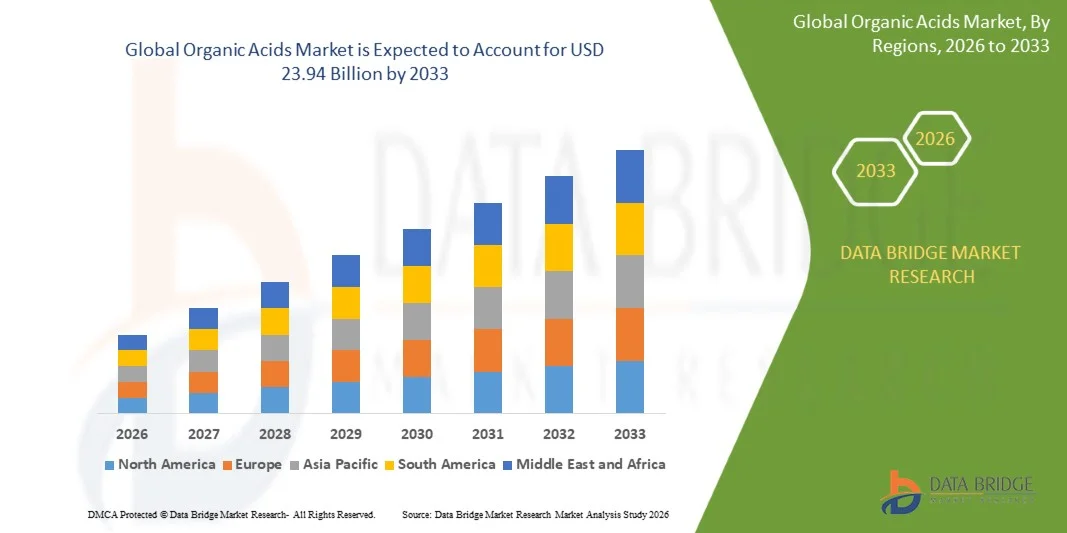
- As per Data Bridge Market Research analysis the organic acids market was valued at USD 14.59 billion in 2025 and is projected to reach USD 23.94 billion by 2033, growing at a CAGR of 6.39% from 2026 to 2033.
- The market is experiencing consistent growth driven by a notable transition from petrochemical methods to bio-based fermentation processes, alongside an increasing demand for clean-label products across food, polymer, and pharmaceutical sectors. The shift toward bio-based production methods is gaining traction due to environmental concerns and the need for sustainable alternatives.
- Rising consumer preference for natural and clean-label products is pushing manufacturers to adopt organic acids in food and beverage formulations. Organic acids, which include acetic acid, citric acid, lactic acid, and others, play a crucial role in various applications such as food preservation, flavor enhancement, and pH regulation. The growing adoption across diverse value chains underscores the market's robust expansion during the forecast period.
Market Size & Forecast
- Market Value (2025): USD 14.59 Billion
- Expected Market Value (2033): USD 23.94 Billion
- Forecast CAGR (2026–2033): 6.39%
- Leading Region in 2025: Asia-Pacific
- Fastest Growing Region: North America
What are the Major Takeaways of the Organic Acids Market?
- Asia-Pacific dominated the organic acids market and accounted for the largest revenue share of 30.58% in 2025, supported by robust manufacturing ecosystems, expanding food processing and animal nutrition sectors, and the rising consumption patterns of its expanding middle-class population.
- North America organic acids market is expected to witness steady growth from 2026 to 2033, supported by increasing demand for clean-label food ingredients, bio-based chemicals, dietary supplements, and pharmaceutical products.
- The acetic acid segment held the largest market revenue share of approximately 34.22% in 2025, driven by its extensive use in the production of vinyl acetate monomer (VAM), purified terephthalic acid (PTA), acetate esters, and food-grade vinegar. Strong demand from the chemicals, food & beverages, and textile industries, coupled with expanding industrial applications, continues to support the segment's market leadership.
- The succinic acid segment is projected to register the fastest growth at a CAGR of 10.02% from 2026 to 2033, driven by increasing adoption of bio-based chemicals, biodegradable polymers, and sustainable industrial applications. Rising investments in renewable chemical production and green manufacturing technologies are further accelerating segment growth.
- The chemical synthesis segment accounted for the largest market revenue share of approximately 61.48% in 2025, driven by its established manufacturing infrastructure, high production efficiency, and large-scale production of industrial organic acids, particularly acetic acid. Cost competitiveness and consistent product quality continue to support its widespread adoption across diverse industrial applications.
- The biomass segment is anticipated to witness the fastest growth at a CAGR of 11.43% from 2026 to 2033, driven by increasing demand for bio-based organic acids, growing investments in fermentation technologies, and expanding regulatory support for sustainable chemicals and renewable feedstocks.
Report Scope and Organic Acids Market Segmentation
|
Attributes |
Organic Acids Key Market Insights |
|
Segments Covered |
|
|
Countries Covered |
North America
Europe
Asia-Pacific
Middle East and Africa
South America
|
|
Key Market Players |
|
|
Market Opportunities |
|
|
Value Added Data Infosets |
In addition to the insights on market scenarios such as market value, growth rate, segmentation, geographical coverage, and major players, the market reports curated by the Data Bridge Market Research also include in-depth expert analysis, pricing analysis, brand share analysis, consumer survey, demography analysis, supply chain analysis, value chain analysis, raw material/consumables overview, vendor selection criteria, PESTLE Analysis, Porter Analysis, and regulatory framework. |
What is the Key Trend in the Organic Acids Market?
- The growing adoption of bio-based and fermentation-derived organic acids is emerging as a key trend in the organic acids market, driven by increasing demand for sustainable chemicals, biodegradable plastics, and clean-label food ingredients.
- For instance, in August 2025, Corbion partnered with BRAIN Biotech AG to develop novel bio-based antimicrobial compounds using advanced biotechnology and fermentation platforms. The collaboration reflects the growing industry investment in fermentation-based technologies and renewable feedstocks that support the development of sustainable organic acid and biochemical solutions.
- Organic acid manufacturers are increasingly investing in renewable feedstocks and advanced fermentation technologies to reduce greenhouse gas emissions while improving production efficiency and product quality.
- For instance, in October 2024, Praj Industries inaugurated its Integrated Biopolymers Demonstration Facility in Pune, India, enabling production of bio-based lactic acid and lactide for biodegradable PLA applications and supporting commercialization of sustainable organic acid technologies.
- As governments and industries continue promoting circular economy initiatives and low-carbon manufacturing, demand for sustainable organic acids is expected to accelerate, strengthening their role across food, pharmaceuticals, personal care, and industrial applications.
What are the Key Drivers of the Organic Acids Market?
- The increasing demand for natural preservatives, acidulants, and bio-based chemical intermediates across food & beverages, pharmaceuticals, animal nutrition, and industrial applications is significantly driving the growth of the organic acids market.
- For instance, in November 2024, INEOS Acetyls and Gujarat Narmada Valley Fertilizers & Chemicals (GNFC) signed agreements to establish a world-scale acetic acid production facility in Bharuch, India, with a planned capacity of approximately 600,000 tonnes per year, addressing rising domestic and international demand.
- Manufacturers are also expanding investments in fermentation technologies to support sustainable production of lactic acid and other renewable organic acids for bioplastics and specialty chemicals.
- With increasing regulatory support for sustainable chemicals and rising demand for renewable ingredients across multiple industries, organic acids are expected to witness strong long-term demand worldwide.
Which Factors are Challenging the Growth of the Organic Acids Market?
- Organic acid manufacturers face significant challenges due to volatile agricultural feedstock prices and high production costs, particularly for sugar, corn, molasses, and other raw materials used in fermentation-based manufacturing.
- Fluctuations in feedstock availability, energy prices, and logistics costs increase manufacturing expenses and reduce profitability, especially for producers relying on bio-based production processes.
- For instance, in April 2025, Corbion reaffirmed capital expenditure of €80–90 million for 2025, including continued investments in its lactic acid and biochemical production network. The announcement highlights the significant capital requirements and ongoing investment needed to expand production capacity, improve operational efficiency, and support sustainable organic acid manufacturing.
- Rising raw material costs, energy price volatility, and continuous investment requirements for sustainable production technologies continue to challenge manufacturers, particularly in price-sensitive markets. These factors increase operational costs and may slow capacity expansion despite growing global demand for organic acids.
How is the Organic Acids Market Segmented?
The organic acids market is segmented on the basis of type, source, end user, and form.
- By Type
On the basis of type, the organic acids market is segmented into acetic acid, citric acid, formic acid, lactic acid, malic acid, succinic acid, gluconic acid, ascorbic acid, fumaric acid, organic acid, and others. The acetic acid segment held the largest market revenue share of approximately 34.22% in 2025, driven by its extensive use in the production of vinyl acetate monomer (VAM), purified terephthalic acid (PTA), acetate esters, and food-grade vinegar. Strong demand from the chemicals, food & beverages, and textile industries, coupled with expanding industrial applications, continues to support the segment's market leadership.
The succinic acid segment is projected to register the fastest growth at a CAGR of 10.02% from 2026 to 2033, driven by increasing adoption of bio-based chemicals, biodegradable polymers, and sustainable industrial applications. Rising investments in renewable chemical production and green manufacturing technologies are further accelerating segment growth.
- By Source
On the basis of source, the organic acids market is segmented into biomass, molasses, starch, chemical synthesis, and agro-industrial residue. The chemical synthesis segment accounted for the largest market revenue share of approximately 61.48% in 2025, driven by its established manufacturing infrastructure, high production efficiency, and large-scale production of industrial organic acids, particularly acetic acid. Cost competitiveness and consistent product quality continue to support its widespread adoption across diverse industrial applications.
The biomass segment is anticipated to witness the fastest growth at a CAGR of 11.43% from 2026 to 2033, driven by increasing demand for bio-based organic acids, growing investments in fermentation technologies, and expanding regulatory support for sustainable chemicals and renewable feedstocks.
- By End-User
Based on end-user, the organic acids market is segmented into food & beverage, animal feed, chemicals & industrial, pharmaceuticals, personal care, and agriculture. The food & beverage segment dominated the market with a revenue share of approximately 48.62% in 2025, owing to the extensive use of organic acids as preservatives, acidulants, flavor enhancers, antioxidants, and pH regulators in processed foods, beverages, dairy products, confectionery, and bakery products. Rising consumer demand for clean-label products and natural food ingredients continues to support segment growth.
The chemicals & industrial segment is expected to register the fastest growth during the forecast period from 2026 to 2033, driven by expanding applications of organic acids in biodegradable polymers, specialty chemicals, industrial processing, and sustainable manufacturing. Increasing adoption of bio-based organic acids in polymer and bioplastics production is further accelerating market expansion.
- By Form
Based on form, the organic acids market is segmented into liquid and dry/crystal/powder. The liquid segment held the largest market revenue share of approximately 58.71% in 2025, driven by its widespread use in food processing, industrial manufacturing, pharmaceuticals, and chemical production due to its ease of handling, rapid mixing, and efficient processing characteristics. Liquid organic acids are also extensively utilized in continuous industrial production processes requiring accurate dosing.
The dry/crystal/powder segment is projected to register steady growth at a CAGR of 6.94% from 2026 to 2033, supported by its longer shelf life, ease of storage and transportation, and increasing demand across dietary supplements, powdered food products, pharmaceuticals, and animal nutrition applications.
Which Region Holds the Largest Share of the Organic Acids Market?
- Asia-Pacific dominated the organic acids market and accounted for the largest revenue share of 30.58% in 2025, supported by robust manufacturing ecosystems, expanding food processing and animal nutrition sectors, and the rising consumption patterns of its expanding middle-class population.
- The region also benefits from rapid industrialization, strong manufacturing capabilities, abundant raw material availability, and supportive government policies promoting green chemistry. China, as a key producer, dominates regional production due to its large-scale facilities for acetic, citric, and lactic acids, benefiting from low production costs and export-oriented operations.
Japan Organic Acids Market Insight
Japan organic acids market is expected to witness steady growth from 2026 to 2033 due to increasing demand for high-quality food ingredients, pharmaceutical formulations, and specialty chemicals. The country's advanced biotechnology capabilities, strong focus on product innovation, and growing preference for sustainable manufacturing practices continue to support market expansion. Rising applications of organic acids in functional foods and personal care products are further contributing to growth.
China Organic Acids Market Insight
China organic acids market accounted for the largest market revenue share in Asia-Pacific in 2025, attributed to its extensive food processing industry, expanding chemical manufacturing sector, and strong production capacity for fermentation-based organic acids. Rising demand for food preservatives, animal feed additives, pharmaceuticals, and bio-based industrial chemicals, along with continued investments in biotechnology and sustainable production, continues to propel the organic acids market in China.
North America Organic Acids Market Insight
North America organic acids market is expected to witness steady growth from 2026 to 2033, supported by increasing demand for clean-label food ingredients, bio-based chemicals, dietary supplements, and pharmaceutical products. Growing investments in biotechnology, sustainable manufacturing, and fermentation technologies continue to drive the adoption of organic acids across diverse industrial applications.
U.S. Organic Acids Market Insight
U.S. organic acids market captured the largest revenue share in 2025 within North America, fueled by expanding demand for processed foods, functional beverages, dietary supplements, and pharmaceutical products. Increasing adoption of bio-based chemicals, coupled with a robust food processing industry and continuous innovation in fermentation technologies, is further driving market growth. Rising applications of organic acids in industrial and agricultural sectors also contribute significantly to market expansion.
Europe Organic Acids Market Insight
Europe organic acids market is expected to witness the fastest growth rate from 2026 to 2033, primarily driven by stringent environmental regulations, increasing demand for sustainable chemicals, and growing adoption of bio-based products. Rising consumption of clean-label food ingredients, coupled with expanding pharmaceutical and personal care industries, is accelerating the use of organic acids across diverse applications. Continuous investments in green manufacturing technologies further support regional market growth.
U.K. Organic Acids Market Insight
U.K. organic acids market is expected to witness the fastest growth rate from 2026 to 2033, driven by increasing demand for natural food preservatives, functional ingredients, and sustainable industrial chemicals. Growing consumer preference for clean-label products, combined with rising investments in biotechnology and food innovation, continues to stimulate market expansion across multiple end-use industries.
Germany Organic Acids Market Insight
Germany organic acids market is expected to witness the fastest growth rate from 2026 to 2033, fueled by the country's strong chemical manufacturing base and increasing emphasis on sustainable production technologies. Rising demand for bio-based chemicals, food additives, pharmaceutical ingredients, and environmentally friendly industrial solutions is supporting market growth. Continuous advancements in fermentation technology further strengthen Germany's position in the European market.
Which are the Top Companies in Organic Acids Market?
The organic acids industry is primarily led by well-established companies, including:
- BASF SE (Germany)
- Cargill, Incorporated (U.S.)
- Archer Daniels Midland Company (U.S.)
- Corbion N.V. (Netherlands)
- Celanese Corporation (U.S.)
- Eastman Chemical Company (U.S.)
- Jungbunzlauer Suisse AG (Switzerland)
- Tate & Lyle PLC (U.K.)
- Henan Jindan Lactic Acid Technology Co., Ltd. (China)
- Fuso Chemical Co., Ltd. (Japan)
- Mitsubishi Chemical Group Corporation (Japan)
- Wilmar International Limited (Singapore)
- Koninklijke DSM-Firmenich N.V. (Netherlands)
- Galactic S.A. (Belgium)
What are Latest Developments in Organic Acids Market?
- In May 2024, Corbion broadened its partnership with IMCD to include Thailand, strengthening its distribution network across the Asia-Pacific region. The collaboration expanded the availability of Corbion’s PURAC lactic acid portfolio, supported by its major production facility in Rayong, Thailand, enabling enhanced commercial support and supply to markets including Singapore, Australia, and New Zealand.
- In December 2023, Corbion completed the mechanical construction of its circular lactic acid production facility in Rayong, Thailand. The plant incorporates an innovative recycling process that eliminates lime consumption and gypsum generation, significantly reducing the carbon footprint of lactic acid production. Commissioning commenced in early 2024.
- In November 2023, ADM entered into a strategic partnership with Solugen to commercialize plant-based organic acids using Solugen’s Bioforge chemoenzymatic platform. The collaboration includes the construction of a 500,000-square-foot manufacturing facility in Marshall, Minnesota, adjacent to ADM’s corn processing complex, with commercial production targeted for 2025.
- In September 2022, BASF introduced a biomass balance (BMB) grade of propionic acid with a cradle-to-gate product carbon footprint of zero. Produced using renewable feedstocks and renewable energy, the product supports applications across food, feed, agriculture, and fragrance industries while helping customers reduce Scope 3 greenhouse gas emissions.

- Interactive Data Analysis Dashboard
- Company Analysis Dashboard for high growth potential opportunities
- Research Analyst Access for customization & queries
- Competitor Analysis with Interactive dashboard
- Latest News, Updates & Trend analysis
- Harness the Power of Benchmark Analysis for Comprehensive Competitor Tracking
Global Organic Acids Market, Supply Chain Analysis and Ecosystem Framework
To support market growth and help clients navigate the impact of geopolitical shifts, DBMR has integrated in-depth supply chain analysis into its Global Organic Acids Market research reports. This addition empowers clients to respond effectively to global changes affecting their industries. The supply chain analysis section includes detailed insights such as Global Organic Acids Market consumption and production by country, price trend analysis, the impact of tariffs and geopolitical developments, and import and export trends by country and HSN code. It also highlights major suppliers with data on production capacity and company profiles, as well as key importers and exporters. In addition to research, DBMR offers specialized supply chain consulting services backed by over a decade of experience, providing solutions like supplier discovery, supplier risk assessment, price trend analysis, impact evaluation of inflation and trade route changes, and comprehensive market trend analysis.
Data collection and base year analysis are done using data collection modules with large sample sizes. The stage includes obtaining market information or related data through various sources and strategies. It includes examining and planning all the data acquired from the past in advance. It likewise envelops the examination of information inconsistencies seen across different information sources. The market data is analysed and estimated using market statistical and coherent models. Also, market share analysis and key trend analysis are the major success factors in the market report. To know more, please request an analyst call or drop down your inquiry.
The key research methodology used by DBMR research team is data triangulation which involves data mining, analysis of the impact of data variables on the market and primary (industry expert) validation. Data models include Vendor Positioning Grid, Market Time Line Analysis, Market Overview and Guide, Company Positioning Grid, Patent Analysis, Pricing Analysis, Company Market Share Analysis, Standards of Measurement, Global versus Regional and Vendor Share Analysis. To know more about the research methodology, drop in an inquiry to speak to our industry experts.
Data Bridge Market Research is a leader in advanced formative research. We take pride in servicing our existing and new customers with data and analysis that match and suits their goal. The report can be customized to include price trend analysis of target brands understanding the market for additional countries (ask for the list of countries), clinical trial results data, literature review, refurbished market and product base analysis. Market analysis of target competitors can be analyzed from technology-based analysis to market portfolio strategies. We can add as many competitors that you require data about in the format and data style you are looking for. Our team of analysts can also provide you data in crude raw excel files pivot tables (Fact book) or can assist you in creating presentations from the data sets available in the report.













