


What is the Organic Almond Oil Market Size and Growth Rate?
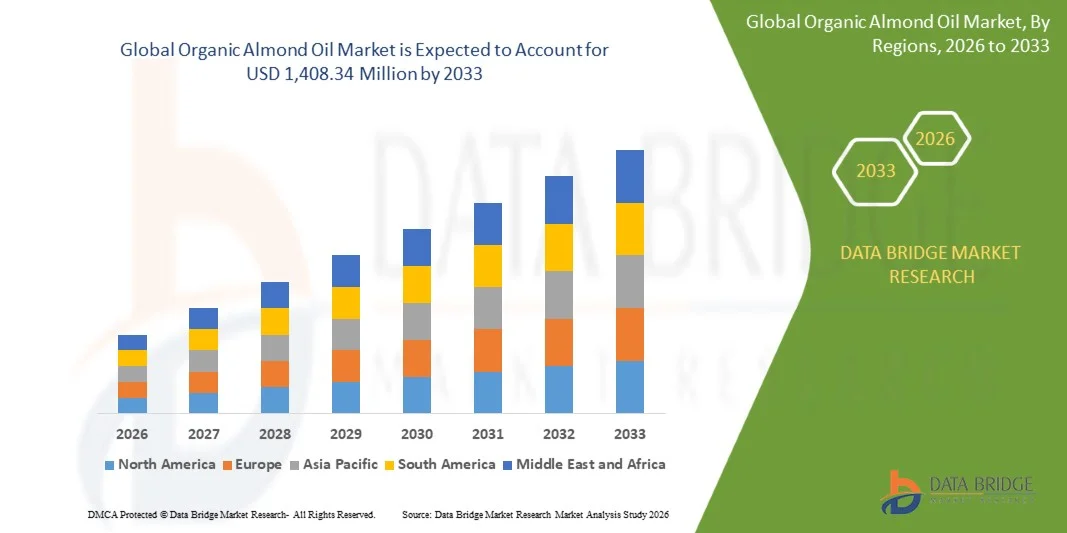
- As per Data Bridge Market Research analysis, the organic almond oil market was valued at USD 415.05 million in 2025 and is projected to reach USD 1,408.34 million by 2033, growing at a CAGR of 16.50% from 2026 to 2033.
- The market is experiencing consistent growth driven by rising consumer demand for natural and organic personal care products, increasing adoption of clean beauty formulations, expanding applications in food and beverage, and growing interest in plant-based wellness and aromatherapy products.
- The increasing consumer preference for chemical-free and sustainably sourced ingredients, combined with rising awareness of the nutritional and skin-conditioning benefits of almond oil, is compelling cosmetic manufacturers, food producers, wellness brands, and pharmaceutical companies to adopt organic almond oil. The expansion of e-commerce and premium specialty retail channels is further improving product accessibility, while growing demand for cold-pressed and certified organic oils is supporting premium product development and market expansion.
Market Size & Forecast
- Global Market Value (2025): USD 415.05 Million
- Expected Market Value (2033): USD 1,408.34 Million
- Forecast CAGR (2026–2033): 16.50%
- Leading Region in 2025: North America
- Fastest Growing Region: Asia Pacific
What are the Major Takeaways of the Organic Almond Oil Market?
- North America dominated the organic almond oil market with the largest revenue share of 34% in 2025, supported by strong consumer demand for natural and organic personal care products and growing use of plant-based ingredients across cosmetics, food, and wellness applications
- Asia-Pacific is expected to be the fastest-growing region at a CAGR of 10.3% from 2026 to 2033, fueled by rising health consciousness, expanding demand for natural and organic personal care products, growing e-commerce penetration, and increasing consumption of almond oil
- The sweet almond oil segment led the market with a 72% share in 2025, driven by its extensive use in cosmetics, personal care, food preparations, aromatherapy, and pharmaceutical formulations.
- Bitter almond oil are the fastest-growing type, projected to register a CAGR of 6.5%, reflecting the surge in interest in specialty botanical ingredients and its use in selected pharmaceutical, fragrance, personal-care, and industrial applications.
- The cosmetics and personal care segment dominated the application category with a 58% revenue share in 2025, led by the extensive incorporation of organic almond oil into skincare, haircare, massage, baby-care, and body-care products.
- Commercial use accounted for 66% of the market share in 2025, preferred by large-scale consumption of organic almond oil by cosmetics manufacturers, food processors, pharmaceutical companies, spas, wellness businesses, and other professional users.
- The food industry segment is the fastest-growing application category, with a CAGR of 6.6%, driven by growing demand for natural and organic ingredients in food and beverage formulations
Report Scope and Organic Almond Oil Market Segmentation
|
Attributes |
Organic Almond Oil Key Market Insights |
|
Segments Covered |
|
|
Countries Covered |
North America
Europe
Asia-Pacific
Middle East and Africa
South America
|
|
Key Market Players |
|
|
Market Opportunities |
|
|
Value Added Data Infosets |
In addition to the insights on market scenarios such as market value, growth rate, segmentation, geographical coverage, and major players, the market reports curated by the Data Bridge Market Research also include in-depth expert analysis, pricing analysis, brand share analysis, consumer survey, demography analysis, supply chain analysis, value chain analysis, raw material/consumables overview, vendor selection criteria, PESTLE Analysis, Porter Analysis, and regulatory framework. |
What is the Key Trend in the Organic Almond Oil Market?
- Organic almond oil brands are increasingly emphasizing cold-pressed, single-origin, and certified-organic positioning to meet demand for traceable, minimally processed ingredients across premium skincare, haircare, and wellness products worldwide today.
- For instance, in November 2025, Women's Health highlighted the renewed popularity of sweet almond oil in skincare, noting its use for moisturizing and soothing dry or irritated skin, as well as applications in hair and nail care. This supports the trend toward multifunctional, naturally derived oils in personal-care formulations.
- Cold-pressed processing preserves naturally occurring tocopherols and supports premium positioning among clean-label beauty and wellness brands globally.
- Cosmetics manufacturers are increasingly incorporating organic almond oil into moisturizers, serums, hair oils, massage products, and plant-based formulations targeting health-conscious consumers.
- For instance, in February 2024, Allure featured sweet almond oil among the ingredients used in belly oils and highlighted Earth Mama Belly Oil, an organic product formulated with organic botanical oils. The coverage demonstrates the increasing incorporation of almond oil and organic plant oils into specialized personal-care products.
- As clean beauty and ingredient transparency continue gaining importance, certified organic almond oil is expected to expand across premium cosmetics, food, wellness, and aromatherapy applications, reinforcing its role as a versatile natural ingredient globally across markets.
What are the Key Drivers of the Organic Almond Oil Market?
- The expansion of clean-label cosmetics and personal-care products is significantly increasing demand for organic almond oil, supported by consumer preference for plant-based ingredients, transparent sourcing, and chemical-free formulations across global beauty markets.
- For instance, in May 2024, Aesop launched its Eleos Aromatique Hand Balm, formulated with natural ingredients including almond oil, macadamia seed oil, aloe vera, and shea butter. The launch demonstrates the continued use of almond oil in premium, naturally positioned personal-care products, supporting demand for plant-derived cosmetic oils.
- Cosmetics manufacturers are integrating almond oil into skincare and haircare products to capitalize on its moisturizing, nourishing, and antioxidant-associated properties across premium formulations.
- For instance, in February 2024, Allure highlighted Earth Mama Belly Oil as its “Best Organic” belly oil, featuring organic botanical ingredients including jojoba seed oil, borage seed oil, and calendula, while its broader coverage also highlighted products containing sweet almond oil. This reflects increasing consumer interest in organic and naturally derived oils for specialized skincare applications.
- With cosmetics remaining a major application, organic almond oil will continue benefiting from clean beauty adoption, e-commerce expansion, premiumization, and increasing demand for plant-based ingredients across emerging and developed markets worldwide
Which Factors are Challenging the Growth of the Organic Almond Oil Market?
- Organic certification requirements and traceability obligations can increase production, testing, and compliance costs for almond oil manufacturers seeking premium positioning in international markets globally.
- For instance, In June 2024, SELF reported concerns among people with tree-nut allergies after Equinox introduced Grown Alchemist personal-care products containing sweet almond oil in its locker rooms. Allergists noted that highly sensitive individuals may experience hives or itchy rashes from topical nut-oil products, particularly those with eczema. This highlights how allergy concerns can limit the use of almond-oil-based personal-care products
- These requirements can limit adoption among smaller producers and increase costs for organic certification, documentation, testing, and supply-chain verification.
- For instance, in October 2024, The Guardian reported calls for clearer allergen labeling on cosmetics because consumers with nut allergies may have difficulty identifying almond-derived ingredients listed under Latin/INCI names. The article specifically cited almond oil as an ingredient that allergy sufferers may need to identify when using cosmetics, highlighting labeling and safety concerns that can discourage usage.
- These compliance requirements, combined with almond price volatility, seasonal supply variations, certification expenses, and competition from alternative plant oils, can pressure margins and restrict wider adoption among price-sensitive manufacturers and consumers in emerging markets.
How is the Organic Almond Oil Market Segmented?
The organic almond oil market is segmented on the basis of type, application, end use, and distribution channel.
- By Type
On the basis of type, the organic almond oil market is segmented into bitter almond oil and sweet almond oil. The sweet almond oil segment dominated the market with 72% share in 2025, supported by its extensive use in cosmetics, personal care, food preparations, aromatherapy, and pharmaceutical formulations. Sweet almond oil is widely preferred because of its mild characteristics, pleasant sensory profile, and high content of fatty acids and vitamin E. It is commonly incorporated into moisturizers, massage oils, haircare products, soaps, and body-care formulations. The segment also benefits from increasing consumer preference for plant-based and naturally derived ingredients in beauty and wellness products. Growing demand for clean-label cosmetic formulations is encouraging manufacturers to use organic sweet almond oil as a natural emollient and conditioning ingredient.
The bitter almond oil segment is projected to register the fastest growth at 6.5% CAGR from 2026 to 2033, driven by increasing interest in specialty botanical ingredients and its use in selected pharmaceutical, fragrance, personal-care, and industrial applications. Bitter almond oil contains distinctive aromatic compounds that make it valuable in fragrance and flavor-related applications when appropriately processed. Increasing research into botanical oils and naturally sourced functional ingredients is creating additional opportunities for bitter almond oil producers. Improvements in extraction, purification, and quality-control technologies are also helping suppliers provide more standardized products. Rising demand for specialty natural ingredients in premium formulations is supporting market expansion. In addition, growing awareness of the potential functional properties of almond-derived oils is encouraging manufacturers to explore new applications.
- By Application
On the basis of application, the organic almond oil market is segmented into food industry, cosmetics and personal care industry, and pharmaceutical industry. The cosmetics and personal care industry segment dominated the market with 58% share in 2025, owing to the extensive incorporation of organic almond oil into skincare, haircare, massage, baby-care, and body-care products. Organic almond oil is valued as a natural emollient that helps moisturize and soften the skin while also supporting hair-conditioning applications. The increasing consumer preference for organic, plant-based, and minimally processed beauty products is strengthening demand from cosmetic manufacturers. Premium and clean-label brands are increasingly highlighting botanical oils as alternatives to synthetic conditioning ingredients. The expanding natural beauty and wellness industry is further increasing the number of formulations containing almond oil.
The food industry segment is projected to witness the fastest growth at 6.6% CAGR from 2026 to 2033, supported by growing demand for natural and organic ingredients in food and beverage formulations. Organic almond oil is increasingly considered for specialty food products, dressings, bakery applications, confectionery, and functional food formulations. The broader clean-label movement is encouraging food manufacturers to replace synthetic ingredients with recognizable plant-based alternatives. Increasing consumer interest in premium oils and healthier food ingredients is further supporting adoption. Expansion of organic food production and certification is also creating opportunities for organically produced almond oil. Food manufacturers are increasingly emphasizing ingredient transparency and natural sourcing in product development.
- By End Use
On the basis of end use, the organic almond oil market is segmented into household use and commercial use. The commercial use segment dominated the market with 66% share in 2025, driven by large-scale consumption of organic almond oil by cosmetics manufacturers, food processors, pharmaceutical companies, spas, wellness businesses, and other professional users. Commercial buyers typically purchase almond oil in larger volumes for incorporation into finished products and formulations. The expansion of natural personal-care manufacturing is increasing demand from cosmetic and contract manufacturers. Food companies are also using almond oil and almond-derived ingredients in selected premium and specialty formulations. Increasing adoption of organic ingredients by professional beauty and wellness businesses is further supporting commercial consumption.
The household use segment is projected to register the fastest growth at 7.1% CAGR from 2026 to 2033, supported by rising consumer awareness of the multifunctional applications of organic almond oil in everyday skincare and haircare routines. Consumers increasingly use almond oil directly as a moisturizer, hair oil, massage oil, and ingredient in homemade personal-care preparations. The growth of e-commerce and direct-to-consumer natural beauty brands is making small-pack organic almond oil products easier to access. Social media and digital content are also increasing consumer awareness of natural oil-based beauty routines. Growing interest in do-it-yourself personal-care and wellness products is creating additional household demand. Premiumization is encouraging consumers to purchase certified organic and cold-pressed oils for personal use.
- By Distribution Channel
On the basis of distribution channel, the organic almond oil market is segmented into online store, departmental stores, hypermarket/supermarket, and wholesaler/distributor. The online store segment dominated the market with 38% share in 2025, supported by the rapid expansion of e-commerce and the increasing availability of organic personal-care and food ingredients through digital platforms. Online channels provide consumers with access to a broad range of organic almond oil brands, sizes, formulations, and certifications. Product reviews, ingredient information, and comparison features also make online purchasing attractive for consumers seeking specialized organic products. Direct-to-consumer brands are increasingly using online platforms to target consumers interested in natural and clean-label products. The convenience of home delivery and availability of niche organic products are further strengthening online sales.
The departmental stores segment is projected to register the fastest growth at 7.4% CAGR from 2026 to 2033, driven by growing consumer preference for premium beauty and wellness products available through established retail environments. Departmental stores provide consumers with opportunities to physically examine organic almond oil products and receive assistance from retail staff. The expansion of premium and natural beauty sections within department stores is increasing product visibility. Brands are also using these outlets to strengthen consumer awareness and build credibility around organic certifications and product quality. Increasing disposable incomes and demand for premium personal-care products are supporting the expansion of this channel. Department stores also provide opportunities for product demonstrations, promotional campaigns, and brand-led merchandising.
Which Region Holds the Largest Share of the Organic Almond Oil Market?
- North America dominated the organic almond oil market with the largest revenue share of 34% in 2025, supported by strong consumer demand for natural and organic personal care products and growing use of plant-based ingredients across cosmetics, food, and wellness applications
- The region also benefits from strong adoption of organic almond oil in cosmetics, personal care, food, pharmaceutical, and wellness applications, alongside growing demand for clean-label and plant-derived ingredients. The presence of established organic-product retailers and expanding e-commerce channels further supports regional consumption. Increasing consumer awareness of natural products and continued investment in almond processing capabilities strengthen North America's leadership position in the global market.
U.S. Organic Almond Oil Market Insight
The U.S. organic almond oil market is witnessing strong growth due to rising consumer demand for natural and organic skincare, haircare, and wellness products. The country’s established personal care industry, extensive retail infrastructure, and strong consumer preference for clean-label ingredients are driving demand for organic almond oil across multiple applications. In addition, increasing adoption of plant-derived ingredients by beauty and wellness brands is supporting market expansion. Growing availability through e-commerce and specialty retailers is further improving consumer access to premium organic almond oil products.
Asia-Pacific Organic Almond Oil Market Insight
The Asia-Pacific organic almond oil market is expected to witness rapid growth, driven by increasing consumer awareness of natural beauty products, expanding personal care industries, and rising demand for botanical ingredients across countries such as China, India, and Japan. Growing e-commerce penetration and wider availability of premium organic products are supporting regional market expansion. In addition, increasing interest in wellness, clean-label formulations, and naturally derived skincare solutions is accelerating almond oil adoption across the region. India and China are emerging as important markets because of their large consumer bases and growing preference for natural and wellness-oriented products.
Japan Organic Almond Oil Market Insight
The Japan organic almond oil market is witnessing consistent growth due to rising consumer interest in natural and organic cosmetics, premium skincare products, and botanical ingredients. Cosmetic manufacturers and wellness brands are increasingly incorporating plant-based oils into formulations designed around skin nourishment, moisturizing, and gentle care. Moreover, Japan’s expanding natural and organic cosmetics market, which increased by 3.1% in FY2024, is supporting demand for naturally derived cosmetic ingredients such as almond oil. Increasing emphasis on sustainability, product quality, and ingredient transparency is further contributing to market growth in Japan.
China Organic Almond Oil Market Insight
The China organic almond oil market is growing rapidly, driven by increasing consumer demand for natural skincare, premium beauty products, and plant-based cosmetic ingredients. Expanding e-commerce platforms and cross-border online retail are improving access to imported and premium organic almond oil products across the country. Growing awareness of clean-label and wellness-oriented products is also encouraging consumers to shift toward naturally derived oils for skincare and haircare applications. In addition, the rapid development of China’s beauty and personal care industry and increasing product innovation are supporting broader adoption of almond oil-based formulations.
U.K. Organic Almond Oil Market Insight
The U.K. organic almond oil market is experiencing steady growth, supported by rising consumer preference for natural, organic, and clean beauty products. Increasing demand for botanical skincare and haircare formulations is encouraging brands to incorporate almond oil into premium personal-care products. Growing awareness of ingredient sourcing, sustainability, and product transparency is also strengthening demand for certified organic oils. Furthermore, the country’s established premium beauty retail and e-commerce ecosystem is improving the availability of specialized organic almond oil products.
Germany Organic Almond Oil Market Insight
The Germany organic almond oil market is expanding steadily due to strong consumer preference for natural and organic skincare products and increasing adoption of clean beauty solutions. Almond oil is increasingly used in skincare, haircare, aromatherapy, and massage products because of its moisturizing and nourishing properties. Germany’s strong natural and organic cosmetics industry is further supporting demand for organically sourced botanical oils, with consumers placing substantial emphasis on sustainability and ingredient transparency. In addition, growing availability of cold-pressed and organic almond oil products is contributing to market expansion.
Which are the Top Companies in Organic Almond Oil Market?
The organic almond oil industry is primarily led by well-established companies, including:
- Jedwards International, Inc. (U.S.)
- MakingCosmetics Inc. (U.S.)
- New Directions Aromatics Inc. (Canada)
- Mountain Rose Herbs (U.S.)
- NOW Health Group, Inc. (U.S.)
- Aromantic Ltd (U.K.)
- All Organic Treasures GmbH (Germany)
- Aromatics International (U.S.)
- Naissance (U.K.)
- Plant Therapy, LLC (U.S.)
- Sky Organics, LLC (U.S.)
- Handcraft LLC (U.S.)
- Marjan Organic Ltd (U.K.)
- Nature's Oil (U.S.)
- Wholesale Supplies Plus (U.S.)
- Crafter's Choice (U.S.)
- Aromaaz International Pvt. Ltd. (India)
- Zheko Global Exports Ltd. (India)
- Goblu Biotech (India)
What are Latest Developments in Organic Almond Oil Market?
- In July 2025, Lick Goods launched its new Scented Bath Oils line, formulated with skin-nourishing ingredients including sweet almond oil and vitamin E. The products were designed to provide moisturizing and soothing benefits while adding a spa-like experience to bath routines. The launch demonstrates continued product innovation using almond oil in premium personal-care and wellness applications, supporting demand for almond-derived oils in topical formulations.
- In June 2024, Austrade Inc. introduced its certified organic Sweet Almond Oil CP, a cold-pressed organic almond oil produced through mechanical pressing and filtration without chemicals, solvents, or additives. The company positioned the ingredient for applications spanning cosmetics, skincare, baby products, massage oils, sauces, marinades, and baked foods. This development strengthens the availability of certified organic almond oil as a versatile ingredient for both food and personal-care manufacturers.
- In October 2023, Organic Harvest launched its first 100% vegan organic makeup range, incorporating organic almond oil across multiple products including matte lipstick, liquid lipstick, BB cream, compact, kohl, and eyeliner. The formulations used organic almond oil for moisturizing, hydrating, and soothing properties, expanding the ingredient's applications beyond traditional hair and skincare oils into color cosmetics. The launch illustrates the growing incorporation of organic almond oil into diverse clean and organic beauty formulations.
- In June 2022, Bajaj Consumer Care launched Bajaj Almond Drops Moisturising Soap, extending its Almond Drops brand from haircare into skincare. The soap was formulated with almond oil and vitamin E and was positioned as a moisturizing product designed to leave skin soft and smooth. The launch demonstrates growing commercialization of almond oil across mass-market personal-care categories and broadens its application in everyday skincare products.
- In July 2021, Nécessaire launched The Body Oil, an organic and cold-pressed blend of five plant oils that included sweet almond oil. The vegan body oil was formulated to nourish, restore, and soften the skin, while the packaging emphasized recyclable materials and sustainability certifications. This launch highlights the increasing use of organic sweet almond oil in premium clean-beauty formulations and the industry's shift toward natural, sustainably positioned personal-care products.

- Interactive Data Analysis Dashboard
- Company Analysis Dashboard for high growth potential opportunities
- Research Analyst Access for customization & queries
- Competitor Analysis with Interactive dashboard
- Latest News, Updates & Trend analysis
- Harness the Power of Benchmark Analysis for Comprehensive Competitor Tracking
Global Organic Almond Oil Market, Supply Chain Analysis and Ecosystem Framework
To support market growth and help clients navigate the impact of geopolitical shifts, DBMR has integrated in-depth supply chain analysis into its Global Organic Almond Oil Market research reports. This addition empowers clients to respond effectively to global changes affecting their industries. The supply chain analysis section includes detailed insights such as Global Organic Almond Oil Market consumption and production by country, price trend analysis, the impact of tariffs and geopolitical developments, and import and export trends by country and HSN code. It also highlights major suppliers with data on production capacity and company profiles, as well as key importers and exporters. In addition to research, DBMR offers specialized supply chain consulting services backed by over a decade of experience, providing solutions like supplier discovery, supplier risk assessment, price trend analysis, impact evaluation of inflation and trade route changes, and comprehensive market trend analysis.
Data collection and base year analysis are done using data collection modules with large sample sizes. The stage includes obtaining market information or related data through various sources and strategies. It includes examining and planning all the data acquired from the past in advance. It likewise envelops the examination of information inconsistencies seen across different information sources. The market data is analysed and estimated using market statistical and coherent models. Also, market share analysis and key trend analysis are the major success factors in the market report. To know more, please request an analyst call or drop down your inquiry.
The key research methodology used by DBMR research team is data triangulation which involves data mining, analysis of the impact of data variables on the market and primary (industry expert) validation. Data models include Vendor Positioning Grid, Market Time Line Analysis, Market Overview and Guide, Company Positioning Grid, Patent Analysis, Pricing Analysis, Company Market Share Analysis, Standards of Measurement, Global versus Regional and Vendor Share Analysis. To know more about the research methodology, drop in an inquiry to speak to our industry experts.
Data Bridge Market Research is a leader in advanced formative research. We take pride in servicing our existing and new customers with data and analysis that match and suits their goal. The report can be customized to include price trend analysis of target brands understanding the market for additional countries (ask for the list of countries), clinical trial results data, literature review, refurbished market and product base analysis. Market analysis of target competitors can be analyzed from technology-based analysis to market portfolio strategies. We can add as many competitors that you require data about in the format and data style you are looking for. Our team of analysts can also provide you data in crude raw excel files pivot tables (Fact book) or can assist you in creating presentations from the data sets available in the report.













